
Independent professionals
"What are your rates?" by email: answering pricing and pre-sales questions without a call, a lost lead or an invented discount
The person asking for your rates is not trying to trap you. They are trying to find out if you are in range before they spend a call on you. Answer that question, then give them one easy next step.
Short answer
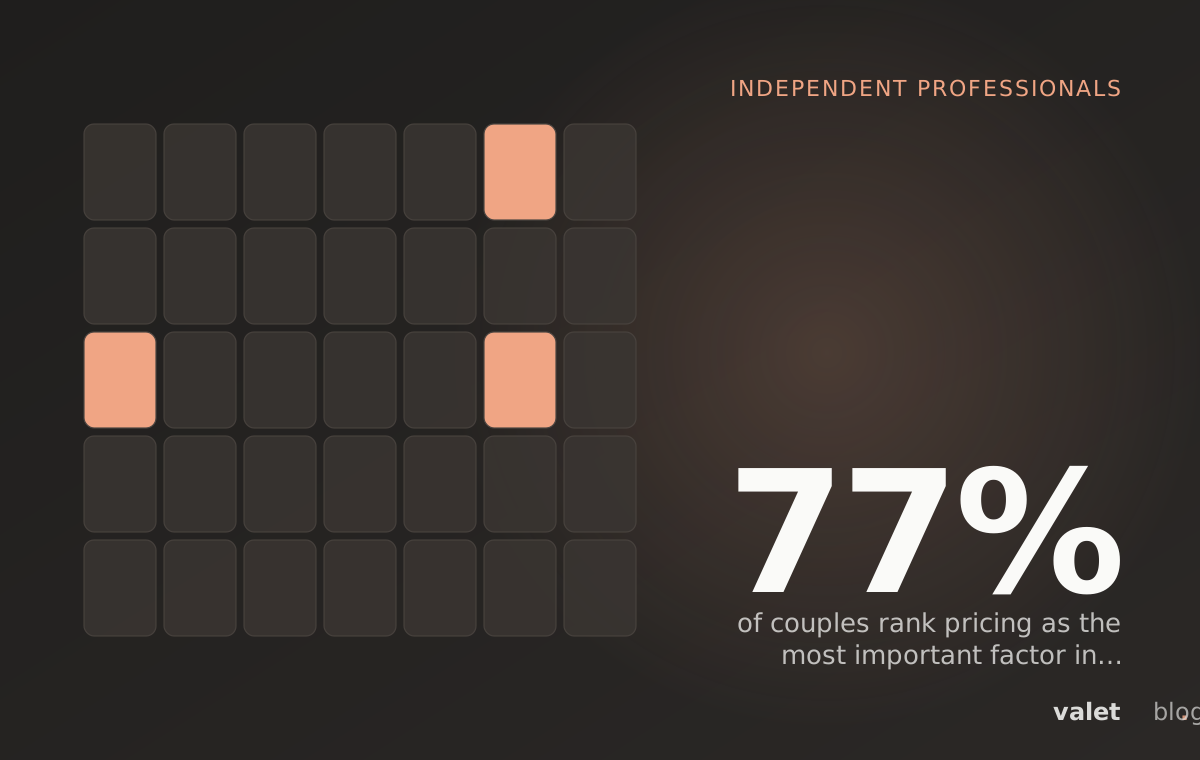
Answer a 'what are your rates?' email with the facts you have already decided: a starting price or range, what it includes, and any minimum. Add one question that sharpens the quote and two real times to talk. Do not withhold the number, and do not invent a discount. Buyers put price first: 77% of couples rank pricing as the top factor when choosing a wedding vendor (WeddingPro). Then follow up twice, each time with something new.
77%
of couples rank pricing as the most important factor in choosing a vendor
WeddingPro, From Hello to Hired
48%
of answered Google-AI pricing calls got no price
Invoca, December 2025
52%
of specialist consultants charge $10K+ per project
Consulting Success Fees Study, ~1,000 consultants, 2026
Answer a "what are your rates?" email with the facts you have already decided. That means a starting price or a range, what it includes, and any minimum. Add one question that would sharpen the quote, and two real times to talk if a call would help. Do not hold the number back, and do not make up a discount to keep them interested. Buyers put price first: 77% of couples say pricing is the most important factor when they choose a wedding vendor.1 Then follow up twice, each time with something new.
The question you are actually asking#
The question you are actually asking is not "how do I phrase my prices." It is "if I give a number by email, will I lose the deal?" Plenty of people who sell services feel that fear. 6 Figure Creative, a podcast for creative freelancers, put it bluntly in July 2025: "This one question has killed so many deals for freelancers. It's triggered so many panic discounts."3
The fear shows up in two opposite habits. Some people hide the price and push for a call. Others send a number in a panic and knock 15% off before anyone asked. A thread in r/marketing on how to handle "What's your rate?" drew more than 120 comments, and the top reply was four words: "Tell them your rate?" That reply is closer to right than most of the advice around it. The catch is that a rate alone is only one layer of a good answer.
Why hiding your price usually costs you the lead#
Hiding your price usually costs you the lead because the buyer is sorting, not committing. Couples contact about five vendors per category.1 A consultant's prospect is often doing the same with three or four firms. When your reply says "let's hop on a call," you have not answered the sorting question. The buyer moves on to the reply that did.
The same pattern shows up outside email. Invoca studied calls placed by Google's AI to ask businesses for prices on a customer's behalf. In its December 2025 report, 26% of those calls went unanswered, and 48% of the answered calls did not get a price.2 In plain English: about six in ten price questions failed at the business, not at the customer.
There is a fair counterpoint. A 2020 photography article titled "Stop emailing rate sheets" said, citing the photographer Pye Jirsa, that conversion rates "tend to drop when you send a price list upfront."5 It gives no figure. And a bare price list is not what this post recommends. A good reply puts a number inside a short, human answer that also moves the conversation forward.
How a good pricing reply works, layer by layer#
A good pricing reply works like a handshake between two computers. Each side sends a small packet, checks it, and sends the next one. If one side goes quiet, a timeout fires and a retry goes out. Here are the layers.
Layer 1: the decided facts#
The decided facts are the numbers you would say out loud to anyone. A starting price, or a range from your last several projects. What is included. Any minimum, like a minimum spend or a minimum engagement length. These go in the first paragraph. They answer the question that was asked.
If you price by project, you can borrow Jonathan Stark's reply to the hourly-rate version of this question: "I don't have an hourly rate. I give fixed prices so clients never have to pay more if things take me longer than expected. Would that work for you?"4 Notice it ends with a question. That keeps the thread open.
Layer 2: one question back#
One question back turns a price list into a conversation. Pick the single fact that moves the price most. For a venue, it is the date and guest count. For a designer, it is the number of pages or screens. For a consultant, it is the size of the team affected. Ask only one. Five questions read like a form.
Layer 3: a real next step#
A real next step means two specific times, not "let me know when works." Pied Piper's 2026 study of 3,211 home-services inquiries found that only 28% were offered a time at all.10 That was a different industry, but the gap is the same. A reply that names Tuesday at 2 and Thursday at 10 saves a round trip and shows the calendar is real.
Layer 4: the follow-up timeout#
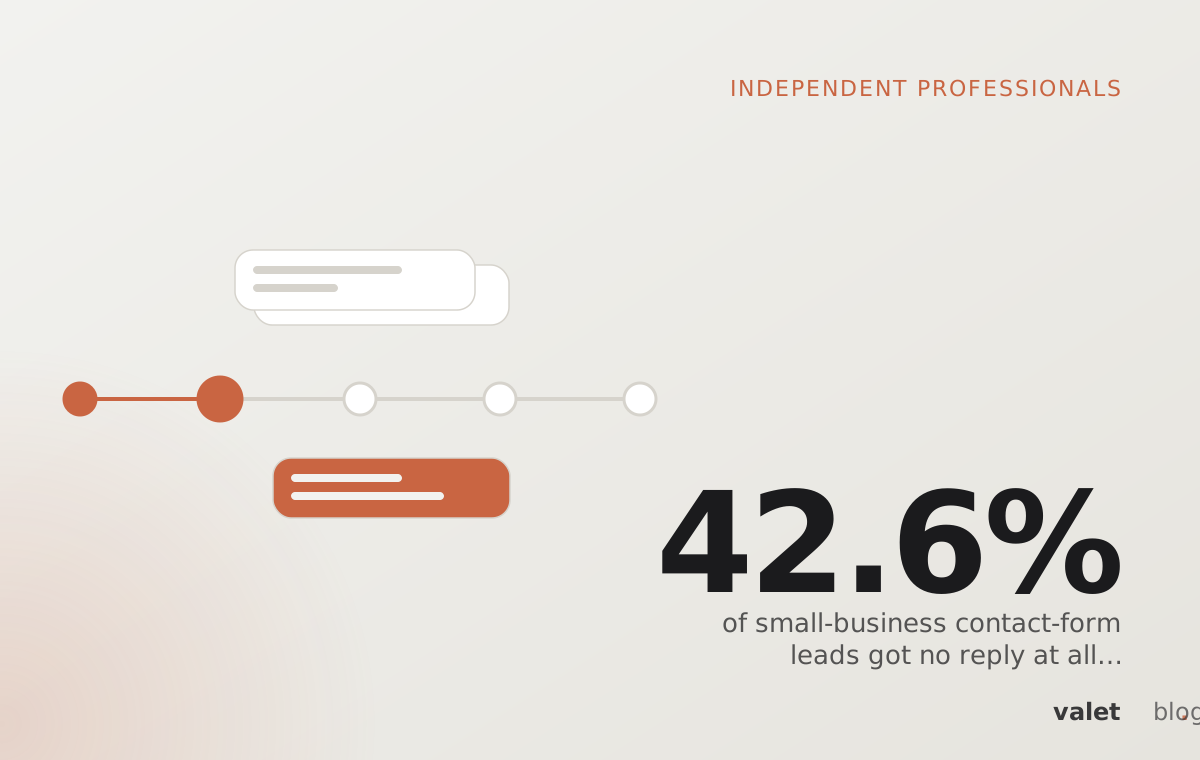
The follow-up timeout is what happens when they go quiet. Leadferno tested 225 small-business contact forms in 2024. It found that 42.6% got no reply at all, and reported that about two-thirds of businesses made only one attempt.9 Silence after your price is normal. It is a queue, not a no. Set a timer: a second message two to three days later, a third about a week after that, then stop. For more on cadence, see how many times to follow up with a lead.
Layer 5: the boundary#
The boundary is the line between what your reply can say and what only you can decide. Prices on your list, inclusions and minimums are inside it. Discounts, payment plans, custom terms and refunds are outside it. When a question crosses the boundary, the honest reply says so and gives a time: "That one I'll answer myself by Thursday."
| If the email says… | Then reply with… | Do not… |
|---|---|---|
| "What are your rates?" | Starting price or range, what's included, minimum, one question, two times | Push to a call without a number |
| "What's your hourly rate?" (you price by project) | Your project price or range and why you price that way | Make up an hourly rate on the spot |
| "Can you do it for less?" | A smaller package you already sell, or ask their budget; you decide any discount yourself | Cut the price in the same reply |
| "Every project is different, right?" | The range of your last several projects and what moves it up or down | Say "it depends" with no number |
| A question your facts don't cover | "I'll confirm that myself by [day]," then do it | Guess |
| No reply after 2–3 days | A second message with something new: a held time, a missing detail | Send "just checking in" |
| No reply after the second message | A short close that leaves the door open; log the lead as lost with a reason | Keep sending forever |
A worked example with real numbers#
A worked example makes the stakes concrete. Consulting Success surveyed about 1,000 consultants for its 2026 fees study. It found that 52% of specialist consultants charge $10,000 or more per project.6 The study also uses $6,000, $12,000 and $24,000 as example project tiers.
Illustration. Suppose you are a specialist consultant. A pricing email that hides the number, or a follow-up that never goes out, costs you one project per quarter. At $6,000 a project that is $24,000 a year. At $10,000 it is $40,000 a year. You do not need a big change in your close rate for the reply to matter.
Here is what the full reply looks like for that consultant.
REPLY (same day)
Subject: Re: Your rates

Hi [Name],

Thanks for asking. Most [type of project] projects I do fall
between [$low] and [$high]. That includes [inclusion 1],
[inclusion 2] and [inclusion 3]. The smallest engagement I take
on is [minimum].

The thing that moves the price most is [key factor]. Roughly how
[big / many / long] is yours?

If a 20-minute call would help, I have [Day, Time] or
[Day, Time]. Reply with one and I'll send an invite.

[Your name]

SECOND MESSAGE (2-3 days later, if no reply)
Hi [Name], I'm still holding [Day, Time] for you until [date].
One thing I didn't mention: [useful fact, e.g. typical timeline
or what you'd need from them to start]. Happy to answer anything
by email if a call isn't convenient.

THIRD MESSAGE (about a week later, if no reply)
Hi [Name], I'll close this out on my side so I'm not filling
your inbox. If the project comes back, reply here any time.
Good luck with it.

(Log it: lost, with a reason. No reply / chose another option /
budget / timing.)
The second message is the one most people skip. It is also the cheapest. It holds a time, adds one fact, and gives the buyer a way to reply without a call. For the wedding version of this sequence, see why couples ghost after pricing.
Where the simple rule stops being true#
The simple rule of "give the number" stops being true in three places.
When a range would mislead. Some work spans a 10-times price range, and the low end would set a false anchor. In that case, give the minimum and the factors, not a range. That is still a number.
When the question is about money you have not decided. A discount, a payment plan or a custom contract term is a decision, not a fact. Do not let a template or a tool invent one. When an assistant makes things up, the business can be held to them. In Moffatt v. Air Canada (2024 BCCRT 149), a tribunal ordered the airline to pay CAD $812.02 after its chatbot gave wrong fare information, and rejected the argument that the chatbot was "a separate legal entity."8 The safe pattern is a boundary: answer from your list, and hand everything else to a person with a reply-by time.
When the buyer is a software company's prospect. A seed-stage SaaS gets pre-sales email too: plan prices, usage limits, security, integrations, "does it do X." The layers are the same. The facts sheet is just longer. One pricing model to know about here: Fin for Sales, from the company formerly called Intercom, charges "$10 per qualified lead," and $1 for a product question or a disqualification.7 Intercom wrote that it considered charging a share of closed revenue and decided against it because of attribution and measurement problems. On 20 qualified leads and 60 product questions a month, that is $260, whether or not a meeting is booked. That is a fair choice for Intercom to make. It does mean "qualified" and "booked" are different counts, and you should track both.
For founders handling this from a shared inbox, see how to handle support@ as a solo or 3-person SaaS founder.
Decision checklist for your next pricing email#
The decision checklist below fits on a sticky note. Run it before you hit send.
- Does the first paragraph contain a number: a starting price, a range or a minimum?
- Does it say what the number includes?
- Is there exactly one question back?
- Are there two specific times, if a call would help?
- Is anything in the email a discount or term you have not decided? Take it out.
- Is a reminder set for two to three days from now?
Adjacent questions people ask next: how many times to follow up, and why so many contact-form leads never get a reply.
Where Valet fits#
Valet is an AI assistant for your written inquiries, at your own address, website form, listing emails and a free Valet page. It answers pricing questions only from your own price list, packages and policies, offers real times from your calendar, and follows up at most twice by default with something useful each time. Discount and haggling requests go to you with one-tap replies, and the customer is told when you will answer. Every reply says it is AI and comes with a receipt. During early access you pay a small monthly base plus a fee only for bookings or quotes Valet wins, capped monthly.
To see what your last pricing emails led to, start with the free lead check: forward 10 to 20 recent inquiries and see what went unanswered, what stopped after one reply, and what it was worth.
Questions people ask
Should I send my prices by email?
Yes, send the prices you have already decided: a starting price or range, what it includes and any minimum. Buyers use price to decide whether a call is worth their time, and a reply with no number gives them a reason to move to the next name on their list.
What if every project is custom?
Give the range your recent projects fell into and say what moves a project up or down. If even a range would mislead, say what the smallest engagement costs and offer a short call with two real times.
How do I follow up after sending my rates and hearing nothing?
Send a second message two to three days later with something new, such as a held time or an answer to a question they did not ask. Send a third, short closing message about a week after that, then log the lead as lost with a reason.
Should I offer a discount if they say it's too expensive?
Not in the same breath. A discount is a money decision for the owner, made deliberately. Offer a smaller package you already sell, or ask what budget they had in mind, and decide on any discount yourself.
How should a SaaS startup answer pre-sales questions by email?
The same way: answer plan prices, limits, security and integration questions from a written facts sheet, offer a real demo time if one helps, and route custom pricing or contract terms to a person with a stated reply time.
Sources
Confidence: H primary source checked · M credible secondary or reported · L vendor claim or single report. Reddit and forum items are quoted from public threads and summarised, not endorsed.
- From Hello to Hired: your guide to lead replies · WeddingPro · undated H
- New Invoca study finds pricing request phone calls from Google's AI surged over 300% in November · Invoca · 2025-12-10 H
- The best way to answer 'How much do you charge?' without undervaluing yourself or scaring clients off · 6 Figure Creative · 2025-07-29 H
- What's your hourly rate? (email edition) · Jonathan Stark · 2021-06-02 H
- Stop emailing rate sheets · APalmanac · 2020-08-03 M
- Consulting fees study · Consulting Success · 2026-09-07 H
- Building outcome-based pricing for Fin for Sales · Intercom · 2026-05-08 H
- A word of caution: company liable for misrepresentations made by chatbot (Moffatt v. Air Canada, 2024 BCCRT 149) · McMillan LLP · 2024-02 H
- Research: Website Contact Forms and Lead Management, Uncovering Costly Mistakes · Leadferno · 2024-06-28 H
- Precision Garage Door Ranked #1 in Customer Lead Handling Effectiveness Home Services Study (Pied Piper PSI 2026) · BusinessWire / Pied Piper Management Company · 2026-04-12 H
How to cite this page
Cite this page
Valet, "'What are your rates?' by email: answering pricing and pre-sales questions without a call, a lost lead or an invented discount", valet.team, October 2026.
Keep reading
 Independent professionalsDiscovery-call no-shows for consultants and coaches: real rates, why they happen, and what actually fixes themA no-show is the last visible failure in a booking path that broke earlier. This piece traces that path stage by stage, separates the sourced numbers from the recycled ones, and ends with a policy and recovery sequence you can copy.Technical desk · 11 min · 1 October 2026
 Independent professionalsWho answers your inquiries when you're on holiday, sick or on parental leave? Coverage without stranding customers with a botSolo owners describe two choices: switch on the out-of-office and hope, or check email from the beach. Both price your absence badly. Here is the case for a third arrangement, where it fails, and a checklist to set it up.Strategy desk · 10 min · 1 October 2026
 Independent professionalsClient ghosted after the proposal or quote: a follow-up plan for consultants, designers and small agenciesSilence after a proposal is the most common ending in independent work, and the least discussed. What the people who send proposals say about it, what the evidence says about the second and third message, and a plan that ends with a reason instead of a fade.People at work · 8 min · 1 October 2026