
After the first reply
How many times should you follow up with a lead before you stop?
A written standard for following up on inbound inquiries: what counts as a follow-up, what each nudge must contain, when the sequence must stop, and how to close a lead with a reason instead of letting it fade.

Short answer
Follow up two or three times after your first reply, then stop and record why. In a 2026 Belkins study of 7.53 million B2B emails, 58.6% of replies came after the first message, so one touch forfeits most of them. Each nudge must add something new (a held time, a missing detail, a quote expiry), and the sequence must end on a reply, an opt-out, or a third silence.
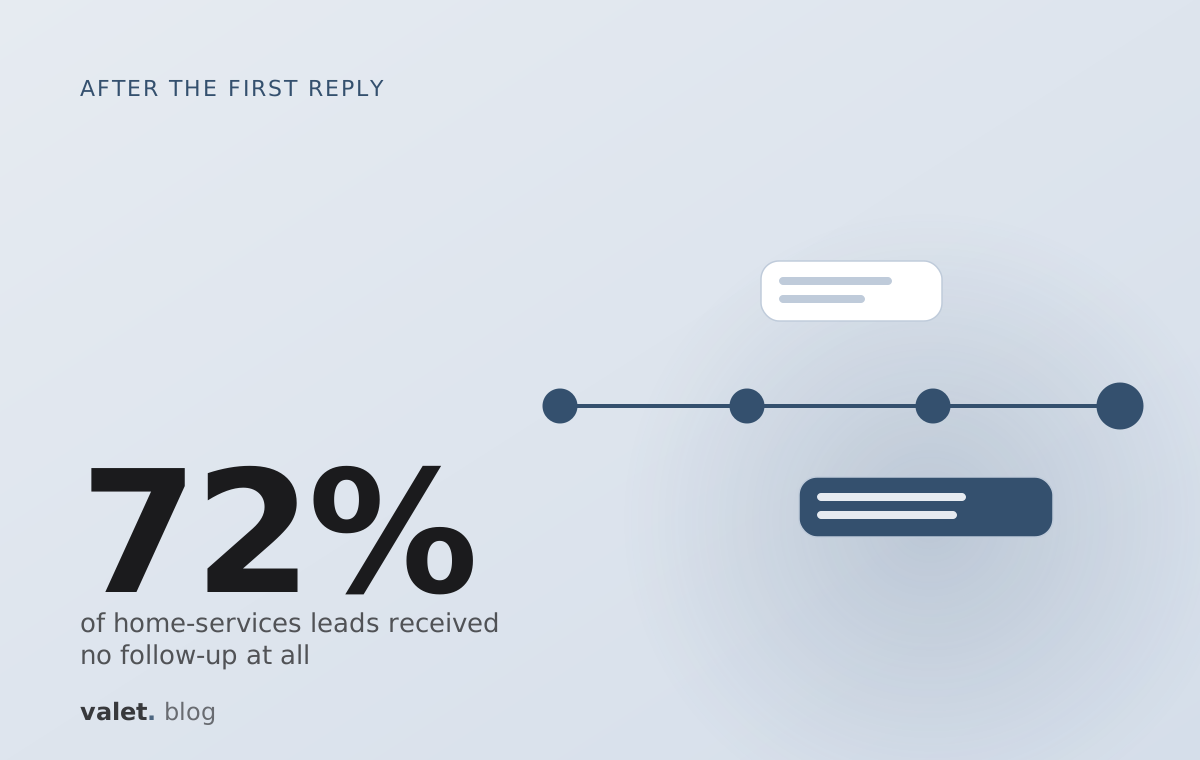
72%
of home-services leads received no follow-up at all
Pied Piper PSI, 3,211 locations, Apr 2026
58.6%
of replies came from follow-up steps 2–6, not the first email
Belkins, 7.53M B2B outbound emails, 2026
55%
of home-services businesses never ask the lead to book
Invoca benchmarks, Jul 2026
Follow up two or three times after your first reply, then stop and write down why. That is the standard this article sets out, and the evidence for it is narrower than most "follow-up statistics" pages admit. The strongest recent counts point the same way: in Pied Piper's 2026 mystery-shop of 3,211 home-services locations, 72% of leads received no follow-up at all1, while a 2026 Belkins analysis of 7.53 million B2B emails found that 58.6% of replies arrived after the first message3. A business that writes once and waits forfeits most of the replies it could have had.
The opposite failure is real too. Some vendors keep writing until the customer complains. A written policy fixes both: a defined number of nudges, a defined content requirement for each, and a defined exit.
What counts as a follow-up?#
A follow-up is a message you send to someone who contacted you first, after your first reply, when they have not yet answered. Three terms need precise definitions before any count means anything, because most of the advice online counts different things.
- First reply. The first message that answers the inquiry. An auto-acknowledgement ("we got your message") does not qualify; Leadferno's 2024 study of 225 small-business contact forms found 15.6% sent an auto-confirmation, while 42.6% never received a human reply at all2.
- Nudge. Any later message on the same inquiry that you send without having heard back. Nudge 1 is the second message the customer receives from you.
- Close. The moment you stop writing and record an outcome: booked, declined, lost with a reason, or waiting on you.
The distinction matters because the published data covers two different situations. Belkins and Apollo measure outbound B2B email to people who never asked to hear from the sender34. A small business answering an inquiry is in the inbound case: the customer wrote first, asked a question, and then went quiet. Inbound tolerance depends on content: an empty "checking in" wears thin quickly, while a nudge that answers the question the customer actually asked is closer to service than to sales.
What does the data say about follow-up counts?#
The current evidence supports three propositions, each with a different confidence level. None of it is a controlled study of inbound small-business inquiries; that dataset does not exist yet in public form.
| Finding | Source, sample, date | What it does and does not show |
|---|---|---|
| 72% of leads got no follow-up; 28% were offered an appointment | Pied Piper PSI, 3,211 home-services locations, Oct 2025–Jan 2026, published Apr 20261 | Shows how rarely businesses follow up at all. Does not show the ideal count. |
| Step 1 drew 41.4% of replies; steps 2–6 drew 58.6%; step 3 drove 35.6% of email-sourced meetings | Belkins, 7.53M B2B outbound emails, 20263 | Shows later touches carry most replies. Outbound cold email, not inbound; no spam or unsubscribe data. |
| Reply rates "drop with each subsequent follow-up, with the decline accelerating sharply after the third message" | Apollo, vendor guide, 20264 | Vendor claim without a published sample. Consistent with Belkins' "3–5 steps" sweet spot. |
| Most businesses made one attempt (reported 65.5%); 13.1% made two | Leadferno, 225 SMB forms, Jun 20242 | Inbound and small-business, but a small sample; treat the one-attempt share as reported. |
| 55% of businesses never asked the caller to book | Invoca home-services benchmarks, Jul 20265 | Phone, not email. Shows that many follow-ups lack a next step even when they happen. |
Read together, the sources establish a floor and a ceiling. The floor: one message is not enough, because more than half of eventual replies come later3. The ceiling: returns fall after the third message, and Apollo reports that a fourth touch raises spam-complaint risk against Google's 0.1% threshold4. Belkins' own "sweet spot" of three to five steps includes the first message3, which places it in the same range as two to three nudges after a reply.
Numbers to retire. "80% of sales need 5–12 follow-ups" and "48% of salespeople never follow up" are still quoted in 2026. VentureBeat reported in August 2014 that the stats were "completely made up" and that the National Sales Executive Association they are attributed to does not exist7. Figures such as "44% give up after one follow-up" have no primary source we could find. None of them should appear in a policy.
What is the 3-3-3 rule in sales?#
The "3-3-3 rule" appears in Google's related questions for follow-up searches (observed 1 October 2026), alongside a "10-3-1 rule". We found no primary source that defines either, and no version we saw ties the rule to measured outcomes or includes a stop condition. Treat any version you meet as a rule of thumb; the standard below adds what those rules lack, which is a defined exit and a recorded reason.
Why do businesses follow up too little, or too much?#
Owners who under-follow-up usually say they do not want to seem desperate. A thread in r/sales (50+ comments, about a year old) puts it plainly: "I know I sound super desperate when I send a quick email a few days later." Another r/sales thread (80+ comments, about two years old) calls the standard "just wondering if you received my quote" message one that "reeks desperation." The fear is legitimate, but it attaches to empty nudges, not to nudges as such.
Owners who over-follow-up usually have no stop rule. In r/weddingvideography (9 comments, about seven years old) a top answer reads: "I never stop contacting them until they say no." From the customer's side, an r/weddingplanning thread titled "Videographer won't leave me alone" (30+ comments, about a year old) shows how that lands.
Published advice does not settle the question. Easy Weddings told vendors in 2019 to follow up "as many times as it takes"9; WeddingPro advised in 2023 that "if you follow up at least one more time than you are now, you'll get more replies"8. Neither sets an upper bound. A Jobber Community answer from August 2026 is closer to a standard: a "2-2-2 rule" of a check-in at two days, a scheduling reminder at two weeks and a seasonal check-in at two months, with a short "Are you still looking to get your [service] done?" line that the poster says gets a response "nearly 80% of the time"6. That reply rate is one owner's report, not a measurement.
When must follow-up stop?#
A follow-up sequence must stop on the first of four events. These are the stop conditions; they are mandatory in the sense that no further nudge is sent once one occurs.
- The customer replies. The sequence ends and the conversation resumes. A reply of any kind, including "not yet", resets the clock; it does not count as a nudge.
- The customer declines or asks you to stop. Close the inquiry immediately with the reason they gave. Do not send a "sorry to see you go" message that asks them to reconsider.
- The cap is reached. After the second nudge (or the third, if the third carries something new), close the inquiry as lost with the best available reason.
- The thing on offer expires. If the held date is gone or the quote has lapsed, a nudge that pretends otherwise is inaccurate. Close or re-quote.
One distinction belongs here. A customer who says "ask me again in March" has not gone silent; they have set a new date. That inquiry should be parked with a reply-by date, not counted against the cap.
What should each follow-up contain?#
Each nudge must add something the customer did not already have. Content requirements are best stated in three tiers: what a nudge must contain, what it should contain, and what it may contain.
- Must: one specific, useful item (a time you are holding, an answer to a question they asked, a missing detail you need, or the date a quote or hold expires); one clear next step the customer can take in a single reply; your business name and a way to say "no thanks".
- Should: reference their original request in their own terms (the date, the room, the job); stay under about 80 words; offer a real time rather than "let me know when works".
- May: include a short line that makes declining easy, such as "If you've gone another way, just say so and I'll close this out." The final nudge may state that you will stop writing.
A nudge that says only "just checking in" fails the "must" tier. Apollo cites Gartner research (632 B2B buyers) in which 73% said they avoid suppliers that send irrelevant outreach4. The Invoca finding that 55% of businesses never ask the caller to book5 is the same failure in another channel: contact without a next step.
| Step | Timing (after previous message) | Must contain | Stop condition |
|---|---|---|---|
| First reply | As fast as you can; same day at worst | A direct answer from your price list or policy, and one next step (a real time, a quote, a question) | Customer replies, declines or books |
| Nudge 1 | About 2 days | Something new: a held time, the answer to a question they asked, or the one detail you need to quote | Reply, decline or opt-out |
| Nudge 2 | About 5–7 days | The expiry: when the hold or quote lapses, plus an easy way to say no | Reply, decline, opt-out; otherwise close unless nudge 3 has new content |
| Nudge 3 (optional) | About 2 weeks | Only if something changed: a new date opened, a price changed, a question you can now answer. States that you will stop writing. | Close as lost with a reason, no matter what |
| Close | Same day as the stop condition | One recorded reason from the list below | Reopen only if the customer writes again or set a date |
Timings are a convention drawn from the 2-2-2 rule6 and common vendor practice, not a measured optimum. Adjust per topic; keep the cap.
How do you close a lead as "lost with a reason"?#
A lead is lost with a reason when you stop writing and record why, in one of a short, fixed list of categories. Silence is a state, not a verdict; the close turns it into a fact you can count. Without a reason, a lost lead is indistinguishable from a forgotten one, and a quarterly review cannot tell you whether your price, your speed or your follow-up is the problem.
| Reason | Definition | What to review |
|---|---|---|
| No reply after cap | Nudges sent per policy, no answer | Speed of first reply; whether each nudge carried something new |
| Chose someone else | Customer said so, or said they booked | Price, availability, speed relative to competitors |
| Price | Customer named cost as the reason | Whether prices were stated up front |
| Date or capacity | You could not offer the time they needed | Calendar holds and lead times |
| Not a fit | Outside your service area, scope or minimum | Whether your page states scope clearly |
| Asked to stop | Customer opted out | Tone and frequency of nudges |
| Parked with a date | Customer named a later date; not lost | Set a reply-by date and keep it |
The same reasons make a review possible later. The Lost Lead Audit uses them to sort 90 days of inquiries into what went unanswered, what stopped after one reply, and what closed with a reason.
Does email law limit how many times you can follow up?#
US federal law sets no numeric cap on follow-up emails, but it does set rules that a follow-up policy must respect. This section is not legal advice; check with counsel for your situation. The applicability funnel has three questions.
- Jurisdiction. The CAN-SPAM Act applies to commercial email in the United States. Canadian senders are under a different statute, Canada's Anti-Spam Legislation (CASL), which this article does not cover.
- Primary purpose. The FTC's compliance guide (updated January 2024) says the law covers "all commercial messages", defined as messages whose primary purpose is "the commercial advertisement or promotion of a commercial product or service"10. It separately recognises "transactional or relationship" content, such as messages that complete or confirm a transaction the recipient already agreed to10. A nudge on a quote the customer requested but has not accepted may not fall cleanly into the transactional category; counsel should classify your templates.
- Obligations if commercial. The guide states: "You must honor a recipient's opt-out request within 10 business days," and it lists penalties of up to $53,088 for each separate email in violation, as shown on the page when we checked10.
The operational consequence is simple. A "please stop" reply must end the sequence at once, as the stop conditions above already require, and every nudge should make declining easy. A capped, content-bearing policy sits well inside these rules; an uncapped sequence that ignores replies does not.
Where this standard stops applying#
The two-to-three-nudge cap is calibrated for inbound inquiries where the customer asked about a specific service. It should be adjusted in three cases. Long sales cycles (venues booked a year out, B2B software) may justify a parked follow-up months later, under the "parked with a date" rule rather than as a fourth nudge. Existing customers asking for support are owed an answer, not a sales sequence. And outbound prospecting is a different activity with different data; Belkins' outbound numbers support more steps there3.
The reply rate by nudge number for inbound small-business inquiries has not been published by anyone. Valet has not published this figure; it is something Valet could measure from free lead checks, with owners' consent. Until then, the honest claim is the one above: one touch is too few, a fourth empty touch is too many. For the broader argument, see why the first reply is free and follow-up is where leads die, and for where the commonly quoted statistics came from, see lead response statistics, traced.
Where Valet fits#
Valet applies this standard by default. The Valet follow-up cap is two nudges per inquiry, and each must carry something useful: a held time, a missing detail, or a quote expiry. Then Valet stops and tells the owner why, and the inquiry closes with a reason under the Valet Inquiry States (New, Answered, Time held, Followed up, Booked, or closed with a reason). The cap can be changed per topic. Every reply comes with a Valet receipt showing what was asked, the rule used and the sources it answered from, and Valet answers only from the owner's own price list, calendar and policies.
If you want to see how your own follow-up compares, the free lead check takes 10–20 recent inquiries and shows what went unanswered, what stopped after one reply, and what it was worth.
Questions people ask
How many times should you follow up with a lead?
Two or three times after your first reply, each with new, useful content, then stop and record a reason. Belkins' 2026 study of 7.53 million B2B emails found 58.6% of replies came after the first message, and Apollo reports reply rates fall sharply after the third.
How many follow-up emails is too many?
A fourth unrequested nudge on an inbound inquiry is usually too many. Apollo (2026) reports the decline in replies accelerates after the third message and that a fourth touch raises spam-complaint risk; customers in public forums describe vendors who keep writing as pestering.
What is the 3-3-3 rule in sales?
Google shows it as a related question for follow-up searches, but we found no primary source that defines it or ties it to measured outcomes. Treat any version as a rule of thumb and add what it lacks: a stop condition and a recorded reason.
When should you stop following up with a lead?
Stop immediately when the person replies, declines or asks you to stop. Otherwise stop after your second or third nudge without a reply, and close the inquiry as lost with a specific reason so it can be counted and reviewed.
Does CAN-SPAM limit how many follow-up emails I can send?
The FTC's compliance guide sets no numeric limit on messages, but commercial emails must honor an opt-out within 10 business days, and each violating email can carry penalties. Whether a given follow-up is commercial depends on its primary purpose. This is not legal advice; check with counsel.
Sources
Confidence: H primary source checked · M credible secondary or reported · L vendor claim or single report. Reddit and forum items are quoted from public threads and summarised, not endorsed.
- Precision Garage Door Ranked #1 in Customer Lead Handling Effectiveness Home Services Study (Pied Piper PSI 2026) · BusinessWire / Pied Piper Management Company · 2026-04-12 H
- Research: Website contact forms and lead management, uncovering costly mistakes · Leadferno · 2024-06-28 H
- Sales follow-up statistics · Belkins · 2026 M
- How to improve reply rates through strategic follow-up emails · Apollo · 2026 L
- The Invoca Home Services Lead Conversion Benchmarks Report 2026 · Invoca · 2026-07 H
- Why do clients disappear after asking for a quote? · Jobber Community · 2026-08 M
- These incredible sales stats everyone cites are actually completely false · VentureBeat · 2014-08 H
- Your questions about lead replies, answered · WeddingPro · 2023 M
- Following leads · Easy Weddings · 2019-11-29 M
- CAN-SPAM Act: A Compliance Guide for Business · U.S. Federal Trade Commission · 2024-01 H
How to cite this page
Cite this page
Valet, "How many times should you follow up with a lead before you stop?", valet.team, October 2026.
Keep reading
 After the first replyThe first reply is now free. The follow-up is where 72% of leads die.Meta, Google and the inquiry tools now answer the first message for you. The money is lost in the days after it, and almost nobody sells that part.From the Valet team · 11 min · 1 October 2026
 After the first replyWhy leads go silent after you send a quote (and what it actually means)Silence after a quote is usually read as a verdict on price. The base rates say it is more often an unfinished conversation, and the thread itself carries signals that tell you which kind you have.Trends desk · 9 min · 1 October 2026
 After the first replyWhen should you follow up after sending a quote: 2 days, 7 days or 2 weeks? (the 2-2-2 rule, tested)The 2-2-2 rule, the five-to-seven-day rule and the ten-day rule all count from the day you hit send. The clock that decides whether a follow-up lands is the customer's, and it runs at different speeds for different jobs.Strategy desk · 9 min · 1 October 2026