
After the first reply
Why leads go silent after you send a quote (and what it actually means)
Silence after a quote is usually read as a verdict on price. The base rates say it is more often an unfinished conversation, and the thread itself carries signals that tell you which kind you have.
Short answer
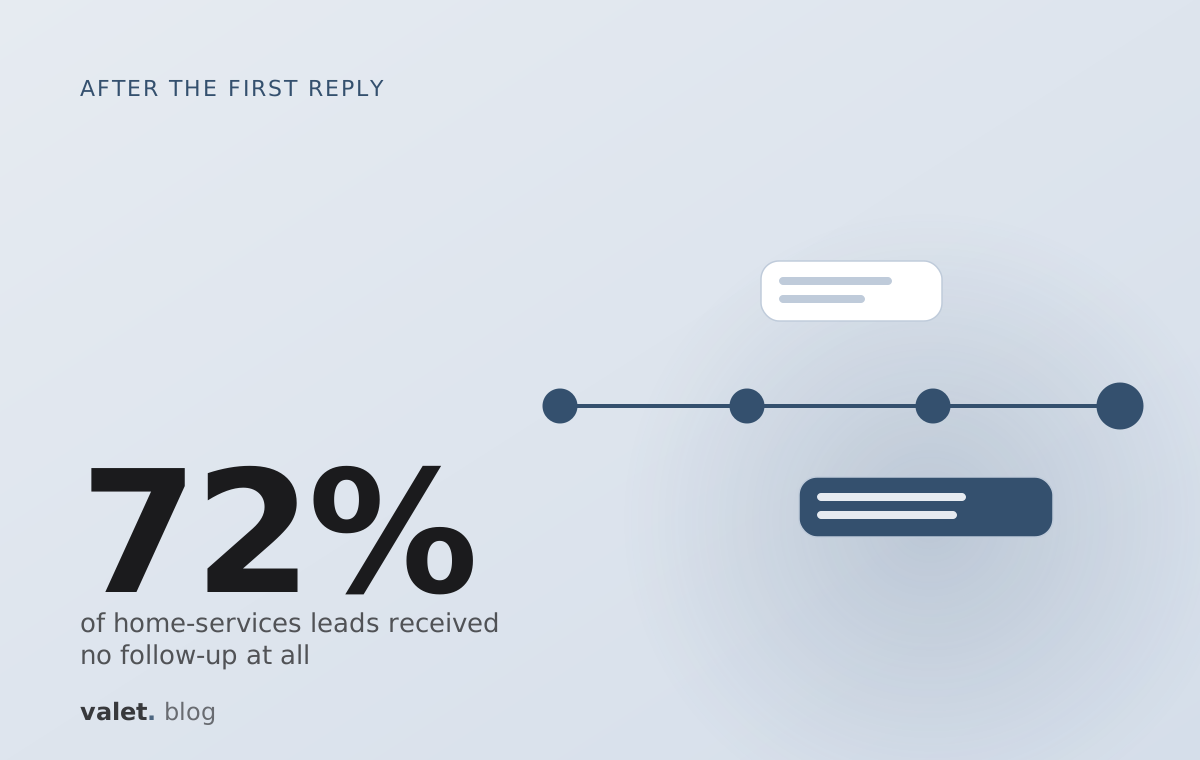
Most leads go quiet after a quote because the decision is not finished, not because it went against you. Customers compare several providers, get busy, or choose someone else without saying so. The silence is often the seller's too: Pied Piper's 2026 mystery shop of 3,211 home-services locations found 72% of leads got no follow-up at all. Treat silence as a state: follow up two or three times with something useful, then close it with a reason.
72%
of home-services leads received no follow-up at all
Pied Piper PSI, 3,211 locations, Apr 2026
58.6%
of replies arrived after the first message, not on it
Belkins, 7.53M B2B emails, 2026
5
vendors per category couples contact, on average
WeddingPro, From Hello to Hired
Most leads go quiet after a quote because the decision is unfinished, not because it went against you. Customers compare several providers, lose the thread in a busy week, or pick someone else and never say so. The silence is frequently the seller's as well: in Pied Piper's 2026 mystery shop of 3,211 home-services locations, 72% of leads received no follow-up at all1. Read silence as a state with a next step, not a verdict. Follow up two or three times with something useful, then close the lead with a recorded reason.
That reading matters because the usual one, "they found me too expensive", leads owners to change the one variable that was probably not the cause. This piece maps the base rates, the four common explanations, and the signals in the thread that separate them.
What does it mean when a client goes quiet after a quote?#
Silence after a quote is a lagging indicator that owners read as a leading one. By the time you notice a customer has not replied, the useful information is already in the thread: what they asked, how specific they were, whether you offered a time, and whether you wrote again. The silence itself carries almost none.
Owners in public forums describe the same pattern across trades. A Jobber Community thread from August 2026 asked why clients request quotes, ask questions and then disappear. One reply listed the reasons in a single sentence: "people get busy, they lose track of their messages, or they get overwhelmed and put off making a decision." Another said: "usually it is because they have a better quote."4 A custom-jewellery seller on the Etsy Community forum, who replies the same day, wrote that "the majority of convos I get do not result in sales"; the answer she got was "Most people don't follow through it's not personal."5
Both answers are right about the customer and silent about the seller. The seller-side numbers are the part most owners never see.
| Finding | Source, sample, date |
|---|---|
| 72% of leads got no follow-up; 28% were offered an appointment when booking was the natural next step | Pied Piper PSI, 3,211 home-services locations, Oct 2025–Jan 2026, published Apr 20261 |
| 42.6% of contact-form leads got no response at all; most businesses (reported as 65.5%) made only one attempt | Leadferno, 225 small-business contact forms, Jun 20242 |
| Step 1 drew 41.4% of replies; steps 2–6 drew 58.6% | Belkins, 7.53M B2B outbound emails, 20263 |
Put those three rows together and a quiet customer looks different. If most businesses write once, and most replies arrive after the first message, then a large share of "the customer went silent" is "the conversation was abandoned at step one by both sides." The Belkins data is outbound B2B email, so treat it as directional for inbound quotes, not as a measured rate.
Is it normal for clients not to reply to quotes?#
Most quotes do not become jobs, in any trade, in any year we can find. The historical base rate is the first thing to fix in your head, because an owner who expects most quotes to convert will read every silence as a personal failure.
- A UK paving contractor on the PavingExpert forum reported a quote conversion rate of "only 15-20%" (2013; one business, dated, but the question has not changed)6.
- Indigo Digital's 2026 wedding-venue benchmark puts qualified enquiry-to-booking at roughly 1 in 58.
- WeddingPro reports that couples contact five vendors per category on average7. Four of those five vendors will lose, and most will hear nothing.
The arithmetic follows from comparison shopping. If a customer asks four or five businesses for the same quote, at most one can win, and few customers write to the others to say so. Indigo Digital put it plainly in July 2026: "They rarely say no, they simply stop replying."9
So silence on most quotes is normal. What is not normal, or at least not necessary, is how little of it the seller does anything about. The question worth asking is which silences are still live.
Why do customers go quiet? Four explanations and how to tell them apart#
Customer silence after a quote has four common explanations, and they call for different responses. None of them can be assigned a probability for your business without your own data; what follows is a way to read the thread, not a forecast.
Explanation 1: the decision is deferred#
A deferred decision is the case the Jobber reply described: busy, overwhelmed, putting it off4. The customer still wants the job done and has not chosen anyone. The leading indicator is a specific request (a date, a room size, a scope) followed by silence with no sign of a competing answer. This is the silence a useful follow-up recovers most often, because nothing has been decided against you.
Explanation 2: they chose someone else#
A customer who chose another provider has finished the decision and simply not told you. "Usually it is because they have a better quote"4 is one owner's view, and the comparison-shopping numbers above support it as a frequent cause. The leading indicator is speed: if the customer's event or job date was close and your first answer took a day, the window may have closed before you wrote. You cannot recover this lead, but you can learn from it if you close it with a reason.
Explanation 3: the price surprised them#
Price shock is real, and it is the explanation owners reach for first. WeddingPro reports that 77% of couples call pricing the most important factor they consider before contacting a vendor7, which means many inquiries are partly a request for a number. The leading indicator is an inquiry that asked "how much" and little else, followed by silence right after the number. If your prices are already public, this explanation becomes less likely, because the customer knew the range before writing.
Explanation 4: they were never ready to buy#
Some inquiries are research, not intent. A thread in r/smallbusiness titled "Why do homeowners ghost after getting a quote" (40+ comments, about a year old) put the seller's side of it bluntly: "They can't prequalify a sales lead." The leading indicator is a vague request with no date, no address and no answer to your one qualifying question. These leads deserve a short, polite close, not a long sequence.
The silence indicator matrix#
The silence indicator matrix turns the four explanations into a decision you can make in under a minute per thread. Read the thread, find the row whose indicators match, and send what the row says.
| Reading | Leading indicators in the thread | What would confirm it | Next message | When to close |
|---|---|---|---|---|
| Deferred decision | Specific request (date, scope, size); asked follow-up questions; no sign of a competing quote | A reply to a nudge that offers a concrete time | Offer a real time you can hold, with the date it lapses | After nudge 2 or 3 with no reply |
| Chose someone else | Near date or deadline; your first answer was slow; customer said they were "getting a few quotes" | A "we went another way" reply to a graceful-out line | One short message that makes saying no easy | On their reply, or after one unanswered nudge |
| Price surprised them | Inquiry was mostly "how much"; silence began right after the number; prices were not public | A reply to a message that names a smaller option already on your list | Mention an existing smaller package or scope, if you have one; no invented discount | After nudge 2 |
| Never ready to buy | No date, no address, no answer to your qualifying question | Silence after a single clear question | One message with one question and an easy out | After one unanswered nudge |
| Never answered by you | Last message in the thread is theirs | Your own sent folder | Answer the original question now, with an apology for the delay | Treat as a new inquiry |
Readings are judgement aids built from the sources in this article, not measured probabilities.
The last row is the one owners skip. If the most recent message in the thread is from the customer, the customer did not go silent. You did.
Never answered vs answered once and dropped: the split that matters#
A quiet inquiry falls into one of two groups, and the split predicts what you can still do. "Never answered" means the last message in the thread is the customer's. "Answered once and dropped" means you replied, they did not, and nobody wrote again. Leadferno's 2024 test found both failures at scale: 42.6% of contact-form leads never got a response, and of the businesses that did respond, most made a single attempt2.
The two groups have different remedies. A never-answered inquiry needs an answer, late or not. An answered-once inquiry needs a second message with something new in it: a held time, a missing detail, the date your quote lapses. The Lost Lead Audit sorts 90 days of threads into these groups with a spreadsheet and a few Gmail searches. For the wording of those later messages, see what to say when a customer doesn't respond to your quote, and for timing, when to follow up after sending a quote.
Illustration, not data. Take a photographer with 10 written inquiries a month and an average booking near The Knot's 2026 average photographer spend of $3,00011. If one or two answered-once inquiries a month would have booked after a useful second message, that is 12 to 24 bookings a year, or roughly $36,000 to $72,000. The recovery rate is an assumption; replace it with your own.
Nobody has published how often answered-once inquiries revive after a second or third message in small-business inbound email. Valet is collecting that rate by nudge number as inquiries move through the Valet Inquiry States, and will publish the method with the numbers. Until then, the figure above is arithmetic, not evidence.
What would change this reading over the next 18 months#
The silence-as-state reading rests on two conditions: customers compare several providers by message, and sellers rarely write a second time. If either condition shifts, the reading shifts with it. Three leading indicators are worth watching.
- AI assistants writing for customers. BrightLocal's 2026 survey of 1,002 US adults found 45% had used AI tools for local recommendations, up from 6% in 202510. If assistants start sending inquiries and tracking replies for customers, the "lost track of their messages" explanation weakens, and an unanswered quote will look more like a decision.
- Response expectations. The same survey found 19% of consumers expect a same-day response, up from 6% in 202510. A rising expectation shortens the window in which a deferred decision stays deferred and not lost.
- Follow-up becoming the norm. If the share of businesses that send a second message rises well above the 28% that offered a time in Pied Piper's 2026 shop1, a single follow-up stops being a differentiator, and content (a held time, a real answer) carries more of the weight.
This reading should be reviewed by October 2027, or sooner if published inbound data shows that second messages do not lift replies for small businesses. That finding would be the revision trigger.
Where Valet fits#
Valet treats a quiet quote as a state, not a verdict. Each inquiry sits in the Valet Inquiry States (New, Answered, Time held, Followed up, Booked, or closed with a reason), so the never-answered and answered-once groups cannot hide. The Valet follow-up cap sends at most two follow-ups by default, each with something useful such as a held time, a missing detail or a quote expiry, then stops and tells the owner why. Valet answers only from the owner's own price list, calendar and policies; anything about discounts or money waits for the owner.
To see your own split, the free lead check takes 10–20 recent inquiries and shows what went unanswered, what stopped after one reply, and what it was worth.
Questions people ask
Why do customers not respond after I send a quote?
The common reasons are that they are still deciding, they got busy and lost the thread, they chose another provider without telling you, or they were never ready to buy. A Jobber Community answer from August 2026 lists the first three almost word for word. Price shock is one cause among several, not the default.
Is it normal for clients not to reply to quotes?
Yes. Most quotes do not turn into jobs in any trade. One UK paving contractor reported converting 15 to 20% of quotes, and a 2026 venue benchmark from Indigo Digital puts qualified enquiry-to-booking at about 1 in 5. Silence on most quotes is the base rate, not a sign that something is wrong with you.
Does silence after a quote mean the price was too high?
Not by itself. Price is one of four common explanations, and the thread usually shows which one applies: a customer who asked for a specific date and then went quiet after the number is a different case from one who sent a vague request to several businesses at once.
How long should I wait before deciding a quoted lead is lost?
Decide after your second or third useful follow-up goes unanswered, not after the first silence. Belkins' 2026 study found 58.6% of replies came after the first message, so a lead that has heard from you only once has not given you its answer yet.
Sources
Confidence: H primary source checked · M credible secondary or reported · L vendor claim or single report. Reddit and forum items are quoted from public threads and summarised, not endorsed.
- Precision Garage Door Ranked #1 in Customer Lead Handling Effectiveness Home Services Study (Pied Piper PSI 2026) · Pied Piper Management Company via BusinessWire · 2026-04-12 H
- RESEARCH: Website Contact Forms and Lead Management – Uncovering Costly Mistakes · Leadferno · 2024-06-28 H
- Sales follow-up statistics · Belkins · 2026 M
- Why do clients disappear after asking for a quote? · Jobber Community · 2026-08 M
- Is it me??? Why don't I hear back? · Etsy Community · undated M
- How long do you leave it to follow-up a quote? · PavingExpert forum · 2013 M
- From Hello to Hired: your guide to lead replies · WeddingPro · undated H
- Wedding venue lead benchmarks guide · Indigo Digital · 2026-08-03 M
- Response-time benchmark for venue enquiries · Indigo Digital · 2026-07-14 M
- Local Consumer Review Survey 2026 · BrightLocal · 2026 H
- Average cost of a wedding photographer (Real Weddings Study) · The Knot · 2026 H
How to cite this page
Cite this page
Valet, "Why leads go silent after you send a quote (and what it actually means)", valet.team, October 2026.
Keep reading
 After the first replyThe first reply is now free. The follow-up is where 72% of leads die.Meta, Google and the inquiry tools now answer the first message for you. The money is lost in the days after it, and almost nobody sells that part.From the Valet team · 11 min · 1 October 2026
 After the first replyHow many times should you follow up with a lead before you stop?A written standard for following up on inbound inquiries: what counts as a follow-up, what each nudge must contain, when the sequence must stop, and how to close a lead with a reason instead of letting it fade.Policy desk · 11 min · 1 October 2026
 After the first replyWhen should you follow up after sending a quote: 2 days, 7 days or 2 weeks? (the 2-2-2 rule, tested)The 2-2-2 rule, the five-to-seven-day rule and the ten-day rule all count from the day you hit send. The clock that decides whether a follow-up lands is the customer's, and it runs at different speeds for different jobs.Strategy desk · 9 min · 1 October 2026