
After the first reply
When should you follow up after sending a quote: 2 days, 7 days or 2 weeks? (the 2-2-2 rule, tested)
The 2-2-2 rule, the five-to-seven-day rule and the ten-day rule all count from the day you hit send. The clock that decides whether a follow-up lands is the customer's, and it runs at different speeds for different jobs.
Short answer
Follow up about two days after a quote when the job is urgent, the date is near, or you are holding a time for the customer; wait closer to a week when there is no date pressure. The 2-2-2 rule (2 days, 2 weeks, 2 months) shared in the Jobber Community in August 2026 is a sound default. The better anchor is the customer's deadline and the expiry of anything you are holding, not the day you sent the quote.
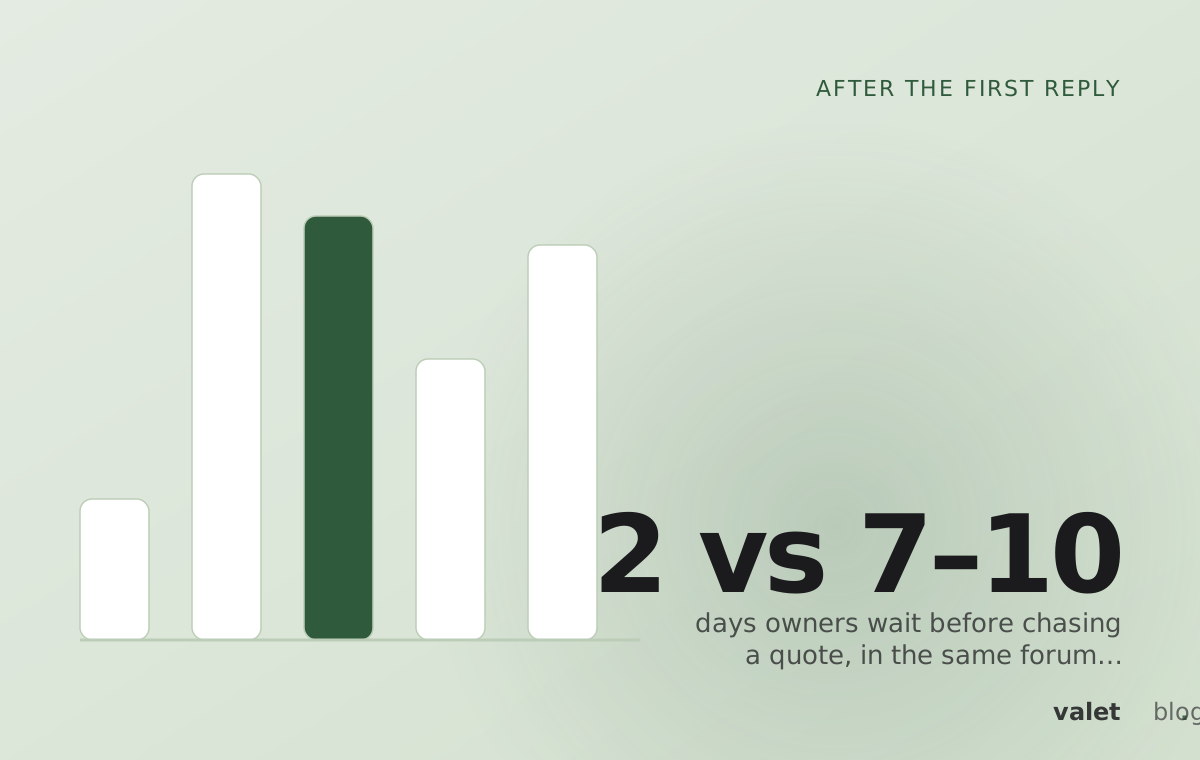
2 vs 7–10
days owners wait before chasing a quote, in the same forum thread
PavingExpert forum, 2013
−46%
lower hiring odds after a one-hour reply delay, as reported
Management Science via Entrepreneur, Fiverr data, Jul 2026
35.6%
of email-sourced meetings came from step 3 of a sequence
Belkins, 7.53M B2B emails, 2026
Follow up about two days after a quote when the job is urgent, the date is near, or you are holding a time for the customer; wait closer to a week when nothing is pressing. The 2-2-2 rule shared in the Jobber Community in August 2026 (a check-in at two days, a scheduling reminder at two weeks, a seasonal check-in at two months) is a sound default1. The flaw it shares with every fixed-day rule is the starting point. It counts from the day you sent the quote. The clock that decides whether a follow-up lands is the customer's.
When should you follow up after sending a quote? The consensus, stated fairly#
The consensus on quote follow-up timing is that you should wait a fixed number of days, long enough not to seem pushy and short enough not to be forgotten. Practitioners agree on that structure and disagree, by a factor of five, on the number.
| Rule | Who says it | Source |
|---|---|---|
| 2 days, then 2 weeks, then 2 months | Jobber Community answer, home services | Aug 20261 |
| "2 days after the quote is received" | A UK contractor describing what "the bigger outfits" do | PavingExpert forum, 20132 |
| "5-7 days later along with a phone call" | A thread in r/msp, "First customer quote but no response back" (30+ comments, about 10 months old) | Reddit, no link |
| "7 to 10 days after I've posted or emailed the quote" | A UK contractor, same thread as above | PavingExpert forum, 20132 |
Each rule has a respectable case. Two days catches the customer while the quote is still open on their screen. A week gives them time to compare, talk to a partner, check a budget. Ten days signals patience in a trade where pushing too early can cost the job. All three are defended by people who quote for a living.
Why owners rely on fixed-day rules#
Fixed-day rules survive because they solve the owner's problem, not the customer's. An owner running jobs all day has no system that watches each quote; a rule of thumb ("chase on Thursday") turns a judgement call into a calendar entry, and that lowers the coordination cost of following up to nearly zero. That is a real benefit, and the alternative for most small businesses is not a better rule but no follow-up at all.
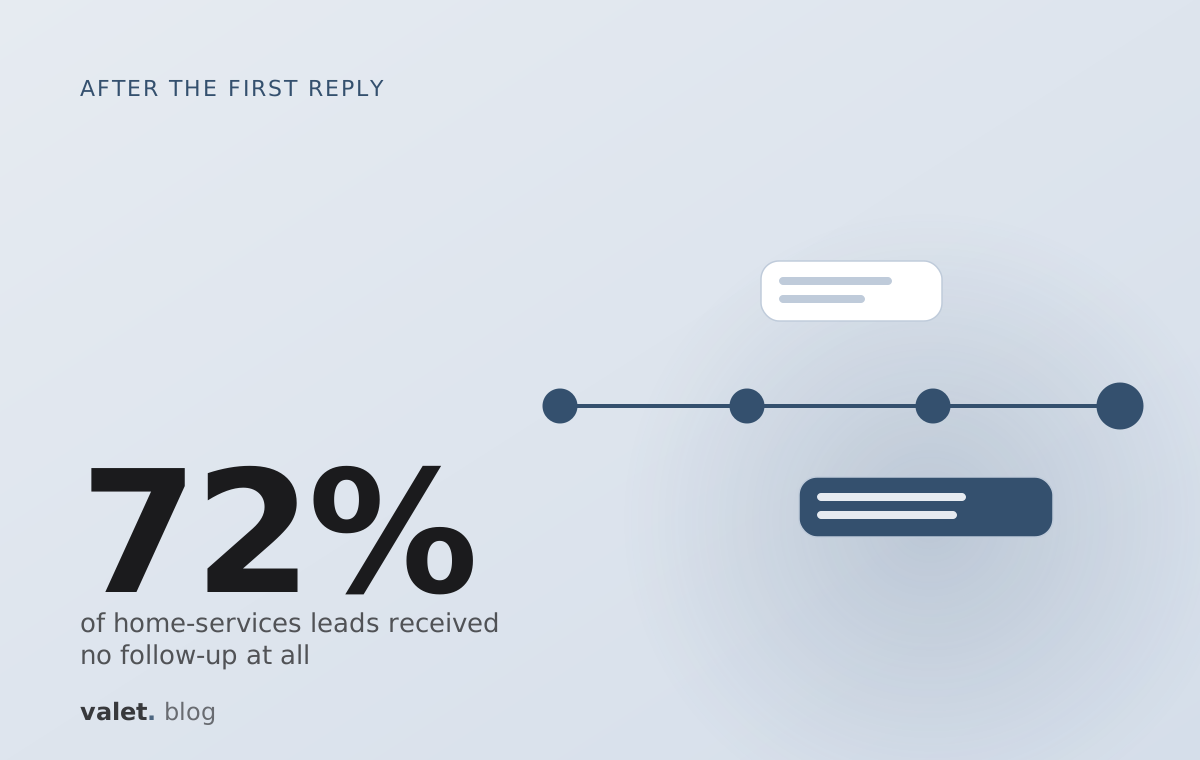
The no-follow-up baseline is not hypothetical. Pied Piper's 2026 mystery shop of 3,211 home-services locations found 72% of leads received no follow-up whatsoever3, and Leadferno's 2024 test of 225 small-business contact forms reported that most businesses made a single attempt9. Against that baseline, any rule is an improvement. Hence its popularity.
The incentive also runs one way. A fixed rule is easy to teach to staff, easy to put in a CRM, and easy to check. Whether it matched what the customer was doing on day two is invisible, so nobody measures it. The rule becomes a local optimum: good for the seller's week, silent about the buyer's.
The cracked assumption: every quote ages at the same speed#
Every fixed-day rule assumes a quote loses value at the same rate whatever the job, and that assumption fails on contact with real inquiries. A quote for a burst pipe is stale by the evening. A quote for a wedding next June is fresh for weeks. A quote with a held time attached expires on the day the hold lapses, regardless of when it was sent.
The response-speed research makes the point for the first reply, and it carries over. A Management Science study of Fiverr, as reported by Entrepreneur in July 2026, found that a one-hour delay in responding cut hiring odds by 46%, and a delay of 24 hours or more made a freelancer 90% less likely to win the job5. Thumbtack reported in November 2025 that pros replying within 30 minutes were 25% more likely to be hired than those replying within three hours6. WeddingPro reports that replying in under three hours makes couples 2.2 times more likely to reply7. These are first-reply findings, not follow-up findings. They show that in some categories the customer's decision window is measured in hours, and that a follow-up scheduled for day seven arrives after the decision.
Customers have a clock in the other direction too. In the same 2013 PavingExpert thread, a reader writing as a customer said: "if I received a phone call more than 3 or 4 days after, chasing me up as a potential customer, I'd probably feel pressured."2 A UK Business Forums member put the customer's preference more sharply in 2006: "I don't really want any pestering or further contact unless I ask for it."8 Neither is a measurement. Both say the right moment depends on what the customer is doing, not on the seller's calendar.
The alternative: time the follow-up to the customer's next deadline#
The better rule fits in one sentence. Send each follow-up shortly before the customer's next real decision point, and make it carry whatever is about to change at that point.
Decision points are concrete. The date of the job or event. The day a time you are holding lapses. The day your quote's price stops being valid. A date the customer named ("we'll decide after we see the other venue on Saturday"). When none of those exists, a fixed default is the fallback, which is exactly where the 2-2-2 rule belongs.
Three lines of evidence, strongest last#
The case for anchoring timing to the customer's deadline rests on three lines of evidence, none of them a controlled test of inbound quote follow-up, which nobody has published.
First, practitioners disagree by a factor of five. Two days and ten days are both defended in the same thread by people with years of quoting behind them2. If a single interval were right for every job, experienced owners would have converged on it. They have not, which suggests they are each right about their own mix of jobs.
Second, later touches matter more than the exact day. Belkins' 2026 study of 7.53 million B2B emails found 58.6% of replies came after the first message, and step 3 produced 35.6% of email-sourced meetings4. The data is outbound and B2B, so read it as directional. What it shows is that the existence of a second and third message matters a great deal, while the debate over day two versus day five is second-order.
Third, decision windows differ by category. The Fiverr, Thumbtack and WeddingPro findings above567 measure different markets, and each finds the payoff from speed concentrated in the first hours. A homeowner with a leak and a couple with a date eighteen months out are not on the same curve. A rule that treats them the same will be early for one and late for the other.
Follow-up timing by situation#
The decision table below replaces a single interval with an anchor for each common situation. The intervals are conventions drawn from the sources above, not measured optima; the anchor column is the part to keep.
| Situation | A fixed rule would say | Anchor instead | First follow-up | Second follow-up |
|---|---|---|---|---|
| Urgent job (repair, same-week service) | 2 days | The customer's need, measured in hours | Same day or next morning, with a time you can do | Next day; then close |
| Job or event within 2 weeks | 2 days | The date itself, and how many slots remain | About 1–2 days, with a held time | The day before the hold lapses |
| Date 1–3 months away | 2 days, then 2 weeks | When competing quotes are likely to land | About 2–3 days | About 7–10 days, with the quote's validity date |
| Date 6+ months away (weddings, venues, big projects) | 2 weeks, then 2 months | Tours, visits or meetings the customer has planned | About 3–5 days | About 2 weeks; park with a date if they name one |
| You are holding a time for them | Ignored by most rules | The hold's expiry | Midway through the hold | Shortly before it lapses; release it on time |
| Customer named a decision date | Whatever the rule says | Their date | A day or two before their date | A day or two after it |
| No date, no deadline, nothing held | 2 days | None available; use the default | About 2 days (the 2-2-2 rule) | About 2 weeks |
Cap at two follow-ups after the quote, or three if the third carries something new; then close the lead with a reason. Intervals are conventions, not measured results.
Two rows do most of the work. "You are holding a time" gives the follow-up a reason to exist and a deadline that is true. "Customer named a decision date" is the case where any fixed rule is guaranteed to be wrong, because the customer has already told you when to write.
Where the 2-2-2 rule still wins#
The 2-2-2 rule still wins in three situations, and they are common. When you have no date, no hold and no idea what the customer is comparing, a default beats guessing. When you have staff following up for you, a rule they can apply without judgement beats a judgement they will not make. And in seasonal trades, the two-month "seasonal check-in" in the 2-2-2 rule1 is a legitimate anchor: the customer's next decision point is the season.
Content also outranks timing. A two-day follow-up that says only "did you get my quote?" will feel like the pressure the PavingExpert customer described2. A two-day follow-up that offers a time you are holding will not. Timing decides when the message arrives; what it says decides whether it is welcome. For wording, see what to say when a customer doesn't respond to your quote.
Where this argument would be wrong, and the Monday-morning decision#
This argument would be wrong if reply rates to inbound quote follow-ups turned out to be flat across delays, whether the job date is a week away or a year away. In that case the simplest fixed rule would be as good as any anchor, and cheaper. Nobody has published reply rates by follow-up delay for small-business inbound inquiries. Valet is collecting them, by delay (day 1, 2, 3, 7 and 14) and by how close the customer's date is, and will publish the method with the numbers.
The Monday-morning decision is small. Add the customer's date to every quote you send, and a validity date to the quote itself. Then set each follow-up relative to those dates rather than to the day you hit send. For how many follow-ups to send before you stop, see how many times to follow up with a lead.
Where Valet fits#
Valet times follow-ups to the inquiry, not to a fixed drip. It offers real times from the owner's calendar, holds them, and uses the hold's expiry or the quote's expiry as the reason to write again. The Valet follow-up cap is two follow-ups by default, each with something useful, after which Valet stops and tells the owner why; the cap can be changed per topic. Every inquiry has a state, a next step and a time, so a quote never sits without a date attached.
To see how your current timing plays out, the free lead check takes 10–20 recent inquiries and shows what went unanswered, what stopped after one reply, and what it was worth.
Questions people ask
How long should I wait to follow up on a quote?
About two days when the job is urgent, the date is close, or you are holding a time; about a week when there is no date pressure. Set the second follow-up just before the next real deadline, such as the day a held time or the quote lapses.
What is the 2-2-2 rule for following up?
A cadence shared in the Jobber Community in August 2026: a friendly check-in after 2 days, a scheduling reminder after 2 weeks, and a seasonal check-in after 2 months. It is a practitioner convention, not a measured optimum.
Is following up two days after a quote too soon?
Not if the follow-up carries something useful, such as a time you are holding or an answer to a question the customer asked. A two-day nudge that only asks whether the quote arrived is more likely to feel like pressure.
How long after an estimate should you follow up for a big job with no deadline?
Around a week for the first follow-up and two to three weeks for the second, unless the customer named a decision date. If they did, follow up a day or two before that date instead of on a fixed schedule.
Sources
Confidence: H primary source checked · M credible secondary or reported · L vendor claim or single report. Reddit and forum items are quoted from public threads and summarised, not endorsed.
- Why do clients disappear after asking for a quote? · Jobber Community · 2026-08 M
- How long do you leave it to follow-up a quote? · PavingExpert forum · 2013 M
- Precision Garage Door Ranked #1 in Customer Lead Handling Effectiveness Home Services Study (Pied Piper PSI 2026) · Pied Piper Management Company via BusinessWire · 2026-04-12 H
- Sales follow-up statistics · Belkins · 2026 M
- Companies are tracking response-time delays for freelance jobs · Entrepreneur (reporting a Management Science study) · 2026-07-16 M
- 3 takeaways from the 2025 Pro Summit · Thumbtack · 2025-11-06 H
- From Hello to Hired: your guide to lead replies · WeddingPro · undated H
- Quote follow ups — how to? · UK Business Forums · 2006 M
- RESEARCH: Website Contact Forms and Lead Management – Uncovering Costly Mistakes · Leadferno · 2024-06-28 H
How to cite this page
Cite this page
Valet, "When should you follow up after sending a quote: 2 days, 7 days or 2 weeks? (the 2-2-2 rule, tested)", valet.team, October 2026.
Keep reading
 After the first replyThe first reply is now free. The follow-up is where 72% of leads die.Meta, Google and the inquiry tools now answer the first message for you. The money is lost in the days after it, and almost nobody sells that part.From the Valet team · 11 min · 1 October 2026
 After the first replyHow many times should you follow up with a lead before you stop?A written standard for following up on inbound inquiries: what counts as a follow-up, what each nudge must contain, when the sequence must stop, and how to close a lead with a reason instead of letting it fade.Policy desk · 11 min · 1 October 2026
 After the first replyWhy leads go silent after you send a quote (and what it actually means)Silence after a quote is usually read as a verdict on price. The base rates say it is more often an unfinished conversation, and the thread itself carries signals that tell you which kind you have.Trends desk · 9 min · 1 October 2026