
After the first reply
What to say when a customer doesn't respond to your quote: 2nd and 3rd follow-ups that aren't "just checking in"
"Just checking in" fails for a reason that has little to do with tone. It hands the customer a chore. The follow-ups that get answered make replying take one word.
Short answer
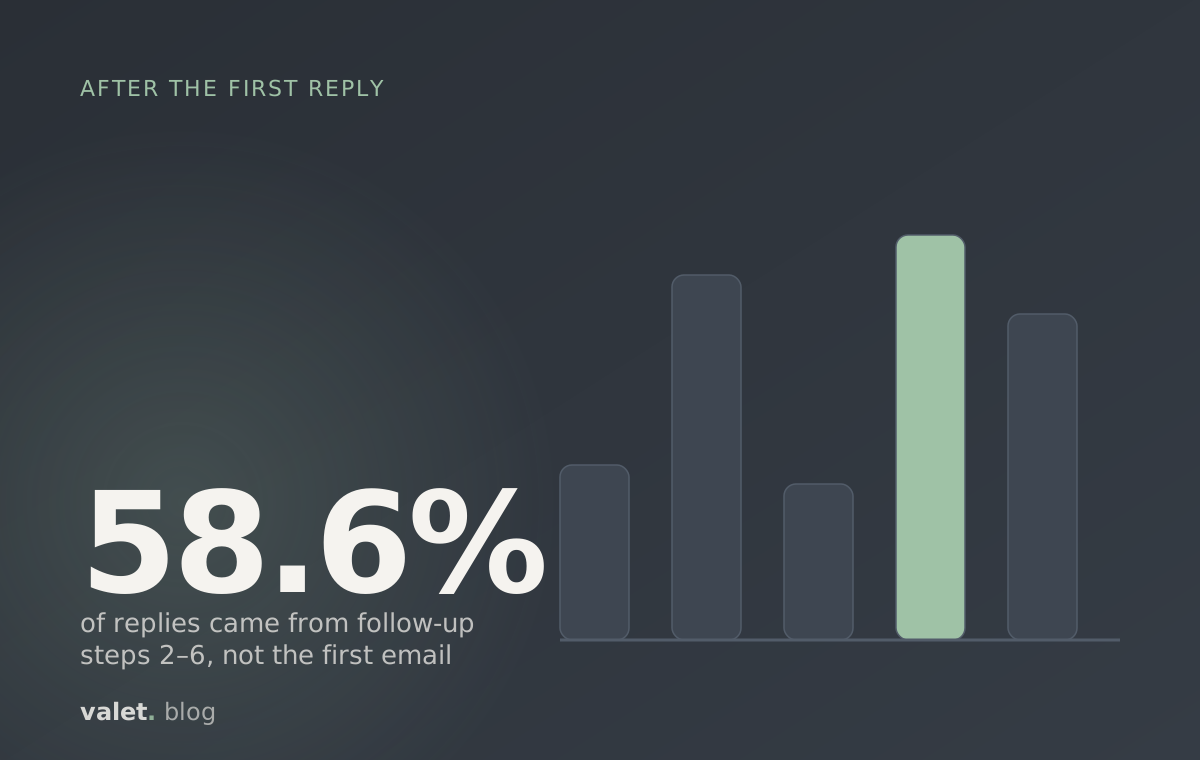
Your second follow-up should give the customer something new and make replying take one word: a time you are holding ("reply yes to keep Thursday"), the one detail you need, or the date your quote lapses. The third should offer a graceful way out and say you will close the file. Belkins' 2026 study of 7.53 million B2B emails found 58.6% of replies came after the first message, so these later messages carry most of the result.
58.6%
of replies came from follow-up steps 2–6, not the first email
Belkins, 7.53M B2B emails, 2026
28%
of home-services leads were offered an appointment when booking was the next step
Pied Piper PSI, 3,211 locations, Apr 2026
55%
of home-services businesses never asked the caller to book
Invoca benchmarks, Jul 2026
A second follow-up after a quote should give the customer one new thing and make replying take one word. Offer a time you are holding ("reply yes to keep Thursday at 10"), ask for the single detail you need, or state the date your quote lapses. The third follow-up should make saying no easy and tell the customer you will close the file. These later messages are where most replies come from: in Belkins' 2026 study of 7.53 million B2B emails, 58.6% of replies arrived after the first message2. Templates for each situation are below.
Why "just checking in" is the default#
The default second message after a quote is some version of "just checking in to see if you had any questions", and the case for it deserves a fair hearing. It is polite. It does not presume. It reminds the customer you exist without pressing them, and an owner who fears seeming desperate can send it without embarrassment.
That fear is widespread and well founded. A thread in r/sales titled "What's a better post price quote follow up than 'hi just…'" (80+ comments, about two years old) opens with an owner admitting "my goto follow up reeks desperation 'hey just wondering if you received my quote'". On the PavingExpert forum, a UK contractor asked other members whether his own follow-up email "seemed pushy"7. Faced with a choice between seeming pushy and seeming polite, owners pick the softest possible wording, and "just checking in" is as soft as wording gets.
Most owners do not reach that choice at all. Leadferno's 2024 test of 225 small-business contact forms reported that most businesses made one attempt and stopped6. For an owner who sends nothing, even "just checking in" is progress.
What does a follow-up ask the customer to do?#
A follow-up email after a quote succeeds or fails on the work it asks of the customer, not on its tone. "Just checking in" asks a lot. To answer it, the customer has to find your quote, reread it, decide, and compose a reply that explains the decision. That is the same chore they were already avoiding when they went quiet. The polite wording hides a transfer of effort from seller to buyer.
| Follow-up says | Customer has to | Easiest possible reply |
|---|---|---|
| "Just checking in on the quote" | Find the quote, reread it, decide, explain | A paragraph, or nothing |
| "Did you get my quote?" | Admit they saw it and have not decided | Nothing, usually |
| "I'm holding Thursday 10am for you until Friday noon. Reply yes to keep it." | Check one date | "Yes" or "no" |
| "To firm up the price I just need the room size." | Answer one question | A number |
| "If you've gone another way, just say so and I'll close this out." | Nothing they have to explain | "Went another way, thanks" |
Apollo, a sales-software vendor, cites Gartner research on 632 B2B buyers in which 73% said they avoid suppliers who send irrelevant outreach3. "Just checking in" is the purest form of irrelevant: it contains no information the customer did not already have. The perverse incentive is that it feels safest to the sender precisely because it asks nothing of the sender.
The missing ingredient is usually a concrete next step. Pied Piper's 2026 mystery shop of 3,211 home-services locations found only 28% of leads were offered an appointment when booking was the natural next step4, and Invoca's 2026 benchmarks found 55% of home-services businesses never asked the caller to book5. A follow-up that names a time does what most first replies did not.
The one-line follow-up that works: "Are you still looking?"#
The strongest counter-example to the argument above is a one-line message, and it supports the argument. A Jobber Community answer from August 2026 recommends "Are you still looking to get your [service] done?" and says it "gets a response nearly 80% of the time"1. That figure is one owner's report with no sample size; treat it as an anecdote, not a rate.
The line works for the same reason the held-time message works. It can be answered with one word. It does not ask the customer to reread anything or justify a decision. And it gives them a graceful out, because "no, we're sorted" is as easy to send as "yes". Its limit is that it carries nothing new, so it suits a final nudge better than a second one, where a held time or a missing detail moves the job forward.
Second and third follow-up templates, by situation#
The templates below are organised by the state of the inquiry, because what you can truthfully offer depends on what has already happened. Each assumes your first reply answered the customer's question and sent the quote. Replace everything in square brackets; delete any line you cannot make true.
STATE 1: Quote sent, no time offered yet (second message)
Subject: Re: [their original subject]
Hi [name], on the [job] at [place]: I can do [day, date] at [time]
or [day, date] at [time]. I'll hold whichever you pick until
[date]. Reply with the one that suits and I'll confirm.
[Your name], [business]

STATE 2: Time offered, not held (second message)
Subject: Re: [their original subject]
Hi [name], I've pencilled you in for [day, date] at [time] for
the [job]. I'll keep it until [date and time], then release it.
Reply "yes" to keep it, or tell me a better day.
[Your name]

STATE 3: Time held, no confirmation (second message)
Subject: Re: [their original subject]
Hi [name], a reminder that [day, date] at [time] is held for you
until [date and time]. To lock it in I just need [the one missing
detail: address / guest count / room size]. One line is plenty.
[Your name]

STATE 4: Quote needs one detail to be firm (second message)
Subject: Re: [their original subject]
Hi [name], the quote I sent assumes [assumption]. If it's actually
[alternative], the price is [price from your list]. Which is closer?
[Your name]

STATE 5: Silent after the second message (third and final message)
Subject: Re: [their original subject]
Hi [name], I'll release [the held time / the date] on [date] and
close the file on the [job] so I'm not filling your inbox.
If you've gone another way, no problem, just say so.
If you'd still like it, reply "still on" and I'll pick it up.
[Your name]

CLOSE-OUT (only after a reply that declines)
Hi [name], thanks for letting me know. I've closed this on my side.
If anything changes, just reply to this email.
[Your name]
Two rules keep these templates accurate. A time you say you are holding must actually be held, and released when you say it will be. A price must come from your list; if the customer's situation needs a price you have not set, the follow-up should say you will confirm it, not guess. Observed reply rates for each template are not published anywhere for small-business inbound quotes. Valet is collecting them by inquiry state and will publish the method with the numbers.
What not to put in a follow-up#
Three common additions to quote follow-ups cost more than they return, and each has a second-order effect the sender does not see.
- An unrequested discount. It assumes the silence was about price, which is one explanation among several (see why leads go silent after a quote). It also resets the customer's anchor: the next quote you send them, or anyone they refer, starts lower. Offer a smaller package only if it already exists on your list.
- A deadline that is not real. "Only two slots left" works once. If the slots are still there next month, the customer learns your deadlines move, and so does everyone they tell. Use the real expiry of a real hold.
- A second question. Every extra question raises the cost of replying. Ask for one thing per message; the second can wait for the reply.
Where "just checking in" is fine#
A plain check-in is fine in a narrow set of cases. When the customer has already told you they will decide by a date, a short "still on track for Friday?" after that date is an easy reply. When you are following up with an existing customer rather than a new inquiry, the relationship carries the context the message lacks. And when there is truly nothing new to offer, a one-line "are you still looking?" beats silence1.
Phone calls change the calculation too. A thread in r/msp, "First customer quote but no response back" (30+ comments, about 10 months old), recommends a follow-up email "along with a phone call". A call carries tone the email cannot, and for a high-value quote it may be worth the time. The same one-question discipline applies.
Where this argument would be wrong, and the Monday-morning decision#
This argument would be wrong if follow-ups with a held time or a single question drew no more replies than a plain check-in once timing is held constant. Belkins' finding that step 3 produced 35.6% of email-sourced meetings2 shows that later messages matter; it does not show which wording wins. That comparison for inbound small-business quotes has not been published.
The Monday-morning decision is to rewrite your one stored follow-up as five, one per state above, and delete "just checking in" from all of them. The stakes are easy to estimate. As an illustration, a photographer whose average booking sits near The Knot's 2026 average photographer spend of $3,0008 who recovers one booking a month from better second and third messages adds about $36,000 a year. Your rate may be lower or higher; count it. For timing, see when to follow up after sending a quote, and for how many messages to send, how many times to follow up with a lead.
Where Valet fits#
Valet writes follow-ups from the inquiry's state. Because it can offer real times from the owner's calendar and hold them, its second message can say "I'm holding Thursday" and mean it, and its last message can release the time on the day it said it would. The Valet follow-up cap is two follow-ups by default, each carrying a held time, a missing detail or a quote expiry, then Valet stops and tells the owner why. Valet answers only from the owner's price list and policies; discounts and haggling go to the owner, and every reply comes with a Valet receipt.
To see what your current follow-ups are doing, the free lead check takes 10–20 recent inquiries and shows what went unanswered, what stopped after one reply, and what it was worth.
Questions people ask
What should I say in a second follow-up email after a quote?
Add one thing the customer did not have before, such as a time you are holding, an answer to a question they asked, or the date the quote expires, and ask for a one-word reply. Reference their job in their own terms and keep it under about 80 words.
What should a third follow-up say?
The third follow-up should make saying no easy, state the one thing that is about to lapse, and say you will close the file if you do not hear back. It is the last message unless the customer replies.
Why does 'just checking in' not work?
It adds nothing new and asks the customer to reopen your quote and write a full answer. A follow-up that can be answered with yes, no or a time is cheaper to answer, so more people answer it.
Should I offer a discount in a follow-up?
Not as a reflex. A discount in a follow-up assumes the silence was about price, and a deadline you later extend teaches customers to wait. Mention a smaller package only if it already exists on your price list, and keep discounts as the owner's decision.
Sources
Confidence: H primary source checked · M credible secondary or reported · L vendor claim or single report. Reddit and forum items are quoted from public threads and summarised, not endorsed.
- Why do clients disappear after asking for a quote? · Jobber Community · 2026-08 M
- Sales follow-up statistics · Belkins · 2026 M
- How to improve reply rates through strategic follow-up emails · Apollo · 2026 L
- Precision Garage Door Ranked #1 in Customer Lead Handling Effectiveness Home Services Study (Pied Piper PSI 2026) · Pied Piper Management Company via BusinessWire · 2026-04-12 H
- The Invoca Home Services Lead Conversion Benchmarks Report 2026 · Invoca · 2026-07 H
- RESEARCH: Website Contact Forms and Lead Management – Uncovering Costly Mistakes · Leadferno · 2024-06-28 H
- How long do you leave it to follow-up a quote? · PavingExpert forum · 2013 M
- Average cost of a wedding photographer (Real Weddings Study) · The Knot · 2026 H
How to cite this page
Cite this page
Valet, "What to say when a customer doesn't respond to your quote: 2nd and 3rd follow-ups that aren't 'just checking in'", valet.team, October 2026.
Keep reading
 After the first replyThe first reply is now free. The follow-up is where 72% of leads die.Meta, Google and the inquiry tools now answer the first message for you. The money is lost in the days after it, and almost nobody sells that part.From the Valet team · 11 min · 1 October 2026
 After the first replyHow many times should you follow up with a lead before you stop?A written standard for following up on inbound inquiries: what counts as a follow-up, what each nudge must contain, when the sequence must stop, and how to close a lead with a reason instead of letting it fade.Policy desk · 11 min · 1 October 2026
 After the first replyWhy leads go silent after you send a quote (and what it actually means)Silence after a quote is usually read as a verdict on price. The base rates say it is more often an unfinished conversation, and the thread itself carries signals that tell you which kind you have.Trends desk · 9 min · 1 October 2026