
Definitions & data
The lead response statistics everyone quotes, traced to their source
Most of the numbers on speed-to-lead pages are 2007 to 2014 vintage, misattributed, or invented. Here is the citation chain for each one, and the newer studies with a sample size you can name.
Short answer
Most lead-response statistics in circulation are 2007 to 2014 vintage or have no traceable source. The '21x / 100x within five minutes' figures come from the Lead Response Management study (InsideSales.com with MIT's James Oldroyd; phone calls, six companies, 15,000+ leads), not HBR 2011. The 'National Sales Executive Association' behind '80% need five follow-ups' does not exist (VentureBeat, 2014). Use 2024 to 2026 data instead: Leadferno 2024 (42.6% of 225 forms unanswered) and Pied Piper 2026 (72% got no follow-up).
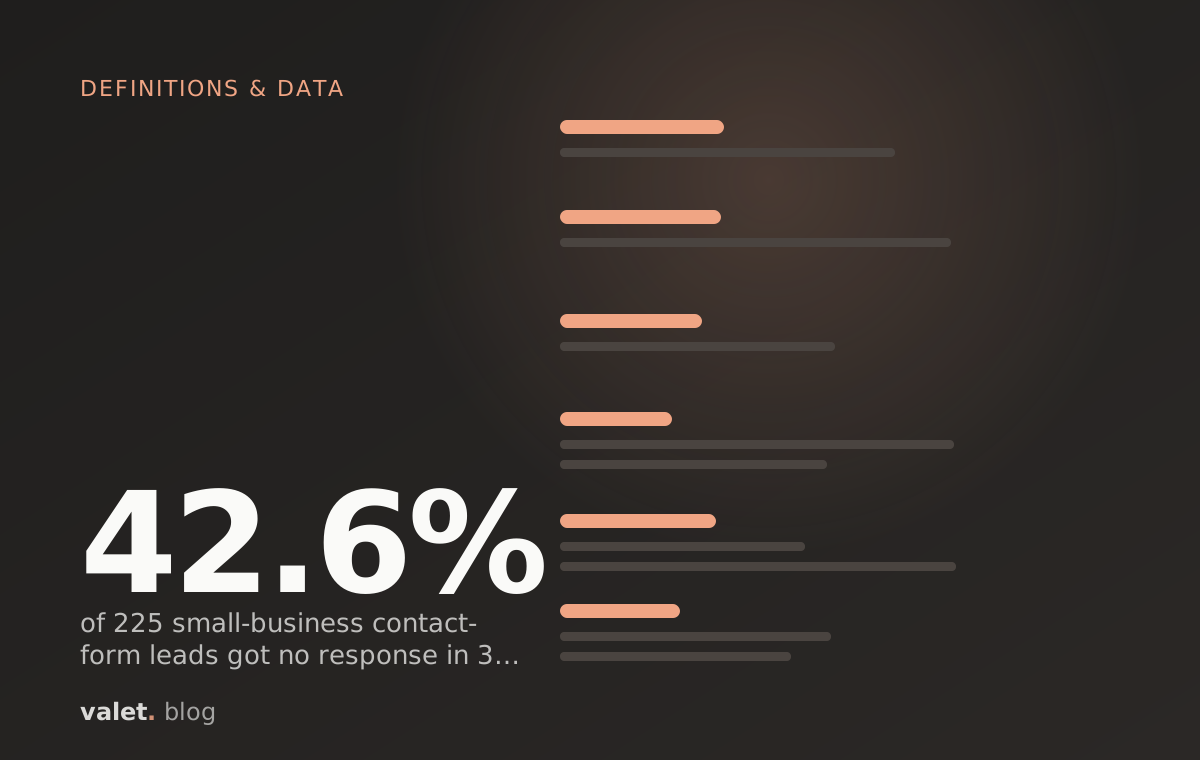
42.6%
of 225 small-business contact-form leads got no response in 3 weeks
Leadferno, June 2024
72%
of mystery-shopped home-services inquiries got no follow-up at all
Pied Piper PSI, 3,211 locations, April 2026
6 companies
supplied the phone data behind the '21x / 100x' five-minute rule
Lead Response Management study page, retrieved October 2026
Most lead-response statistics in circulation are 2007 to 2014 vintage, misattributed, or have no source at all. The "21x / 100x within five minutes" figures come from a phone-call study of six companies, not from Harvard Business Review. The "National Sales Executive Association" behind "80% of sales need five follow-ups" does not exist. "78% buy from the first responder" has no located primary study. The 2024 to 2026 replacements are better: Leadferno found 42.6% of 225 small-business contact forms got no reply in three weeks15, and Pied Piper found 72% of 3,211 home-services inquiries got no follow-up16.
The Technical desk traced each number hop by hop, from the page where it is quoted today back to the earliest document that names a method and a sample. Where the chain broke, the break is written down. The result is the Valet Stats Ledger at the end of this page: one row per claim, with a status and a replacement.
Where do the speed-to-lead statistics come from?#
Speed-to-lead statistics on 2026 "statistics" pages come mostly from three roots: a 2007-era phone study, a March 2011 HBR article, and an image that circulated with a fabricated source. One page shows the whole failure mode. SetSmart's April 2026 roundup lists more than a dozen statistics with attributions5. Several carry no year. Two of them, "21x" and "100x", are credited to different sources and years (HBR 2011 and "InsideSales.com / MIT, 2012"), although both come from the same study. "80% require 5+ follow-ups" is credited to "Marketing Donut".
The same numbers repeat across vendor pages. A post linked from Hacker News in July 2026 credits "21x more likely to qualify" to Harvard Business Review and states "78% of customers buy from whoever responds first" with no source6. Prospeo's 2026 playbook says "78% of buyers choose the first vendor to respond", also uncited7. A September 2026 lead-cost post repeats 78% and an "8x within 5 minutes" figure8. A 2024 UK white paper repeats 78%, 391% and "47 hours", names HBR 2011 "the cornerstone study", and gives no sample size for its own UK figures9.
The stakes are budget, not trivia. These numbers are the argument for buying speed tooling. Chili Piper's entry Routing & Scheduling tier, for example, is listed from $1,250 a month including 15 seats23. A three-person team deciding on that spend should know which multipliers were measured, on what, and when.
How the citation chain was traced#
The Valet trace method treats each statistic like a request through a proxy chain: follow every hop until a hop either terminates at a document with a method, a sample and a date, or terminates at nothing. Each claim then gets one of three statuses.
- Use. Primary document read, sample size and date known, and the claim matches what was measured.
- Use with caveat. Primary document exists but was not fully readable, or the claim is valid only for a narrower setting than the one it is quoted for.
- Retire. No primary document located, the source is fabricated, or the number is quoted for a context it never measured.
How we got this: each claim was followed from 2024 to 2026 pages back to the earliest document cited, using Valet's research notes and direct retrieval of the primary pages in October 2026 where they were reachable (VentureBeat 2014, the Lead Response Management study page, the BYU record of the HBR article, Leadferno, the Pied Piper release, Belkins). The HBR 2011 article body and the Management Science paper were not readable in full; claims that depend on them are marked.
Is the 21x five-minute rule from Harvard Business Review?#
The 21x and 100x five-minute figures come from the Lead Response Management study, not from Harvard Business Review. That study was run with MIT professor James Oldroyd on InsideSales.com data. Its own page describes "three years of data from six diverse companies, analyzing over fifteen thousand leads and more than a hundred thousand call attempts"2.
The study page reports "a 21-fold decrease in the odds of qualifying" a lead and "a 100-fold increase in contact ratios" when the first call happens within 5 minutes rather than 302. It also reports a fourfold drop in qualification odds between 5 and 10 minutes, and that after 20 hours, extra call attempts hurt contact rates. Every one is a phone metric.
Failed hypothesis: the HBR 2011 article is the origin#
The HBR article "The Short Life of Online Sales Leads" (March 2011) is a separate piece by Oldroyd, McElheran and Elkington4. Its public abstract says only: "Our research shows that most companies are not responding nearly fast enough." The figures commonly attributed to it (an audit of 2,241 US companies, 23% never responding, a roughly 7x qualification lift within an hour, an average response of 42 hours) could not be checked against the article body, which is paywalled3. Note the drift: secondary pages give the average as 42 hours or 47 hours59.
Failed hypothesis: "600x after an hour" is the same study#
Easy Weddings' 2018 vendor guide credits MIT/InsideSales with "4x less likely" after 10 minutes and "600x" after an hour14. The fourfold figure matches the study page. A 600x figure does not appear on the study page as retrieved in October 2026; the page instead reports a tenfold drop in contact after the first hour2. The 600x figure is a mutation in transit.
The year is the last loose wire. Citing literature usually dates the study to 2007. The study page itself gives no collection years, and its footer reads © 2022. Cite it as "the Lead Response Management study (InsideSales.com with James Oldroyd, MIT)" and let the reader see that it is undated.
Does the National Sales Executive Association exist?#
The National Sales Executive Association does not exist, and the follow-up statistics credited to it are invented. Stewart Rogers checked in VentureBeat on 15 August 2014: "These stats are completely made up, and the National Sales Executive Association doesn't exist"1. He reports searching the Better Business Bureau and IRS records without a match, and that the stats are "usually shown as an image with the source confidently displayed in the bottom-right corner."
The fabricated set includes "48% of sales people never follow up with a prospect" and the ladder from "2% of sales are made on the first contact" to "80% of sales are made on the fifth to twelfth contact"1. Twelve years after the debunk, the 80% figure is still quoted, now credited to "Marketing Donut"5. The attribution changed. The missing data did not.
A sibling family of numbers has the same defect. Instantly's follow-up guide cites "44% of salespeople give up after one follow-up" (Spotio/HubSpot), "80% of sales require at least five touches" (Peak Sales Recruiting) and "92% give up after the fourth call" (IRC Sales Solutions), none dated or linked to primary research10. Hartford Funds (May 2025) repeats a similar ladder without a source11. All of these are status Retire.
Do 78% of customers buy from the first company that responds?#
The "78% buy from the first responder" figure has no located primary study with a method or a sample. Its attribution moves between hosts. SetSmart credits "Lead Connect, 2023"5; other pages give the same source with the year 2019; the GetNextPhone post pairs it with an "8x" figure from the older InsideSales material8. A statistic whose year drifts by four years between citations is a cache entry with no origin server behind it.
Two more numbers fail the same test. "391% more conversions when you respond within one minute" is credited to Velocify, with no year or sample on the pages that quote it59. "50% of sales go to the vendor that responds first" (also quoted as 35 to 50%) is credited to InsideSales.com, undated5. All three: Retire.
Do 50% of couples book the first wedding vendor who replies?#
The "50% of couples book the first vendor who replies" figure is repeated by wedding-industry education pages without a primary citation. WeddingPro's 2021 lead-reply guide says "Up to 50% of bookings go to the vendor who responds first" and "Responding within 5 minutes makes you 9 times more likely to convert"12. A WeddingPro piece first published in 2018 says "50% of couples choose the first vendor to reply" and "40% of couples report vendors don't respond within five days"13. Easy Weddings said the same 50% in May 201814. None of the three shows a survey, a sample or a date of collection.
WeddingPro's own "From Hello to Hired" report is the better source for this segment. It states that couples reach out to 5 vendors per category on average, and that replying in less than 3 hours makes couples 2.2x more likely to reply22. That report is undated on its page, so cite it with that caveat. For what to do after the pricing reply, see why couples ghost after you send pricing.
Which lead response statistics should you use in 2026?#
The 2024 to 2026 lead-response studies share a property the old ones lack: each names its sample, its window and its channel. They also agree on the failure point. The first reply is unreliable, and the follow-up is mostly absent.
| Study | Sample and method | Finding | Scope limit |
|---|---|---|---|
| Leadferno, June 202415 | 225 small-business contact forms; home, professional and medical services; top-10 local results, 25+ reviews; tracked 3 weeks | 42.6% no response; first human reply averaged 17 h 49 m; 3.1% replied within 5 min; 65.5% made just one attempt; 4.8% of forms broken | One vendor's test; US local services |
| Pied Piper PSI, April 202616 | 31 brands, 3,211 locations, Oct 2025 to Jan 2026; mystery shop by phone, chat and web form; follow-up tracked for 24 h | 72% no follow-up; 28% offered an appointment where scheduling was the natural next step | Home services; 24-hour follow-up window |
| DelPrete, Aug 202417 | 100+ secret shops, 25+ real-estate brokerages | 47% of online inquiries unanswered; mean reply 8 h 17 m, median 39 min | Real estate |
| Invoca, July 202618 | Home-services call data | 55% of businesses don't ask the lead to buy or book | Phone calls |
| Management Science, via Entrepreneur, July 202619 | 11M+ Fiverr transactions plus an 8,600-participant experiment | 1-hour delay cut hiring odds by 46%; 24 h+ was 90% less likely to win than an immediate reply | Freelance marketplace; paper not read directly |
| Belkins, June 202620 | 7,530,489 B2B emails sent in 2025 | Follow-ups produced 58.6% of all replies; 3 to 5 steps is the practical range | Cold outbound, not inbound |
| Thumbtack, Nov 202521 | Platform data, shared at its 2025 Pro Summit | Pros replying within 30 min were 25% more likely to be hired than those replying within 3 h | One marketplace |
Lead response time is a tail-latency problem#
Lead response time behaves like tail latency, and averages hide it. DelPrete's real-estate data shows a median reply of 39 minutes and a mean of 8 hours 17 minutes17. The median says the typical inquiry was handled within the hour. The mean says a long tail of inquiries waited most of a working day or longer. Leadferno reports only a mean (17 h 49 m)15, so its p50 is unknown. When you quote a response-time figure, state whether it is a mean or a median; when you measure your own, track the p90, because the leads that leak sit in the tail.
The second lesson is that speed is the cheap part now. The measured gap in 2026 is what happens after the first reply: no follow-up in 72% of shops, no appointment offered in 72% of cases where one fit16. That is the argument of the first reply is free; follow-up is where leads die, and the reason the follow-up count question deserves its own answer in how many times to follow up with a lead.
The Valet Stats Ledger#
The Valet Stats Ledger lists each widely quoted lead-response claim with where it appears, its traced origin, a status and a replacement. Paste it into a deck review or a content checklist.
| Claim | Where it's quoted | Traced origin | Status | Replacement |
|---|---|---|---|---|
| 21x more likely to qualify if you respond in 5 min vs 30 | 2026 roundups, credited to "HBR 2011" | Lead Response Management study (InsideSales.com, Oldroyd/MIT): phone calls, 6 companies, 15,000+ leads; usually dated 2007, page undated | Use with caveat (phone only; correct the attribution) | Thumbtack 2025: 30 min vs 3 h = +25% hired; Fiverr 2026: 1 h delay = −46% |
| 100x more likely to make contact within 5 min | Credited to "InsideSales.com / MIT, 2012" | Same study as 21x | Use with caveat (phone contact rate) | Same as above |
| 600x less likely after an hour | Easy Weddings 2018 | Not on the study page, which reports a 10x contact drop after the first hour | Retire | WeddingPro: reply within 3 h, couples 2.2x more likely to reply |
| 7x / 23% never respond / 42 h (or 47 h) average | Roundups, UK 2024 white paper | Attributed to HBR, March 2011 (Oldroyd, McElheran, Elkington); body not verified | Use with caveat: "attributed to HBR 2011" | Leadferno 2024: 42.6% no reply, 17 h 49 m mean |
| 80% of sales need 5 to 12 follow-ups; 48% never follow up | Credited to NSEA, now "Marketing Donut" | Fabricated; NSEA does not exist (VentureBeat, 2014) | Retire | Belkins 2026: follow-ups = 58.6% of replies (B2B outbound) |
| 44% give up after one follow-up; 92% after four | Instantly, Hartford Funds and others | No dated primary research located | Retire | Leadferno 2024: 65.5% made just one attempt |
| 78% buy from the first responder | Prospeo, vendor blogs, UK white paper | "Lead Connect" 2019 or 2023, or InsideSales; no method or sample located | Retire | Pied Piper 2026: 72% got no follow-up |
| 391% more conversions within 1 min | Roundups, UK white paper | Credited to Velocify; no year or sample shown | Retire | Leadferno 2024: 3.1% replied within 5 min |
| 50% of sales (or couples) go to the first vendor | InsideSales (undated), WeddingPro 2021, Easy Weddings 2018 | No primary survey located | Retire | WeddingPro "Hello to Hired": couples contact 5 vendors per category |
| 5 min = 9x more likely to convert (weddings) | WeddingPro 2021 | No method shown | Retire | WeddingPro: under 3 h = 2.2x reply |
| 40% of couples hear nothing within 5 days | WeddingPro 2018, Easy Weddings 2018 | No method shown; 2018 | Retire | Leadferno 2024; Pied Piper 2026 |
| 42.6% of contact-form leads get no response | Leadferno | Leadferno, 28 June 2024, 225 forms, 3-week window | Use | (current) |
| 72% get no follow-up; 28% offered an appointment | Pied Piper release | Pied Piper PSI, 12 April 2026, 3,211 locations | Use | (current) |
| 1 h delay cuts hiring odds 46% | Entrepreneur | Management Science, Fiverr data, 2026 | Use with caveat (paper not read directly) | (current) |
What is still uncertain about these statistics#
Four links in the chain remain unverified, and each is marked in the ledger. The HBR 2011 article body was not readable, so its commonly quoted numbers stay "attributed to". The Lead Response Management study page gives no collection years. The Management Science paper on Fiverr response times was read only through trade-press coverage. Leadferno's "65.5% made just one attempt" is quoted in Leadferno's wording; the excerpt does not state its denominator.
Scope is the other residual risk. Pied Piper measured home services within a 24-hour window16. Belkins measured cold B2B outbound, not someone who wrote to you first20. No public study yet measures follow-up outcomes for inbound written inquiries to small businesses: an email to info@, a form, a directory lead. The Lost Lead Audit method (count what went unanswered, what stopped after one reply, and what it was worth) is how Valet is collecting that data; no Valet figure is published here because none is ready. The method is in the 90-day Lost Lead Audit.
If you hold a primary document for a row marked Retire, send it and the row will be updated with a date.
Where Valet fits#
Valet is an AI assistant that answers a small business's written inquiries (email, contact forms, directory leads) from the owner's own price list, calendar and policies. It offers real times, follows up at most twice by default with something useful each time, then stops and tells the owner why. That is the Valet follow-up cap, and it targets the gap the 2026 studies measure: the missing second message, not the first reply.
If you want your own numbers instead of borrowed ones, the free lead check is the start: forward 10 to 20 recent inquiries, or show them on a call, and see what went unanswered, what stopped after one reply, and what it was worth.
Questions people ask
Is the 21x five-minute lead response statistic from Harvard Business Review?
No. The 21x qualification and 100x contact figures come from the Lead Response Management study, run with MIT's James Oldroyd on InsideSales.com data from six companies, over 15,000 leads and 100,000+ call attempts. HBR's March 2011 article 'The Short Life of Online Sales Leads' is a separate piece by Oldroyd, McElheran and Elkington.
Does the National Sales Executive Association exist?
No. VentureBeat reported in August 2014 that the stats credited to it ('48% never follow up', '80% of sales are made on the fifth to twelfth contact') are made up and that the organisation does not exist. The numbers still circulate in 2026 roundups under other labels.
Is it true that 78% of customers buy from the first business to respond?
No primary study with a method and sample size was located for this figure. Pages attribute it to 'Lead Connect' with years that drift between 2019 and 2023, or to InsideSales.com. Treat it as unsourced and retire it.
What lead response statistics can I cite in 2026?
Leadferno (June 2024, 225 contact forms: 42.6% no response, first human reply averaged 17 h 49 m), Pied Piper (April 2026, 3,211 home-services locations: 72% no follow-up, 28% offered an appointment) and the Management Science Fiverr study reported in July 2026 (a 1-hour delay cut hiring odds by 46%).
Is the five-minute rule still true?
The five-minute finding measured phone contact and qualification rates in a sales-call dataset, not email or form replies. Newer marketplace data still shows speed matters (Thumbtack: replies within 30 minutes were 25% more likely to be hired than replies within three hours), but the 21x multiplier should not be applied to written inquiries.
Sources
Confidence: H primary source checked · M credible secondary or reported · L vendor claim or single report. Reddit and forum items are quoted from public threads and summarised, not endorsed.
- These incredible sales stats everyone cites are actually completely false · VentureBeat (Stewart Rogers) · 2014-08-15 H
- The Lead Response Management Study · Lead Response Management / InsideSales.com with James Oldroyd (MIT) · undated (page retrieved 2026-10) H
- The Short Life of Online Sales Leads · Harvard Business Review (Oldroyd, McElheran, Elkington) · 2011-03 M
- The Short Life of Online Sales Leads (record and abstract) · BYU ScholarsArchive · 2011 H
- Lead response time statistics · SetSmart · 2026-04-11 L
- ChatGPT, Yelp and AI lead response (vendor blog linked from Hacker News) · hirejosie.ai · 2026-07 L
- Demo Request Follow Up: 2026 Playbook + Templates · Prospeo · 2026 L
- Paid lead response time · GetNextPhone · 2026-09-22 L
- The Lead Response Crisis: how poor response times cost UK SMEs billions in lost revenue · Made Smarter / Ignite AI · 2024 L
- How many times should you really follow up with a prospect? · Instantly · undated L
- How to re-engage prospects who go silent · Hartford Funds · 2025-05-06 L
- How to respond to wedding leads on The Knot and WeddingWire · WeddingPro · 2021-10-18 (updated 2026-09) L
- Still waiting to hear from a lead? Here's why · WeddingPro · 2018 (modified 2026-09-02) L
- Responding to enquiries · Easy Weddings Pro · 2018-05-23 L
- Research: website contact forms and lead management, uncovering costly mistakes · Leadferno · 2024-06-28 H
- Precision Garage Door Ranked #1 in Customer Lead Handling Effectiveness Home Services Study · Pied Piper Management Company via BusinessWire · 2026-04-12 H
- Secret shopping: 47% of online property inquiries are ignored · Mike DelPrete · 2024-08 H
- The Invoca Home Services Lead Conversion Benchmarks Report 2026 · Invoca · 2026-07 H
- Companies are tracking response time delays for freelance jobs (Management Science study coverage) · Entrepreneur · 2026-07-16 M
- Sales follow-up statistics · Belkins · 2026-06-26 M
- 3 takeaways from the 2025 Pro Summit · Thumbtack · 2025-11-06 H
- From Hello to Hired: your guide to lead replies · WeddingPro · undated H
- Pricing · Chili Piper · 2026 H
How to cite this page
Cite this page
Valet, "The lead response statistics everyone quotes, traced to their source", valet.team, October 2026.
Keep reading
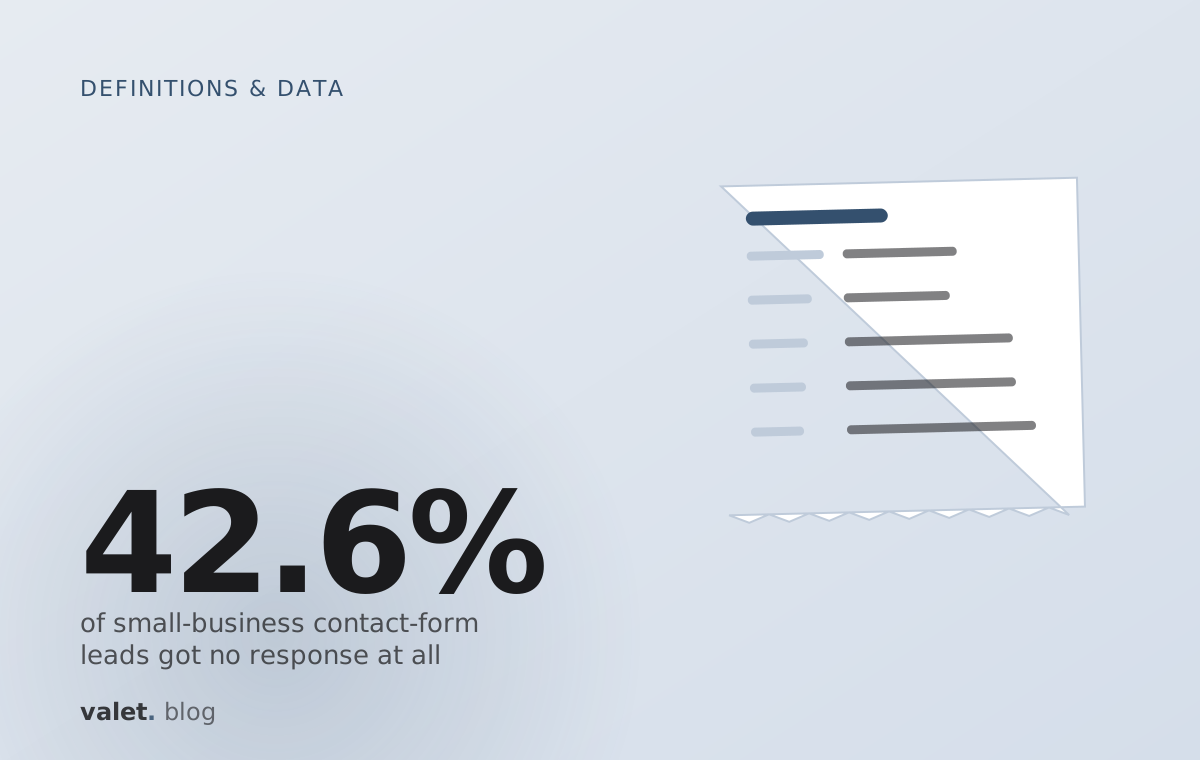 Definitions & dataHow to audit your last 90 days of inquiries: the Lost Lead Audit method, template and agency versionA spreadsheet, a handful of Gmail searches and five outcome labels will show you how many inquiries you never answered, how many stopped after one reply, and what they were worth.From the Valet team · 11 min · 1 October 2026
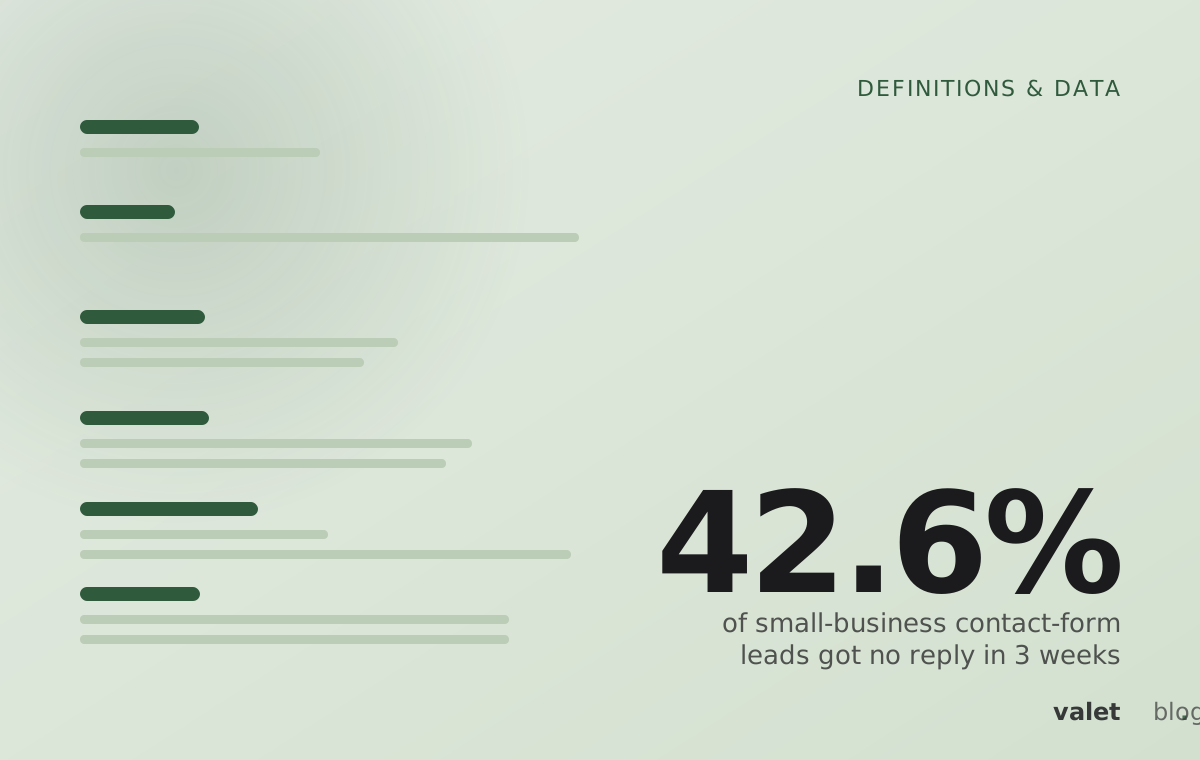 Definitions & dataInbound inquiry response and follow-up statistics (2026), by verticalEvery number here names its sample, its channel and its year. The table shows which verticals have measured follow-up at all, and the one statistic nobody has published yet: inquiries answered once and then dropped.Playbooks · 8 min · 1 October 2026
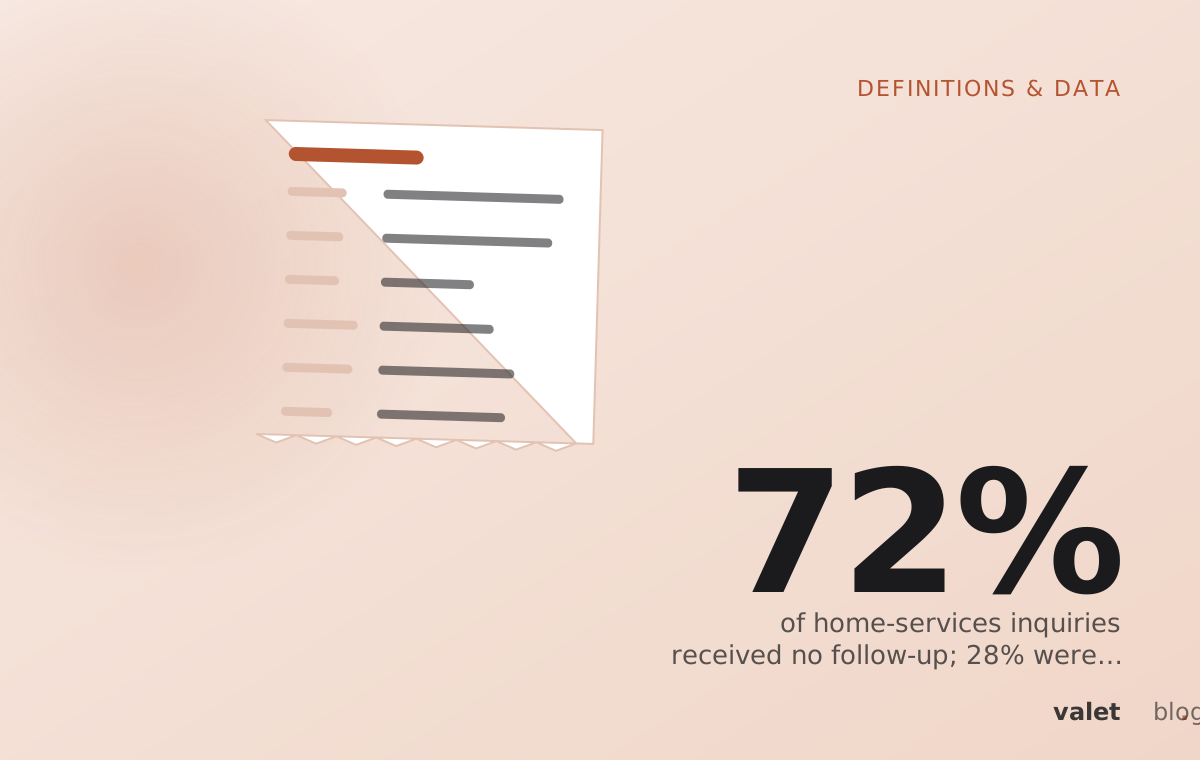 Definitions & dataThe inquiry-state glossary: 11 states from "new" to "booked" or "lost with a reason", with exit rulesMost lead pipelines have entry rules and no exit rules, so inquiries pile up in "contacted". This glossary defines 11 states, what moves an inquiry out of each one, and what the customer is told at every step.Technical desk · 10 min · 1 October 2026