
Definitions & data
The inquiry-state glossary: 11 states from "new" to "booked" or "lost with a reason", with exit rules
Most lead pipelines have entry rules and no exit rules, so inquiries pile up in "contacted". This glossary defines 11 states, what moves an inquiry out of each one, and what the customer is told at every step.
Short answer
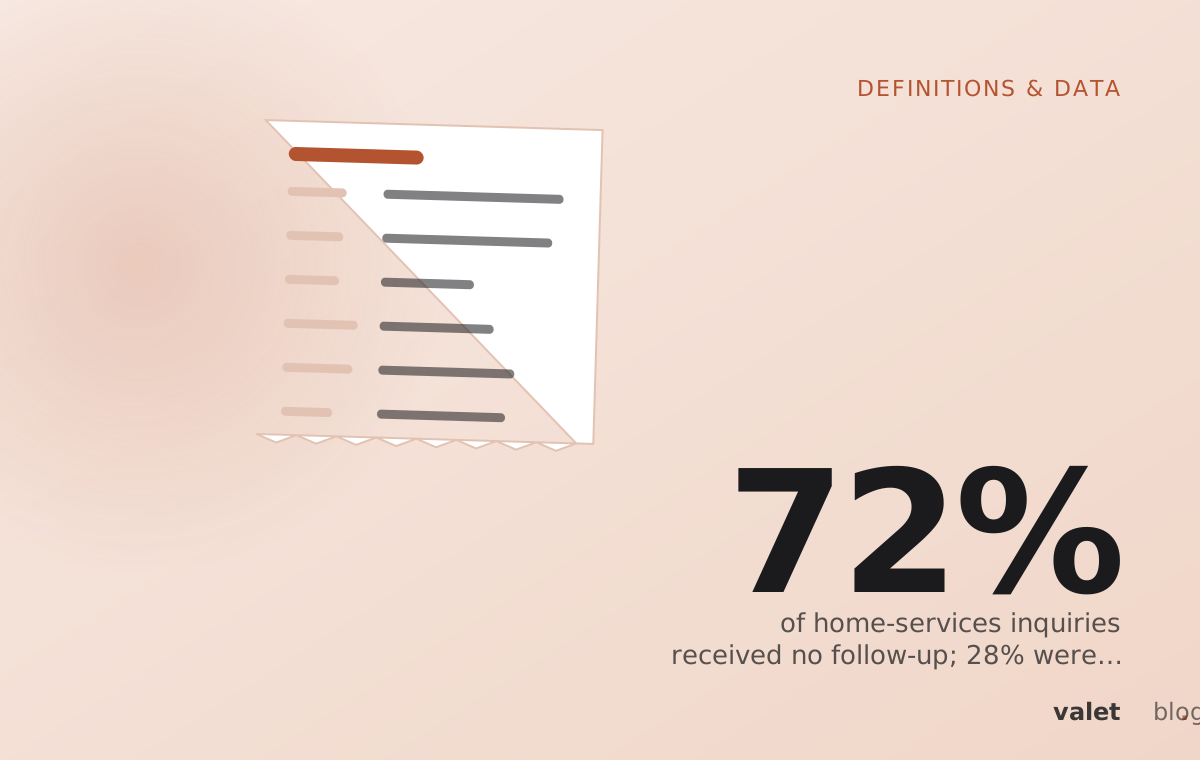
An inquiry state is the one position an inquiry holds at a given moment, defined by what has happened and what must happen next. This glossary uses 11: New, Answered, Time offered, Held, Waiting on customer, Needs owner, Booked, Deposit paid, Attended, Lost with a reason, and Revived. Every state has an exit rule. Pied Piper's 2026 study of 3,211 home-services inquiries found 72% got no follow-up, which is what a pipeline without exit rules produces.
72%
of home-services inquiries received no follow-up; 28% were offered an appointment
Pied Piper PSI, 3,211 inquiries, Apr 2026
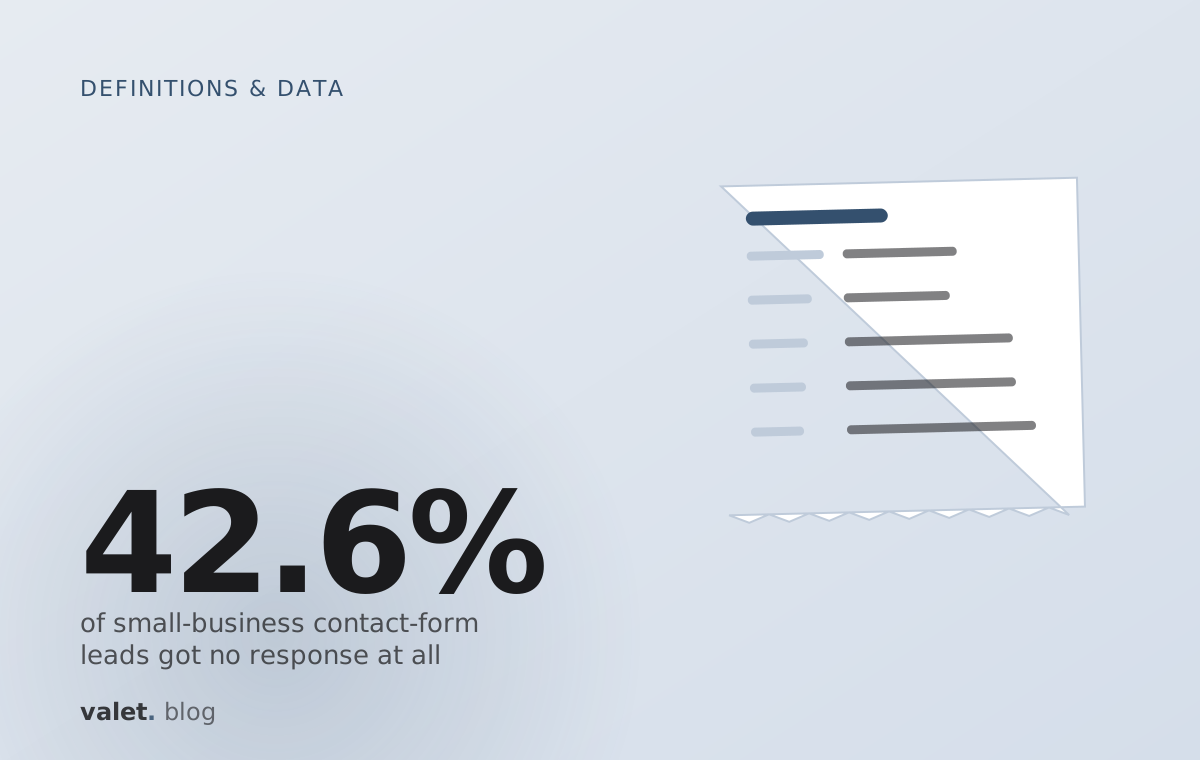
42.6%
of small-business contact-form inquiries never got a human reply
Leadferno, 225 forms, Jun 2024
55%
of home-services businesses never asked the caller to book
Invoca benchmarks, 2026
An inquiry state is the single position an inquiry holds at a given moment, defined by what has already happened and what must happen next. This glossary defines 11 states, from New to Booked or Lost with a reason, and gives each one an exit rule, a person who moves it, a clock and the line the customer sees. The reason to bother is measurable: Pied Piper's 2026 mystery-shop of 3,211 home-services inquiries found that 72% received no follow-up at all and only 28% were offered an appointment1. That distribution is what a pipeline with entry rules and no exit rules produces.
The glossary is written for owners, small agencies and anyone configuring a CRM. It works in a spreadsheet. The state sheet near the end is the part to copy.
What is an inquiry state?#
An inquiry state is a label with four properties: an entry condition, an exit rule, an owner and a clock. A label without those four is a tag, not a state. "Contacted" is the usual example: it records that something happened, says nothing about what happens next, and has no condition under which an inquiry leaves it.
The symptom of a tag-based pipeline is a growing middle column. New inquiries get a first reply and move to "Contacted" or "In progress". Nothing moves them out. After 90 days the column holds a mix of customers who booked elsewhere, customers waiting on a price, and customers waiting on you, and the system cannot tell them apart.
Three properties make a state set usable:
- Exclusive. An inquiry is in exactly one state. "Answered" and "Waiting on customer" cannot both be true.
- Exhaustive. Every inquiry fits a state, including spam (excluded before New) and silence (Waiting on customer, then Lost with a reason).
- Terminating. Every non-terminal state has a rule that forces an exit within a known time.
Where do inquiries stall? What the 2024–2026 counts show#
Inquiries stall in two places: before the first real reply, and between the first reply and a booked time. Three independent counts locate the loss.
| Stage that fails | Measured rate | Source, sample, date |
|---|---|---|
| New never exits (no human reply) | 42.6% of contact-form inquiries | Leadferno, 225 SMB forms, Jun 20242 |
| New exits only to an auto-acknowledgement | 15.6% sent an auto-confirmation | Leadferno, Jun 20242 |
| Answered never moves to follow-up | 72% received no follow-up | Pied Piper PSI, 3,211 inquiries, Apr 20261 |
| Answered moves to Time offered | 28% were offered an appointment | Pied Piper PSI, Apr 20261 |
| No ask to book at all | 55% of businesses never asked the caller to book | Invoca home-services benchmarks, 2026 (phone)3 |
The misleading signal is first-reply time. A business can post a good median reply time and still lose most inquiries in the Answered state, because reply time is measured at the first transition and the loss happens at the second. Belkins' 2026 analysis of 7.53 million outbound B2B emails found the first message drew 41.4% of replies and later steps drew 58.6%5. That is cold outbound email, not inbound inquiries, so read it as direction: most of the response a sequence produces arrives after the transition most pipelines never make.
Three state models that do not close the loop#
Three common fixes add labels or effort without adding exit rules. Each was worth testing against the counts above; none changes the distribution.
More pipeline stages#
A CRM with nine stages and no exit rules has nine places to stall instead of three. Stages such as "Interested", "Warm" and "Hot" describe the owner's guess about the customer, not an event. They cannot be audited, because no message or calendar entry proves an inquiry is "warm".
Rules of thumb such as "3-3-3" or "10-3-1"#
"What is the 3-3-3 rule in sales?" and "What is the 10-3-1 rule in sales?" appear in Google's related questions for follow-up searches (observed 1 October 2026). We found no primary source that defines either, and no version we saw includes a stop condition. A cadence without an exit leaves every unanswered inquiry in an open state.
"Never stop until they say no"#
The opposite policy removes the exit entirely. A top answer in an r/weddingvideography thread (9 comments, about seven years old) reads: "I never stop contacting them until they say no." The state never terminates, the customer becomes the termination mechanism, and the inquiry is lost with no reason recorded.
Root cause: states without exit rules#
The root cause is a state machine with no terminal state for silence and no distinction between a reserved time and a confirmed one. Two defects follow.
The first defect is that silence has nowhere to go. A customer who stops replying is not lost on day one and not active on day 60. Without a Waiting on customer state that expires into Lost with a reason, silence accumulates in Answered. A thread in r/smallbusiness (150+ comments, about two years old) shows the owner's side of the timing problem: three weeks after a quote, "there is no longer room on the calendar". The quote expired; the state did not.
The second defect is that Held and Booked are merged. A thread in r/WeddingPhotography titled "Clients ghosting AFTER saying they are ready to book" (60+ comments, about seven months old) describes customers who agreed in principle and then went quiet. If "ready to book" is logged as Booked, the calendar shows revenue that does not exist and nobody follows up. Held, with an expiry, keeps that inquiry in the active set until the customer confirms or the hold lapses.
The 11 inquiry states, defined#
The 11 inquiry states fall into four groups: active states that the business moves, states that wait on someone, terminal states, and one re-entry state. Definitions first; the state sheet with exit rules follows.
Active states#
- New. A real inquiry has arrived and has had no answering reply. An auto-acknowledgement does not exit New.
- Answered. A reply has answered the question, or asked the one detail needed to answer it, and named a next step.
- Time offered. The business has proposed one or more specific times from its real calendar. A booking link alone is not a specific time.
- Held. A specific time is reserved on the calendar for this customer, with a stated expiry, pending confirmation.
Waiting states#
- Waiting on customer. The business has sent something that needs the customer's answer. The follow-up clock runs here.
- Needs owner. The inquiry needs a decision only the owner can make (a discount, a refund, a complaint, a contract term), and the customer has been told when the owner will reply.
Terminal states#
- Booked. The customer confirmed, and a calendar event with an invite exists.
- Deposit paid. Money has been received against the booking. Optional; only for businesses that take deposits.
- Attended. The appointment, tour, call or job took place. Optional; it separates bookings from no-shows.
- Lost with a reason. The inquiry is closed and one reason from a fixed list is recorded: chose someone else, over budget, date taken, wrong fit, or no response after follow-up.
Re-entry state#
- Revived. A closed inquiry has reopened because the customer wrote again or a date they set ("ask me in March") arrived. It keeps its history and its original loss reason.
Booked is the terminal state for the inquiry. Deposit paid and Attended are terminal states for the booking. Keeping them separate stops a no-show or an unpaid deposit from being counted as a lost inquiry.
The state sheet: exit rules, owners, clocks and what the customer is told#
The state sheet below is the artifact. Each row answers five questions: how an inquiry enters, what forces it out, who moves it, how long it may sit, and what the customer has been told. The clocks are defaults to adjust, not measured optima. Jobber's 2026 survey of 1,050 home-service owners reported that more than 70% of their customers expect a same-day response4, which is why New carries a same-day clock.
| State | Enters when | Exits when (exit rule) | Who moves it | Clock | Customer has been told |
|---|---|---|---|---|---|
| New | A real inquiry arrives (spam excluded) | A reply answers the question or asks the one missing detail → Answered; owner-only topic → Needs owner | Whoever answers the inbox | Same day | Nothing yet, or an acknowledgement |
| Answered | First answering reply sent with a next step | Times proposed → Time offered; reply needs their input → Waiting on customer | Whoever answered | Same reply; Answered should not persist | The answer and the next step |
| Time offered | Specific real times proposed | Customer picks or you reserve one → Held; no pick → Waiting on customer | Business | Until the follow-up clock starts | The times, in their time zone |
| Held | A time is reserved, with an expiry | Customer confirms → Booked; hold expires → Waiting on customer or Lost with a reason | Business | The hold expiry you stated | Which time is held and until when |
| Waiting on customer | You sent something that needs their answer | Customer replies → back to the matching active state; cap reached or offer expired → Lost with a reason | Business (sends nudges) | Your follow-up cap, e.g. two useful nudges | What you need from them, and when an offer expires |
| Needs owner | A decision only the owner can make | Owner decides → the matching active state, Booked, or Lost with a reason | Owner | The reply-by time the customer was given | When the owner will reply |
| Booked | Customer confirmed; event and invite exist | Terminal for the inquiry. Booking moves to Deposit paid or Attended | Business | None | The confirmation and invite |
| Deposit paid | Money received against the booking (optional) | Terminal; booking moves to Attended | Owner | None | Receipt of payment |
| Attended | The appointment or job took place (optional) | Terminal | Owner | None | Nothing further required |
| Lost with a reason | Declined, cap reached, or offer expired | Terminal; customer writes again or set date arrives → Revived | Business | Close the same day the stop condition occurs | A last message that makes declining easy, if the cap was reached |
| Revived | A closed inquiry reopens | Next reply sent → Answered (history kept) | Whoever answers | Same day | An answer that shows you kept their details |
Loss reasons (fixed list): chose someone else · over budget · date taken · wrong fit · no response after follow-up. Clocks are Valet's suggested defaults, not benchmarks.
How to run the state sheet in a spreadsheet or CRM#
The state sheet runs in any tool that holds one row per inquiry. The implementation has five steps, and the order matters because each step depends on the previous column existing.
- Add four columns. State, Next step, Due by, and Loss reason. Restrict State and Loss reason to drop-down lists so nobody types "warm".
- Set Due by on every non-terminal row. A row in an active or waiting state with an empty Due by is a defect. Filter for it weekly.
- Write the follow-up cap down. Decide how many nudges an inquiry gets in Waiting on customer and what each must contain. The reasoning and a policy table are in how many times to follow up with a lead before you stop.
- Record a reason on every close. A Lost row with no reason cannot be counted. If you did not follow up, the honest reason is not "no response after follow-up".
- Count terminal states monthly. Booked, Lost with a reason, and anything still open past its clock. Those three counts are the inputs to follow-through rate.
For a backlog, start with a review rather than a migration. The Lost Lead Audit sorts 90 days of past inquiries into five outcomes that map onto these states, so the history and the live sheet measure the same thing.
Trade-offs and residual risk#
An 11-state model has costs, and a business should take only the states it will maintain. Three trade-offs are worth naming.
- Granularity costs upkeep. Time offered and Held are separate because the second carries an expiry and a calendar reservation. A solo owner who never reserves times can merge them. Merging Held into Booked is the one shortcut to refuse.
- Needs owner can become a black hole. Gorgias' analysis of AI-touched tickets (October 2025 to April 2026) found that one-third of tickets handed to a human never received a human reply6. A Needs owner state with no reply-by clock reproduces that failure inside a small business.
- Loss reasons are self-reported. "Chose someone else" is often an inference. The list keeps the inference honest by forcing a choice among a few defined options, but it is not ground truth.
One question remains open: the right clock for Waiting on customer differs by vertical, and nobody has published inbound-specific data that settles it. Treat the cap as a policy you set, then review it against your own Lost with a reason counts.
Where Valet fits#
Valet runs a subset of this glossary on every inquiry it handles. The Valet Inquiry States are New, Answered, Time held, Followed up and Booked, or closed with a reason logged; each inquiry carries a next step and a time. Valet offers real times from the owner's calendar, holds them and sends invites, and stops after the Valet follow-up cap (two follow-ups by default, each with something useful) and tells the owner why. Deposits, discounts and complaints go to the owner, and the customer is told when the owner will reply. Deposit paid, Attended and Revived stay on the owner's own sheet.
To see how your current inquiries distribute across these states, the free lead check takes 10–20 recent inquiries and shows what went unanswered, what stopped after one reply, and what it was worth.
Questions people ask
What are the standard lead status definitions for a small business?
A workable set has 11 states: New, Answered, Time offered, Held, Waiting on customer, Needs owner, Booked, Deposit paid, Attended, Lost with a reason, and Revived. Each needs an entry condition, an exit rule, a person who moves it and a clock.
When should you mark a lead as lost?
Mark a lead lost when the customer declines, when your follow-up cap is reached with no reply, or when the thing you offered (a held date, a quote) expires and you choose not to re-offer. Always record one reason from a fixed list, such as chose someone else, over budget, date taken, wrong fit, or no response after follow-up.
What is the difference between Held and Booked?
Held means a specific time is reserved on your calendar with an expiry, but the customer has not confirmed. Booked means the customer confirmed and a calendar event with an invite exists. Treating a hold as a booking hides the customers who go quiet after saying they are ready.
Does an auto-reply move an inquiry out of New?
No. An acknowledgement such as "we got your message" does not answer anything. An inquiry leaves New only when a reply answers the question or asks the one thing needed to answer it.
Is Revived a separate state or just New again?
Keep it separate. A revived inquiry has history: a reason it was lost and messages already sent. Counting it as New inflates your inquiry volume and hides how many lost leads came back.
Sources
Confidence: H primary source checked · M credible secondary or reported · L vendor claim or single report. Reddit and forum items are quoted from public threads and summarised, not endorsed.
- Precision Garage Door Ranked #1 in Customer Lead Handling Effectiveness Home Services Study (Pied Piper PSI 2026) · Pied Piper Management Company via BusinessWire · 2026-04-12 H
- Research: Website contact forms and lead management, uncovering costly mistakes · Leadferno · 2024-06-28 H
- The Invoca Home Services Lead Conversion Benchmarks Report 2026 · Invoca · 2026 H
- Blue Collar Strong: The 2026 Home Service Trends Report (1,050 owners) · Jobber · 2026 H
- Sales follow-up statistics · Belkins · 2026 M
- The cheapest ticket is the one a human never touches · Gorgias Ecom Lab · 2026 H
How to cite this page
Cite this page
Valet, "The inquiry-state glossary: 11 states from new to booked or lost with a reason, with exit rules", valet.team, October 2026.
Keep reading
 Definitions & dataHow to audit your last 90 days of inquiries: the Lost Lead Audit method, template and agency versionA spreadsheet, a handful of Gmail searches and five outcome labels will show you how many inquiries you never answered, how many stopped after one reply, and what they were worth.From the Valet team · 11 min · 1 October 2026
 Definitions & dataThe lead response statistics everyone quotes, traced to their sourceMost of the numbers on speed-to-lead pages are 2007 to 2014 vintage, misattributed, or invented. Here is the citation chain for each one, and the newer studies with a sample size you can name.Technical desk · 13 min · 1 October 2026
 Definitions & dataInbound inquiry response and follow-up statistics (2026), by verticalEvery number here names its sample, its channel and its year. The table shows which verticals have measured follow-up at all, and the one statistic nobody has published yet: inquiries answered once and then dropped.Playbooks · 8 min · 1 October 2026