
Definitions & data
What is follow-through rate? (and why first-reply rate is the wrong number to track)
A fast first reply is now easy to buy, and it says little about whether a customer was looked after. Follow-through rate counts what happened next: how many inquiries reached a real ending.
Short answer
Follow-through rate is the share of inquiries that reach an ending within a set window, usually 30 days: booked, or closed as lost with a recorded reason. Formula: (booked + lost with a reason within N days) ÷ all real inquiries. It beats first-reply rate because most of the loss happens after the first reply; Pied Piper's 2026 study of 3,211 home-services inquiries found 72% got no follow-up at all.
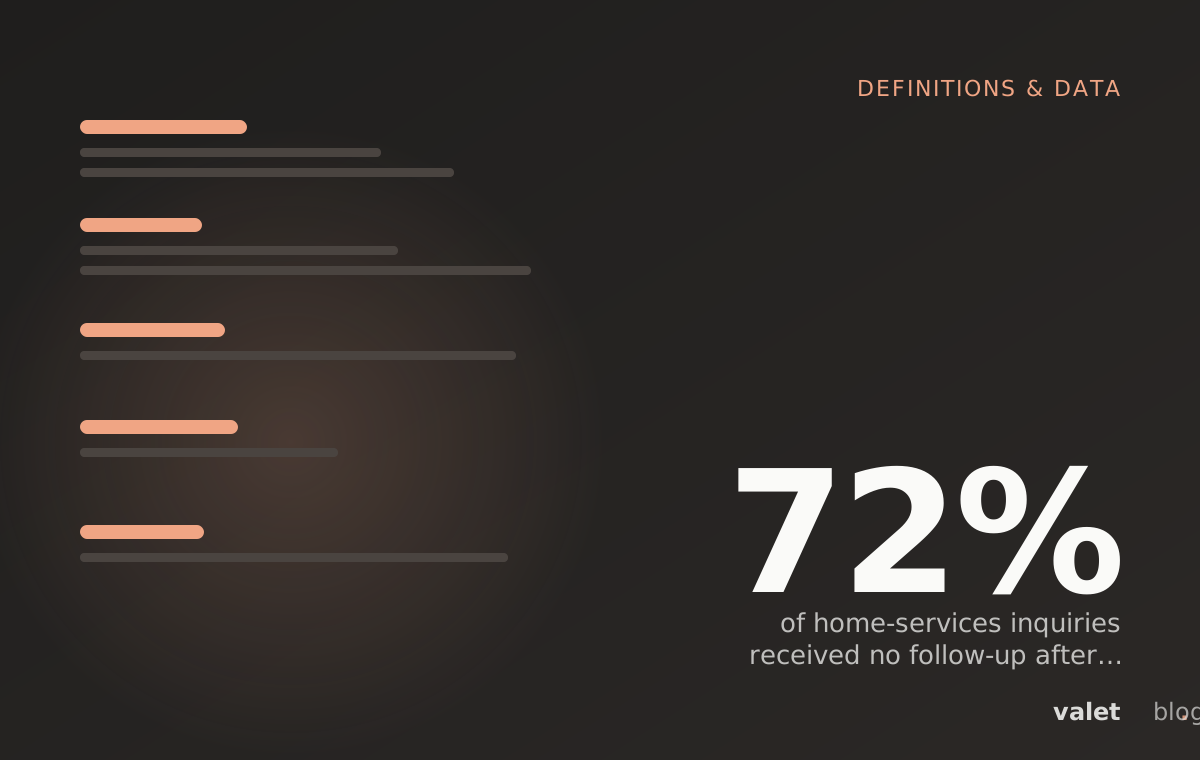
72%
of home-services inquiries received no follow-up after first contact
Pied Piper PSI, 3,211 inquiries, Apr 2026
58.6%
of replies to multi-step email sequences arrived after the first message
Belkins, 7.53M B2B emails, 2026
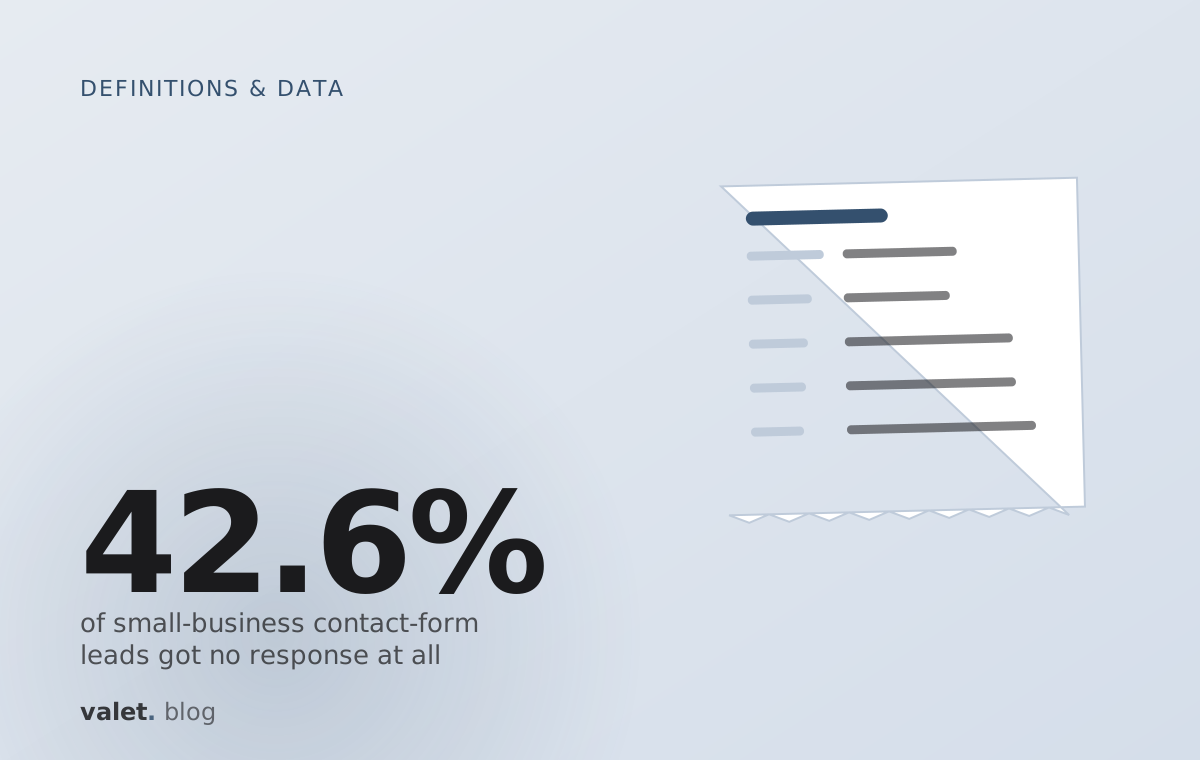
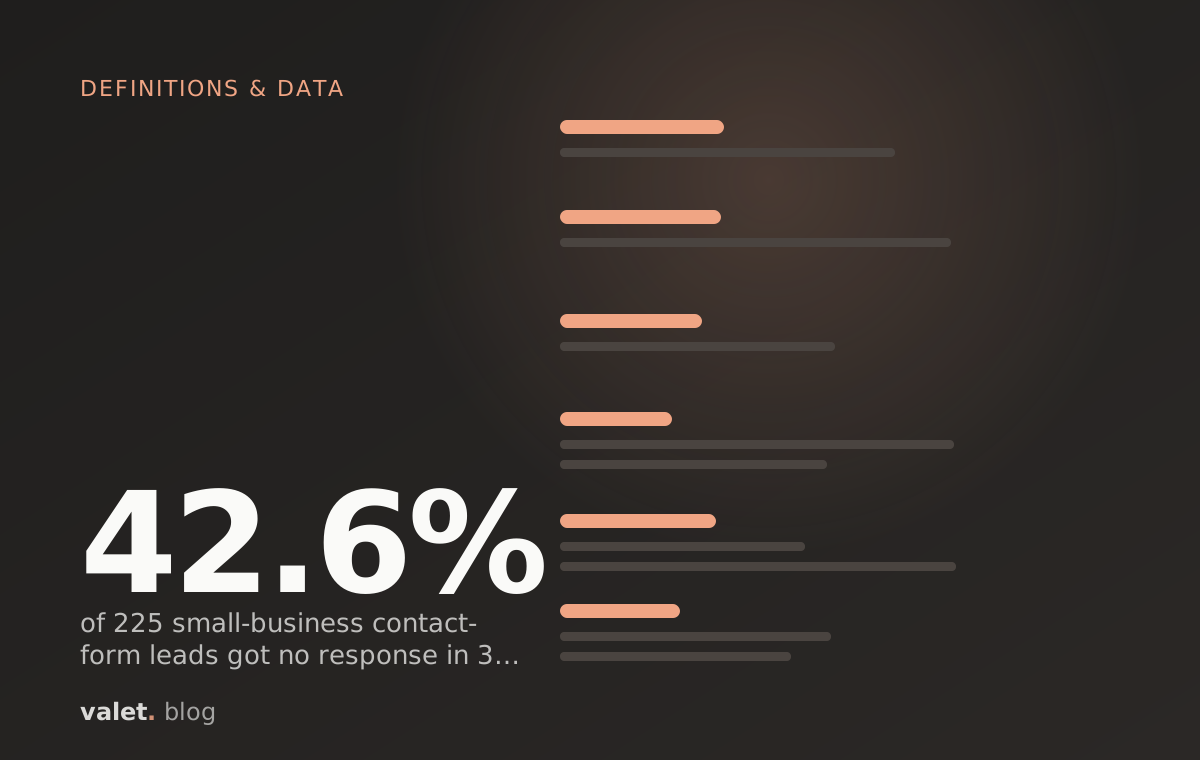
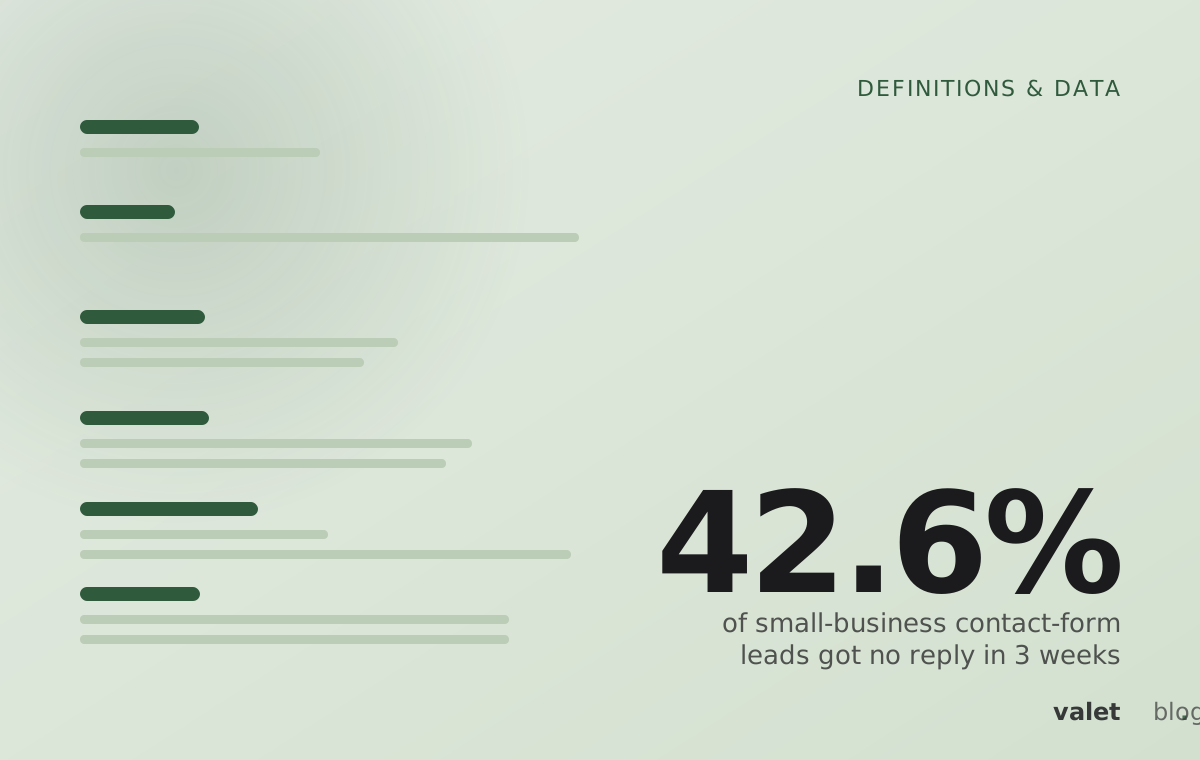
42.6%
of small-business contact-form inquiries never got a human reply
Leadferno, 225 forms, Jun 2024
Follow-through rate is the share of inquiries a business carries to an ending within a set window, usually 30 days. An ending means one of two things: the customer booked, or the inquiry was closed as lost with a recorded reason. The formula is short: booked plus lost-with-a-reason within N days, divided by all real inquiries. It matters because the loss sits after the first reply. Pied Piper's 2026 mystery-shop of 3,211 home-services inquiries found that 72% received no follow-up at all1. A business can answer every message fast and still leave most of them without an ending.
What is follow-through rate?#
Follow-through rate measures whether each inquiry reached a decision, not whether it received a message. It counts two endings as success. Booked is the obvious one. Lost with a reason is the less obvious one, and it counts because a closed inquiry with a reason is a finished piece of work: the customer was answered, followed up, and let go cleanly.
Four terms carry the definition:
- Real inquiry. A message from a person or their assistant asking about your service. Spam and vendor pitches are excluded before counting.
- Ending. Booked, or Lost with a reason from a fixed list (chose someone else, over budget, date taken, wrong fit, no response after follow-up). The full set of states is in the inquiry-state glossary.
- Window (N days). How long an inquiry has to reach an ending. We use 30 days as the default: long enough for a first reply, two spaced follow-ups and a decision, short enough to show a problem within a month.
- Open past the window. Anything still in Answered, Waiting or Needs owner after N days. These are the inquiries nobody finished.
An auto-reply is not an answer, and a lost inquiry with no reason is not an ending. Both rules exist because both are easy to fake on a dashboard.
Why first-reply rate looks good and tells you little#
First-reply rate counts inquiries that received an answering reply, divided by all inquiries. It is the number most tools report and most owners watch. It describes the first minute of a relationship that may need three weeks.
A thread in r/WeddingPhotography from about six months ago (140+ comments) shows the gap from the inside. A photographer asked for help because couples would not answer the initial inquiry reply. The poster's evidence of diligence was speed: "My response time is less than two hours." Speed was not the problem being reported. What happened after the reply was. One reply in the thread asked the question that matters: "How quickly are they receiving this response? Is it automated? Or do you send it manually?"
The same split shows up among people who build these systems. In r/CRMSoftware, in a thread about leads that arrive after hours (20+ comments, two days before this was written), the top answer describes the arrangement many businesses have settled into: "Automation for the first touch, real person for the follow-up". In r/gohighlevel (10+ comments, about a year old), the top answer to whether AI agents follow up was blunt: "Most AI agents won't follow up unless you set a specific step for that."
Put those together and the problem has a shape. The first reply is now automated, cheap and fast. The second and third messages still depend on a person who is, at that hour, doing the actual work.
Illustration A Tuesday in a flower studio. A florist is stripping thorns from a bucket of garden roses, the radio low, a cooler humming behind her. Her phone shows 4 new inquiries, all answered within the hour by her auto-reply and a quick personal note. Her CRM reports a 100% first-reply rate. Under that number sit 11 couples from last month who got a price list and have not written back. Each needs a different second message: one asked about August, one about peonies, one never said how many tables. She knows which is which. She has not had a free hour to write them.
What follow-through asks of the person doing it#
Follow-through is skilled work, and the skill is in the second message, not the first. A first reply can be built from a price list. A useful follow-up has to remember what this customer asked, notice what is still missing, and offer something that changes their decision: a held date, an answer to the question they did not repeat, a quote that expires on a named day.
Owners who do this well tend to describe it as housekeeping rather than selling. A top answer in an r/smallbusiness thread about a quote that went quiet (10+ comments, about five months old) puts it plainly: "Send the reminder. You're only 'bothering them' if they don't want it." Owners who avoid it describe a fear of seeming desperate. Both are reacting to the same fact: an empty "just checking in" carries nothing, and a follow-up with real content is a service.
The work also needs an exit. Closing an inquiry as lost with a reason is part of the craft, because it frees the owner from carrying it. A follow-through rate rewards that close as much as a booking, which is the point: it measures care for every inquiry, not only for the ones that pay.
How to calculate follow-through rate#
Follow-through rate is calculated over inquiries old enough to have had the full window. Count only inquiries that arrived at least N days ago, so recent ones are not counted as failures before they had a chance.
FOLLOW-THROUGH RATE (N = 30 days unless stated)

Definition
  Share of real inquiries that reached an ending within N days of arrival.
  Ending = Booked, or Lost with a reason from a fixed list.

Formula
  (Booked within N days + Lost with a reason within N days)
  ÷ real inquiries that arrived at least N days ago

Counting rules
  1. Exclude spam and vendor pitches before counting.
  2. An auto-acknowledgement is not an answer.
  3. "Lost" without a reason does not count as an ending.
  4. Anything still Answered / Waiting / Needs owner after N days
     counts against the rate.
  5. A revived inquiry is counted once, in the period it first arrived.

Report next to it
  First-reply rate  = inquiries with an answering reply ÷ real inquiries
  Booking rate      = Booked ÷ real inquiries
  Open past window  = still open after N days ÷ real inquiries

Provenance line for any statistic you quote
  Source · year of data collection · sample size · inbound or outbound
A worked example shows why the three numbers belong side by side. The figures are an illustration, not a real business.
| Measure | Count | Rate |
|---|---|---|
| Real inquiries | 40 | – |
| Received an answering reply | 38 | First-reply rate 95% |
| Booked within 30 days | 8 | Booking rate 20% |
| Lost with a reason within 30 days | 6 | – |
| Still open after 30 days | 26 | Open past window 65% |
| Follow-through (8 + 6) | 14 | Follow-through rate 35% |
The first-reply rate says the business is responsive. The follow-through rate says 26 customers are still waiting for someone to finish the conversation. Only the second number points at the work left to do.
What an unfinished inquiry is worth#
The cost of a low follow-through rate is the bookings hidden in the open column. Illustration Take a photographer with 10 inquiries a month, five of which go quiet after one reply and never get a follow-up. Assume 15% of those would have booked with two useful follow-ups. That is about nine bookings a year. At The Knot's 2026 average photographer spend of $3,0005, the open column is worth about $27,000 a year. Change the inputs to your own; the Lost Inquiry Calculator does the same arithmetic.
Which lead statistics to trust: 2007–2012 claims versus 2024–2026 counts#
Most lead statistics in circulation measure first-reply speed, and most of them are old or untraceable. That is part of why the industry watches first-reply rate: it is what the famous numbers describe. A provenance line separates the two eras.
| Claim | What it measures | Provenance | Use? |
|---|---|---|---|
| "21× / 100× more likely within 5 minutes" | First-reply speed | A 2007 study, often mislabelled "HBR 2011" | Retire |
| "391% more conversions within 1 minute" | First-reply speed | Velocify, about 2012 | Retire |
| "78% buy from the first responder" | First-reply speed | InsideSales, 2011; year drifts in repetition | Retire |
| 72% no follow-up; 28% offered an appointment | What happened after first contact | Pied Piper, 3,211 home-services inquiries, published Apr 20261 | Yes |
| 42.6% of contact-form inquiries never got a human reply | Whether a first reply happened | Leadferno, 225 small-business forms, Jun 20243 | Yes |
| 47% of online property inquiries unanswered | Whether a first reply happened | Mike DelPrete, real estate, Aug 20244 | Yes |
| 41.4% of replies from step 1; 58.6% from steps 2–6 | Where replies come from in a sequence | Belkins, 7.53M outbound B2B emails, 20262 | Yes, as direction (outbound, not inbound) |
The full trace of the older numbers is in lead-response statistics, traced to source. The pattern is the useful part: the old canon is about speed; the recent counts are about what happened next.
Is there a follow-through rate benchmark?#
No public study measures follow-through rate directly for small businesses, and we will not invent one. The recent counts bound it from the outside. If 72% of inquiries in a home-services sample got no follow-up1, few of the ones that went quiet after a first reply can have been closed with a reason. Support data points the same way: Gorgias' analysis of October 2025 to April 2026 found one-third of AI-touched tickets handed to a human never received a human reply6, which is an inquiry left open with nobody holding it.
A benchmark needs the denominator these studies lack: every inquiry, followed to its ending. Valet is collecting that through free lead checks, where an owner shares 10–20 recent inquiries and each one is sorted by how far it got. Any figure would come with its method and sample size before publishing any figure by segment.
What the number does not tell you#
A follow-through rate counts endings; it does not judge them. An inquiry closed as "over budget" counts the same as a booking, which is correct for measuring diligence and silent on whether your prices are right. Read it next to booking rate and your loss reasons, not alone.
It also does not make the work lighter. The florist in the illustration still has to know which couple asked about peonies. The number only tells her, on the first of the month, that 26 conversations are waiting for an ending, and which ones they are. What she does with the afternoon is still hers.
Where Valet fits#
Valet is built to raise follow-through rate on written inquiries. Every inquiry it handles has a state, a next step and a time under the Valet Inquiry States: New, Answered, Time held, Followed up, Booked, or closed with a reason logged. The Valet follow-up cap is two follow-ups by default, each carrying something useful such as a held time, a missing detail or a quote expiry; then Valet stops and tells the owner why. Money questions, complaints and anything not on the owner's facts go to the owner, and the customer is told when the owner will reply.
To see your own open column, the free lead check takes 10–20 recent inquiries and shows what went unanswered, what stopped after one reply, and what it was worth.
Questions people ask
What is follow-through rate?
Follow-through rate is the share of inquiries a business carries to an ending within a set window: either booked, or closed as lost with a recorded reason. An inquiry still sitting in "answered" or "waiting" when the window closes counts against it.
How do you calculate follow-through rate?
Take every real inquiry that arrived in a period, at least N days ago (30 is a sensible default). Count how many reached Booked or Lost with a reason within N days. Divide that count by the total. Exclude spam, and do not count an auto-reply as an answer.
Why is first-reply rate the wrong number to track?
First-reply rate measures only the first step, which many tools now automate. Most of the loss happens later: in Pied Piper's 2026 home-services study, 72% of inquiries got no follow-up. A business can reply to every inquiry and still leave most of them without an ending.
Is there a benchmark for follow-through rate?
Not yet. No public study measures it directly for small businesses. Related 2024–2026 counts (72% no follow-up, 42.6% of forms never answered) suggest many businesses would score low. Valet is collecting the inputs through free lead checks and will publish the method before any figure.
How many times is it acceptable to follow up with a lead?
Two or three times after your first reply, each with something new and useful, then close the inquiry with a reason. Closing with a reason is what makes follow-through rate countable.
Sources
Confidence: H primary source checked · M credible secondary or reported · L vendor claim or single report. Reddit and forum items are quoted from public threads and summarised, not endorsed.
- Precision Garage Door Ranked #1 in Customer Lead Handling Effectiveness Home Services Study (Pied Piper PSI 2026) · Pied Piper Management Company via BusinessWire · 2026-04-12 H
- Sales follow-up statistics · Belkins · 2026 M
- Research: Website contact forms and lead management, uncovering costly mistakes · Leadferno · 2024-06-28 H
- Secret shopping: 47% of online property inquiries are ignored · Mike DelPrete · 2024-08-13 H
- How much does a wedding photographer cost? (Real Weddings Study) · The Knot · 2026 H
- The cheapest ticket is the one a human never touches · Gorgias Ecom Lab · 2026 H
How to cite this page
Cite this page
Valet, "What is follow-through rate? (and why first-reply rate is the wrong number to track)", valet.team, October 2026.
Keep reading
 Definitions & dataHow to audit your last 90 days of inquiries: the Lost Lead Audit method, template and agency versionA spreadsheet, a handful of Gmail searches and five outcome labels will show you how many inquiries you never answered, how many stopped after one reply, and what they were worth.From the Valet team · 11 min · 1 October 2026
 Definitions & dataThe lead response statistics everyone quotes, traced to their sourceMost of the numbers on speed-to-lead pages are 2007 to 2014 vintage, misattributed, or invented. Here is the citation chain for each one, and the newer studies with a sample size you can name.Technical desk · 13 min · 1 October 2026
 Definitions & dataInbound inquiry response and follow-up statistics (2026), by verticalEvery number here names its sample, its channel and its year. The table shows which verticals have measured follow-up at all, and the one statistic nobody has published yet: inquiries answered once and then dropped.Playbooks · 8 min · 1 October 2026