
After the first reply
The Lost Inquiry Calculator: what unanswered emails, forms and marketplace leads cost you per year
Every lost-leads calculator we found counts missed phone calls. This one counts written inquiries, shows its formula, and tells you where the borrowed defaults stop being true for your business.
Short answer
Value each inquiry at your close rate times your average booking, then count three groups: inquiries never answered, inquiries answered once with no follow-up, and a conservative floor. Leadferno's 2024 test of 225 small-business forms found 42.6% got no reply, so a consultant with 8 inquiries a month, a 25% close rate and $6,000 projects has about $61,000 a year in unanswered inquiries alone. Replace every default with your own 90-day counts.
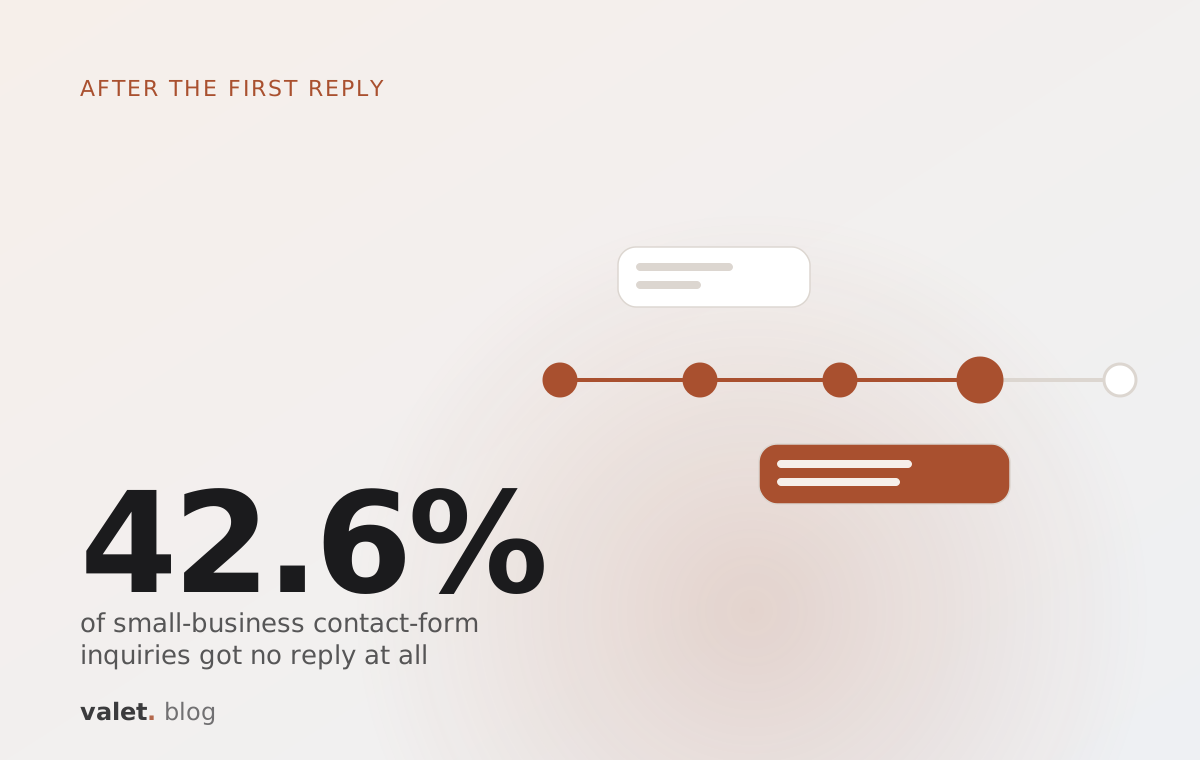
42.6%
of small-business contact-form inquiries got no reply at all
Leadferno, 225 forms, Jun 2024
$2,580
expected value of one qualified venue inquiry (1 in 5 books × $12,900)
Indigo Digital, Aug 2026; The Knot Real Weddings Study, 2026
$61k
a year in unanswered inquiries for a consultant at 8/month, 25% close, $6,000 projects
Valet arithmetic on Leadferno 2024 and Consulting Success 2026
The short version: an inquiry is worth your close rate times your average booking, and the cost of an unanswered inbox is that value multiplied by the inquiries nobody carried to an answer. Leadferno's 2024 test of 225 small-business contact forms found 42.6% got no reply at all5. For a consultant with 8 inquiries a month, a 25% close rate and $6,000 projects, that default alone puts about $61,000 a year in the unanswered pile. The rest of this article shows the formula, the worked cases, and the point where the defaults break.
A Thumbtack pro did this math by hand#
The thread on the Thumbtack Community forum was titled "What % of 'direct leads' actually end up booking you?"1 The pro who started it had counted. About 30 direct leads had come in. In the pro's words, "every single one has just vanished after 1 or 2 messages."
Others answered with their own ledgers. One had been charged $78 two days earlier "for a direct lead and the person doesnt even respond to a text." Another summed up the year in one line: "for every $5 I make, I pay $3."1 The thread's poll drew 13 votes; 9 of them (69%) picked "Most of my direct leads never reply, but I occasionally book one."1
What none of them had was the other half of the ledger: how many of those leads they had answered within the hour, how many they had written to a second time, and what each one would have been worth. They had a cost per lead. They did not have a value per inquiry.
Why existing lost-lead calculators don't fit written inquiries#
The lost-leads calculators that rank today were built for phones. Footbridge Media's, published 18 June 2025 for home-service trades, asks for three inputs: "Missed Calls Per Week," "Estimated Close Rate (%)" and "Average Job Value ($)."2 Others we found, for real estate and for lead response time, are also built around calls.
A written inquiry fails differently from a call. A call is missed or answered in the moment. An email or form inquiry can be answered the next afternoon, answered once and never followed up, or answered by an auto-reply that says nothing. The money leaks at each of those points, and a missed-call formula only sees the first.
The wedding trade has asked the right question without doing the arithmetic. Indigo Digital wrote in August 2026: "if even one in twenty qualified enquiries is lost purely because of a slow or absent response," the answer is "very often tens of thousands of dollars a year." The article shows no worked numbers3.
Vendors who pay for leads feel the gap most. A photographer's February 2025 BBB review, collected by The Knot Whistleblowers advocacy site, described an $8,000 annual contract that produced "one elopement and two weddings," with "No clear way to track ROI."4 Nobody in that review, or in the Thumbtack thread, could say how many inquiries went unanswered and how many went quiet after one reply. That is the spreadsheet that was missing.
How the Lost Inquiry Calculator works#
The Lost Inquiry Calculator values every inquiry the same way, then counts three groups. The value per inquiry is your close rate on answered inquiries times your average booking. The three groups are the ones a written inbox actually produces.
- Line A: never answered. Inquiries per year × share never answered × value per inquiry. Default share: 42.6% (Leadferno, 225 small-business forms, June 2024)5.
- Line B: answered once, no follow-up. Inquiries per year × share answered × share given one attempt only × value per inquiry × 0.5. Default: 57.4% answered and 65.5% one attempt only5. The half-weight is our assumption, explained below.
- Line C: the floor. Inquiries per year × 5% × value per inquiry. This is Indigo's "one in twenty" framing3, written out as arithmetic. It is the number to quote when someone says your estimate is too high.
Line A is the exposure from silence. Line B is the exposure from stopping too early. Line C is a floor that assumes almost everything else is fine.
Why Line B is half-weighted#
An inquiry that got one reply is not lost in the way an unanswered one is. Some of those customers book after one message. No public study measures how many inbound small-business inquiries would have booked with a second message. The nearest evidence is outbound: in a 2026 Belkins analysis of 7.53 million B2B emails, 58.6% of replies came after the first message10. That is cold email, not an inbound inquiry, so we use it only to justify a round half-weight rather than a full one. If your own data says otherwise, change it.
Where the defaults broke: the venue that "lost" $330,000#
The first time we ran the worksheet on a venue preset, it produced a number nobody would believe. The inputs were defensible. Indigo Digital's benchmark guide says about 1 in 5 qualified venue enquiries books, and that a venue booking 60 weddings a year needs about 300 qualified enquiries6. The Knot's 2026 Real Weddings Study, 10,474 couples, puts the average reception venue at $12,9007. That gives $2,580 of expected value per qualified inquiry.
Then Line A ran: 300 × 42.6% × $2,580 ≈ $329,700 a year of unanswered inquiries. For a venue whose 60 bookings bring in about $774,000, that means ignoring 128 qualified couples a year while still booking 60. That may be true of some venue somewhere. The default cannot tell you whether it is true of yours.
The failure was not in the arithmetic. It was in the borrowed rate. Leadferno tested home-service, professional-service and medical businesses that ranked in the top 10 of Google's local results, and tracked replies by email, phone and text for three weeks5. None of them were wedding venues. A venue with a dedicated sales coordinator may answer 95% of inquiries; a solo photographer shooting every Saturday may answer 60%. The 42.6% is a measured rate for someone else's inbox.
A second snag sat inside Line B. Leadferno reports "65.5% making just one attempt" without stating the denominator5. Since 42.6% got nothing, 65.5% cannot be a share of all inquiries, or the two would add to more than 100%. We read it as a share of the businesses that replied. That is an inference, and the worksheet labels it as one.
Rule from the venue run. A default rate is a placeholder until you have counted your own. If Line A is larger than your annual revenue would allow, your answered share is higher than 57.4%; replace it before you show the number to anyone.
Worked examples: venue, photographer, consultant#
The presets below use sourced prices and labelled assumptions. Close rates other than the venue's are assumptions, because we found no reliable public close rate for photographers or consultants. Inquiry volumes are illustrations.
| Preset | Inquiries / yr | Close rate | Average booking | Value per inquiry | Line A | Line B | Line C (floor) |
|---|---|---|---|---|---|---|---|
| Wedding venue | 300 (Indigo example)6 | 20% (Indigo, ~1 in 5)6 | $12,900 (The Knot 2026)7 | $2,580 | $329,700 | $145,500 | $38,700 |
| Photographer, typical couple | 60 (assumed) | 20% (assumed) | $3,000 (The Knot 2026)7 | $600 | $15,300 | $6,800 | $1,800 |
| Photographer, established | 60 (assumed) | 20% (assumed) | $5,800 (Fearless, 138 pros, 2025)8 | $1,160 | $29,600 | $13,100 | $3,500 |
| Solo consultant | 96 (8 a month, assumed) | 25% (assumed) | $6,000 (Consulting Success low tier)9 | $1,500 | $61,300 | $27,100 | $7,200 |
Values rounded to the nearest $100. Consulting Success's 2026 study of nearly 1,000 consultants gives illustrative project tiers of $6K, $12K and $24K and reports 52% of specialists charge $10K+ per project9; the $6,000 tier is the conservative choice.
Read the table by column, not by row total. Line A and Line B overlap with the floor and should not be added to it. For the consultant, the useful sentence is: at default rates, about $61,000 a year sits in inquiries that never got a reply, another $27,000 in inquiries that got one reply and nothing else, and even the floor is $7,200.
We left accountants, coaches and tutors out of the presets on purpose. The fees we found for them were single anecdotes or uncited ranges, and a preset built on those would look more precise than it is. Use your own average fee.
The Lost Inquiry Calculator worksheet#
The worksheet below is the whole calculator. It fits in one spreadsheet tab, and every default has a "your number" column beside it, because the venue run showed what happens when the defaults stay in.
| Cell | Input or line | Default | Your number | Formula |
|---|---|---|---|---|
| B1 | Written inquiries per year (email, forms, listing and marketplace emails) | none | count last 90 days × 4 | input |
| B2 | Close rate on answered inquiries | venue 20%; others: your own | booked ÷ answered | input |
| B3 | Average booking value ($) | The Knot 2026 by category; Consulting Success tiers | from your price list | input |
| B4 | Value per inquiry ($) | =B2*B3 | ||
| B5 | Share never answered | 42.6% (Leadferno 2024) | your count ÷ B1 | input |
| B6 | Share of answered given one attempt only | 65.5% (Leadferno 2024; denominator inferred) | your count ÷ answered | input |
| B7 | Line A: never answered ($/yr) | =B1*B5*B4 | ||
| B8 | Line B: answered once, no follow-up ($/yr) | half-weight 0.5 (assumption) | =B1*(1-B5)*B6*B4*0.5 | |
| B9 | Line C: floor ($/yr) | 5% (Indigo "one in twenty") | =B1*0.05*B4 | |
| B10 | Sanity check | If B7 > one year's revenue, re-count B5 |
Sources for defaults: Leadferno, 225 forms, June 20245; Indigo Digital, August 202636; The Knot, 20267; Consulting Success, 20269. Line B's half-weight is a Valet assumption.
How to get your own numbers in an afternoon#
The worksheet's defaults are there to start the conversation; your last 90 days end it. The counts that matter are short, and most owners can pull them from Gmail searches and a sent folder.
- Count inquiries by source. Search for form notifications, listing and marketplace lead emails, and direct inquiries. Write the 90-day total in B1 (times four for a year).
- Mark each one. Never answered; answered once with no follow-up; answered more than once; booked. Leave nothing unmarked; an inquiry you are unsure about is usually "never answered".
- Compute your close rate. Booked ÷ answered. This is the most honest value of an inquiry you have.
- Put the three lines side by side. If Line B is larger than Line A, your problem is follow-up, not first replies. In Pied Piper's 2026 mystery shop of 3,211 home-services inquiries, 72% got no follow-up at all11, so this is a common result.
The full method, with Gmail search strings and the five outcome labels, is in the Lost Lead Audit. If Line A is your largest line and form inquiries are a big share of it, check whether your form is delivering at all; the contact-form leak covers that. If Line B dominates, how many times to follow up sets out a capped standard.
What the Thumbtack pro could have known#
The pro with 30 vanished direct leads knew the cost per lead to the dollar. With this worksheet the pro would also know whether those leads went quiet after the first message or the second, and what each was worth at the pro's own close rate. That turns "are these leads fake?" into a question the ledger can answer: how many got a second message with something new in it, and how many of those booked.
We do not yet have a published distribution of those outcomes for written inquiries. Valet is collecting it as inquiries move through the Valet Inquiry States, and the defaults in this worksheet will be replaced with measured rates, with their method, when the sample supports it.
Where Valet fits#
Valet answers email, website-form and listing inquiries from the owner's own price list, packages, calendar and policies, offers and holds real times, and follows up at most twice by default, each time with something useful. Every inquiry has a state, a next step and a time, so Lines A and B stop being estimates and become counts. Money questions, complaints and contracts wait for the owner.
If you would rather not build the spreadsheet, the free lead check runs this calculation on real messages: forward 10–20 recent inquiries, or show them on a call, and see what went unanswered, what stopped after one reply, and what it was worth.
Questions people ask
How much do missed leads cost a small business?
Multiply the inquiries you did not answer by your close rate and your average booking. At Leadferno's 2024 rate of 42.6% unanswered, a consultant with 8 inquiries a month, a 25% close rate and $6,000 projects leaves about $61,000 a year unanswered. Your own 90-day count will be more accurate than any default.
How much is a wedding lead worth?
A qualified venue inquiry is worth about $2,580 in expected value if 1 in 5 books (Indigo Digital, 2026) at The Knot's 2026 average venue spend of $12,900. A photographer inquiry at a 20% close rate is worth about $600 at The Knot's $3,000 average, or $1,160 at the $5,800 average from a 2025 survey of 138 established photographers.
Is there a lost leads calculator for emails and contact forms?
The calculators we found, such as Footbridge's (June 2025), count missed phone calls. The worksheet in this article counts written inquiries: never answered, answered once with no follow-up, and a conservative floor.
Why does the calculator give such a large number for my business?
The default rates come from Leadferno's 2024 test of home-service, professional and medical businesses, not from your inbox. If you answer most inquiries, the 42.6% default overstates your loss. Replace it with your own share of unanswered inquiries from the last 90 days.
Sources
Confidence: H primary source checked · M credible secondary or reported · L vendor claim or single report. Reddit and forum items are quoted from public threads and summarised, not endorsed.
- What % of 'direct leads' actually end up booking you? · Thumbtack Community · undated (retrieved 2026-10) M
- Lost Leads Calculator · Footbridge Media · 2025-06-18 M
- The real cost of a missed enquiry · Indigo Digital · 2026-08-03 L
- Vendor complaints archive (BBB reviews and petition comments) · The Knot Whistleblowers (advocacy site) · 2025–2026 M
- Research: Website contact forms and lead management, uncovering costly mistakes · Leadferno · 2024-06-28 H
- Wedding venue lead benchmarks guide · Indigo Digital · 2026-08-03 M
- Average wedding vendor costs (Real Weddings Study 2026, n=10,474) · The Knot · 2026-09-29 H
- 2025 USA wedding photography prices · Fearless Photographers · 2025 H
- Consulting Fees Study 2026 · Consulting Success · 2026-09-07 H
- Sales follow-up statistics · Belkins · 2026 M
- Precision Garage Door Ranked #1 in Customer Lead Handling Effectiveness Home Services Study (Pied Piper PSI 2026) · Pied Piper Management Company via BusinessWire · 2026-04-12 H
How to cite this page
Cite this page
Valet, "The Lost Inquiry Calculator: what unanswered emails, forms and marketplace leads cost you per year", valet.team, October 2026.
Keep reading
 After the first replyThe first reply is now free. The follow-up is where 72% of leads die.Meta, Google and the inquiry tools now answer the first message for you. The money is lost in the days after it, and almost nobody sells that part.From the Valet team · 11 min · 1 October 2026
 After the first replyHow many times should you follow up with a lead before you stop?A written standard for following up on inbound inquiries: what counts as a follow-up, what each nudge must contain, when the sequence must stop, and how to close a lead with a reason instead of letting it fade.Policy desk · 11 min · 1 October 2026
 After the first replyWhy leads go silent after you send a quote (and what it actually means)Silence after a quote is usually read as a verdict on price. The base rates say it is more often an unfinished conversation, and the thread itself carries signals that tell you which kind you have.Trends desk · 9 min · 1 October 2026