
Weddings & events
Why couples ghost after you send pricing, and what the second message should say
The usual answers are price, a hidden price list, or a slow reply. The bigger leak is that most vendors send one reply and stop, while the couple is still choosing between five of you.

Short answer
Couples usually go quiet after pricing because they asked about five vendors in your category at once (WeddingPro, 'From Hello to Hired') and silence is how they defer or decline, not because every quiet couple found you too expensive. Most vendors then send nothing else: in adjacent small-business studies, 65.5% made one attempt (Leadferno 2024). The second message should add something new, such as a held date with an expiry or one missing detail, and a third should close politely.
5
vendors per category couples reach out to, on average
WeddingPro, From Hello to Hired
2.2x
more likely couples reply when vendors answer in under 3 hours
WeddingPro, From Hello to Hired
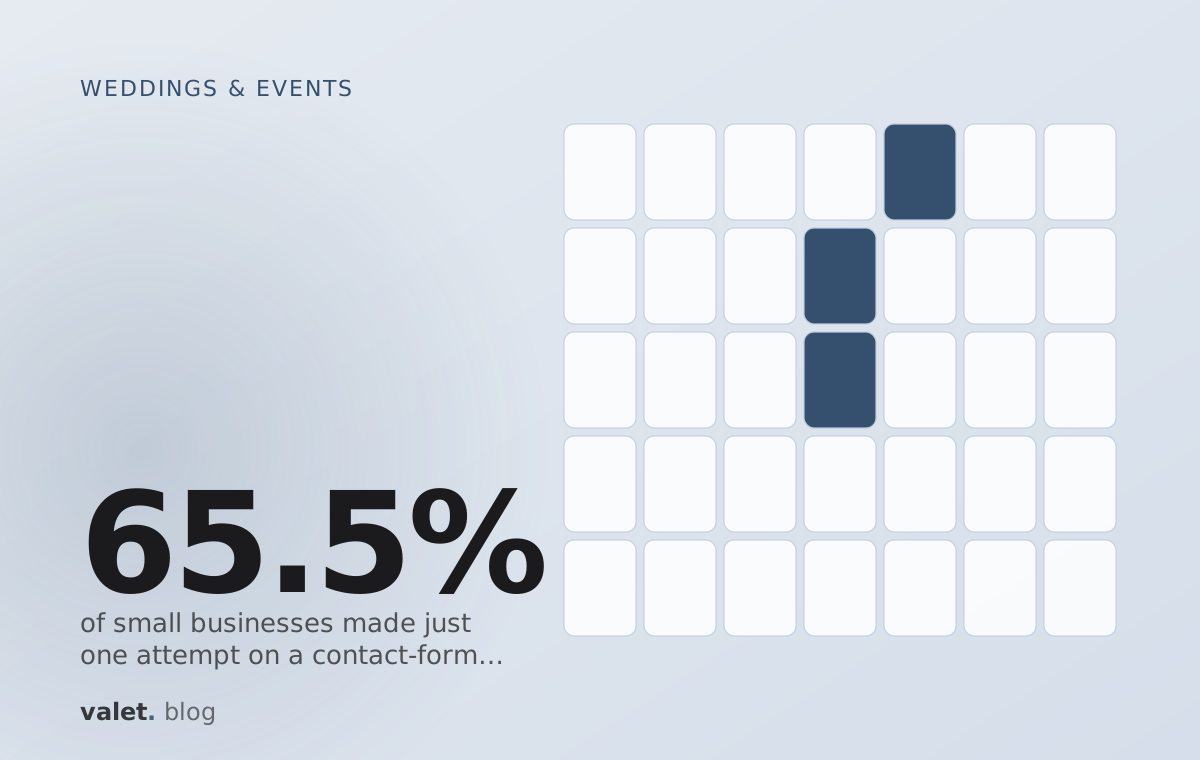
65.5%
of small businesses made just one attempt on a contact-form lead
Leadferno, 225 forms, June 2024
Couples usually go quiet after pricing because they asked about five vendors in your category at the same time1, and silence is how most of them say "not yet" or "someone else". Price explains some of those silences. It does not explain the pattern. The larger leak sits on the vendor side: in small-business contact-form tests, 65.5% of businesses made just one attempt12. The second message, sent two to three days later with something new in it, is where the comparison gets decided. A third message should close the loop politely.
Why couples ghost after pricing: the consensus answer#
The consensus on wedding-inquiry ghosting has three parts, and each part has a respectable case behind it. Stated fairly, it runs like this.
First, you were too expensive. A couple opened the PDF, saw a number above the one in their head, and felt awkward saying so. A UK venue-owner community made the argument plainly in January 2025: "If a couple does enquire and then discovers the pricing is far above what they anticipated, they may feel embarrassed or disheartened and choose to avoid further communication"3. WeddingPro's own report says 77% of couples call pricing the most important factor they weigh before contacting a vendor1.
Second, the pricing was in the wrong place. If prices were on your site, the couples who could not afford you would never have written; if they were hidden, the couples who wrote were partly asking "what does this cost?" and left once they knew. The industry's best-known sales speaker, Alan Berg, advises answering a pricing question with "a price range" and a request "for more details"4.
Third, you were too slow. WeddingPro reports that replying in under three hours makes couples 2.2x more likely to reply1, and Thumbtack found pros replying within 30 minutes were 25% more likely to be hired than those replying within three hours5.
All three are true some of the time. Hence the durability.
Why smart vendors believe the consensus#
Vendors believe the price-and-speed explanation because both variables are visible, controllable and cheap to change, while the variable that matters most is invisible in a normal inbox. A photographer can see her price list and her reply timestamp. She cannot see that the couple sent the same templated form to four other photographers on the same evening, or that two of those four sent a second message on Thursday.
The incentives point the same way. Marketplaces publish response-time targets because response time is the one vendor behaviour their systems can measure; what happens on day four of an email thread is outside their view. Each actor is optimising the step it can observe, which is a local optimum, not a strategy.
There is also a coordination cost the vendor never sees priced. Following up on 40 silent couples by hand, with a different note for each, takes real evenings. Rewriting a pricing page takes one afternoon and feels like action. When the expensive fix is invisible and the cheap fix is visible, rational people pick the cheap fix. Then the silences continue, and the conclusion hardens: "couples are flaky", or worse, "these leads are fake".
That last conclusion is now common enough that The Knot Worldwide addressed it in April 2025, listing ghosting as one of the reasons vendors misread real leads: "when couples don't respond after initial contact, vendors perceive them as fake"2.
The cracked assumption: silence is not a verdict#
The consensus rests on one assumption that does not hold: that a couple's silence after pricing is a decision. Silence is a state. A couple who reached out to five photographers1 has five threads open, and most will end without an explicit no, because writing four polite rejections is a chore nobody planned for.
Couples say this themselves. A thread in r/weddingplanning titled "Why do couples ghost vendors?" (90+ comments, about three years old) suggests that planning a wedding is the first big project many couples have run, and they lack the habit of "sending out rejection emails". A thread in r/Weddingsunder10k (20+ comments, about a month old) puts the other side: "If I have to send a vendor an inquiry to know what their starting prices are", the inquiry is not a commitment. A photographer-CRM vendor, Studio Ninja, writes that ghosting "typically occurs after the vendor's reply, not at initial contact"6.
The second crack is on the vendor side: there is no stop rule. Published advice spans "As many times as it takes"9, "follow up at least one more time than you are now"10, and "4-7 touchpoints"11. A reply in r/weddingvideography (9 comments, about seven years old) states the logical end point: keep contacting them until they say no. Without a stop rule, most vendors pick the only rule that feels safe, which is to send nothing after the pricing reply. The measured result in adjacent small-business segments is one attempt and done12.
Put the two cracks together and the second-order effect appears. If the couple is holding five open threads and four vendors send one reply each, the vendor who sends a useful second message is no longer competing on price or speed. That vendor is competing against nobody.
The alternative mechanism, in one sentence#
A couple's silence after pricing is a place in a queue, and the vendor who sends a second message with new information, then a clear close, converts that place into a decision while the other vendors wait for a reply that is never coming.
The booking itself is a zero-sum trade-off: one photographer per wedding. The follow-up is not. A second message costs the couple ten seconds and costs the vendor almost nothing, but it moves the vendor from "one of five" to "the one still talking to us".
Three lines of evidence, weakest first#
The weakest line is couples' own testimony, and it still points one way. On WeddingWire's forums, couples describe judging vendors by follow-through: "If a vendor doesn't contact within a week I just move on" (July 2019)7; "If they don't respond after 5 business days, move on to some place else" (May 2024)8. Couples apply a stop rule to vendors. Vendors rarely apply one to couples. On r/WeddingPhotography, a widely upvoted thread (60+ comments, 668 upvotes, about two years old) draws the line where most vendors would: "Ghosting an inquiry is fine." What stings is silence after a couple has asked for the contract.
The middle line is platform data about how couples shop. WeddingPro reports 5 vendors contacted per category and a 2.2x reply lift for answers under three hours1. Both numbers describe a comparison under way, not a verdict delivered. A couple who replies to some vendors and not others is ranking them, and rankings move.
The strongest line is measured follow-through, from adjacent small-business studies with stated samples. Leadferno tested 225 small-business contact forms in 2024: 42.6% got no response at all, and 65.5% of businesses made just one attempt12. Pied Piper's 2026 mystery shop of 3,211 home-services locations found no follow-up at all 72% of the time13. Belkins' analysis of 7.5 million B2B emails sent in 2025 found follow-ups produced 58.6% of all replies14. None of these is a wedding study, and cold B2B email is not a couple's inquiry. But they agree on the shape: most replies that ever arrive come after the first message, and most businesses never send a second one. No published study yet measures this for wedding vendors; for the wider statistics and their provenance, see the lead response statistics, traced.
The money is easy to underestimate. Indigo Digital estimates about 1 in 5 qualified venue enquiries books, so 60 weddings a year needs about 300 qualified enquiries18, and asks what it costs if even one in twenty is lost to a slow or absent response19. As an inference, at The Knot's 2026 average venue spend of $12,90015: 300 × 5% × 20% × $12,900 ≈ $38,700 a year for one venue.
Where the consensus still wins#
The price explanation wins when your price is far from the couple's budget, and no second message fixes that. The Knot's 2026 study puts the average photographer spend at $3,000, with quartiles of $1,500, $2,800 and $4,70015; a 2025 survey of 138 established photographers found an average of $5,80016. A photographer at $6,000 answering couples who budget near the median will see silence that is a verdict. Range-first replies, as Berg recommends, filter those couples early and save both sides an awkward thread.
The speed explanation wins when your first reply is slow. If your median first reply runs past three hours, fix that before writing a single follow-up; the 2.2x figure applies to the first message1.
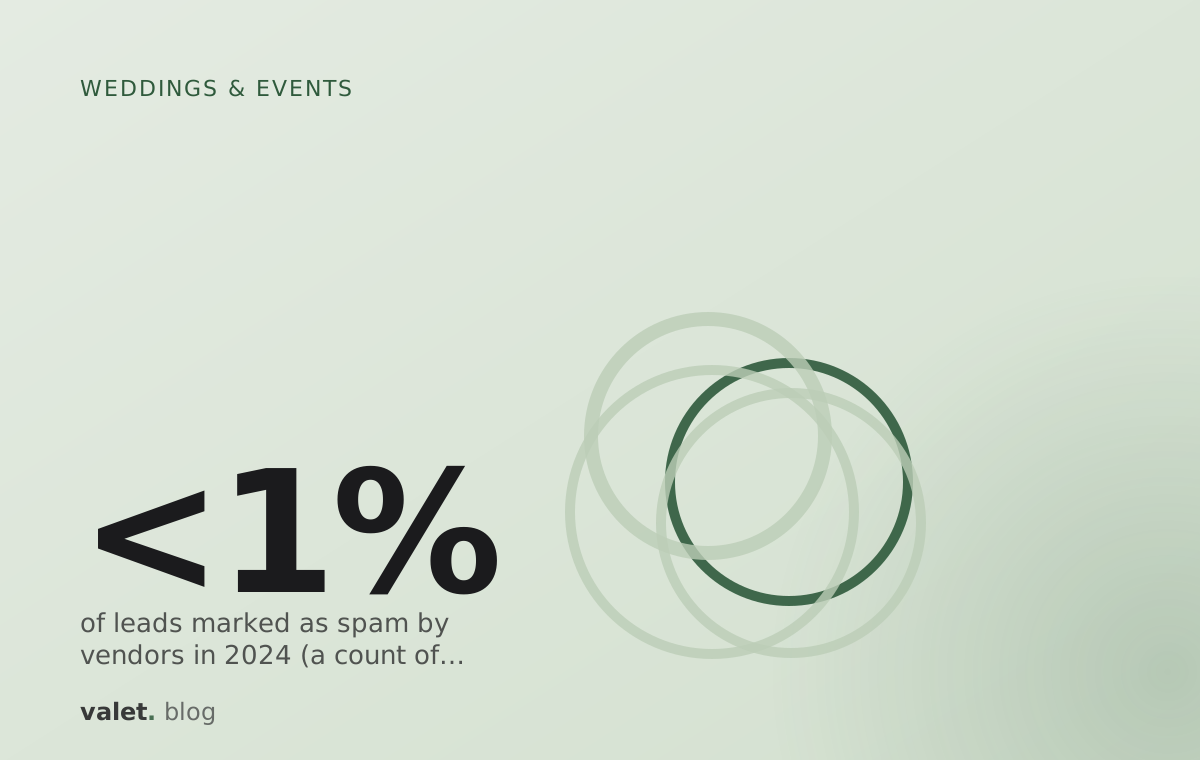
The "fake lead" explanation sometimes wins too. WeddingPro says less than 1% of leads were marked spam by vendors2, while Sen. Grassley's October 2025 letter to the FTC cites nearly 200 whistleblower complaints about lead legitimacy17. An inquiry with no date, no venue and no name may have no couple behind it. Send it one follow-up, not two.
What the second message should say: templates by situation#
The second message works when it gives the couple something they did not have after the first: a held date with an expiry, an answer to the question they did not ask, a smaller option that already exists on your list, or a single question with a reason attached. "Just checking in" adds nothing, so it reads as pressure. The third message closes the loop and releases the date. Edit the bracketed parts.
SITUATION A: Pricing sent, no reply after 2-3 days (photographer, DJ, florist, planner)
Subject: [Date] - I can hold it until [day]

Hi [names],

Quick follow-up on the pricing I sent on [day]. [Date] is still open on my
calendar, and I can hold it for you until [day, time] while you compare.

One thing couples often ask after seeing packages: [answer, e.g. "the
8-hour package includes the engagement session" / "travel within 30 miles
is included"].

If it helps, reply with your guest count and venue and I'll tell you which
package fits without anything you don't need.

[Your name]


SITUATION B: Venue, pricing sent, no tour booked
Subject: Two tour times for [venue name]

Hi [names],

Following up on the pricing for [date]. The easiest way to decide is to
see the space. I have [day, time] or [day, time] open for a 45-minute
tour. Reply with whichever works and I'll send a calendar invite.

[Date] is currently available; I can hold it until [day] if you'd like.

[Your name]


SITUATION C: You sent a range; the couple never gave date, guest count or location
Subject: One detail so I can give you a real number

Hi [names],

The range I sent is wide because it depends on [guest count / hours /
location]. If you send me that one detail, I'll reply with the exact
package price, so you can compare like for like.

[Your name]


SITUATION D: The couple said "send the contract", then went quiet
Subject: Your contract for [date]

Hi [names],

Sending the contract again in case it got buried: [link]. Your date is
held until [day, time]. After that I'll release it, since another couple
has asked about the same weekend. [Only include this line if it is true.]

Any questions about [deposit / payment schedule / cancellation], just
reply here and I'll answer them.

[Your name]


SITUATION E: The couple said the price was "a bit over budget", then went quiet
Subject: A smaller option for [date]

Hi [names],

You mentioned the [package] was over budget. [Smaller package name] is
[price] and covers [what's included]; the main difference is [what's left
out]. If that's closer, I can hold [date] for you until [day].

[Your name]
(Only offer packages that already exist on your price list. Discounts
are the owner's call, not the template's.)


THIRD MESSAGE (any situation): about a week after the second, then stop
Subject: Releasing [date]

Hi [names],

I haven't heard back, so I'll assume you've found the right fit and
release [date] on [day]. No need to reply. If anything changes, write
back here and I'll check the calendar for you.

Congratulations again, and good luck with the planning.

[Your name]

(Log the lead as lost, with a reason: no reply / booked elsewhere /
budget / date taken. That log is your next audit.)
The third message matters more than it looks. It ends the thread on your terms and gives the couple a no-effort exit, and a release notice is the one message that asks for nothing. More on cadence and caps in how many times to follow up with a lead.
The decision inversion table#
The decision inversion table pairs each consensus move with the assumption underneath it and the move that follows if the assumption is wrong. It also says when to keep the consensus move anyway.
| Consensus move | Assumption under it | Inverted move | Keep the consensus when |
|---|---|---|---|
| Cut the price or send a discount after silence | Silence is a price verdict | Send a second message with new information first; offer an existing smaller package only if they mentioned budget | Couples tell you the number is out of range, repeatedly |
| Hide prices and push to a call | A number scares couples off | Give a real range in the reply, plus one question back | Every package is fully custom and a range would mislead |
| Reply faster | Speed is the only lever | Keep fast first replies and schedule the second and third messages | Your median first reply is over 3 hours |
| Follow up until they say no | Persistence alone wins | Two follow-ups with substance, then a release message and a logged reason | The couple asked you to check back on a set date |
| Write off silent leads as fake | Silence means no real couple | Treat silence as a state with a next step and a date; mark lost only after the close | The inquiry has no date, venue or name |
Where this argument would be wrong, and the Monday-morning decision#
This argument fails if a vendor sends a useful second and third message on 20 consecutive silent pricing inquiries and gets no replies at all, not even a no. That result means price or fit is the binding constraint for that business, and the consensus answer is the right one. It also fails if the vendor's own records show that most silent couples already received two or more follow-ups; then the leak is elsewhere.
The Monday-morning decision is a 30-minute audit. Pull your last 20 pricing inquiries and sort them into three piles: never answered, answered once and dropped, and followed up at least twice. If the middle pile is the biggest, the second message is your cheapest booking, and the templates above are the place to start. The full method is in the 90-day Lost Lead Audit.
Where Valet fits#
Valet is an AI assistant for a small business's written inquiries, including directory and marketplace lead emails, website forms and email to your own address. It answers from your own price list, packages and calendar, offers real tour or consult times and holds them, and follows up at most twice by default, each time with something useful such as a held date or a missing detail. Then it stops and tells you why. Discounts, deposits and contracts wait for you. Every reply is signed as your assistant and says it is AI.
To see your own three piles without doing the sorting, start with the free lead check: forward 10 to 20 recent inquiries and see what went unanswered, what stopped after one reply, and what it was worth.
Questions people ask
Why do couples stop replying after I send my wedding pricing?
Couples contact about five vendors per category on average (WeddingPro), so most pricing replies land in a comparison, not a decision. Silence usually means 'not yet' or 'someone else', and many couples never send a no. Price is one cause; it is not the only one.
How long should I wait before following up on a wedding pricing email?
Send the second message two to three days after the pricing reply, and the third about a week after that. Each one should carry something new, such as a held date with an expiry, an answer to the question they did not ask, or a smaller package that is already on your list.
Should I lower my price if couples ghost after pricing?
Not as a first move. Discounting assumes silence was a price verdict. Send a useful second message first; offer an existing smaller package only if the couple said budget was the issue, and keep discounts as the owner's decision.
When should I stop following up with a wedding inquiry?
After two follow-ups with no reply, send a short close that releases the date and leaves the door open, then log the lead as lost with a reason. Endless 'just checking in' messages cost goodwill and tell you nothing.
Sources
Confidence: H primary source checked · M credible secondary or reported · L vendor claim or single report. Reddit and forum items are quoted from public threads and summarised, not endorsed.
- From Hello to Hired: your guide to lead replies · WeddingPro · undated H
- Taking action on feedback · WeddingPro (The Knot Worldwide) · 2025-04-02 H
- The link between ghosting and Price on Application for wedding venues · Coco Wedding Venues · 2025-01-27 M
- Lead reply questions with Alan Berg · WeddingPro · 2023-06-23 M
- 3 takeaways from the 2025 Pro Summit · Thumbtack · 2025-11-06 H
- Why couples ghost wedding vendors · Studio Ninja · undated L
- Why are vendors so hard to contact? · WeddingWire forums · 2019-07-22 H
- Love a venue but can't get a response · WeddingWire forums · 2024-05-21 H
- Following up leads · Easy Weddings Pro · 2019-11-29 M
- Your questions about lead replies, answered · WeddingPro (Alan Berg) · 2023 M
- Wedding inquiry follow-up guide · Davey & Krista · 2026-04-14 L
- Research: website contact forms and lead management, uncovering costly mistakes · Leadferno · 2024-06-28 H
- Precision Garage Door Ranked #1 in Customer Lead Handling Effectiveness Home Services Study · Pied Piper Management Company via BusinessWire · 2026-04-12 H
- Sales follow-up statistics · Belkins · 2026-06-26 M
- Average wedding vendor costs (Real Weddings Study, n=10,474) · The Knot · 2026-09-29 H
- 2025 USA wedding photography prices · Fearless Photographers · 2025 H
- Grassley presses FTC to investigate alleged fraud, deceptive business practices at wedding website The Knot · Office of Sen. Chuck Grassley · 2025-10-22 H
- Wedding venue lead benchmarks guide · Indigo Digital · 2026-08-03 M
- The real cost of a missed enquiry · Indigo Digital · 2026-08-03 L
How to cite this page
Cite this page
Valet, "Why couples ghost after you send pricing, and what the second message should say", valet.team, October 2026.
Keep reading
 Weddings & events"Our leads from The Knot / WeddingWire never respond": ghost leads, fake leads, or leads nobody followed up?Vendors say the leads are fake. The Knot says they are templated and ghosted. A U.S. senator has asked the FTC to look. None of them has published what happened to each inquiry, and that is the only record that settles it for your listing.Policy desk · 10 min · 1 October 2026
 Weddings & eventsHow many times should you follow up with a couple who hasn't replied? (And when the lead is dead)Wedding advice runs from "one more time than you are now" to "as many times as it takes". Nobody says when to stop. Here is a stop rule, a list of lost reasons, and the three messages that sit between the first reply and the end.People at work · 11 min · 1 October 2026
 Weddings & events"Why are wedding vendors so hard to reach?" Where your inquiry goes, when to move on, and the 2026 mystery-shop methodMost wedding vendors are one or two people who are at someone else's wedding when your message arrives. Here is where your inquiry goes, what mystery shops in other trades found, when to move on, and how the first wedding-specific shop is being run.Explainers · 9 min · 1 October 2026