
Independent professionals
Discovery-call no-shows for consultants and coaches: real rates, why they happen, and what actually fixes them
A no-show is the last visible failure in a booking path that broke earlier. This piece traces that path stage by stage, separates the sourced numbers from the recycled ones, and ends with a policy and recovery sequence you can copy.
Short answer
There is no reliable public no-show rate for discovery calls. The widely repeated 20–40% for free coaching calls is uncited (Talkspresso, 2026), and an aggregator's ~18% for professional consultations gives no year. Most no-shows trace to earlier stages: questions left unanswered before the slot, a confirmation that landed in junk, a time never confirmed by reply. Fix those, send one recovery message with two new times, then close the inquiry with a reason.
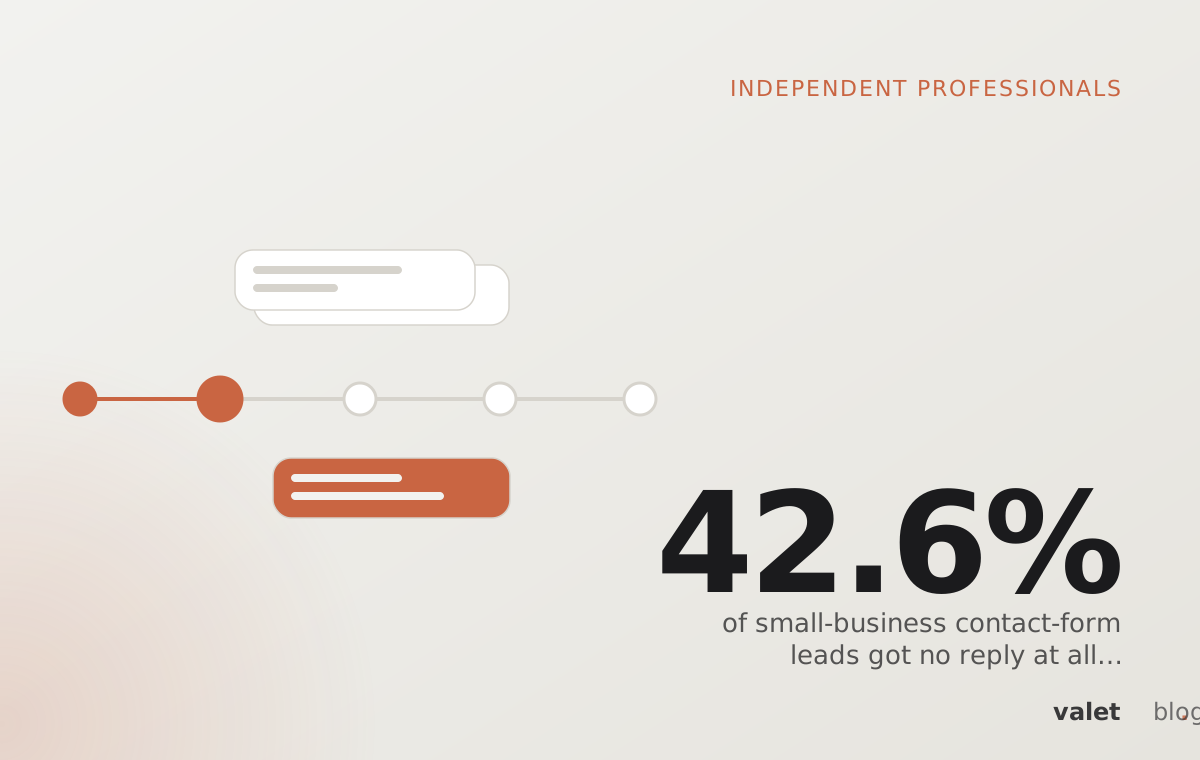
42.6%
of small-business contact-form leads got no reply at all, before any call could be booked
Leadferno, 225 forms, Jun 2024
28%
of home-services inquiries were offered a specific time
Pied Piper PSI, 3,211 inquiries, Apr 2026
1 h 45 m
of owner time per discovery-call cycle (30 min prep, 45 min call, 30 min proposal)
Freelancing Females, Apr 2026
There is no reliable public no-show rate for discovery calls. The 20–40% figure that circulates for free coaching calls is uncited4, and the ~18% figure for professional consultations reaches us through an aggregator with no year attached5. What can be traced is the booking path. Most no-shows are the visible end of a failure that happened earlier: a question nobody answered, a confirmation that went to junk, a time that was picked from a link but never confirmed by reply.
This piece treats a no-show like an alert: symptom, signal versus noise, fixes ruled out, root cause, then a policy you can copy.
What does a discovery-call no-show look like?#
A discovery-call no-show is a booked slot where the prospect neither attends nor cancels. The clearest public report we found is a post in the WHAM sales community on Skool from September 2024. The founder had done what most sales training recommends: qualified the prospect, set the frame for the next call, and asked directly whether anything would stop him attending.
asked 'if their was any reason why he wouldn't be able to make it' he said 'no' Come today he didn't show up.
Mohammed Umar, Skool WHAM sales community, September 2024
The post title asks "where did I mess up?"1. That is the right question, and the answer is rarely in the minute the call was due. A verbal yes on a call is one data point. It says nothing about whether the invite reached the calendar, whether the prospect understood what the second call was for, or whether a question they had was still open.
What is the real no-show rate for discovery calls?#
No independent benchmark exists for consultants, coaches or tutors. The numbers that rank in search are a mix of vendor claims and medical research applied out of context. The table below separates them by what they actually measure.
| Figure | Where it comes from | Confidence | Usable as |
|---|---|---|---|
| 20–40% no-shows on free calls; "some coaches report up to 50%"; 5–10% on paid calls | Talkspresso blog, 27 Mar 2026, attributed to "industry data"4 | Low: no sample, no method | Nothing. Retire it. |
| ~18% no-shows for professional consultations (legal, financial) | SchedulingKit, attributed to Clio, no year given5 | Low to medium: second-hand | A rough order of magnitude, labelled as reported |
| Reminders reduce no-shows "up to 50%" | Cochrane review as cited by SchedulingKit5 | Medium, but medical appointments | Evidence that reminders help in clinics, not for sales calls |
| 5 hours a week on unproductive calls; 1 h 45 m per call cycle | Freelancing Females, 7 Apr 20267 | Medium: practitioner estimate | The cost side of the equation |
The misleading signal is the 20–40% range. It is precise enough to look measured and broad enough to fit any experience. It also frames the problem as attendance, which pushes owners toward attendance fixes: more reminders, deposits, stricter confirmations. The data that is sourced points somewhere else, to the stages before the booking.
How we got this: we traced each figure on the first page of results for "discovery call no show" and "no show rate for free consultations" back to its stated source as of 1 October 2026. Valet does not yet publish its own no-show data. The method we will use is described in the last section; Valet has not published those counts and no figure is given here.
Where does the booking path break?#
A discovery call passes through six stages between the first email and the meeting. Each stage can fail silently, and only the last failure is visible as a no-show. Mapping the stages makes the failure points checkable.
| Stage | What should happen | Observed failure |
|---|---|---|
| 1. Inquiry received | A human-quality reply arrives | 42.6% of small-business contact-form leads got no reply at all; first human replies averaged 17 h 49 m9 |
| 2. Questions answered | Price range, scope and format are stated in writing | Prospects book without knowing what the call is for6 |
| 3. Time offered | Two or three specific times are proposed | Only 28% of home-services inquiries were offered a time10 |
| 4. Time confirmed | The prospect confirms, and the confirmation is seen | "Sometimes the confirmation email goes to Junk and gets missed"2 |
| 5. Reminder and agenda | The prospect is reminded what the call covers | Reminders exist in every scheduler, so this stage is rarely the gap |
| 6. Call or no-show | Attendance, or a recovery message | Most owners send nothing after a no-show, or send a reproach |
Stages 1 and 3 come from small-business and home-services data, not coaching, but they show the funnel narrows long before anyone misses a call.
Which no-show fixes don't touch the cause?#
Three fixes dominate the advice. Each one addresses a real effect, and each one can be ruled out as the root cause using the public evidence.
Hypothesis 1: the prospect forgot, so send more reminders#
Reminders are table stakes; every mainstream scheduler sends them. The reminder statistic that gets quoted is medical5. A reminder also assumes the booking itself is sound. In the Calendly review from a tutor on Capterra (November 2025), students "think they've confirmed when they haven't" because the confirmation went to junk2. A reminder sent to the same address goes to the same folder.
Hypothesis 2: the call was free, so charge a deposit#
A deposit is the most debated fix. A Clarity.fm thread from August 2019 shows the full range: a flat refusal ("Don't be petty.") from one expert, a "10% deposit to lock in the call" from another, and "Good luck on trying to collect on that one." from a third3. A thread in r/Entrepreneur (20+ comments, around January 2026) asks whether requiring a deposit is "professional" or "rude", with a founder describing a Stripe gateway added to a scheduler to solve "the 'no-show' problem"11. A deposit filters intent. It does not answer the prospect's questions, and Lisa Larter's experience with paid one-time calls was that "the vast majority of the time, the people who paid for the one-time call never became clients"8.
Hypothesis 3: the prospect wasn't committed, so ask for commitment#
The Skool post rules this one out directly. The founder asked for commitment and got a verbal yes1. A spoken promise on a call is weak telemetry because it costs the prospect nothing and is given under social pressure.
Why do people book a call and not show up?#
The root cause sits at the information layer, not the reminder layer. A vendor post from CreatorFlow (August 2026) puts it in one line: "Most discovery call no-shows are decided before the call is booked, not forgotten afterwards"6. It names two mechanisms that match the stage map.
- Impulse booking. "They tapped a link in a moment of interest, the calendar was there, they picked a slot"6. The booking was cheap, so cancelling it by not showing up is cheap too.
- Undefined call. "'Book a free call' could mean a sales pitch, a free coaching session, or a friendly chat"6. A prospect who fears a pitch has a reason to stay away.
- Unseen confirmation. The confirmation email lands in junk, so the prospect's calendar never holds the time2.
- Open questions. If the price range or the format was never stated, the call is where the prospect expects to find out. Some decide not to find out.
All four share one property: the booking was made by a link, not by a reply. A link records a slot. A reply in the email thread records that the prospect read the proposed time, saw what the call covers, and agreed. One commenter in a 2021 Hacker News thread on scheduling links argued that "the sender should do the extra work of embedding the times in an email"12. That extra work is the confirmation step most booking paths skip.
What to do when a discovery call is a no-show#
The fix has two parts. The first runs before the slot and removes the upstream causes. The second runs after a no-show and replaces silence or reproach with one useful message and a defined exit.
- Answer in writing first. Reply to the inquiry with your price range or minimum, what the call covers, how long it lasts and whether it is a sales conversation. Use the facts you have already decided.
- Offer two or three specific times in the thread. Keep the booking link as a fallback, not as the only path.
- Hold the time and confirm by reply. Ask the prospect to reply with the time that works. A reply proves the email arrived and was read.
- Send the agenda the day before. Three lines: what you will cover, what they should bring, how to move the time.
- After a no-show, wait ten minutes, then send one message. No reproach. Offer two new times and restate the purpose.
- Send one more nudge two to three days later, then close. Record the inquiry as lost with a reason, such as "no-show, no reply to two offers".
POLICY (put on the booking page and in the confirmation)
- This is a [20]-minute call about [your project / your goals].
  It is a conversation about fit, not a free session.
  My fees start at [range or minimum]; I will confirm a quote after the call.
- Please reply to confirm the time. If it stops working, reply with
  "move" and I will send two new times.
- If we miss each other, I will offer two new times once.
  If those don't suit, I will close the request so it isn't hanging over you.

NO-SHOW MESSAGE 1 (10 minutes after the start time)
Subject: Missed you at [time] — two new times
Hi [name], looks like today didn't work out, no problem.
I can do [day, time] or [day, time]. Reply with one and I'll send the invite.
The call covers [purpose] and takes [20] minutes.

NO-SHOW MESSAGE 2 (2–3 days later, only if no reply)
Hi [name], I'm holding [day, time] for you until [date].
If the timing isn't right, just reply "later" and I'll check back in [month].

CLOSE (no reply after message 2)
Log: lost, reason "no-show, no reply to two offers", date, value estimate.
Do not send a third message.
The cap of one recovery message plus one nudge is deliberate. It matches the two-to-three nudge standard set out in how many times to follow up with a lead, adjusted for the fact that a no-show already signals lower intent than a silent quote.
What does a no-show cost, and what does the fix cost?#
The cost of a no-show is the prep time plus the empty slot, and the cost scales with your call volume. The arithmetic below uses stated assumptions, not measured rates, so replace each input with your own.
| Input | At ~18% no-shows | At 30% no-shows |
|---|---|---|
| Free calls booked per week | 8 | 8 |
| Working weeks per year | 48 | 48 |
| No-shows per year | 69 | 115 |
| Hours lost (1 h each: prep plus slot) | 69 h | 115 h |
| Value at $150/h | $10,368 | $17,280 |
The 18% column uses the second-hand professional-services figure5; the 30% column is an assumed value inside the uncited range4. Neither includes the projects those prospects would have bought.
The fix has its own costs. Writing out your price range in the first reply will lose some prospects who would have booked a call and then balked at the number. That is a filter working as intended, but it reduces the booked-call count, which can feel like a regression if call volume is the metric you watch. Confirming by reply adds one round trip, so some impulse bookers never complete it. The residual risk is the prospect who confirms, reads the agenda and still does not appear. The recovery messages exist for that case.
How do you measure your own no-show rate?#
A no-show rate is only comparable when the denominator is defined. Most owners count "calls booked", which mixes confirmed slots with link clicks nobody looked at again. Use these definitions over the last 90 days of inquiries.
- Booked. A time was picked by link or by reply.
- Confirmed. The prospect replied to confirm, or accepted the calendar invite.
- Attended. The call took place at the booked or moved time.
- Moved. The prospect asked for a new time before the slot. Not a no-show.
- No-show. Booked, not moved, not attended.
- Recovered. A no-show that later attended after a recovery message.
Report two numbers: no-shows as a share of booked, and no-shows as a share of confirmed. If the gap between them is large, the problem is at stage 4, not at the call. The Lost Lead Audit walks through finding every inquiry in Gmail; add these six columns to it. Reproduction note: count by inquiry, not by calendar event, because one prospect who moves twice creates three events.
Where Valet fits#
Valet covers stages 1 to 4 and the recovery. It answers the inquiry from your own price list and policies, offers real times from your calendar, holds one, and books it when the prospect replies. Each inquiry moves through the Valet Inquiry States (New, Answered, Time held, Followed up, Booked, or closed with a reason), so a no-show shows up as a state with a next step, not a gap. The Valet follow-up cap is two nudges by default, each with something useful such as a held time, and then Valet stops and tells you why. Every reply has a Valet receipt. The free lead check takes 10–20 recent inquiries and shows which ones went unanswered, which stopped after one reply, and what they were worth.
Questions people ask
What is a normal no-show rate for discovery calls?
No independent benchmark exists for consultants or coaches. Talkspresso (2026) claims 20–40% for free calls without citing a source, and SchedulingKit attributes about 18% for legal and financial consultations to Clio without a year. Measure your own rate over 90 days before comparing.
What should I do when a prospect doesn't show up for a discovery call?
Wait ten minutes, then send one short message that offers two specific new times and restates what the call covers. If there is no reply, send one more message two to three days later, then close the inquiry as lost with a reason.
Why do people book a call and not show up?
The common causes sit upstream of the call: the prospect booked on impulse without knowing what the call was, their questions were never answered in writing, or the confirmation went to junk and they never saw it. Reminders do not fix any of those.
Should I charge a deposit for discovery calls to stop no-shows?
A deposit filters out low-intent bookings, but it also filters out some good prospects and does not answer their questions. Practitioners disagree sharply; treat it as a trade-off rather than a fix, and test it against answering questions before the slot.
Do reminder emails reduce no-shows?
The often-quoted 'reminders cut no-shows by up to 50%' figure comes from medical appointment research, reported second-hand. Reminders help when the booking is sound; they cannot rescue a booking the prospect never confirmed or never understood.
Sources
Confidence: H primary source checked · M credible secondary or reported · L vendor claim or single report. Reddit and forum items are quoted from public threads and summarised, not endorsed.
- Discovery call no show, where did I mess up? · Skool, WHAM sales community · 2024-09 H
- Calendly reviews, page 2 · Capterra · 2025-11 H
- If a call is scheduled and the client does not show up for the call, are they charged? · Clarity.fm · 2019-08-20 H
- Free vs paid discovery calls · Talkspresso · 2026-03-27 L
- Appointment no-show statistics · SchedulingKit · undated L
- Coach discovery call no-shows (Instagram DM) · CreatorFlow · 2026-08-24 L
- Are discovery calls worth it? · Freelancing Females (Substack) · 2026-04-07 M
- Discovery calls are a conflict of interest · Lisa Larter · 2021-09-15 M
- Research: Website contact forms and lead management, uncovering costly mistakes · Leadferno · 2024-06-28 H
- Precision Garage Door Ranked #1 in Customer Lead Handling Effectiveness Home Services Study (Pied Piper PSI 2026) · BusinessWire / Pied Piper Management Company · 2026-04-12 H
- "Is it 'professional' or just 'rude' to require a deposit…" (thread, 20+ comments; Google snippet) · Reddit, r/Entrepreneur · c. 2026-01 M
- Calendly link etiquette discussion (item 29260468) · Hacker News · 2021-11-17 H
How to cite this page
Cite this page
Valet, "Discovery-call no-shows for consultants and coaches: real rates, why they happen, and what actually fixes them", valet.team, October 2026.
Keep reading
 Independent professionals"What are your rates?" by email: answering pricing and pre-sales questions without a call, a lost lead or an invented discountThe person asking for your rates is not trying to trap you. They are trying to find out if you are in range before they spend a call on you. Answer that question, then give them one easy next step.Explainers · 9 min · 1 October 2026
 Independent professionalsWho answers your inquiries when you're on holiday, sick or on parental leave? Coverage without stranding customers with a botSolo owners describe two choices: switch on the out-of-office and hope, or check email from the beach. Both price your absence badly. Here is the case for a third arrangement, where it fails, and a checklist to set it up.Strategy desk · 10 min · 1 October 2026
 Independent professionalsClient ghosted after the proposal or quote: a follow-up plan for consultants, designers and small agenciesSilence after a proposal is the most common ending in independent work, and the least discussed. What the people who send proposals say about it, what the evidence says about the second and third message, and a plan that ends with a reason instead of a fade.People at work · 8 min · 1 October 2026