
Independent professionals
Client ghosted after the proposal or quote: a follow-up plan for consultants, designers and small agencies
Silence after a proposal is the most common ending in independent work, and the least discussed. What the people who send proposals say about it, what the evidence says about the second and third message, and a plan that ends with a reason instead of a fade.
Short answer
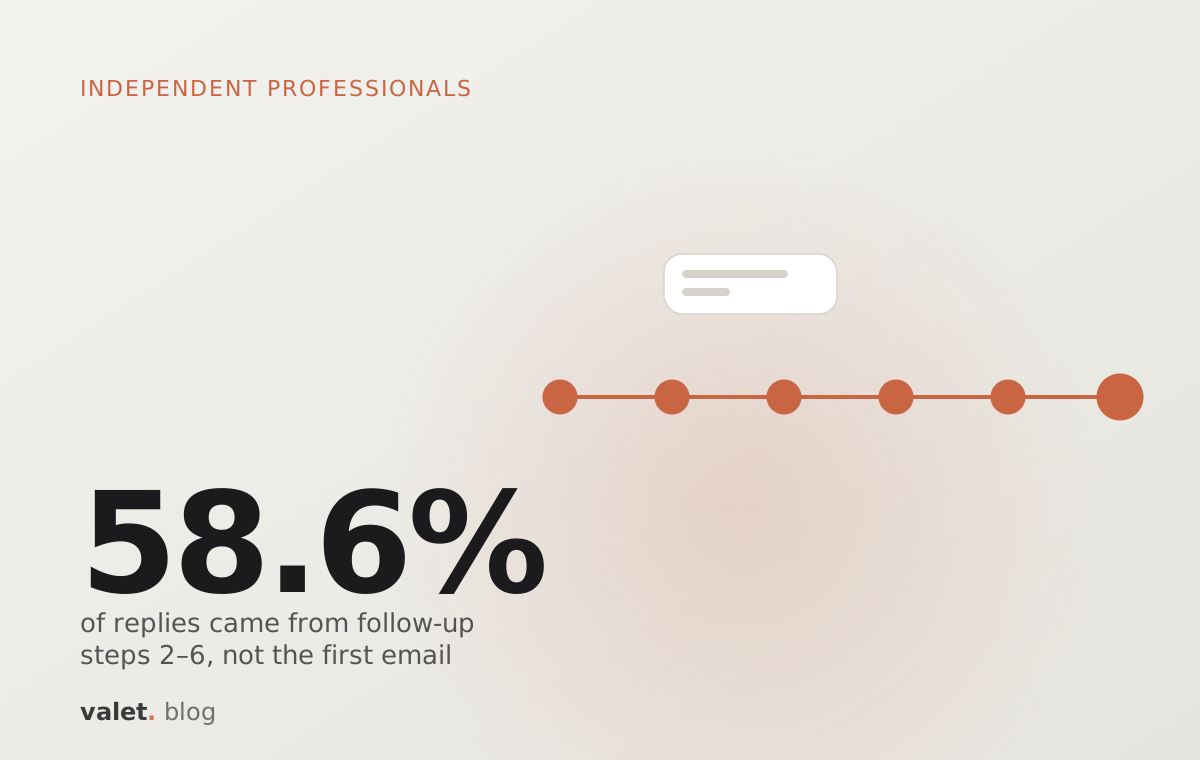
Follow up twice after a proposal goes quiet, then close it with a reason and leave the door open. Send the first nudge two or three working days after the proposal with something useful, the second about a week later with a decision aid such as a smaller option or an expiry date. A 2026 Belkins study of 7.53 million B2B emails found 58.6% of replies came after the first message.
58.6%
of replies came from follow-up steps 2–6, not the first email
Belkins, 7.53M B2B emails, 2026
72%
of home-services leads received no follow-up at all
Pied Piper PSI, 3,211 inquiries, Apr 2026
52%
of specialist consultants charge $10K or more per project
Consulting Success fees study, ~1,000 consultants, 2026
When a client goes quiet after your proposal, send two follow-ups and then close it with a reason. The first goes two or three working days after the proposal and carries something useful. The second goes about a week later and helps them decide: a smaller option, a date that expires. Then a short note closes the file and leaves the door open. A 2026 Belkins study of 7.53 million B2B emails found that 58.6% of replies came after the first message7. Stopping after one is the most common mistake, and the easiest to fix.
What does it feel like when a client ghosts you after a proposal?#
Being ghosted after a proposal is quiet. Nothing happens, and that is the whole event. Around May 2026 a small-business owner posted in r/smallbusiness about a quote for a kitchen refit. The customer "said he'd get back to me by the weekend." The thread title begins "Sent a quote last week, heard nothing" and asks what the silence means3.
The top answer was short: "Send the reminder. You're only 'bothering them' if they don't want it"3. The question itself is the tell. The owner was asking for permission to write a second email.
That hesitation shows up in every trade that sends prices by email. A bookkeeper on AccountingWEB in June 2017 described quoting £2,400 a year all-in. "He came back to me to say I was a lot more than he'd expected," the bookkeeper wrote. Later: "He has now come back to say the figure he had in mind was £1500"1. That bookkeeper was lucky, in a way: there was an answer. Most proposals end with no answer at all.
Illustration For example, a freelance designer sends a brand proposal at 4:50 on a Thursday, attached as a PDF, three options priced. She checks the sent folder twice that evening to be sure it went. On Monday she opens the thread again and reads her own email. By Wednesday she has drafted "just checking in" three times and deleted it three times. Nothing is wrong with the proposal. She just does not know what to say next.
Why does silence after a quote hit so hard?#
Silence is hard because it has no information in it. A no tells you something. A counter-offer tells you more. Silence lets you write every possible story yourself, and most people write the worst one.
Bill Cates, writing for financial advisors in August 2026, described what prospects do instead of declining: "It shows up as silence. Delayed decisions. 'I've been meaning to get back to you.' No response at all"2. His point is that the prospect is not saying no. They are avoiding the conversation where they would have to.
Coaches report the same thing at a later step. A StrongTalk UK podcast episode from May 2026 covers prospects who "inquire, appear interested, receive payment links, then disappear"6. Freelancers have lived with it for years. A thread in r/freelance (60+ comments, around 2020) asks what is up with potential clients ignoring you; the top answer: "They have too many choices. IMO, only 30-40 percent will respond. Most wont"4. That is one person's estimate, not a measurement. It is also what many people in the thread seemed to accept.
The cost is not only money. It is the hours of a proposal, the open loop that sits in your head, and the small damage to your own pricing confidence each time a number meets silence.
What do experienced freelancers and agencies do after sending a proposal?#
People who send proposals for a living have mostly settled on a rhythm, and it is short. In r/msp (30+ comments, around December 2025), a new managed-services owner asked what to do about a first quote with no reply. The advice: "email the quote, send a follow up email 5-7 days later along with a phone call"5.
Others have learned when to stop. In an r/smallbusiness thread with 150+ comments (around 2024), one reply suggests telling a returning customer that "it's been 3 weeks since you've sent the quote and… there is no longer room on the calendar"11. That is a nudge with something real in it: the calendar changed.
Not everyone believes in follow-up. A thread in r/freelance (40+ comments, around 2019) includes this: "Every time I've tried to follow up on a ghosted lead, it was a waste of time"12. That view is honest about the writer's experience. The data below suggests the experience depends heavily on what the follow-up said.
The bookkeeper's thread had its own piece of craft. One reply, signed paulgrca.net, said the writer had "never met anybody who got 100% of the work they quoted for"1. Losing some proposals is part of the job. The skill is in losing them on purpose, with a reason, rather than by drift.
What does the data say about following up on a proposal?#
The public data on follow-up is thin for independent professionals, but it points one way. None of it measures consultants or designers directly.
| Finding | Source | What it does and does not show |
|---|---|---|
| 41.4% of replies came from the first email; 58.6% from steps 2–6 | Belkins, 7.53M B2B emails, 20267 | Later messages carry most replies. Outbound cold email, not proposals. |
| 72% of leads got no follow-up; 28% were offered a time | Pied Piper PSI, 3,211 home-services inquiries, Apr 20269 | Most businesses stop early. Home services, not professional services. |
| Most businesses that replied made only one attempt (reported as 65.9%) | Leadferno, 225 small-business forms, Jun 20248 | Single-touch is the norm. Small sample; treat the share as reported. |
| 52% of specialists charge $10K+ per project | Consulting Success, ~1,000 consultants, 202610 | The value of a single proposal is large enough to justify two emails. |
The pattern is that most businesses send one message and wait, while most replies arrive later. Belkins also found step 3 drove 35.6% of email-sourced meetings7. That supports a second and sometimes a third message. It does not support a fifth.
How we got this: Valet does not yet publish data on when the second or third nudge converts for proposals. When we do, it will count proposals by segment, record the nudge number on which each reply arrived, and report closes with a stated reason separately from fades. Until then, no figure is given here.
A follow-up plan for a proposal that went quiet#
The plan below has four messages and a hard stop. Each one carries something the client did not have before. None of them says "just checking in" on its own.
DAY 0 — PROPOSAL SENT
End with one clear next step:
"If this looks right, reply with a start week and I'll hold it."

NUDGE 1 — 2–3 working days later
Subject: Re: [proposal name] — one thing I didn't mention
Hi [name], one detail that may help: [answer to the question they
are most likely to have: timeline / what's included / payment terms].
I can hold a start in the week of [date] until [date].
  Consultant:  "...the first two weeks are discovery; nothing is
                billed beyond phase 1 until you approve phase 2."
  Designer:    "...option B covers the logo and the three templates
                you mentioned; the full system can follow later."
  Agency:      "...we can start with the landing page alone if
                budget timing is the question."

NUDGE 2 — about 7 days after nudge 1
Subject: Re: [proposal name] — a smaller option, and a date
Hi [name], if the full scope isn't right for now, [smaller option
and price] would get you [outcome]. The proposal holds at these
prices until [date]; after that I'll need to re-quote.

CLOSE — about 7 days after nudge 2, if still silent
Subject: Closing this for now
Hi [name], I'll close this proposal for now so it's not hanging
over either of us. If things change, reply to this thread and
I'll pick it back up.
Log: lost, reason [price / timing / went elsewhere / no response],
value, date.

REVIVE — 60–90 days later, only if something changed
A new slot, a new offer, or their stated timing has arrived.
One message. No reply = leave it closed.

NEVER: a third "checking in"; a discount you hadn't decided
before the proposal; guilt ("I spent hours on this").
The plan follows the two-to-three nudge standard in how many times to follow up with a lead. The close message does two jobs: it releases the client from an awkward silence, and it gives you a reason to log. A loss with a reason can be counted and learned from. A fade cannot. If the proposal followed a discovery call that nearly did not happen, the recovery messages in discovery-call no-shows use the same shape.
What changes when the follow-up is a system, not a mood#
The difference between an owner who follows up and one who does not is rarely discipline. It is whether the next message is already decided. The designer in the illustration did not lack courage. She lacked a sentence.
| What changed | What did not |
|---|---|
| Every quiet proposal gets two useful messages | Some clients still never reply |
| Each proposal ends booked or closed with a reason | Price objections still need your judgement |
| The owner stops redrafting "checking in" | The proposal still has to be good |
| Lost reasons can be counted over a quarter | A reason is a guess when the client never says |
The money is worth stating plainly, with the caveat that these are assumptions. Illustration A consultant with two open proposals a month at $6,000–$12,000, which spans the lower illustrative tiers in Consulting Success's 2026 fees study10, who wins one extra proposal a quarter by following up, adds $24,000–$48,000 a year. Your own numbers will differ. The Lost Lead Audit shows how to find them in your inbox.
Where Valet fits#
Valet can carry the plan above for inquiries that come through a forwarded address. It answers from your own price list and policies, holds real times from your calendar, and sends follow-ups with something useful in each one. The Valet follow-up cap is two nudges by default, after which it stops and tells you why, and every inquiry ends in a state under the Valet Inquiry States: booked, or closed with a reason. Discount requests and haggling go to you with one-tap replies; Valet never invents a price. Every reply has a Valet receipt. The free lead check looks at 10–20 recent inquiries and shows which went unanswered, which stopped after one reply, and what they were worth.
Some proposals will still go quiet. The kitchen-refit customer may never have written back. The difference is that the person who sent the quote gets to decide when it is over.
Questions people ask
What should I do when a client ghosts me after a proposal?
Send two follow-ups, each with something new: an answer to a likely question, a held start date, a smaller option or an expiry. If neither gets a reply, send a short note closing the proposal, record why you think it was lost, and stop.
How long should I wait to follow up on a proposal?
Two or three working days for the first nudge, then about a week for the second. Earlier than two days can read as pressure; later than a week lets the decision drift.
How many times should I follow up on a proposal with no response?
Twice, sometimes three times if the third carries something new such as an expiring date. Belkins' 2026 data shows most replies come after the first message, but returns fall sharply after the third.
Why do clients ghost after a proposal?
Usually because saying no is uncomfortable and silence is easy, or because the decision stalled on their side. As one advisor coach put it in 2026, prospects are not saying no: 'It shows up as silence. Delayed decisions.'
Should I send a 'closing the file' email?
Yes, as the last message. It is polite, it often prompts a reply, and it lets you record the proposal as lost with a reason instead of leaving it open indefinitely.
Sources
Confidence: H primary source checked · M credible secondary or reported · L vendor claim or single report. Reddit and forum items are quoted from public threads and summarised, not endorsed.
- Potential new client says I'm too expensive, am I? · AccountingWEB Any Answers · 2017-06-05 H
- They're not saying no: why financial advisor prospects don't respond · Advisorpedia (Bill Cates) · 2026-08-28 M
- "Sent a quote last week, heard nothing. Does silence…" (thread, 10+ comments; Google snippet) · Reddit, r/smallbusiness · c. 2026-05 M
- "What is up with potential clients just ignoring you after…" (thread, 60+ comments; Google snippet) · Reddit, r/freelance · c. 2020 M
- "First customer quote but no response back" (thread, 30+ comments; Google snippet) · Reddit, r/msp · c. 2025-12 M
- Ep. 43: What to do when coaching clients ghost you (enquiries and active clients) · StrongTalk UK podcast · 2026-05-10 M
- Sales follow-up statistics · Belkins · 2026 M
- Research: Website contact forms and lead management, uncovering costly mistakes · Leadferno · 2024-06-28 H
- Precision Garage Door Ranked #1 in Customer Lead Handling Effectiveness Home Services Study (Pied Piper PSI 2026) · BusinessWire / Pied Piper Management Company · 2026-04-12 H
- Consulting fees study · Consulting Success · 2026-05-01 H
- "What would you do? Client ghosted after quote, popped…" (thread, 150+ comments; Google snippet) · Reddit, r/smallbusiness · c. 2024 M
- "How to follow up after a potential client asks for your rates…" (thread, 40+ comments; Google snippet) · Reddit, r/freelance · c. 2019 M
How to cite this page
Cite this page
Valet, "Client ghosted after the proposal or quote: a follow-up plan for consultants, designers and small agencies", valet.team, October 2026.
Keep reading
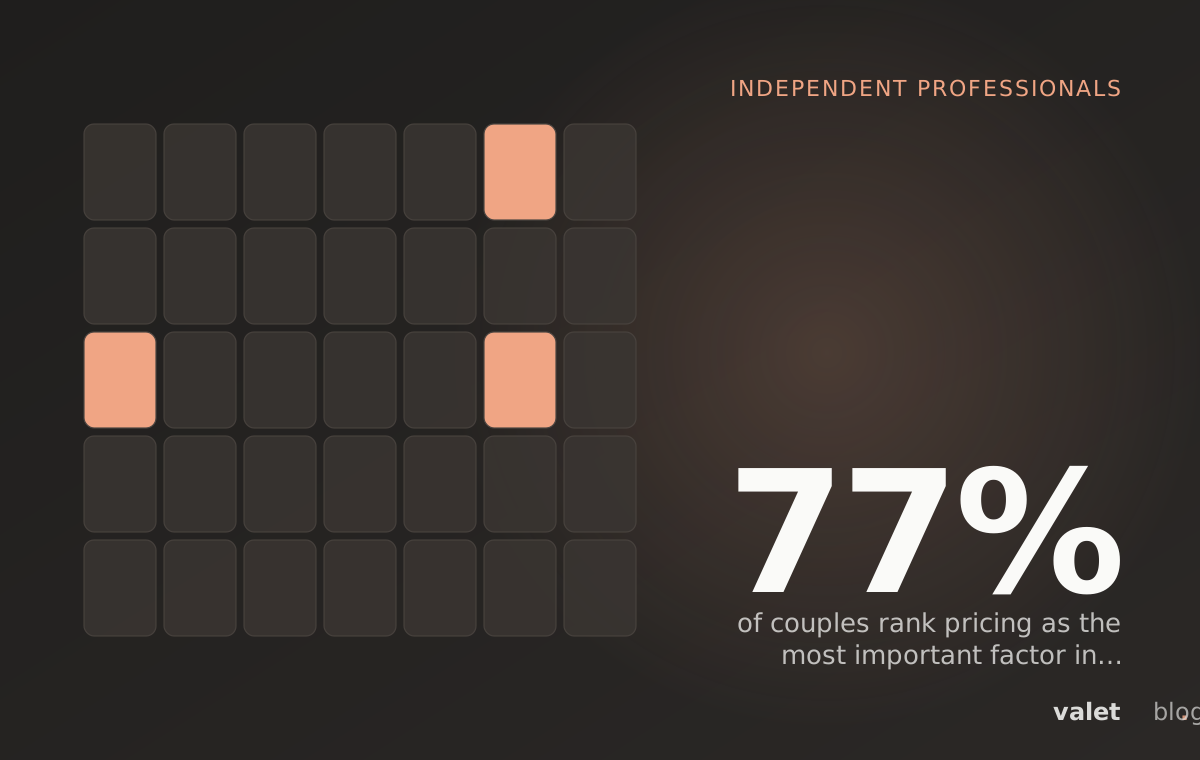 Independent professionals"What are your rates?" by email: answering pricing and pre-sales questions without a call, a lost lead or an invented discountThe person asking for your rates is not trying to trap you. They are trying to find out if you are in range before they spend a call on you. Answer that question, then give them one easy next step.Explainers · 9 min · 1 October 2026
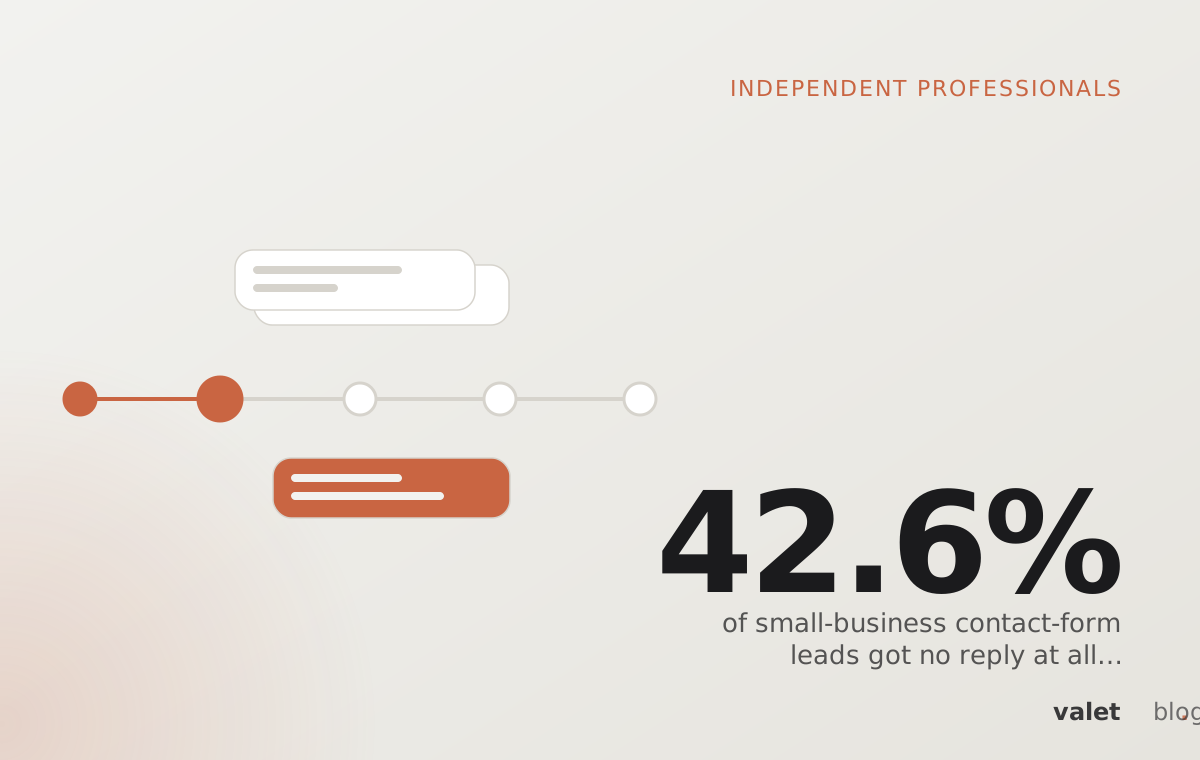 Independent professionalsDiscovery-call no-shows for consultants and coaches: real rates, why they happen, and what actually fixes themA no-show is the last visible failure in a booking path that broke earlier. This piece traces that path stage by stage, separates the sourced numbers from the recycled ones, and ends with a policy and recovery sequence you can copy.Technical desk · 11 min · 1 October 2026
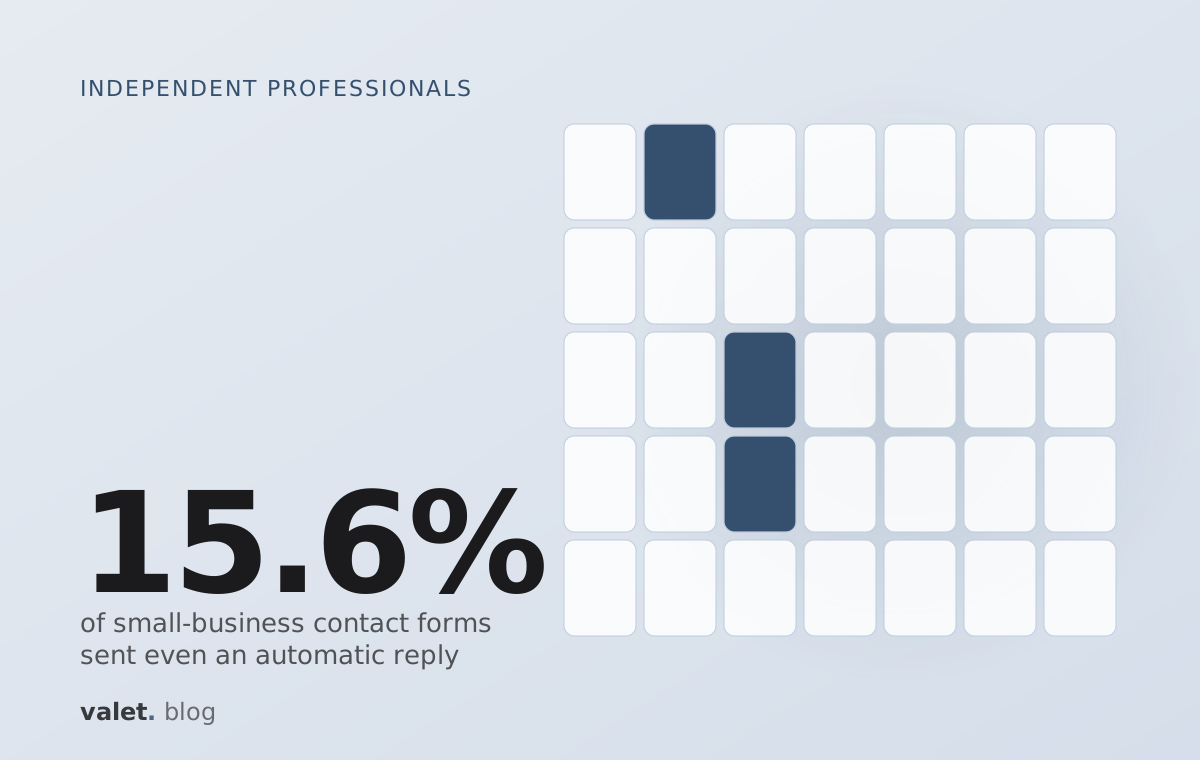 Independent professionalsWho answers your inquiries when you're on holiday, sick or on parental leave? Coverage without stranding customers with a botSolo owners describe two choices: switch on the out-of-office and hope, or check email from the beach. Both price your absence badly. Here is the case for a third arrangement, where it fails, and a checklist to set it up.Strategy desk · 10 min · 1 October 2026