
Independent professionals
Coaches: prospects who book, get the payment link and disappear. Follow-up with judgement, not pressure
A discovery call goes well, the payment link goes out, and then nothing. This post traces where that pipeline breaks, which explanations usually turn out wrong, and the post-call message set that closes the loop without pressure.
Short answer
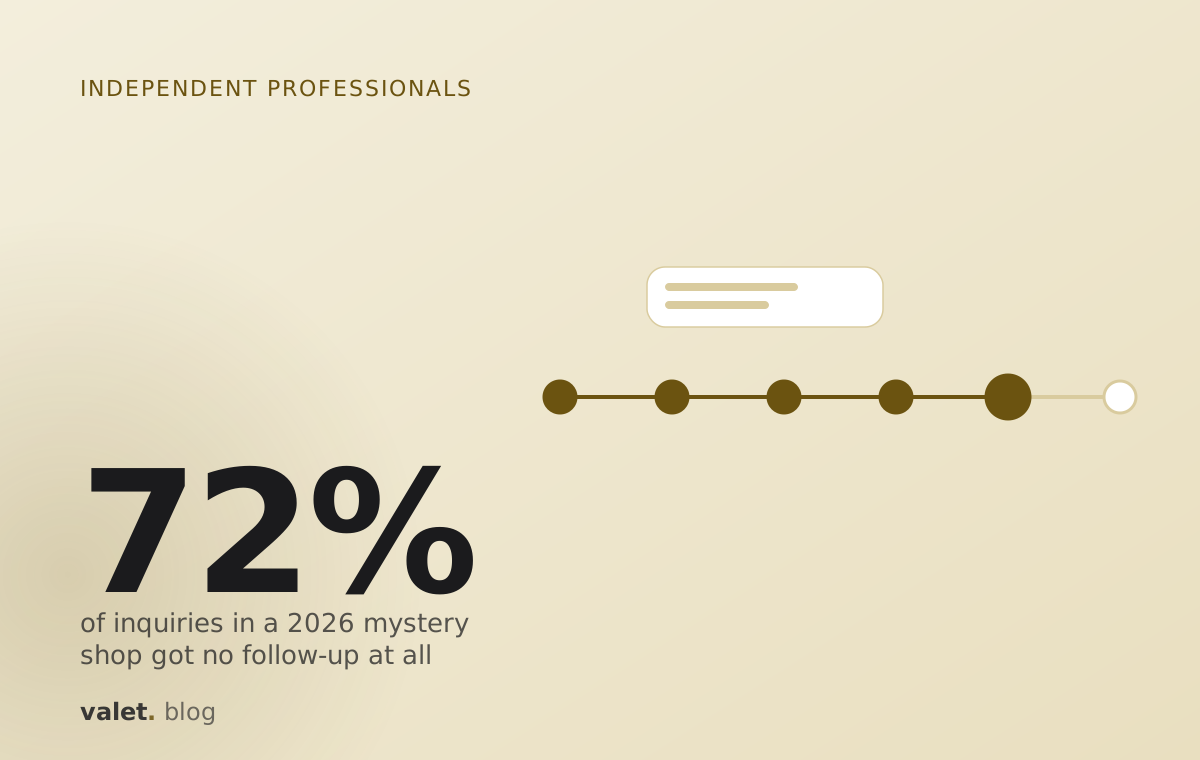
When a coaching prospect takes the payment link and goes quiet, the usual cause is an unanswered question plus no owned next step, not a lost lead. Send a same-day recap that asks for the one remaining question, then two useful nudges (around day 2 and day 6–7), then close with a recorded reason. Never add a discount to restart the thread. In Pied Piper's 2026 study of 3,211 inquiries, 72% got no follow-up at all.
72%
of inquiries in a 2026 mystery shop got no follow-up at all
Pied Piper PSI, 3,211 home-services inquiries, Apr 2026
1 h 45 m
of prep, call and proposal time per discovery call that goes nowhere
Freelancing Females, Apr 2026
17 h 49 m
average first human reply to small-business contact forms
Leadferno, 225 forms, Jun 2024
A prospect who takes your payment link and goes quiet has usually not decided against you. In most cases one question is still open and nobody owns the next step. Fix that with a same-day recap that asks for the open question, two useful nudges around day 2 and day 6–7, and a close with a recorded reason. A discount sent into silence is not one of the steps. The failure is common outside coaching too: in Pied Piper's 2026 mystery shop of 3,211 home-services inquiries, 72% got no follow-up at all4.
This post treats the problem as a pipeline with a defect: the symptom, the stages, three wrong explanations, the root cause, and the fix.
What does "they got the payment link and disappeared" look like?#
Coaches describe the same pattern: the prospect enquires, takes a discovery call, sounds keen, gets the payment link, and stops replying. The StrongTalk UK podcast gave the pattern its own episode in May 2026. The show notes put it in one line: "Someone enquires, seems keen, maybe gets sent a payment link - then disappears"1. The host's framing is worth keeping: "Both sting. Neither means what you think it means."1
Coaches ask about it in public too. A thread in r/lifecoaching titled "New coach question: what do you do when a client doesn't…" drew 40+ comments in September 2026. Another r/lifecoaching thread on "the most annoying parts about building a coaching business" (10+ comments, about four months old) names a "discovery call follow-up system" as one of them.
The symptom has a precise shape. The prospect did three things that took effort: they enquired, booked, and attended. Then the cheapest step, paying, did not happen. That is not what a cold lead looks like.
Where does the post-call pipeline break?#
A coaching sale passes through five stages after the first enquiry, and most coaching tools record only some of them. The table maps each stage to what usually records it and what goes unrecorded.
| Stage | Typical system of record | What is usually not recorded |
|---|---|---|
| 1. Enquiry | Email, contact form, DM | Time to first reply; whether a time was offered |
| 2. Discovery call booked and held | Scheduling tool | Questions the prospect asked and you answered "I'll send that over" |
| 3. Payment link sent | Payment or coaching platform | Whether the email arrived in the inbox or in junk |
| 4. Silence | Nothing | Who owns the next message, and when it is due |
| 5. Paid, or lost | Payment platform (paid only) | A reason for every prospect who did not pay |
Stage 4 has no system of record at all. Coaching platforms cover the stages either side of it. Paperbell's home page, read on 1 October 2026, lists features including "discovery sessions", "reminder emails", "post-appointment messaging", "expiring packages" and "coupon codes"6. We found no feature on that page for following up with a prospect who has not paid. The product is built for scheduling, payments and existing clients, and the prospect who goes quiet between the call and payment falls outside what it records.
Three explanations that are usually not the root cause#
Coaches reach for three explanations when a prospect goes quiet after the link. Each can be true in a specific case, and each can be tested. None explains the pattern as a whole.
Hypothesis 1: "They were never serious"#
The "never serious" explanation fits no-shows better than post-call silence. CreatorFlow, a vendor writing about Instagram-sourced coaching calls, argues that "Most discovery call no-shows are decided before the call is booked, not forgotten afterwards," because people "tapped a link in a moment of interest"2. That mechanism describes someone who never turns up. A prospect who attended, talked through their situation and asked for the link has shown a different level of intent. Test it by counting: if most of your silent prospects attended the full call, low intent is not the main defect.
Hypothesis 2: "The price scared them off"#
Price is a reasonable suspect and a poor default conclusion. If the price was stated before or during the call, the prospect asked for the link knowing it. If it appeared for the first time on the payment page, that is a sequencing defect, and you can fix it in the recap. Test it by checking where each silent prospect first saw the number. The fix is never a discount sent into silence: it answers a question the prospect has not asked and teaches them that waiting lowers the price.
Hypothesis 3: "The link never arrived"#
Delivery failure is real and under-tested. A payment link sent as an automated email from a platform domain passes through the same filters as any bulk message. The same failure shows up in scheduling tools: a tutor reviewing Calendly on Capterra in November 2025 wrote that "sometimes the confirmation email goes to Junk and gets missed"7. Test it directly. Send the link to your own Gmail and Outlook addresses and see which folder it lands in. Then paste the link into a personal email from your own address as well, so it arrives inside a thread the prospect already trusts.
What is the root cause?#
The root cause is an open question with no owner of the next step. The call ends with something unresolved: a date, a format, whether the package covers a specific issue, whether a partner agrees, whether they can start after a holiday. The prospect walks away to think, and nobody is assigned to restart the thread.
Techstars mentor Nora Khalili describes the mechanism in founder-led sales, and it transfers directly: "If an objection (concern, obstacle, hesitation, etc.) exists, it will only get larger in their minds when they walk away." Her blunter line follows: "If an objection exists, chances are the follow-up call will not happen."3
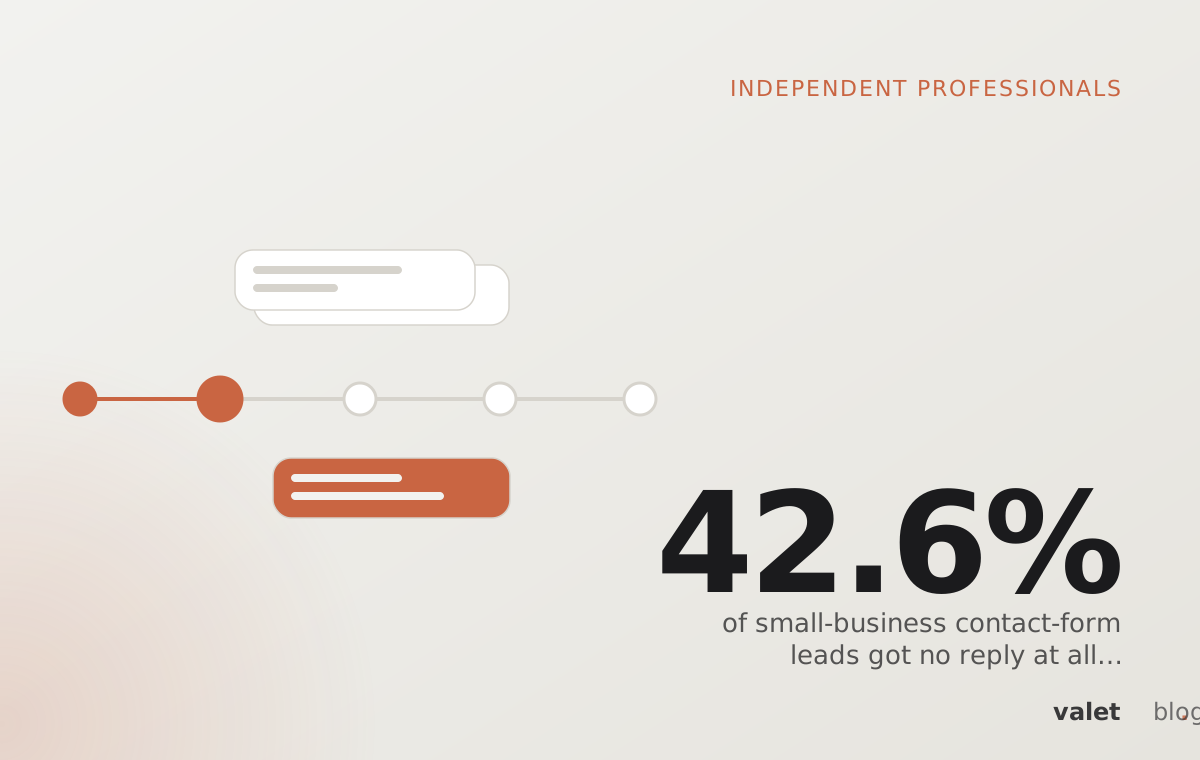
The broader data shows how rarely the next step is owned. Pied Piper found that 72% of 3,211 home-services inquiries got no follow-up, and only 28% were offered an appointment4. Leadferno's 2024 test of 225 small-business contact forms found 42.6% got no reply at all and an average first human reply of 17 hours 49 minutes5. Neither study covers coaches, so treat the figures as the base rate for small businesses, not a coaching benchmark. The direction is the same: the loss happens after contact, at the point where someone has to send the next message.
The cost to the coach is time already spent. Freelancing Females estimates a typical cycle at 30 minutes of prep, a 45-minute call and 30 minutes on a proposal8. That is about 1 hour 45 minutes per prospect, spent before the silence starts.
The fix: a post-call message set with a cap#
The fix is a fixed set of messages, each with a job, a timing and a stop condition. Every message must carry something the prospect does not have yet. None may lower the price, invent urgency, or put pressure on a decision that may involve money, health or family.
MESSAGE 0 - Recap (same day as the call)
Subject: Your [package name] plan, and the one thing left to decide
Hi [name], thanks for today. What we agreed:
- Goal: [their words]
- Package: [name], [length], [price as stated on the call]
- Start: [date] (I'm holding this start date until [date + 7 days])
Payment link: [link]
Most people have one question left at this point. What's yours?
If now isn't the right time, just say so and I'll close this out.

NUDGE 1 - Answer (about 2 days later)
Hi [name], one thing that often comes up after a call: [answer to
the question they raised, or the most common one, from your own
policy - e.g. what happens if you miss a session].
Your [date] start is still held until [date]. Link again: [link]

NUDGE 2 - Expiry and an easy no (about 6-7 days after the recap)
Hi [name], I'm releasing the [date] start on [date] so I can offer
it to someone else. If you'd like it, the link is here: [link].
If you've decided against it or the timing is wrong, a one-word
reply is fine and I'll stop writing.

NUDGE 3 - Only if something changed (optional, about 2-3 weeks)
Send only with real news: a new cohort date, a format they asked
about, a change in schedule. Say this is the last message.

CLOSE (same day the cap is reached)
Record one reason: no reply after cap / price / timing / chose
someone else / not a fit / asked to stop / parked until [date].
The timings follow the convention set out in how many times to follow up with a lead: two useful nudges after the first reply, an optional third only with new content, then a close. They are a convention, not a measured optimum for coaching. Change them per offer, and keep the cap.
Judgement, not pressure. Coaching decisions often involve money, health, relationships or work. If a prospect mentions a health, legal or safety matter, answer it yourself and do not let any template or tool reply. "Spots are filling fast" is acceptable only if it is true and you can name the date.
How do you revive a coaching prospect who went quiet months ago?#
A revival message is justified only when something has changed for the prospect or for your offer. The close reason tells you which prospects are worth reviving. "Timing" and "parked until [date]" are the strongest candidates. "Price" is a candidate only if you have a different format at a different price that you would offer anyone. "Asked to stop" is never revived.
- Filter by reason. Pull prospects closed as timing or parked in the last 30–90 days. Leave out everyone who asked you to stop.
- Find the change. Name what is different now: a new cohort, a shorter package, a date that matches what they said on the call. If nothing has changed, do not send.
- Send one message. Refer to their goal in their own words, state the change, and offer one real start date. Make no reference to the earlier silence.
- Record the result. Log replied, booked, or no reply. A revival that gets no reply closes for good.
How we are measuring this: revive outcomes by close reason (timing, price, parked, no reply after cap) and by days since close could be measured as inquiries move through Valet; no figure is published yet. We have no figure to publish yet and will publish the method alongside any numbers.
What is a ghosted-after-call prospect worth?#
The value is the package price multiplied by how many silent prospects a better close would recover, and you can run it in a minute with your own inputs. The example below is an illustration, not a benchmark.
Illustration A coach selling a 3-month package priced between $1,500 and $5,000. Two prospects a month go quiet after the link. If the post-call set recovers 1 in 5 of them, that is about 4.8 clients a year: roughly $7,200 a year at $1,500, or $24,000 at $5,000. The time already spent is a cost on top, at about 1 hour 45 minutes per prospect8.
The recovery rate in that illustration is an assumption. No independent study measures it for coaching, and the published no-show figures for coaching calls are vendor claims without a cited dataset. Run the Lost Lead Audit on your last 90 days of prospects to replace the assumption with your own count.
Trade-offs and where this approach stops working#
The capped set gives up some prospects. A few people would have paid after a fourth or fifth message, and the cap gives them up by default. The alternative is a coach who keeps writing to people who have stopped reading, and in a relationship business that costs more than one lost sale.
The set also cannot fix lead quality. The StrongTalk episode suggests that if ghosting happens regularly, the cause may be content and lead quality rather than anything personal1. Lisa Larter makes a related point about paid one-off calls: "The vast majority of the time, the people who paid for the one-time call never became clients."9 If most of your silent prospects found you through a channel that sends low-intent traffic, fix the channel first and the follow-up second.
A residual risk sits with tooling. If the recap is generated by software, it must quote only the price and terms you set. A follow-up that invents a payment plan or a discount is a commitment you may have to honour. Related pieces cover why prospects go quiet after pricing and why follow-up, not the first reply, is where leads are lost.
Where Valet fits#
Valet can run the post-call set from your own facts. You forward the address prospects write to, and Valet answers their questions from your packages, prices and policies and offers real start dates from your calendar. The Valet follow-up cap sends two nudges by default, each with something useful, then stops and tells you why. Each inquiry moves through the Valet Inquiry States (New, Answered, Time held, Followed up, Booked, or closed with a reason). Discounts, refunds, payment plans and anything touching health go to you with one-tap replies, and the prospect is told when you will reply. Every message has a Valet receipt and is signed as your AI assistant.
To see where your own prospects stall, the free lead check reviews 10–20 recent inquiries and shows what went unanswered, what stopped after one reply, and what it was worth.
Questions people ask
What do I do when a coaching client ghosts after the discovery call?
Send one recap the same day that restates what you agreed, includes the payment link and asks for the one question still open. Follow up twice more with something useful each time, then close the inquiry with a reason. Do not offer a discount to restart the conversation.
How many times should I follow up with a coaching lead who didn't pay?
Two nudges after the recap, roughly two days and a week later, is a sound default. A third is justified only if something changed, such as a new start date or a cohort closing. After that, stop and record why.
Should I offer a discount if a prospect goes quiet after the payment link?
No. A discount sent into silence teaches the prospect that waiting lowers the price, and it answers a question they may not have asked. If price was the objection, they can tell you; your recap should make that easy to say.
Is it the payment link that's the problem?
Sometimes. A link from a payment or scheduling platform can land in junk or promotions. Send a test link to your own Gmail and Outlook addresses, and paste the link inside a personal email rather than relying only on the platform's automated message.
Sources
Confidence: H primary source checked · M credible secondary or reported · L vendor claim or single report. Reddit and forum items are quoted from public threads and summarised, not endorsed.
- #43. What To Do When Coaching Clients Ghost You (Enquiries AND Active Clients) · StrongTalk UK podcast (show notes) · 2026-05-10 M
- Discovery call no-shows: Instagram DM · CreatorFlow (vendor blog) · 2026-08-24 L
- Why You Are Losing Deals · Techstars (Nora Khalili) · 2025-06-03 M
- Precision Garage Door Ranked #1 in Customer Lead Handling Effectiveness Home Services Study (Pied Piper PSI 2026) · BusinessWire / Pied Piper Management Company · 2026-04-12 H
- Research: Website contact forms and lead management, uncovering costly mistakes · Leadferno · 2024-06-28 H
- Paperbell home page (feature list) · Paperbell · 2026-10-01 H
- Calendly reviews, page 2 · Capterra · 2026 H
- Are discovery calls worth it? · Freelancing Females (Substack) · 2026-04-07 M
- Discovery Calls are a Conflict of Interest · Lisa Larter · 2021-09-15 M
How to cite this page
Cite this page
Valet, "Coaches: prospects who book, get the payment link and disappear", valet.team, October 2026.
Keep reading
 Independent professionals"What are your rates?" by email: answering pricing and pre-sales questions without a call, a lost lead or an invented discountThe person asking for your rates is not trying to trap you. They are trying to find out if you are in range before they spend a call on you. Answer that question, then give them one easy next step.Explainers · 9 min · 1 October 2026
 Independent professionalsDiscovery-call no-shows for consultants and coaches: real rates, why they happen, and what actually fixes themA no-show is the last visible failure in a booking path that broke earlier. This piece traces that path stage by stage, separates the sourced numbers from the recycled ones, and ends with a policy and recovery sequence you can copy.Technical desk · 11 min · 1 October 2026
 Independent professionalsWho answers your inquiries when you're on holiday, sick or on parental leave? Coverage without stranding customers with a botSolo owners describe two choices: switch on the out-of-office and hope, or check email from the beach. Both price your absence badly. Here is the case for a third arrangement, where it fails, and a checklist to set it up.Strategy desk · 10 min · 1 October 2026