
Startups & support@
Why inbound leads don't convert at a tiny startup: the demo-request and sales@ inbox nobody reads
At a seed-stage startup, inbound usually dies in the reply, not the lead. This runbook shows how to test your own demo-request flow, set up sales@ so every request gets a complete answer, and catch the failure modes before they cost a deal.
Short answer
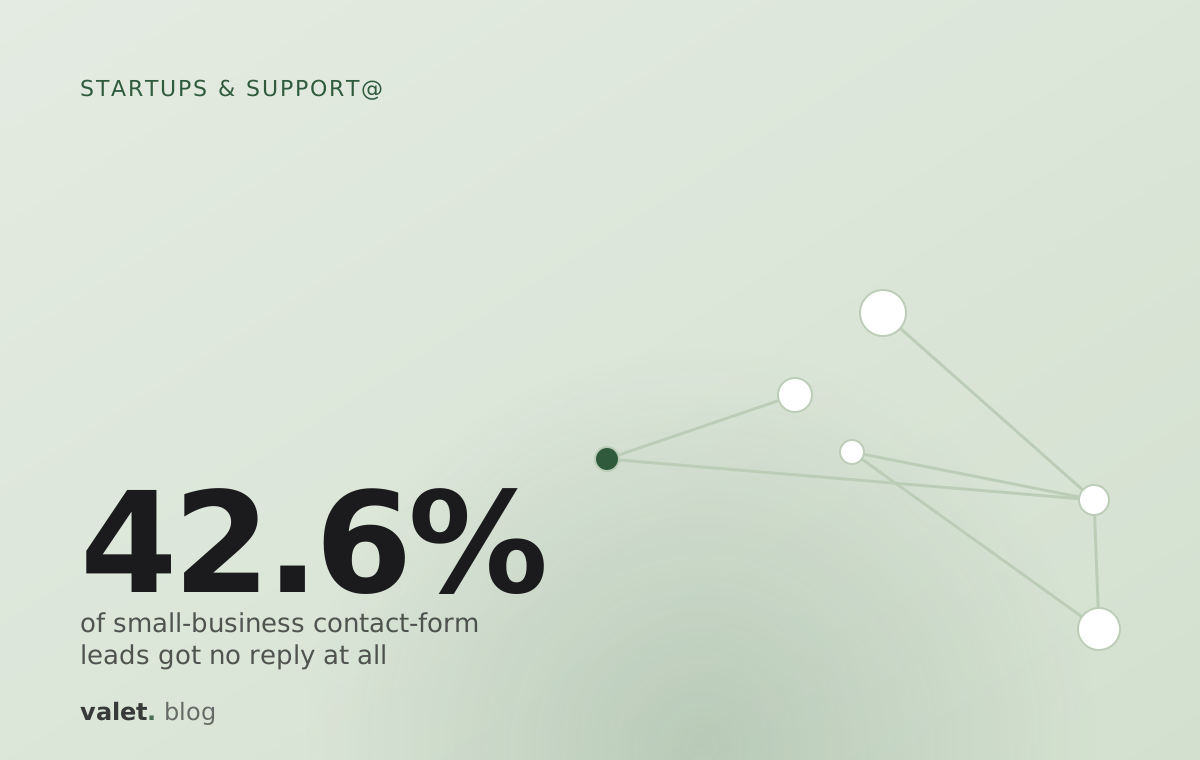
At a 1–3 person startup, inbound leads usually fail at the reply, not the lead. The demo request arrives at 6 pm, the answer comes the next morning with a calendar link and no answer to the buyer's question, and nobody sends a second message. Leadferno's 2024 test found 42.6% of small-business form leads got no reply at all. Fix it with a same-day complete reply, a real time offered, two capped follow-ups and a named owner for hard questions.
42.6%
of small-business contact-form leads got no reply at all
Leadferno, 225 forms, Jun 2024
−46%
lower hiring odds after a 1-hour reply delay, on Fiverr
Management Science study via Entrepreneur, Jul 2026
$1,250/mo
entry price of a dedicated inbound routing tool, including 15 seats
Chili Piper pricing page, Oct 2026
At a 1–3 person startup, inbound leads rarely fail because the lead was bad. They fail at the reply. The demo request lands at 6 pm. The answer goes out the next morning with a calendar link and nothing else. The buyer's actual question goes unanswered, and nobody writes a second time. Leadferno's 2024 test of 225 small-business contact forms found 42.6% got no reply at all1. This runbook fixes the reply: a complete first answer, a real time offered, two capped follow-ups, and a named owner for hard questions.
Outcome: every demo request and sales@ email gets a complete reply the same day and ends booked or closed with a reason. Time: about 3 hours to set up, 30 minutes a week to run. Access you need: admin on your email domain, edit rights on the website form, and write access to the calendar demos are booked into.
Why don't inbound leads convert at a tiny startup?#
Inbound at a tiny startup breaks in three places. Each one is a reply problem.
- The reply is late. A thread in r/Entrepreneur (80+ comments, about six months old) describes it: "Someone would fill it out at 6pm and we'd email them the next morning with calendar links." A thread in r/CRMSoftware (20+ comments, late September 2026) says the same about night-time leads: "the first useful reply comes the next morning."
- The reply is empty. A calendar link is a next step, not an answer. If the buyer asked about price, an integration or SSO, the link answers none of it.
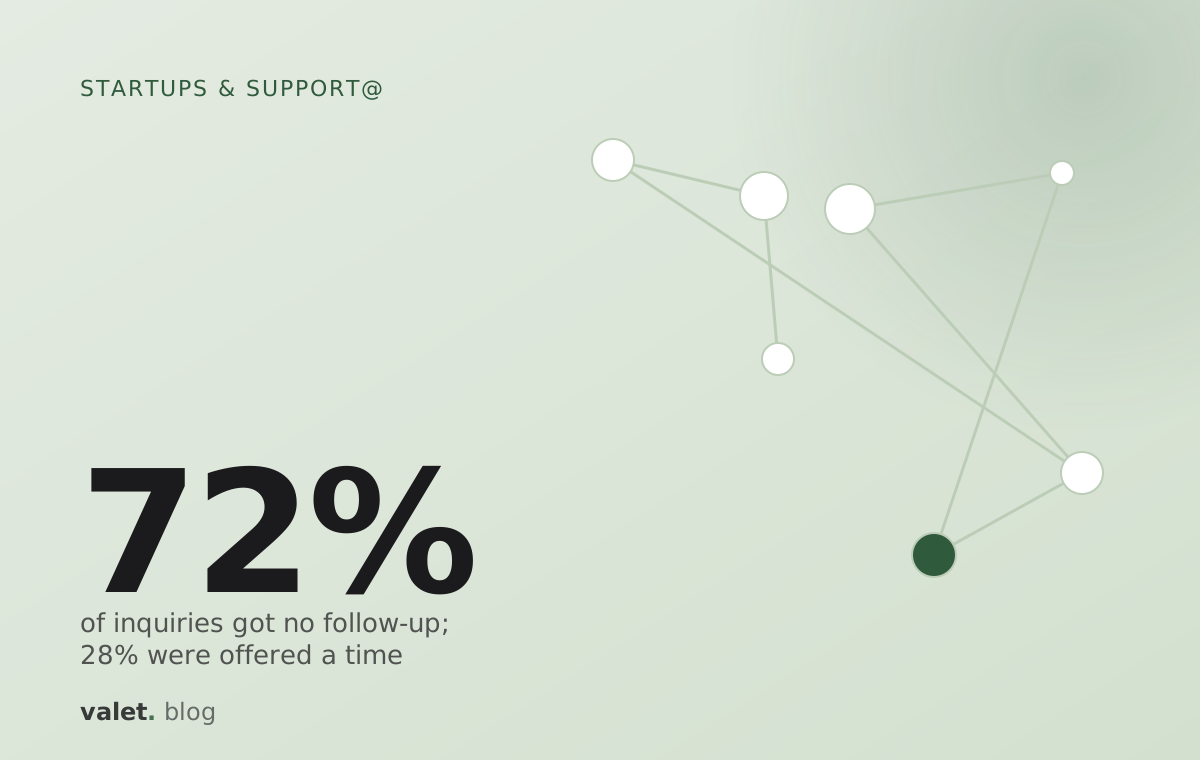
- There is no second reply. Pied Piper's 2026 mystery shop of 3,211 home-services inquiries found 72% got no follow-up at all4. A thread in r/AskMarketing (10+ comments, about five months old) says leads "just die in the CRM."
Founder-sales advice has said this for years. Pete Kazanjy's Founding Sales tells founders to "respond to inbound leads as quickly as they come in. Don't let them wait around—they're excited now."2 Techstars mentor Nora Khalili adds why the second message matters: "If an objection (concern, obstacle, hesitation, etc.) exists, it will only get larger in their minds when they walk away."3
Who should use this runbook?#
This runbook is for founder-led sales at the stage before a sales hire. Check the filter before you start.
Use this runbook if: you have 1–3 people; inbound arrives by a demo form, sales@ or hello@; nobody's job is to watch that inbox; you get fewer than about 100 inbound requests a month.
Do not use it if: you already have a sales rep with routing and a CRM sequence (tune that instead), or most of your inbound is existing customers asking for support (use the support@ runbook).
Pre-flight: run the 6 pm test#
The 6 pm test is a dry run of your inbound flow as a buyer sees it. Run it before you change anything. It gives you a baseline.
- Submit your own demo form at 6 pm on a weekday. Use a personal Gmail address. Ask one real question: "Do you integrate with HubSpot, and what does it cost for 10 seats?" Verify: note the exact time sent.
- Send the same question to sales@ from a second address. Verify: both messages show as delivered in your sent folder.
- Do not warn your team. The test only works if the flow runs as it does on a normal day.
- Record four things the next day. Time to first reply. Whether the reply answered the question. Whether it offered a specific time. Whether a second message ever came.
- Exit branch: if nothing arrived within 24 hours, stop here. Fix delivery first (Step 1 below) before you change any wording.
Leadferno found that 4.8% of the forms it tested were broken, and that 15.6% of businesses sent an automatic confirmation email1. An auto-confirmation does not count as a reply in this test.
How to set up inbound so every request gets a complete reply#
Run the steps in order. Each step has a check. Do not move on until the check passes.
- Route every inbound path to one inbox. Point the demo form, sales@ and hello@ to one address that one person reads. Verify: submit the form and email each alias; all three arrive in the same place within 2 minutes. If not: check the form's notification address and your domain's forwarding rules.
- Write the facts sheet. One page: plans and prices, seat minimums, integrations, security answers (SSO, data location), trial terms, what you do not do. Verify: answer the 6 pm test question using only this page. If you cannot, add the missing line.
- Name a daily owner and a backup. Write it down: who reads sales@ on which day, and who covers. Verify: each person can say who owns today without looking it up.
- Set two holdable demo slots per day. Block them in the calendar so the reply can offer real times, not only a link. Verify: tomorrow has at least two open slots.
- Adopt the first-reply format. Answer the question from the facts sheet, offer two specific times, ask one prep question. Verify: rerun the 6 pm test; the reply contains all three parts.
- Schedule the two follow-ups. Nudge 1 about 2 days later with something new. Nudge 2 about 5–7 days later with the held time's expiry and an easy "no thanks". Then close with a reason. Verify: every open thread has a due date for its next message.
- Define what goes to the founder. Custom pricing, discounts, security questionnaires, contracts, legal terms. The owner tells the buyer when the founder will reply. Verify: one test request for a discount reaches the founder with a reply-by time.
| Item | Standard | Owner | Check |
|---|---|---|---|
| First reply, working hours | Within 1 hour | Daily owner: [name] | Weekly: slowest reply time |
| First reply, after hours | By 10:00 next working day at the latest | Daily owner | Weekly: count of replies after 10:00 |
| First reply content | Answer from facts sheet + two real times + one prep question | Daily owner | Spot-check 3 replies a week |
| Nudge 1 | About 2 days, must add something new | Daily owner | No open thread without a due date |
| Nudge 2 | About 5–7 days, states when the hold expires, easy no | Daily owner | Same |
| Close | After nudge 2 or on reply; one reason recorded | Daily owner | Every closed thread has a reason |
| Founder handoff | Discounts, custom terms, security reviews, contracts | Founder: [name] | Buyer told the reply-by time |
| Coverage | Backup named for every day | Backup: [name] | Calendar shows owner and backup |
Timings are a working convention for small teams, not a measured optimum. Keep the cap of two nudges; adjust the hours to your market.
Failure modes and exact fixes#
Most setups fail in one of five ways within the first month. Each has a symptom you can see and a fix you can run.
Failure 1: the form works, the email does not arrive#
The symptom is a form that shows "thanks" and an inbox that shows nothing. Form notifications sent from a website plugin can fail sender checks and land in spam. Fix: send notifications from an address on your own domain with SPF and DKIM set, and add a second destination such as a shared channel. Verify by rerunning the 6 pm test weekly for a month.
Failure 2: the reply is a link, not an answer#
The symptom is a buyer who books, then asks the same question on the call, or never books. The reply skipped the question. Fix: the first line of every reply answers the question in the buyer's words. If the facts sheet lacks the answer, the reply says when you will have it, and you add the line the same day.
Failure 3: nobody owns today#
The symptom is a thread that two people each assumed the other answered. Fix: one name per day in the calendar, plus a backup. Do not share ownership across the team. A shared owner is the same as no owner.
Failure 4: follow-ups pile up or never start#
The symptom is either a buyer who gets four "checking in" emails or one who gets none. Fix: two nudges, each with new content, then close. For the full sequence and wording, see demo-request follow-up without a sales team. For the evidence behind the cap, see how many times to follow up with a lead.
Failure 5: the tool you bought was built for a sales team#
The symptom is paying for seats nobody uses. Inbound tooling is usually priced for teams. Chili Piper's routing and scheduling tier starts at $1,250 a month and includes 15 seats6. Intercom prices Fin for Sales at "$10 per qualified lead", with product questions at $1, and explains that it chose not to charge on closed revenue because attribution and measurement break down7. Neither price is wrong for its buyer. Check whether you are that buyer before you sign. Builders see the same gap: one Hacker News post from September 2026 describes building an "Inbound message AI assistant" to "handle scheduling and back and forth"8.
Rollback#
Roll back any change that makes the 6 pm test worse. The rollback trigger is simple: a slower first reply, or a reply that no longer answers the question. Revert the change, rerun the test, and keep the facts sheet and the owner rota. Those two never make things worse.
What does a slow reply cost a startup?#
The cost is lost pipeline, and you can estimate it with your own numbers. The figures below are an illustration with assumed inputs.
Illustration A seed SaaS with 20 inbound requests a month, an $8,000 annual contract value and a 20% close rate. That inbound is worth about $384,000 a year in closed contracts. If a quarter of it hits the same no-reply rate Leadferno measured (42.6%)1, about 2 requests a month never get an answer. At 20% close, that is roughly $41,000 a year in contracts that never had a chance.
Speed matters on top of that. A 2026 Management Science study of more than 11 million Fiverr transactions, as reported by Entrepreneur, found a one-hour delay cut hiring odds by 46%, and a delay of 24 hours or more cut them by 90%5. That is a marketplace where buyers compare sellers side by side. Treat it as direction, not a SaaS benchmark.
How this will be measured: a Valet mystery shop of startup demo-request flows will record four fields per flow (time to first reply, whether the question was answered, whether a time was offered, whether a second message came) and compare the pattern with Lost Lead Audits from other industries. No results exist yet; any future figures would come with the sample size and method. The 6 pm test above uses the same four fields on your own flow.
Post-execution health check: the weekly 30-minute review#
Run this every Monday. It keeps the setup from drifting.
- Count last week's inbound. Every form, sales@ and hello@ request. Verify: the count matches the inbox.
- Find the slowest first reply. If it broke the SLA, name the cause: no owner, missing fact, or after-hours gap.
- Check every open thread has a next date. Any thread without one is a lead in limbo. Give it a date or close it.
- Read the close reasons. Three "price" closes in a week is a pricing-page problem. Three "no reply after cap" closes is a first-reply problem.
- Add one line to the facts sheet. Every week there is a question you answered by hand. Write it down once.
For a full 90-day look back, use the Lost Lead Audit. For the argument that follow-up, not first-reply speed, is where most leads are lost, see the first reply is free; follow-up is where leads die.
Where Valet fits#
Valet runs this SLA for written inbound. You forward sales@ or the demo form's address. Valet answers from your facts sheet, offers and holds real demo times from your calendar, and sends replies from your own address once the domain is verified. The Valet follow-up cap sends two useful nudges, then stops and tells you why. Discounts, custom terms, contracts and anything it cannot answer from your facts come to you, and the buyer is told when you will reply. Every reply has a Valet receipt and is signed as your AI assistant. Valet reads only what you forward.
The free lead check reviews 10–20 recent inbound requests and shows what went unanswered, what stopped after one reply, and what it was worth.
Questions people ask
Why are my inbound leads not converting?
At a small startup the usual cause is the reply: it arrives late, it sends a calendar link without answering the buyer's question, and nobody follows up. Test it by submitting your own demo form at 6 pm and timing what comes back.
How fast should a startup respond to inbound leads?
Within the hour in working hours, and with a complete answer by the next morning at worst. A 2026 Management Science study of Fiverr, reported by Entrepreneur, found a one-hour delay cut hiring odds by 46%; that is a marketplace, so treat it as direction rather than a startup benchmark.
Who should own sales@ at a three-person startup?
One named person per day, with a written backup. The owner answers from a shared facts sheet, offers real demo times, and sends the follow-ups. Pricing exceptions, security reviews and contracts go to the founder.
What should the first reply to a demo request contain?
A direct answer to whatever the buyer asked, such as price, an integration or a security question; two real demo times; and one question that helps you prepare. A calendar link alone does not answer anything.
Sources
Confidence: H primary source checked · M credible secondary or reported · L vendor claim or single report. Reddit and forum items are quoted from public threads and summarised, not endorsed.
- Research: Website contact forms and lead management, uncovering costly mistakes · Leadferno · 2024-06-28 H
- Founding Sales: inbound lead capture and response · Holloway (Pete Kazanjy) · 2022-08-22 M
- Why You Are Losing Deals · Techstars (Nora Khalili) · 2025-06-03 M
- Precision Garage Door Ranked #1 in Customer Lead Handling Effectiveness Home Services Study (Pied Piper PSI 2026) · BusinessWire / Pied Piper Management Company · 2026-04-12 H
- Companies are tracking response time delays for freelance jobs · Entrepreneur (reporting a Management Science study) · 2026-07-16 M
- Chili Piper pricing · Chili Piper · 2026-10-01 H
- Building outcome-based pricing for Fin for Sales · Intercom · 2026-05-08 H
- Hacker News comment 49690821 ("What are you working on", Sep 2026) · Hacker News · 2026-09-14 H
How to cite this page
Cite this page
Valet, "Why inbound leads don't convert at a tiny startup", valet.team, October 2026.
Keep reading
 Startups & support@Should a startup use AI for customer support? What founders who lost customers say, and the three missing controlsCustomers accept AI support when they can reach a person. The failures that cost startups customers trace to three missing controls, not to the model.Data desk · 11 min · 1 October 2026
 Startups & support@How to handle support@ as a solo or 3-person SaaS founder (without hiring, and without a bot that traps people)Sort support@ into four categories, give each a written promise and an automation level, and check the handoffs every week. Here is the runbook, plus the six ways it breaks.Playbooks · 12 min · 1 October 2026
 Startups & support@An AI agent that answers vs one that finishes the job: what "acts" means for a small business, and the four controls that make it safeMost AI tools sold to small businesses answer the first message and stop. This piece defines what it means for an agent to finish the job, traces where answer-only tools lose the inquiry, and sets out the four controls that make acting safe.Technical desk · 11 min · 1 October 2026