
Startups & support@
An AI agent that answers vs one that finishes the job: what "acts" means for a small business, and the four controls that make it safe
Most AI tools sold to small businesses answer the first message and stop. This piece defines what it means for an agent to finish the job, traces where answer-only tools lose the inquiry, and sets out the four controls that make acting safe.
Short answer
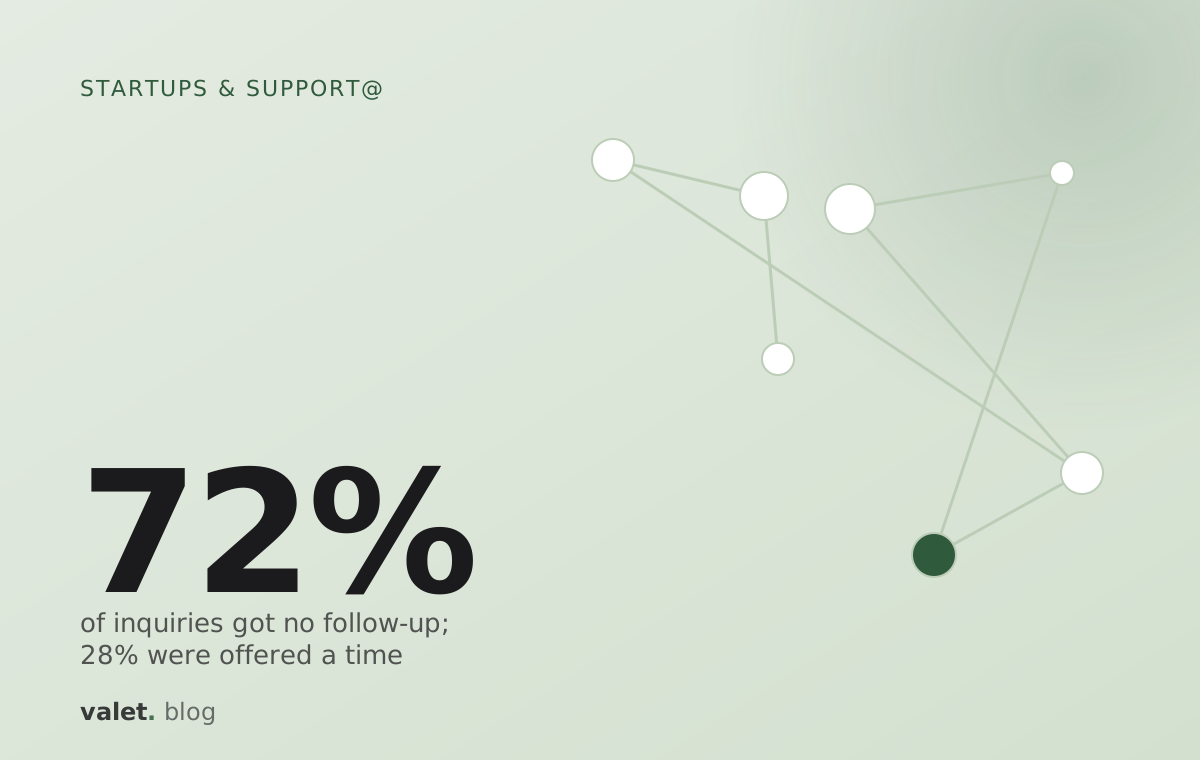
An AI agent that answers replies to the message in front of it and stops. One that finishes the job carries the inquiry to an end state: it answers from your facts, holds a real time, follows up until booked or lost, hands hard cases to you with a reply-by time, and logs a receipt. Four controls make that safe: facts-only answers, approval tiers, an honest handoff, and a receipt per action. The gap is real: Pied Piper (2026) found 72% of 3,211 inquiries got no follow-up.
72%
of inquiries got no follow-up; 28% were offered a time
Pied Piper PSI, 3,211 home-services inquiries, Apr 2026
1 in 3
AI-handed-off support tickets never got a human reply
Gorgias Ecom Lab, Oct 2025–Apr 2026
16%
of small businesses have deployed an AI agent; 79% know about them
Bluehost, 350 US owners, May 2026
An AI agent that answers replies to the message in front of it and stops. An agent that finishes the job carries the inquiry to an end state: booked, or closed with a reason. In between, it answers from your facts, holds a real time, follows up, and hands the hard cases to you with a time the customer is told to expect. Four controls make that safe: facts-only answers, approval tiers, an honest handoff, and a receipt for every action. The gap is measurable. In Pied Piper's 2026 mystery shop of 3,211 home-services inquiries, 72% got no follow-up at all and only 28% were offered a time1.
This piece treats "answer vs act" as a systems question: where an inquiry goes after the first reply, three fixes that do not close the gap, the root cause, and the controls.
What is the difference between an AI agent that answers and one that acts?#
An answer-only AI tool produces text in response to an input. An acting agent changes state in the world (a calendar hold, a sent invite, a scheduled follow-up, a handoff with a deadline) and keeps track of what it changed. The distinction is the one owners and founders already draw in their own words.
A thread in r/startups (10+ comments, about nine months old) asks for an "AI agent that can actually perform actions, not just answer FAQs," and in the same post: "Will website owners trust an AI to take actions on their site?" A thread in r/aiToolForBusiness (20+ comments, September 2026) describes the shift: "once it can actually take actions instead of just generating text to copy-paste, it stops being a fancy prompt." The demand is for completion; the worry is trust.
For a small business, "acts" has a narrow, testable meaning. The five actions below define it.
- Answer from facts. Reply using only the owner's price list, packages, policies and documents, and say so when the answer is not there.
- Hold a real time. Read the live calendar, offer open slots, hold the one offered, and send the invite when the customer accepts.
- Follow up until an end state. Write again on a schedule, with something useful each time, until the inquiry is booked or closed with a reason.
- Hand off with a reply-by time. Pass anything outside the rules to the owner, and tell the customer when the owner will reply.
- Record a receipt. Log what was asked, the rule used, the sources used and what was sent, for every reply and action.
Where does an inquiry go after the first reply?#
An inquiry has a lifecycle with a start, several intermediate states and two possible ends. Answer-only tools cover the first transition, from new to answered. Every later transition depends on a person noticing that it is due.
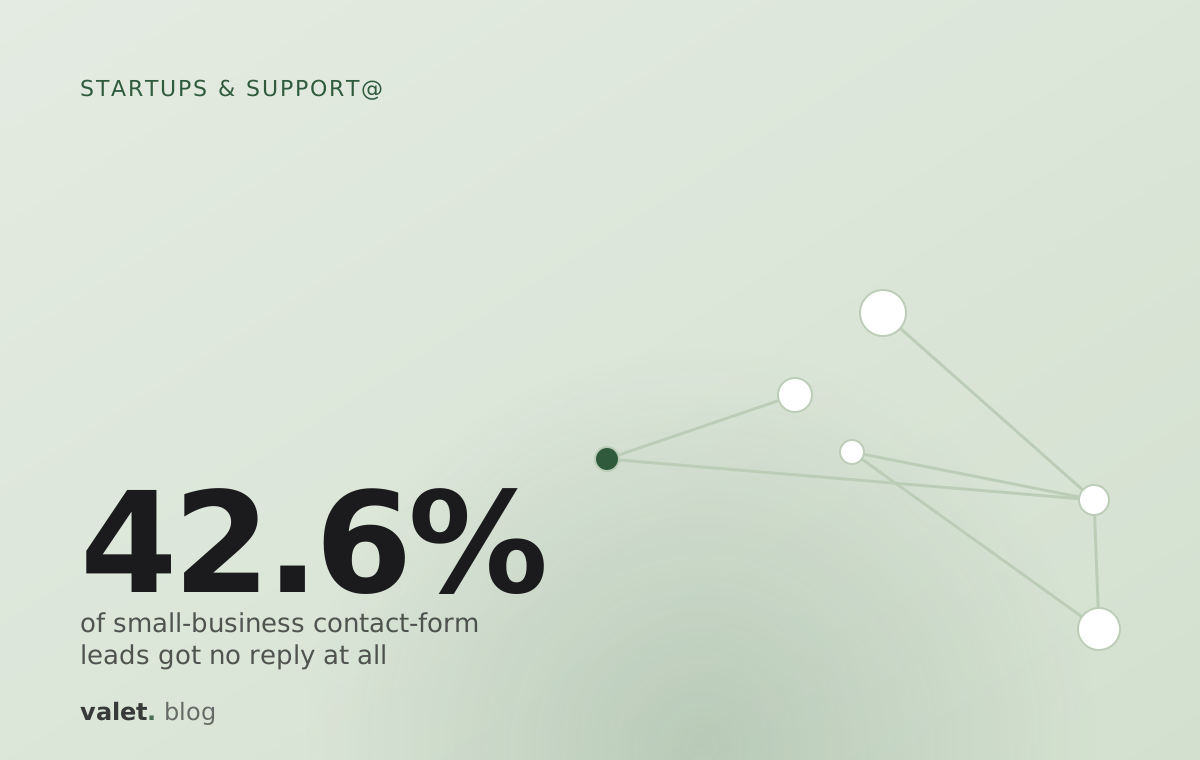
The published baselines show what happens to those later transitions. Pied Piper's 2026 study found 72% of inquiries got no follow-up and 28% were offered an appointment1. Leadferno's 2024 test of 225 small-business contact forms found 42.6% got no reply at all, with the first human reply averaging 17 hours 49 minutes. Of the businesses that did reply, Leadferno reports that about two-thirds made only one attempt2. Both studies cover small businesses broadly rather than one trade, but they agree on where the loss sits: after the first contact, where somebody has to send the next message.
The handoff transition fails in a different way. Gorgias Ecom Lab data from October 2025 to April 2026 found that 55% of AI-touched support tickets ended in a human handoff. The median wait after handoff was 10 hours, and one-third of handed-off tickets never got a human reply5. Pied Piper's 2025 Service Telephone study scored AI-to-human transfer failure at 56% in auto dealerships6. The handoff exists, and on the other side of it nobody picks up.
Three fixes that do not close the gap#
Three fixes are usually tried before the root cause is found. Each improves something real, and none of them changes the state of an inquiry after reply one.
Fix 1: a faster first reply#
A faster first reply shortens the time to the first transition, and that is all it does. In 2026 the first reply became a bundled feature: Meta's Business Agent answers WhatsApp, Instagram and Messenger DMs, and Google is piloting an agent inside Business Profile messages. The platforms' own documentation shows where they stop. 360dialog's documentation for Meta's agent states: "Once the agent hands off to a human, it stops answering that chat"4. The 72% no-follow-up figure measures a step that speed does not touch.
Fix 2: a better model or better wording#
Better prose does not change state. A thread in r/CRMSoftware (September 2026) titled "What I actually want from an AI customer support tool" opens with "the biggest difference isn't really how well an AI can write a response." A well-written reply that offers no time and schedules no follow-up still leaves the inquiry in "answered" with no owner and no clock.
Fix 3: a handoff button#
A handoff without a deadline turns a stuck conversation into a silent one. The Gorgias figures above show the median handed-off ticket waiting 10 hours, with one in three never answered5. Meta's agent, per 360dialog, also "loses earlier conversation context" on hand-back4. The customer leaves a bot conversation for an empty queue.
What is the root cause?#
The root cause is that answer-only tools are stateless at the inquiry level. Each reply responds to one input. Nothing records what state the inquiry is in, what the next step is, or when that step is due. The follow-up never fires, because nothing in the system knows it is owed.
Users of these tools describe the same defect. A thread in r/gohighlevel (10+ comments, about a year old) titled "Conversation AI Agents don't follow up?" has as its top answer: "Most AI agents won't follow up unless you set a specific step for that." The fix is structural. Every inquiry needs three fields at all times: a state, a next step, and a due time. The Valet Inquiry States are one implementation (New, Answered, Time held, Followed up, Booked, or closed with a reason logged). Any agent that claims to act should be able to show its equivalent.
The four controls that make acting safe#
An agent that acts can also act wrongly, and the documented failures show the pattern. In Moffatt v. Air Canada (2024 BCCRT 149), the tribunal rejected the airline's argument that its chatbot was "a separate legal entity" and ordered CAD $812.02 in damages and fees7. In April 2025 Cursor's support bot "Sam" invented a one-device policy that did not exist; users cancelled, and the company refunded the user and began labelling AI replies9. In June 2026 a BMW dealer's bot in Toronto offered CAD $27,162.79 on a trade-in against a best offer of CAD $20,000, and the dealer honoured it8.
Owners already know this. Bluehost's May 2026 survey of 350 US small-business owners found 79% aware of AI agents but only 16% had deployed one; just 6% highly trust AI with their brand voice, and accuracy was the top fear at 32%. The study's summary line is "Human in the loop is essential"3. A thread in r/AI_Agents (40+ comments) puts the risk in one line: "one hallucinated refund or commitment at 2am costs you the customer." The four controls below answer that risk.
- Facts-only answers. The agent answers only from facts the owner wrote and never invents a price, discount or policy. Missing facts wait for the owner.
- Approval tiers per topic. Each topic is set to run alone, ask first, or always go to the owner. Money, complaints, contracts, deposits, and health, legal or safety questions default to the owner.
- Handoff with a reply-by time. When the agent stops, the customer is told when the owner will reply, and the inquiry keeps its state and history.
- A receipt per action. Every reply and action records what was asked, the rule used, the sources used and where it was sent from, with a way to correct it or pause the topic.
| Inquiry | Answer-only bot | Agent that acts | Control that makes it safe |
|---|---|---|---|
| "How much is the standard package?" | Generates an answer, possibly from the open web | Quotes the price list, offers two open times | Facts-only answers |
| "Can we do Thursday at 3?" | "Please book via our link" | Checks the calendar, holds the slot, sends the invite on acceptance | Touches only events it created; receipt |
| No reply for 2 days | Nothing happens | Nudge 1 with the held time and when it expires | Follow-up cap (two by default) |
| No reply after the cap | Nothing happens | Stops, closes with a reason, tells the owner | State and reason logged |
| "Can you do it for 20% less?" | May agree or improvise | Hands to owner; tells the customer when the owner will reply | Approval tier: always owner |
| Complaint or refund request | Apologises, loops, or promises | Hands to owner with the history and a reply-by time | Approval tier; handoff with reply-by |
| Question not covered by your facts | Guesses | Says it will check, asks the owner | Facts-only answers; receipt shows the gap |
| Customer asks "is this a bot?" | Varies | Every reply is already signed as the business's AI assistant | Disclosure on every message |
Behaviour of the agent column describes the design standard set out in this article, not any vendor's benchmark.
What does the answer-only gap cost?#
The cost is the inquiries that stall in "answered" multiplied by your close rate and booking value. The arithmetic below uses the two published baselines and is an illustration, not a forecast.
Illustration A services business with 15 written inquiries a month and a $3,000 average booking. Apply Leadferno's 42.6% never answered2, and assume about two-thirds of the rest get one reply and nothing after, in line with Leadferno's reported one-attempt share. That is about 12 of 15 inquiries a month that stall. If 20% of those would have booked with a held time and two useful follow-ups, the gap is about 2.4 bookings a month, or roughly $86,000 a year.
Change any input and the total moves. You can count your own version with the Lost Lead Audit of your last 90 days.
How we are measuring this: the share of inquiries ending in each final state (booked, closed with a reason, waiting on the owner) could be measured as inquiries move through Valet; no figure is published yet. No figure is published yet.
How to test whether an AI tool acts or only answers#
The test takes about 30 minutes of setup and a 72-hour wait. It works on any tool, including one you already pay for.
- Send five test inquiries. Use a personal address: a price question, a request for a specific time, a discount request, a complaint, and a question your facts do not cover.
- Do not reply to the first answers. Go silent, the way real customers do.
- Check at 48 hours. Did any thread get a follow-up with something new in it? Was a time held, and when does the hold expire?
- Check the hard cases. Did the discount and complaint reach you? Was the tester told when you would reply, and did the tool stop answering for you?
- Ask for the record. For each reply, can the tool show what rule and which sources it used? Can you correct an answer or pause a topic?
A tool that passes steps 3 to 5 acts. A tool that produced five good first replies and nothing else answers. For the handoff step in detail, see what "never stuck with a bot" has to mean. For how vendors define a billable outcome, see what counts as an AI resolution.
Trade-offs and residual risk#
The controls add latency where it hurts most. A discount request or a complaint now waits for a person, and some of those customers will not wait. That cost is accepted on purpose: the BMW and Air Canada cases show what the faster alternative can cost78.
Facts-only answers are only as good as the facts. An agent that refuses to guess will say "I'll check" more often than a generative bot, until the owner fills the gaps the receipts reveal. The follow-up cap gives up the few customers who would have replied to a fourth message. And an agent that holds calendar times has to stay strictly within the events it created, or it becomes a risk to the owner's own diary. For support rather than sales, see should a startup use AI for customer support. For the sales side, see why inbound leads don't convert at a tiny startup and demo-request follow-up without a sales team.
Where Valet fits#
Valet is built to the standard above for written inquiries: email, website forms, marketplace and directory lead emails, and requests on your free Valet page. It answers only from your own facts, offers and holds real times from your calendar, and touches only the events it created. The Valet follow-up cap sends two useful nudges by default, then stops and tells you why. Each topic runs on Autopilot, Ask me first, or Always you, and money, complaints, contracts and safety questions come to you with one-tap replies while the customer is told when you will reply. Every reply has a Valet receipt and says it is AI. Valet never reads the rest of your inbox.
To see how your current setup performs, the free lead check reviews 10–20 recent inquiries and shows what went unanswered, what stopped after one reply, and what it was worth.
Questions people ask
What is the difference between an AI chatbot and an AI agent for a small business?
A chatbot answers the message in front of it. An agent that acts carries the inquiry to an outcome: it holds a time, follows up, books, or hands off with a promised reply time, and records each action. The practical test is what state an inquiry is in 48 hours after the first reply.
Can an AI agent book appointments for my business?
Yes, if it reads your real calendar, offers only open times, holds the slot it offered and sends the invite. It should touch only the calendar events it created, and anything involving money or a contract should wait for you.
Is it safe to let an AI agent act for my business?
It is safe when four controls are in place: it answers only from facts you wrote, each topic has an approval tier, hard cases go to you with a reply-by time the customer is told, and every action leaves a receipt you can check and correct. Without those, an agent can promise things you never offered.
Why does my AI chatbot not follow up with leads?
Most first-reply tools have no memory of where an inquiry stands and no clock telling them when to write next. A thread in r/gohighlevel put it plainly: most AI agents won't follow up unless you set a specific step for that.
Sources
Confidence: H primary source checked · M credible secondary or reported · L vendor claim or single report. Reddit and forum items are quoted from public threads and summarised, not endorsed.
- Precision Garage Door Ranked #1 in Customer Lead Handling Effectiveness Home Services Study (Pied Piper PSI 2026) · BusinessWire / Pied Piper Management Company · 2026-04-12 H
- Research: Website contact forms and lead management, uncovering costly mistakes · Leadferno · 2024-06-28 H
- State of Small Business AI Confidence 2026 · Bluehost · 2026-05 H
- Meta Business Agent: known limitations · 360dialog docs · 2026 H
- The cheapest ticket is the one a human never touches · Gorgias Ecom Lab · 2026 H
- Group 1 tops annual Pied Piper Service Telephone Effectiveness study as some stores lean into AI tools · Auto Remarketing · 2025-07-07 H
- A word of caution: company liable for misrepresentations made by chatbot (Moffatt v. Air Canada, 2024 BCCRT 149) · McMillan LLP · 2024-02 H
- BMW dealer forced to pay $5,000 extra for used X3 over AI chatbot error · The Drive · 2026-06 H
- Cursor AI support bot invents fake policy and triggers user uproar · Ars Technica · 2025-04-17 H
How to cite this page
Cite this page
Valet, "An AI agent that answers vs one that finishes the job", valet.team, October 2026.
Keep reading
 Startups & support@Should a startup use AI for customer support? What founders who lost customers say, and the three missing controlsCustomers accept AI support when they can reach a person. The failures that cost startups customers trace to three missing controls, not to the model.Data desk · 11 min · 1 October 2026
 Startups & support@How to handle support@ as a solo or 3-person SaaS founder (without hiring, and without a bot that traps people)Sort support@ into four categories, give each a written promise and an automation level, and check the handoffs every week. Here is the runbook, plus the six ways it breaks.Playbooks · 12 min · 1 October 2026
 Startups & support@Why inbound leads don't convert at a tiny startup: the demo-request and sales@ inbox nobody readsAt a seed-stage startup, inbound usually dies in the reply, not the lead. This runbook shows how to test your own demo-request flow, set up sales@ so every request gets a complete answer, and catch the failure modes before they cost a deal.Playbooks · 10 min · 1 October 2026