
Startups & support@
Demo-request follow-up without a sales team: the two-nudge sequence and when to stop
Sales playbooks recommend eight to twelve touches. A founder answering inbound demo requests needs something different: one complete reply, two nudges that each carry something new, and a clear point at which to stop.
Short answer
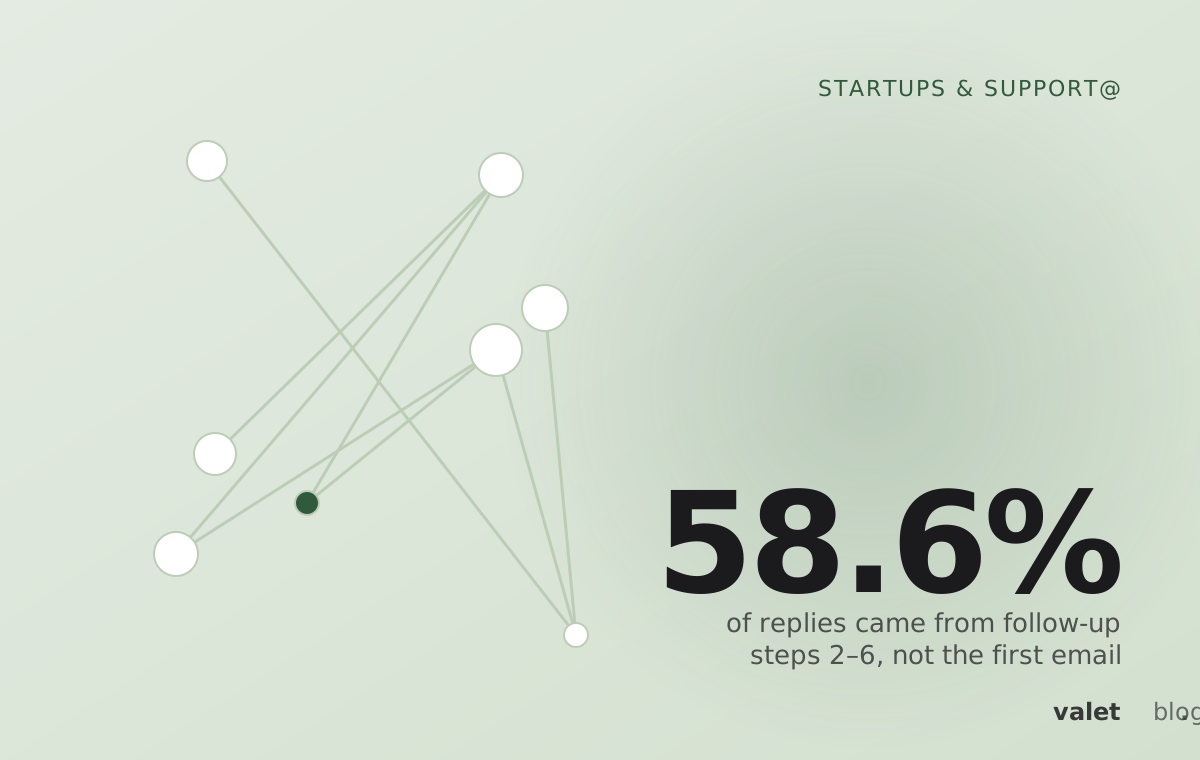
For an inbound demo request, send one complete reply the same day (answer their question, offer two real times), then at most two nudges: about two days later with something new, and about a week later stating when the held time expires. Then close with a reason. Belkins' 2026 study of 7.53 million B2B emails found 58.6% of replies came after the first message, so one email is too few; eight touches is an outbound-team playbook, not an inbound one.
58.6%
of replies came from follow-up steps 2–6, not the first email
Belkins, 7.53M B2B outbound emails, 2026
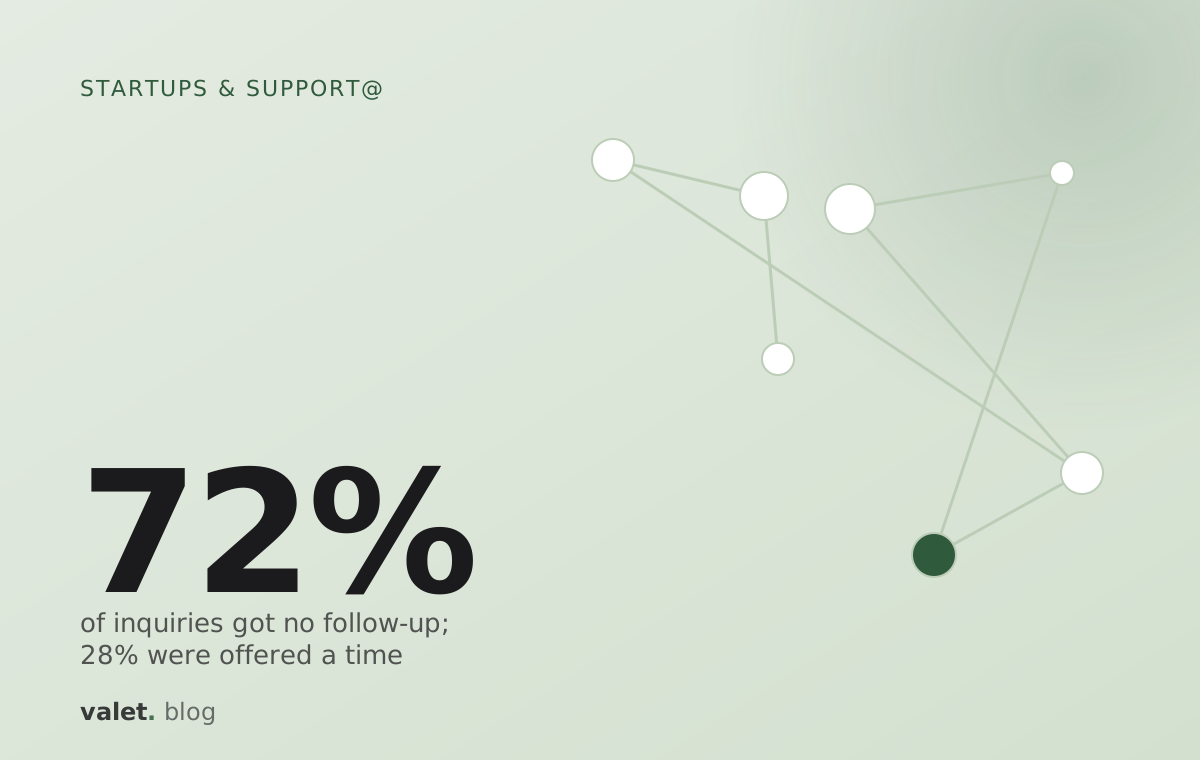
72%
of inquiries got no follow-up at all
Pied Piper PSI, 3,211 home-services inquiries, Apr 2026
38% → 79%
demo show rate reported by one founder after warming prospects with a product tour
Indie Hackers post, 340 tour visitors, May 2026
For an inbound demo request, send one complete reply the same day, then at most two nudges, then stop and record why. The reply answers the buyer's question and offers two real times. Nudge 1, about two days later, adds something new. Nudge 2, about a week after the reply, says when the held time expires and makes "no" easy. One email is too few: Belkins' 2026 study of 7.53 million B2B emails found 58.6% of replies came after the first message1. Eight to twelve touches is a playbook for outbound reps, not for a founder answering people who asked.
We cap follow-up at two by default in Valet. This post explains why, gives the sequence we would hand any founder, and is plain about what we do not yet know.
Why does demo-request follow-up need its own rule?#
A demo request is an inbound inquiry with a sales label on it. The buyer chose to write. That changes the economics of every message after the first one.
Most published advice for this query comes from outbound sales. Prospeo's 2026 playbook for demo-request follow-up recommends "eight to twelve touchpoints over 17-21 days across email, phone, and LinkedIn," and cites "RAIN Group research" that "meetings require 8 touches on average"4. That is a reasonable plan for a team with reps, a dialler and a sequencing tool, working a list of people who never asked to hear from them.
A seed-stage founder has none of that. The headcount is one or two people. The opportunity cost of every hour is product work. And the person on the other end already raised their hand. The question is not how to wear down resistance, but how to finish a conversation the buyer started.
What the eight-touch playbook gets right#
The eight-touch playbooks are right about one thing: a single message forfeits most replies. The data behind that is reasonably solid.
Belkins analysed 7.53 million B2B emails in 2026. The first email drew 41.4% of replies; steps two through six drew 58.6%; step three alone drove 35.6% of email-sourced meetings1. That is outbound email, and Belkins publishes no spam-complaint or unsubscribe data alongside it. The direction is still clear. Stopping after one message leaves most of the outcome on the table.
The failure most founders have is zero follow-up, not too much. Pied Piper's 2026 mystery shop of 3,211 home-services inquiries found 72% got no follow-up at all5. Leadferno's 2024 test of 225 small-business contact forms found 42.6% got no reply of any kind6. Neither study covers SaaS, but both describe what happens when follow-up depends on somebody remembering.
Why we cap it at two, not eight#
We cap follow-up at two because the third, fourth and eighth messages in an inbound thread cost more than they return. That is a judgement, not a measured optimum, and the reasoning matters more than the number.
First, the eight-touch figures come from a different activity. A request for a demo is not a cold prospect, and the trust you spend on a fourth "just bumping this" is trust you may need when the buyer does come back. Second, the louder sales statistics that justify heavy cadences are weak. Prospeo's playbook states that "78% of buyers purchase from the first company that responds," attributed to its own benchmarks4; versions of that figure have circulated for more than a decade with shifting sources. VentureBeat showed in 2014 that the widely quoted "80% of sales need 5–12 follow-ups" figure traced to an organisation that does not exist8.
Third, founders already feel the cost of empty nudges. A thread in r/sales (50+ comments, about a year old) puts it plainly: "I know I sound super desperate when I send a quick email a few days later after hearing nothing from a lead." The fix for that feeling is not more messages or none. It is a message that carries something the buyer needs.
The trade-off is real. Some buyers would have replied to a third or fourth nudge, and a cap of two gives them up by default. We accepted that cost because the alternative, a tool that keeps writing to people who have stopped reading, damages the one asset a small company cannot buy back: its reputation with people who asked.
The demo-request sequence#
The sequence has three messages and a close. Each message has a job, and none of them may introduce a price, a discount or a term you have not already set.
REPLY - same day (within the hour in working hours)
Subject: Re: Demo request - [their question, in their words]
Hi [name], thanks for reaching out.
[Direct answer to what they asked, from your pricing page,
docs or security notes. If you don't know yet, say when you will.]
I can show you [the specific thing they care about] on a 25-minute
call. I'm holding two times for you:
- [Tue 14 Oct, 10:00 ET]
- [Wed 15 Oct, 15:30 ET]
Reply with one and I'll send the invite. One question so I can
prepare: [e.g. which tool are you replacing?]

NUDGE 1 - about 2 days later, only something new
Hi [name], one thing that may help before you decide:
[a doc, a short recording or an answer to the next question
buyers like them usually ask]. Still holding [time] for you.

NUDGE 2 - about 5-7 days after the reply, expiry and an easy no
Hi [name], I'll release the time I'm holding on [date].
If a demo is still useful, pick any slot here: [link].
If the timing's wrong or you've gone another way, a one-line
reply is fine and I'll close this out.

CLOSE - same day as the stop condition
Record one reason (see the rubric below). No further messages
unless they write again or named a later date.
Two rules sit behind the template. The reply answers before it schedules: Techstars mentor Nora Khalili notes that "If an objection (concern, obstacle, hesitation, etc.) exists, it will only get larger in their minds when they walk away"7. And a calendar link goes in nudge 2 as a fallback, not in place of real times in the reply. For the operating setup behind this (who owns sales@, the facts sheet, the weekly review), see why inbound leads don't convert at a tiny startup.
What should you send when a demo is booked, or missed?#
Once a demo is booked, the goal changes from getting a reply to getting attendance. Andrew Schafer's 2023 advice on demo-request flows sets out a sensible pattern: a confirmation with product details, a follow-up two days later with a relevant customer example, and a reminder the day before the call3. Schafer's subtitle is the reason: "There are no spare customers."3
Show rate is where the money moves. One founder reported on Indie Hackers in May 2026 that demo show rate rose from 38% to 79% for prospects who first went through a five-minute product tour; the test ran 30 days with 340 tour visitors2. That was cold outbound, not inbound, and one founder's experiment. The founder's lesson still travels: "The tour doesn't replace the conversation. It earns the right to have a better one."2
For a no-show, send one message the same day. No guilt, two new specific times, an easy way to say the timing is wrong. If the buyer misses a second booked demo without a word, close the request. A third chase costs your calendar and teaches the buyer that your time is free.
| Close when | Reason to record | What to review monthly |
|---|---|---|
| Two nudges sent, no reply | No reply after cap | Did the reply answer their question? Were real times offered? |
| Buyer says no or asks you to stop | Declined / asked to stop | Tone and frequency of nudges |
| Buyer names a competitor or a decision elsewhere | Chose someone else | Speed and completeness of first reply |
| Buyer names price or budget | Price | Whether pricing was visible before the request |
| Two booked demos missed without a word | No-show twice | Confirmation and reminder messages |
| Outside who you serve (size, use case, region) | Not a fit | Whether the site says who it is for |
| Buyer names a later date | Parked until [date], not lost | Set the date; do not count it against the cap |
What is a better demo-request flow worth?#
The value is extra demos held, times your close rate, times contract value. The inputs below are an illustration with stated assumptions.
Illustration A seed SaaS with 20 demo requests a month, an $8,000 annual contract value and a 20% close rate on demos held. If confirmations, reminders and a complete first reply lift show rate by 10 points, that is 2 more demos a month and about 0.4 more contracts, roughly $38,000 a year. The Indie Hackers lift of 38% to 79%2 would be worth about four times that, but it came from a different setup and should not be planned against.
Compare that with your burn rate rather than with a sales hire. The sequence above costs no headcount. Its unit economics are a few minutes of founder time per request, against contract values in the thousands.
What we do not know yet#
Reply rates by nudge number for inbound demo requests have not been published by anyone we can find. The Belkins figures are outbound1, and the cadence above is a convention built from them and from inbound practice, not a measured optimum.
How we are measuring this: reply and booking rates for the first reply, nudge 1 and nudge 2 could be measured as inquiries move through Valet; no figure is published yet, together with how often a capped thread is reopened by the buyer later. No figures are published yet.
The unresolved question for the industry is the one this post cannot settle: whether a third nudge with real news (a new feature, a changed price, an integration the buyer asked about) earns its place on inbound. Our default says no unless something changed. For the general version of this rule, see how many times to follow up with a lead. For why follow-through matters more than first-reply speed, see the first reply is free; follow-up is where leads die.
Where Valet fits#
Valet runs this sequence for written inbound, including demo forms and sales@. It answers from your own facts (pricing, plans, integrations, security notes), offers and holds real times from your calendar, books the demo and sends the invite. The Valet follow-up cap sends two nudges by default, each with something useful, then stops and tells you why. Discounts, custom terms and contracts come to you with one-tap replies, and the buyer is told when you will reply. Every message has a Valet receipt and is signed as your AI assistant.
The free lead check reviews 10–20 recent demo requests and shows what went unanswered, what stopped after one reply, and what it was worth.
Questions people ask
How many times should you follow up on a demo request?
Twice after your first reply, with something new each time, then stop and record a reason. The buyer asked to hear from you, so the risk is too few useful messages, not too many. Sequences of eight or more touches are built for outbound reps prospecting people who never asked.
What should a demo no-show follow-up email say?
Send one short message the same day: no guilt, two specific new times, and an easy way to say the timing is wrong. If they miss a second booked demo without a word, close the request with a reason rather than chasing.
Should I offer a discount to get a demo request to reply?
No. A discount sent to someone who has gone quiet answers a question they did not ask and sets the price before you have learned what they need. If price is the objection, make it easy for them to say so and handle it yourself.
When should I mark a demo request as lost?
When the buyer declines or asks you to stop, when two nudges have gone unanswered, when they miss two booked demos without a word, or when they clearly fall outside who you serve. Record one reason every time so you can see patterns.
Sources
Confidence: H primary source checked · M credible secondary or reported · L vendor claim or single report. Reddit and forum items are quoted from public threads and summarised, not endorsed.
- Sales follow-up statistics · Belkins · 2026 M
- The "Book a Demo" button was killing my pipeline. Here's what I replaced it with · Indie Hackers · 2026-05-12 M
- Get More Leads From Your "Request A Demo" Button · Andrew A. Schafer (Substack) · 2023-11-09 M
- Demo Request Follow Up: 2026 Playbook + Templates · Prospeo · 2026 L
- Precision Garage Door Ranked #1 in Customer Lead Handling Effectiveness Home Services Study (Pied Piper PSI 2026) · BusinessWire / Pied Piper Management Company · 2026-04-12 H
- Research: Website contact forms and lead management, uncovering costly mistakes · Leadferno · 2024-06-28 H
- Why You Are Losing Deals · Techstars (Nora Khalili) · 2025-06-03 M
- These incredible sales stats everyone cites are actually completely false · VentureBeat · 2014-08 H
How to cite this page
Cite this page
Valet, "Demo-request follow-up without a sales team: the two-nudge sequence and when to stop", valet.team, October 2026.
Keep reading
 Startups & support@Should a startup use AI for customer support? What founders who lost customers say, and the three missing controlsCustomers accept AI support when they can reach a person. The failures that cost startups customers trace to three missing controls, not to the model.Data desk · 11 min · 1 October 2026
 Startups & support@How to handle support@ as a solo or 3-person SaaS founder (without hiring, and without a bot that traps people)Sort support@ into four categories, give each a written promise and an automation level, and check the handoffs every week. Here is the runbook, plus the six ways it breaks.Playbooks · 12 min · 1 October 2026
 Startups & support@An AI agent that answers vs one that finishes the job: what "acts" means for a small business, and the four controls that make it safeMost AI tools sold to small businesses answer the first message and stop. This piece defines what it means for an agent to finish the job, traces where answer-only tools lose the inquiry, and sets out the four controls that make acting safe.Technical desk · 11 min · 1 October 2026