
Definitions & data
What is an action receipt for an AI agent? "What did the AI say, and why?" The eight fields, an example and the undo window
Owners ask one question about an AI that talks to customers: what did it say, and why? An action receipt answers it for each message. This is the definition, the eight fields, a worked example, what can be undone, and a spec anyone can copy.
Short answer
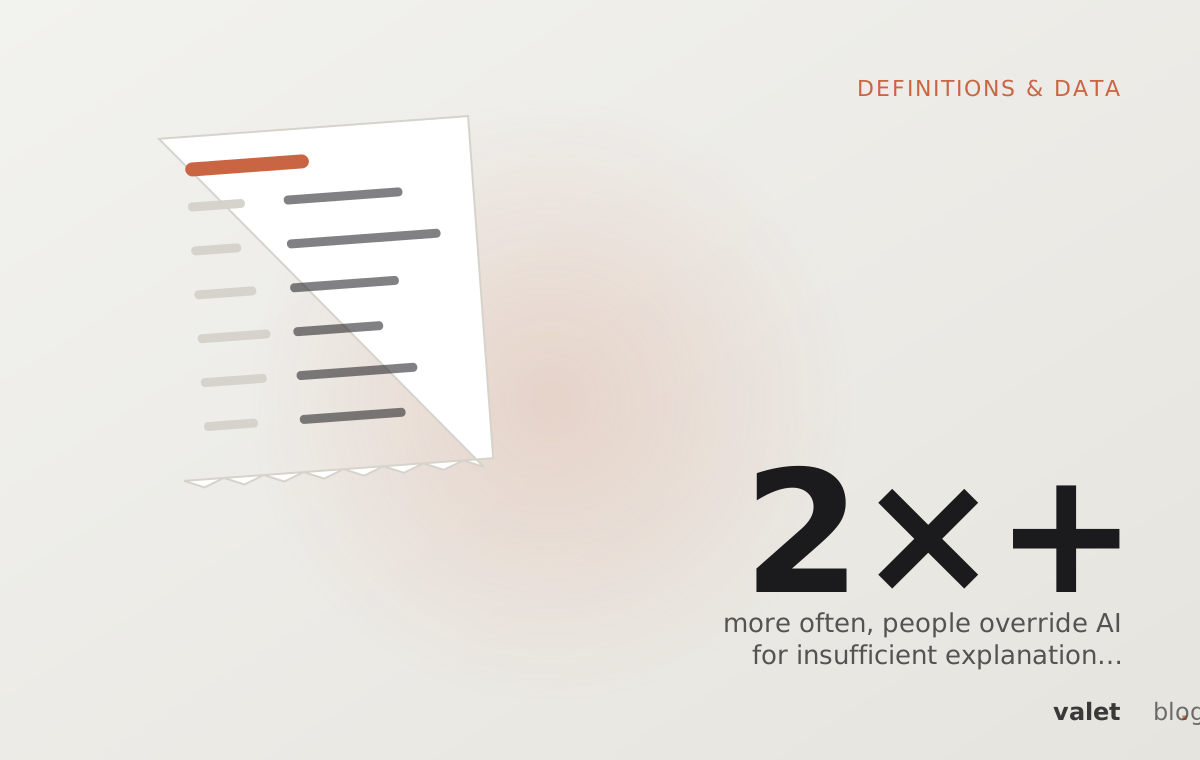
An action receipt is a per-message record of what an AI agent did for a customer and why: what was asked, the rule applied, the sources used, the action taken, who approved it, how it was sent and labelled, what the customer was promised, and what can still be undone. It differs from a transcript, which shows words but not reasons. SAS/IDC reported in September 2026 that missing explanation is cited more than twice as often as a wrong answer when people override AI.
2×+
more often, people override AI for insufficient explanation than for a wrong answer
SAS/IDC via Semafor, 2,700 decision-makers, 2 Sep 2026
CAD $812.02
Air Canada was ordered to pay over its chatbot's wrong answer
Moffatt v. Air Canada, 2024 BCCRT 149
6%
of small businesses highly trust AI with their brand voice
Bluehost, 350 US owners, 2026
An action receipt is a per-message record of what an AI agent did for a customer and why. It holds eight fields: what was asked, the rule applied, the sources used, the action taken, who approved it, how it was sent and labelled, what the customer was promised, and what can still be undone. A transcript shows the words; a receipt shows the reason behind them. The reason is what people need. In a September 2026 SAS/IDC study of 2,700 decision-makers, "insufficient explanation" was reported as the top reason for overriding an AI decision, cited more than twice as often as the answer simply being wrong1.
We publish this definition and the spec below so any owner can hold any AI tool to it, ours included.
What is an action receipt for an AI agent?#
An action receipt is created every time an AI agent sends a reply or takes an action on a customer's behalf, and it is written for the owner rather than for an engineer. Three neighbouring records are often confused with it.
- A transcript records the words exchanged. It answers "what did the AI say?" but not "why?".
- A system audit log records events in machine terms: API calls, timestamps, user IDs. It is complete and unreadable to most owners.
- A conversation summary is a paraphrase written after the fact. Its quality varies by conversation.
The receipt sits between them. It is one record per reply or action, in plain language, with the rule and the source attached. An owner should be able to read one in under a minute and know whether the agent did what the business would have done.
Why "what did the AI say, and why?" needs an answer for every message#
We decided early that every Valet reply would carry a receipt. The reasoning was a trust calculation. An owner who cannot see what an assistant said will, sensibly, stop letting it say anything, and the cost of the product is then all overhead and no work. Bluehost's 2026 survey of 350 US small-business owners found only 6% highly trust AI with their brand voice5. A tool asking for that trust has to show its working.
The public record shows what happens without per-message records:
- Summaries vary. A G2 reviewer of Smith.ai's AI receptionist (construction, 24 September 2025) wrote: "I wish that the summary were consistent some are very detailed and some are not."2
- Context gets lost at handoff. In an r/CRM thread titled "Best AIs for customer support? Tested a bunch." (60+ comments, about seven months old), the question that stuck was: "When AI escalates to a human, how much context actually transfers?"
- Owners end up reading logs by hand. An r/Dentists thread from late September 2026 is titled "Honest experience with an AI receptionist: I read every failed call from 15 months". One failure pattern it names: "AI said it would do it, then couldn't, and took a message".
Developers building agents that spend money have reached the same conclusion from the other side. Show HN posts in 2026 include Ledge, described as a "policy layer for AI agent payments (prevents unauthorized txns)"6. The common idea is a record of what the agent was allowed to do, checked at the moment it acts.
The eight fields of an action receipt#
The eight fields below are the spec. Each answers one question an owner, a customer or a tribunal could ask about a single reply. A header carries the time, the inquiry and its state.
| # | Field | What it records | The question it answers |
|---|---|---|---|
| – | Header | Timestamp, inquiry reference, current state (for example Time held) | When, and where in the conversation? |
| 1 | Asked | The customer's message in their own words, the channel, and when it arrived | What was the AI responding to? |
| 2 | Rule | The topic it matched and that topic's setting (for example Autopilot, Ask me first, Always you) | Was the AI allowed to answer this alone? |
| 3 | Sources | The owner's documents used: price list and its version, calendar, policy page | Where did the facts come from? |
| 4 | Action | What was done: reply sent, time offered, time held with expiry, invite sent, handed to owner | What changed in the world? |
| 5 | Approved by | Automatic under the rule, owner one-tap, or owner edit | Who let it go out? |
| 6 | Sent as | The address it was sent from and the label (signed as the business's assistant, says it is AI) | What did the customer see? |
| 7 | Promise | What the customer was told happens next: a hold expiry, an owner reply-by time | What does the business now owe? |
| 8 | Undo | What can still be reversed, how, and until when; how to correct or pause the topic | Can this be taken back? |
Spec as published by Valet, 1 October 2026. Free to copy and adapt with attribution.
Fields 2 and 3 carry most of the weight. A wrong answer with a correct source points at the agent. A wrong answer with a wrong source points at the document, which is the cheaper fix. Without both fields, every error looks the same.
An example action receipt#
The example below shows one receipt for one action: a held time at a small venue. It is an illustration, not a real customer.
Receipt (example)
- Asked
- "Is Saturday 14 June free for 120 guests, and what is the hire fee?" (website form, Sun 21:10)
- Rule
- Availability and published prices: Autopilot
- Sources
- Calendar; 2026 price list
- Action
- Answered the fee from the price list; held Saturday 14 June
- Approved by
- Automatic (Autopilot)
- Sent
- From bookings@ (the business's own address), signed as the business's AI assistant
- Promise
- Hold kept until Wed 18:00
- Undo
- Release the hold any time before Wed 18:00; the email itself cannot be unsent
The same record in a machine-readable form lets an agency or a developer store receipts from more than one tool in one place. Field names are suggestions; the values are the same illustration.
{
  "time": "Sun 21:11",
  "inquiry": "INQ-0001",
  "state": "Time held",
  "asked": {
    "text": "Is Saturday 14 June free for 120 guests, and what is the hire fee?",
    "channel": "website form",
    "received": "Sun 21:10"
  },
  "rule": { "topic": "Availability and published prices", "setting": "Autopilot" },
  "sources": ["Calendar", "2026 price list"],
  "action": ["reply sent", "time held: Sat 14 June"],
  "approved_by": "automatic",
  "sent_as": { "from": "bookings@", "label": "AI assistant for the business" },
  "promise": "Hold kept until Wed 18:00",
  "undo": { "reversible": ["release hold"], "until": "Wed 18:00",
            "not_reversible": ["email sent"] }
}
The undo window: which AI actions can be reversed?#
"Undo" is not one feature. It is a property of each action, and a receipt should state it per action rather than promise it in general. The table sets out the common cases for an inquiry assistant.
| Action | Reversible? | How, and until when |
|---|---|---|
| Reply sent | No | Correct with a further message; fix the source so it does not recur |
| Time offered | Yes, with a message | Withdraw the offer before the customer accepts |
| Time held | Yes | Release before the stated expiry |
| Booking and invite | Yes, with notice to the customer | Cancel the event the agent created; tell the customer why |
| Handed to owner | Not applicable | The promise field fixes the reply-by time the owner must meet |
| Topic answering in future | Yes | Pause the topic so the agent stops answering it |
The first row is the uncomfortable one. Once a customer has read a price, no software can take it back. That is why the rule and source fields matter more than any undo button: they let the business stop a wrong answer from being sent twice.
How receipts help when a customer disputes what the AI said#
A receipt turns a disputed answer into a lookup. Two public cases show what the lookup would have found.
In June 2026 BMW Toronto's chatbot offered a customer CAD $27,162.79 for a used X3, against the dealer's real offer of CAD $20,000; the dealer revoked the offer and later honoured it3. The dealer's sales manager said a human employee's miscommunication led the bot to read the amount the customer still owed on the car as the amount the dealership would pay3. The number was real; it came from the wrong record. A Sources field would have shown that in one line.
In Moffatt v. Air Canada (2024 BCCRT 149), the tribunal ordered Air Canada to pay CAD $812.02 after its chatbot gave wrong information about a bereavement fare, and rejected the argument that the chatbot was a separate legal entity responsible for its own actions4. A receipt does not change who is responsible. It shortens the time to find out what was said, from which page, under which rule. This is not legal advice; check with counsel on whether a wrong answer binds you.
What the spec leaves out, and the open question#
The spec leaves out a confidence score. A number such as "92% confident" invites the owner to trust a figure the owner cannot check. The rule and the source can be checked. Given the SAS/IDC finding that explanation, not accuracy, drives overrides1, we chose the checkable fields.
It also leaves out anything the agent did not touch. A receipt covers the reply and the action, not the rest of the inbox. That boundary is deliberate: Valet never reads the rest of the inbox, and a receipt standard should not require a tool to.
The open question is adoption. A receipt is only useful if buyers ask for it. Until vendors publish per-message records as a matter of course, the most useful thing an owner can do is put the eight fields into a vendor checklist, such as the questions to ask an AI vendor before it talks to your customers, and see which answers come back.
Where Valet fits#
Every Valet reply carries a Valet receipt: what was asked, the rule used, the sources used, where it was sent from and how it was labelled, with "Correct this" and "Pause topic" on each. Valet answers only from the owner's own facts, signs every reply as the business's assistant and says it is AI, and sends money, complaints and contracts to the owner with the customer told when the owner will reply. The receipt is also what makes our pricing checkable; see what counts as a booking made by Valet.
To see what your current replies would look like with a record behind each one, the free lead check takes 10–20 recent inquiries and shows what went unanswered, what stopped after one reply, and what it was worth.
Questions people ask
What is an action receipt for an AI agent?
A record created each time an AI agent replies to or acts for a customer, showing what was asked, which rule applied, which of the business's sources were used, what was done, who approved it, how it was sent and labelled, what the customer was promised, and what can still be undone.
How is an action receipt different from an audit log or a transcript?
A transcript shows the words exchanged. A system audit log shows events in machine terms. An action receipt is written for the owner and adds the reason: the rule and the sources behind each reply, so a disputed answer can be traced in seconds.
Can I see what my AI replied to customers?
Ask your vendor for a per-message record, not a summary. Reviewers of some AI receptionists report that summaries vary; one G2 reviewer wrote that "some are very detailed and some are not." A per-message receipt with rule and sources is the standard to ask for.
Can you undo what an AI agent did?
Some actions can be reversed and some cannot. A held time can be released and a calendar event the agent created can be cancelled. A sent email cannot be unsent; it can only be corrected by a further message. A receipt should say which applies and until when.
Do action receipts help if a customer disputes what the AI said?
Yes. A receipt shows the source the answer came from, so a disputed price or policy can be checked against the business's own documents. It does not decide liability; check with counsel on whether you must honour a wrong answer.
Sources
Confidence: H primary source checked · M credible secondary or reported · L vendor claim or single report. Reddit and forum items are quoted from public threads and summarised, not endorsed.
- Deployment of AI in businesses outpaces trust, study finds (SAS/IDC Data and AI Impact Report) · Semafor · 2026-09-02 M
- Smith.ai AI Receptionist reviews · G2 · 2025-09-24 H
- BMW dealer forced to pay $5,000 extra for used X3 over AI chatbot error · The Drive · 2026-06-20 H
- A word of caution: company liable for misrepresentations made by chatbot (Moffatt v. Air Canada, 2024 BCCRT 149) · McMillan LLP · 2024-02 H
- State of small business AI confidence · Bluehost · 2026 H
- Show HN: Ledge, "policy layer for AI agent payments (prevents unauthorized txns)" · Hacker News · 2026-03 H
How to cite this page
Cite this page
Valet, "What is an action receipt for an AI agent? The eight fields, an example and the undo window", valet.team, October 2026.
Keep reading
 Definitions & dataHow to audit your last 90 days of inquiries: the Lost Lead Audit method, template and agency versionA spreadsheet, a handful of Gmail searches and five outcome labels will show you how many inquiries you never answered, how many stopped after one reply, and what they were worth.From the Valet team · 11 min · 1 October 2026
 Definitions & dataThe lead response statistics everyone quotes, traced to their sourceMost of the numbers on speed-to-lead pages are 2007 to 2014 vintage, misattributed, or invented. Here is the citation chain for each one, and the newer studies with a sample size you can name.Technical desk · 13 min · 1 October 2026
 Definitions & dataInbound inquiry response and follow-up statistics (2026), by verticalEvery number here names its sample, its channel and its year. The table shows which verticals have measured follow-up at all, and the one statistic nobody has published yet: inquiries answered once and then dropped.Playbooks · 8 min · 1 October 2026