
Definitions & data
What counts as a booking made by Valet: the public outcome-attribution rule
Valet charges a fee only for bookings or quotes it wins. This page states exactly what that means, what does not count, how an owner checks a fee against their own calendar, and how the rule compares with Intercom, HubSpot, Clio and Tidio.
Short answer
A booking made by Valet is an inquiry that arrived through a channel Valet handles, where Valet offered or held a real time from the owner's calendar, the customer confirmed, and Valet created the calendar event and sent the invite. Bookings the owner makes by phone or by hand do not count. Unlike a resolution (Fin bills $0.99 when "no further help is requested"), the owner can check every booking in their own calendar.
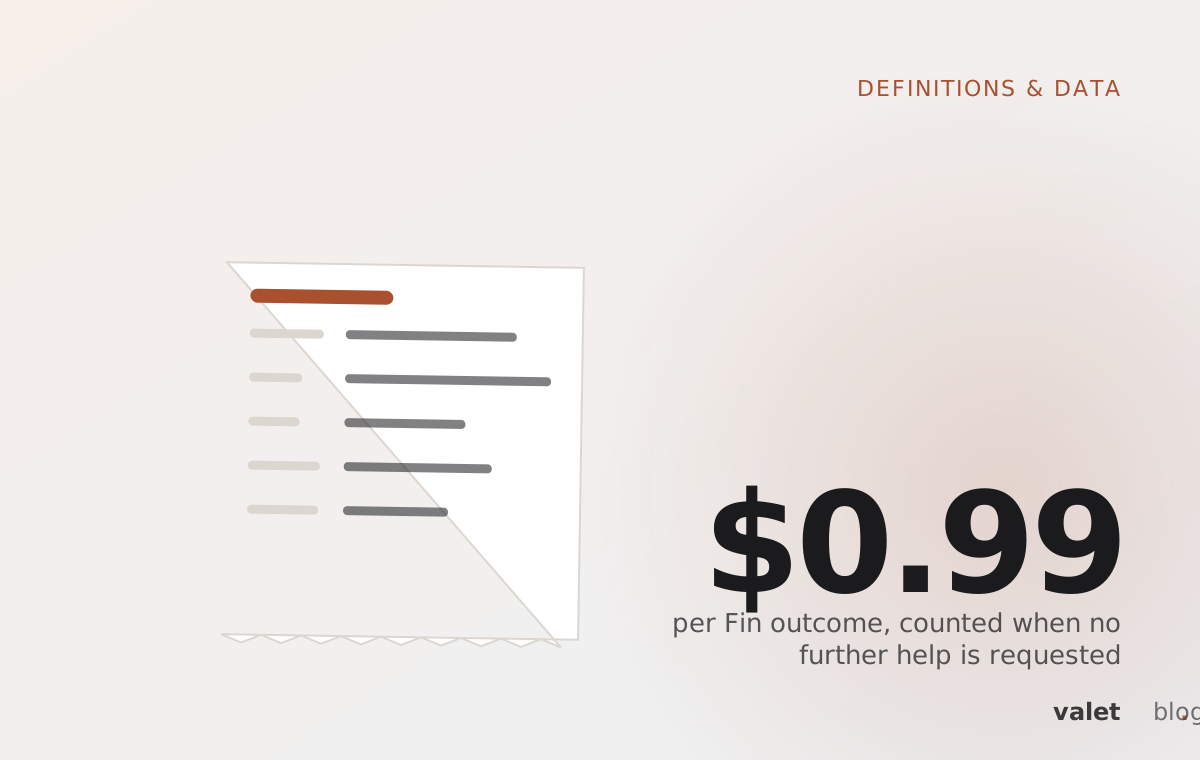
$0.99
per Fin outcome, counted when no further help is requested
fin.ai/pricing, checked 1 Oct 2026
$25
per converted client for Clio Grow AI, the one booking-like unit in this set
LawNext, 20 Aug 2026
1 in 3
AI-touched tickets handed to a human never got a human reply
Gorgias Ecom Lab, Oct 2025–Apr 2026
A booking made by Valet is an inquiry that arrived through a channel Valet handles, where Valet offered or held a real time from the owner's calendar, the customer confirmed, and Valet created the calendar event and sent the invite. That is the only event, apart from a quote the customer accepts in writing, for which Valet charges its outcome fee. Bookings the owner makes by phone or by hand do not count. We publish the rule because a fee tied to an outcome is only fair if the buyer can see the outcome. Fin bills $0.99 when "no further help is requested after Fin's last answer"1. A booking sits in your own calendar.
This page states the rule as of 1 October 2026. When it changes, the page changes, and the date at the top changes with it.
Why we charge per booking, not per reply or per resolution#
We price Valet as a small monthly base plus a fee only for bookings or quotes Valet wins, capped monthly and month to month. The decision behind that sentence was about which unit to put the fee on, because the unit decides what the product is rewarded for.
A per-reply fee rewards volume. An assistant paid per message is paid to write more messages, which is the opposite of the Valet follow-up cap of two useful follow-ups. A per-resolution fee rewards an ending that the vendor classifies. A per-booking fee rewards the event the owner hired us for. Of the three, only the last puts our revenue and the owner's revenue on the same line.
The trade-off is plain. When Valet does the work and the customer books someone else, we earn no fee. That is margin dilution we accept on purpose. The alternative would be unit economics that improve when the owner's do not.
What the market's pricing pages say#
Outcome pricing is now the default story for AI support, and the case for it is easy to make. HubSpot's chief customer officer, as reported by Resolve247, put it in one line: "Outcome-based pricing removes that risk. You pay when it works, full stop."3 We agree with the direction. The question is who decides that it worked.
Fin charges $0.99 per outcome with a 50-outcome monthly minimum, and defines a resolution as "No further help is requested after Fin's last answer."1 HubSpot reportedly cut its Breeze Customer Agent price to $0.50 per resolved conversation in April 2026, with "resolved" reported as no human handoff within 72 hours3. Tidio offers "Pay-per-resolution billing" only on its Premium plan, listed as "Contact for pricing"5. Each of these units is observed by the vendor's system. The buyer sees the bill and a transcript.
Where per-resolution pricing breaks: an outcome the buyer cannot see#
A resolution defined as the absence of a further request counts a customer who was helped and a customer who gave up the same way. The meter cannot tell them apart, and neither can the buyer, after the fact.
Handoff data shows why that matters. Gorgias' analysis of AI-touched tickets from October 2025 to April 2026 found that 55% ended in a human handoff and that one-third of handed-off tickets never received a human reply6. Under a definition that turns on whether a handoff happened within a window, a customer who needed a person and did not get one in time can be billed as resolved.
Intercom has published the clearest account of why a business result is hard to bill. Writing about Fin's sales role on 8 May 2026, it said the purest outcome price "would be a percentage of closed revenue," and then declined it for two reasons2:
Between the moment Fin qualifies a lead and the moment a deal closes, dozens of things can impact the final result.
Intercom blog, on attribution, 8 May 2026
To track closed revenue, we'd need deep integration into every customer's CRM, tracking each opportunity from qualification through to close.
Intercom blog, on measurement, 8 May 2026
Both objections are sound for a long B2B sale. For a small service business they shrink, because the result is a single event with a timestamp: a time confirmed on a calendar. Attribution is the question of whose work produced that event. Measurement is the question of whether the buyer can see it. A booking created by the assistant, in the owner's calendar, with an invite to the customer, answers both.
The rule: what counts as a booking made by Valet#
The rule below is the whole attribution standard. Every condition must hold. If any one fails, no fee applies.
A BOOKING MADE BY VALET — all five must be true

1. Channel   The inquiry arrived through something Valet handles:
             a forwarded address (info@, hello@, bookings@, support@),
             a website contact form, a listing or marketplace lead email,
             or the owner's Valet page.
2. Work      Valet answered it and offered or held a real time
             from the owner's calendar.
3. Event     The calendar event is one Valet created, and Valet sent
             the invite to the customer.
4. Confirmed The customer confirmed the time (the inquiry reached Booked).
5. Record    Each Valet reply on the inquiry has a Valet receipt.

A QUOTE WON BY VALET
   The customer accepted, in writing, a quote Valet sent from the
   owner's own price list.

DOES NOT COUNT
   - The owner booked it by phone, in person, or by hand.
   - The calendar event was not created by Valet.
   - A time was held but never confirmed.
   - The topic was set to "Always you" and the owner handled it.

CHECK IT
   Every fee points to one calendar event in the owner's calendar
   and to the receipts for that inquiry. Fees are capped monthly.
What happens when Valet hands a question to the owner#
Handoffs do not disqualify a booking on their own. Money, complaints, contracts, deposits, and health, legal or safety questions go to the owner with one-tap replies, and the customer is told when the owner will reply. If the owner answers with a one-tap reply and Valet then holds the time and creates the event, the booking counts: the event is Valet's, and the receipts show both the owner's decision and Valet's work. If the owner takes the thread over and books it personally, it does not count.
We chose this line because the alternative rewards the wrong behaviour. A rule that excluded every handed-off inquiry would pay us more for answering questions we should not answer. A rule that counted the owner's own bookings would charge the owner for their own work.
How an owner checks or disputes a fee#
An owner checks a Valet fee against two records, and neither depends on our classification. The first is the calendar: the event Valet created, with the invite sent to the customer, sits in the owner's own calendar. Valet only touches calendar events it created, so anything else on that calendar is the owner's.
The second record is the receipts. Every Valet reply carries a Valet receipt showing what was asked, the rule used, the sources used, where it was sent from and how it was labelled, with "Correct this" and "Pause topic" on each. A booking fee is a claim that a chain of those receipts ended in a confirmed event. If the owner reads the chain and disagrees that it was Valet's booking, the owner raises it with us, and the receipts and the calendar are the evidence both sides read. The receipt format is described in what an action receipt for an AI agent is.
How the rule compares with Intercom, HubSpot, Clio and Tidio#
The contrast that matters is not the unit price. It is whether a small business can verify each billed unit from its own records, and what it can do if it disagrees.
| Vendor | Billed unit and price | Definition (verbatim where available) | Verifiable by the buyer? | Dispute path |
|---|---|---|---|---|
| Fin (Intercom) | $0.99 per outcome; 50 minimum1 | "No further help is requested after Fin's last answer."1 | Partly: silence counts as success | Not stated in the sources cited here |
| Fin for Sales | $10 per qualified lead2 | Qualification; closed revenue explicitly not used2 | Partly: qualification is the vendor's judgment | Not stated in the sources cited here |
| HubSpot Breeze | $0.50 per resolved conversation (from $1.00, Apr 2026)3 | Reported as no human handoff within 72 hours3 | Partly: handoff timing is visible; correctness is not | Not stated in the sources cited here |
| Clio Grow AI | $25 per converted client4 | "when a client is hired who was captured through the voice agent, or when Grow AI revives a prospect who has stopped responding and they go on to sign their engagement agreement"4 | Mostly: the signed engagement is the firm's; "involved" needs a vendor record | "No charge if the lead doesn't convert or Grow AI isn't involved in the conversion"4 |
| Tidio Lyro | Per resolution on Premium only, "Contact for pricing"5 | No public definition on the pricing page5 | Unknown | Not stated in the sources cited here |
| Valet | Booking or quote won; small monthly base; fees capped monthly | The five-condition rule above | Yes: an event Valet created in the owner's calendar, plus a receipt per reply | Receipts and calendar event, raised with Valet |
HubSpot and Clio wording via secondary sources (confidence M). For the full set of resolution definitions, see what counts as an AI resolution.
Clio's rule is the closest to ours, and it is worth naming. It bills on a business result the firm can see, a signed engagement. The difference is the last mile: Clio's "involved" still rests on the vendor's record of the conversation, where Valet's rule rests on an event that exists in the owner's calendar only because Valet created it.
What this rule costs us, and what it does not settle yet#
The rule has a cost we can name. Valet does the answering, the holding and the following up on every inquiry it handles, and earns its outcome fee only on the ones that book. The opportunity cost of that work on inquiries that end as lost with a reason is ours, not the owner's. We think that is the correct place for it, since the owner already carries the cost of getting the inquiry in.
Three cases are not settled by this version of the rule, and we would rather list them than pretend otherwise:
- Cancellations. A customer who confirms and cancels later. This version does not fix a window in days for treating a cancelled booking differently.
- No-shows. A confirmed booking where the customer does not arrive. The calendar shows the event either way.
- Deposits. Deposits go to the owner, so Valet does not see whether one cleared. The rule therefore counts confirmation, not payment.
The open industry question is broader. Per-resolution vendors could publish a buyer-verifiable rule for the bookings their agents make, and Intercom has explained in public why it chose not to for closed revenue2. Until more vendors publish one, buyers should ask every outcome-priced tool the same three questions: what is the unit, where can I see it, and what happens when I disagree.
Where Valet fits#
Valet answers email, website forms, listing and marketplace lead emails, and requests on the owner's free Valet page, from the owner's own facts only. It offers and holds real times from the calendar, books, and sends invites, and every reply carries a Valet receipt and says it is AI. During early access the price is a small monthly base plus a fee only for bookings or quotes Valet wins, under the rule on this page, capped monthly and month to month.
To see how many bookings your current inquiries could have produced, the free lead check takes 10–20 recent inquiries and shows what went unanswered, what stopped after one reply, and what it was worth.
Questions people ask
What counts as a booking made by Valet?
An inquiry that came in through a channel Valet handles, where Valet answered, offered or held a real time from the owner's calendar, the customer confirmed, and Valet created the calendar event and sent the invite. A quote counts when the customer accepts in writing a quote Valet sent from the owner's price list.
Does Valet charge if I book the customer myself?
No. If you book by phone, in person, or by writing the reply yourself and adding the event to your calendar, Valet did not create the booking and no fee applies. Valet only touches calendar events it created.
How can I check a Valet booking fee?
Every fee maps to a calendar event Valet created, with an invite to the customer, in your own calendar, and to the Valet receipts for each reply on that inquiry. You can check both without relying on Valet's own classification.
How is pay per booking different from pay per resolution?
A resolution is classified by the vendor; Fin, for example, counts one when no further help is requested. A booking is an event the buyer can see in their own calendar. Pay per resolution can bill for a customer who gave up; pay per booking cannot.
Is there a cap on Valet's booking fees?
Yes. During early access the price is a small monthly base plus a fee only for bookings or quotes Valet wins, capped monthly, month to month.
Sources
Confidence: H primary source checked · M credible secondary or reported · L vendor claim or single report. Reddit and forum items are quoted from public threads and summarised, not endorsed.
- Fin pricing · Fin (formerly Intercom) · 2026-10-01 H
- Building outcome-based pricing for Fin for Sales · Intercom · 2026-05-08 H
- HubSpot Breeze pricing change · Resolve247 · 2026-04 M
- Clio grows Clio Grow with launch of Grow AI, providing 24/7 intake agents · LawNext · 2026-08-20 M
- Tidio pricing · Tidio · 2026-10-01 H
- The cheapest ticket is the one a human never touches · Gorgias Ecom Lab · 2026 H
How to cite this page
Cite this page
Valet, "What counts as a booking made by Valet: the public outcome-attribution rule", valet.team, October 2026.
Keep reading
 Definitions & dataHow to audit your last 90 days of inquiries: the Lost Lead Audit method, template and agency versionA spreadsheet, a handful of Gmail searches and five outcome labels will show you how many inquiries you never answered, how many stopped after one reply, and what they were worth.From the Valet team · 11 min · 1 October 2026
 Definitions & dataThe lead response statistics everyone quotes, traced to their sourceMost of the numbers on speed-to-lead pages are 2007 to 2014 vintage, misattributed, or invented. Here is the citation chain for each one, and the newer studies with a sample size you can name.Technical desk · 13 min · 1 October 2026
 Definitions & dataInbound inquiry response and follow-up statistics (2026), by verticalEvery number here names its sample, its channel and its year. The table shows which verticals have measured follow-up at all, and the one statistic nobody has published yet: inquiries answered once and then dropped.Playbooks · 8 min · 1 October 2026