
Trust & AI handoff
What to ask an AI vendor before it talks to your customers: 12 questions (limits, handoff, receipts, disclosure, undo, insurance)
The demo shows the AI writing a good reply. The questions that decide whether you keep your customers are about what happens when it should not reply at all.
Short answer
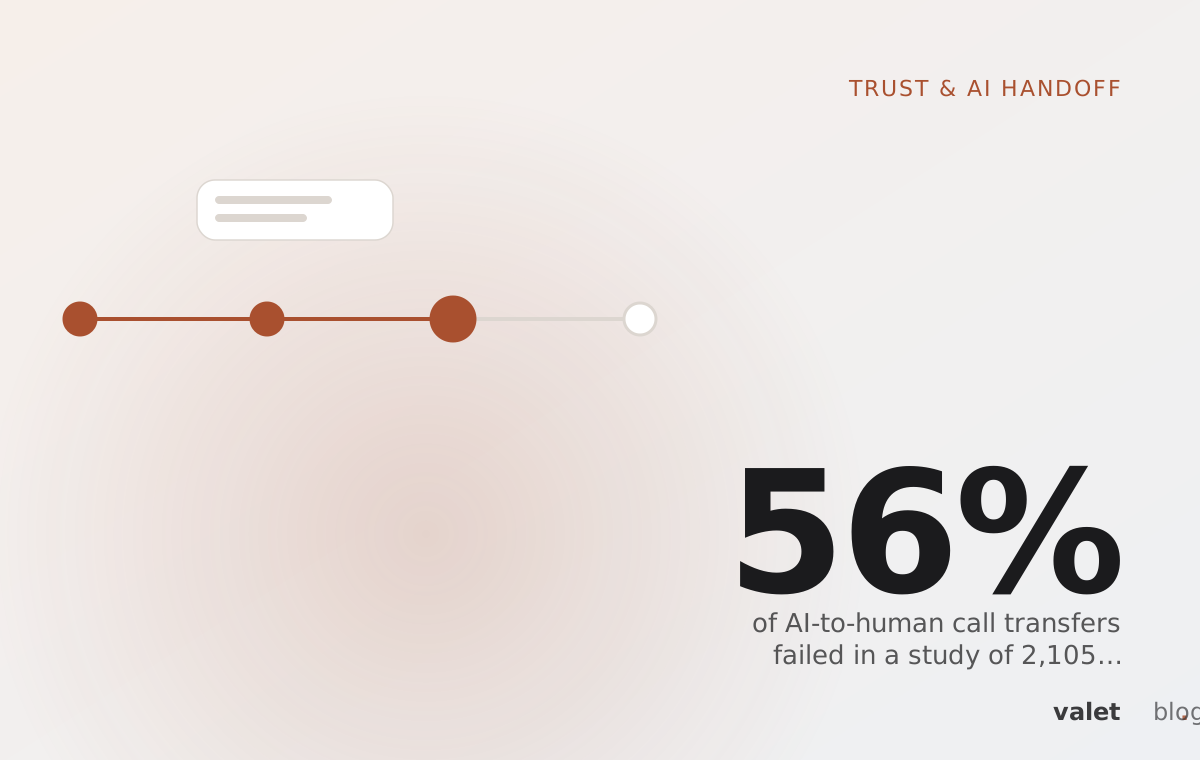
Ask twelve questions in six groups before an AI writes to your customers: limits (what it may say about prices and policy), handoff (when it stops, what the customer is told, what you receive), receipts (can you see each reply and why), disclosure (does it say it is AI), undo (how you pause and correct it) and liability (who pays when it is wrong). Handoffs are where AI service breaks most: Pied Piper found 56% of AI-to-human transfers failed (2025).
56%
of AI-to-human call transfers failed in a study of 2,105 dealerships and 200 independents
Pied Piper Service Telephone study via Auto Remarketing, 2025
6%
of small businesses highly trust AI with their brand voice (n=350)
Bluehost State of Small Business AI Confidence, 2026
2×
"insufficient explanation" was cited more than twice as often as a wrong answer as the reason to override an AI (2,700 decision-makers)
SAS/IDC via Semafor, September 2026
In March 2026 a developer posted on Hacker News that he had built an AI receptionist for a mechanic shop. One of the shortest replies came from a user called jofzar: "Not a single clip/recording of how this sounds? Like CMON this is the bare minimum here."1 Further down the same thread, another user explained why he had fired a plumber on a five-figure remodel. The plumber's AI receptionist "couldn't forward to me to human."2
Those two comments hold the whole buying problem. Before an AI writes to your customers, ask the vendor twelve questions in six groups: limits, handoff, receipts, disclosure, undo, and who pays when it is wrong. A good answer is specific and you can test it. A vague answer is also an answer.
Why the demo is the wrong place to judge an AI vendor#
An AI vendor demo shows the assistant writing a good reply to an easy question. Your customers will mostly send easy questions too. The ones that cost you money are the others: the price match, the complaint, the refund, the person who wants a human and says so twice.
Small-business owners already sense this. Bluehost surveyed 350 US small businesses in 2026. Only 16% had deployed an AI agent, and only 6% highly trusted AI with their brand voice. Their top fears were accuracy (32%) and losing the human touch (29%). Bluehost's summary was that owners "prioritize approval mechanisms before AI directly engages customers."3
Larger companies report the same instinct from the other side. In a SAS/IDC study of 2,700 decision-makers in 28 countries, the top reason people overrode an AI decision was "insufficient explanation of how it reached its answer." That reason came up more than twice as often as the answer simply being wrong.4
A thread in r/CRMSoftware (September 2026) put it in a buyer's plain words: "the biggest difference isn't really how well an AI can write a response."5 The twelve questions below are about everything else.
Limits: what will it say about prices, discounts and policies?#
Limits are the rules about what the AI may state as fact. The three limit questions decide whether your AI can create an obligation you never agreed to.
1. Where do its answers about money and policy come from?#
The question is whether the AI answers from your written price list and policies, or from whatever sounds right. In February 2026 a store owner in r/AiForSmallBusiness wrote that their Shopify bot was "literally promising free shipping to everyone for no reason." Another owner in the thread gave the fix that worked for them: keep codes and pricing "in a structured source" and let the bot answer only when it finds "an exact match, otherwise it should escalate/ask a human."6
2. What does it do when the answer is not in my facts?#
A good vendor tells you exactly what happens on a miss. The AI should say it does not know, pass the question to you, and tell the customer when you will reply. A vendor who says the model "handles it" has told you it will guess.
3. Can a customer talk it into a deal?#
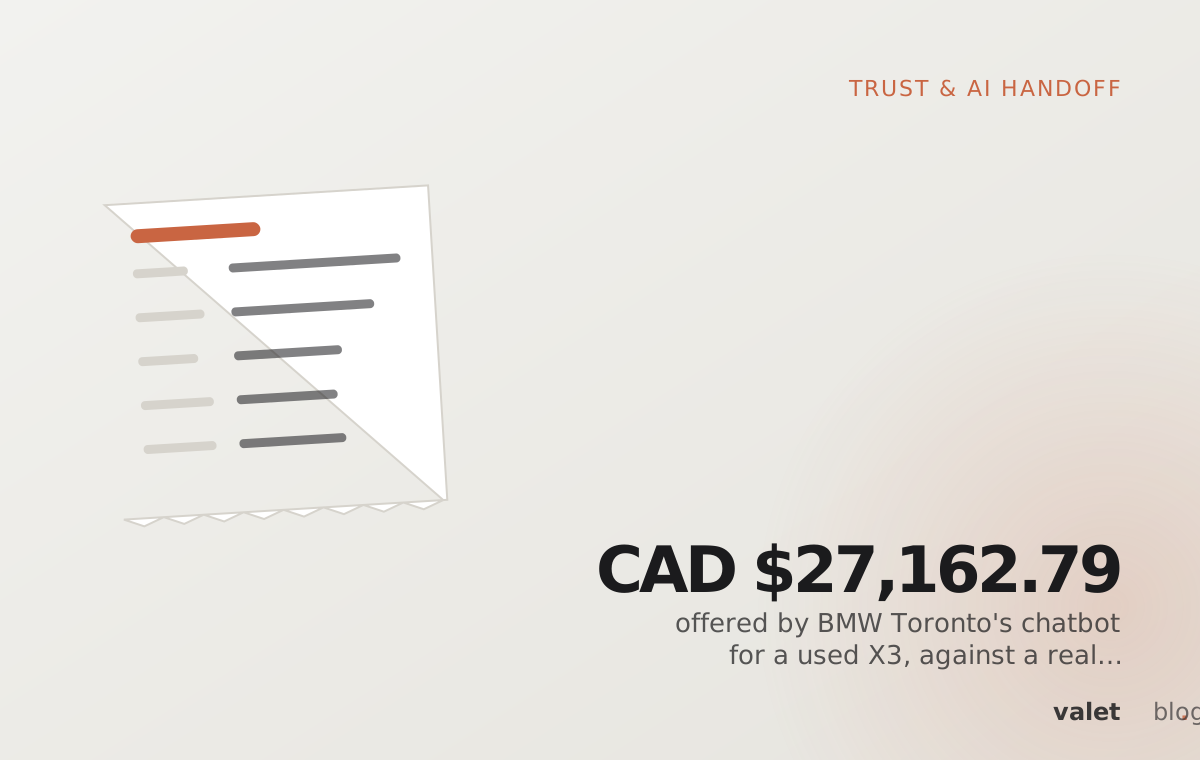
Ask who holds the authority to change a number. In June 2026 a BMW Toronto chatbot called Quinn offered a customer CAD $27,162.79 for a used X3. The dealer's real best offer was CAD $20,000. The figure came from a human employee's miscommunicated number, which the bot treated as an offer. The dealer revoked it, then honoured it after CBC News called.7 The safe answer from a vendor is that the AI has no authority to discount, match or negotiate at all.
Handoff: when does it stop, and who takes over?#
The handoff is the moment the AI stops answering and a person takes over. It is also where AI service breaks most often. In Pied Piper's 2025 study of 2,105 dealerships and 200 independent shops, 56% of AI-to-human call transfers failed. Pied Piper's Cameron O'Hagan said "handoffs to people frequently fall apart."8
4. What makes it stop, and can I set the triggers?#
Ask for the list of default triggers and whether you can add your own. Money questions, complaints, contracts, deposits and any request for a person should all be on it.
5. What does the customer hear while they wait?#
Ask to see the exact handoff message. Some products go quiet after handing off. Meta's Business Agent documentation, published by 360dialog, says: "Once the agent hands off to a human, it stops answering that chat." It also says "the handoff notice is the fixed message you define" and cannot be adapted per customer language.9 A good answer includes a reply-by time the customer can see.
6. What do I receive when it hands off?#
Ask what lands in front of you: the whole conversation, or a summary. One owner reviewing Smith.ai's AI receptionist on G2 wrote that the AI would collect a caller's details and then transfer them, and staff "would ask for all the same info again. That annoyed prospects for sure."10 A thread in r/CRM (60+ comments, c. March 2026) asked the same thing: "how much context actually transfers?"11
Check the pricing page here too. Resolve247 reports that HubSpot's Breeze Customer Agent counts a conversation as resolved when there is "no human handoff within 72 hours."12 Under a definition like that, a slow handoff can still be billed as a success. Our page on what counts as an AI resolution lays the definitions side by side.
Receipts: can you see what it said, and why?#
A receipt is a record of one reply: what the customer asked, the rule the AI applied, the sources it used and where it sent the reply. Receipts are how you answer a dispute in two minutes instead of two days.
7. Can I see every reply with the rule and source behind it?#
Ask to see a real record, not a dashboard of totals. In the BMW case the bad number started with a person, not the model. Only a record that names the source shows you that.7 Another G2 reviewer of Smith.ai wished "the summary were consistent some are very detailed and some are not."10
8. Can I see it handle real conversations before I sign?#
This is jofzar's question. Ask for sample transcripts of the hard cases: a price match, a refund request, an angry customer, a customer who asks for a person. Then send your own test inquiries during the trial.
Disclosure and undo: does it say it is AI, and how do you stop it?#
Disclosure means the customer knows they are writing to an AI. Undo means you can stop a topic and correct a reply once you see a problem.
9. Does every reply say it is from an AI assistant?#
In April 2025 a support agent called "Sam" at the code-editor company Cursor told a user that the product was designed to work with one device per subscription. As Ars Technica reported, "no such policy existed, and Sam was a bot." Afterwards co-founder Michael Truell wrote that AI responses used for email support "are now clearly labeled as such."13 In the EU, Article 50(1) of the AI Act has applied since 2 August 2026. It requires that people be "informed that they are interacting with an AI system" unless that is already obvious.14 Whether it applies to your business is a question for counsel; this is not legal advice.
10. If it gets something wrong, how fast can I pause and correct it?#
Ask what you press, and what happens next. A good answer names a control that pauses one topic without turning the whole assistant off. It should also let you correct the fact so the same mistake does not repeat. Ask whether the correction reaches the customer who got the wrong answer.
Liability and insurance: who pays when it is wrong?#
Liability for an AI reply usually sits with the business that deployed it. The last two questions find out whether your vendor or your insurer shares any of that.
11. What do your terms say about responsibility for the AI's output?#
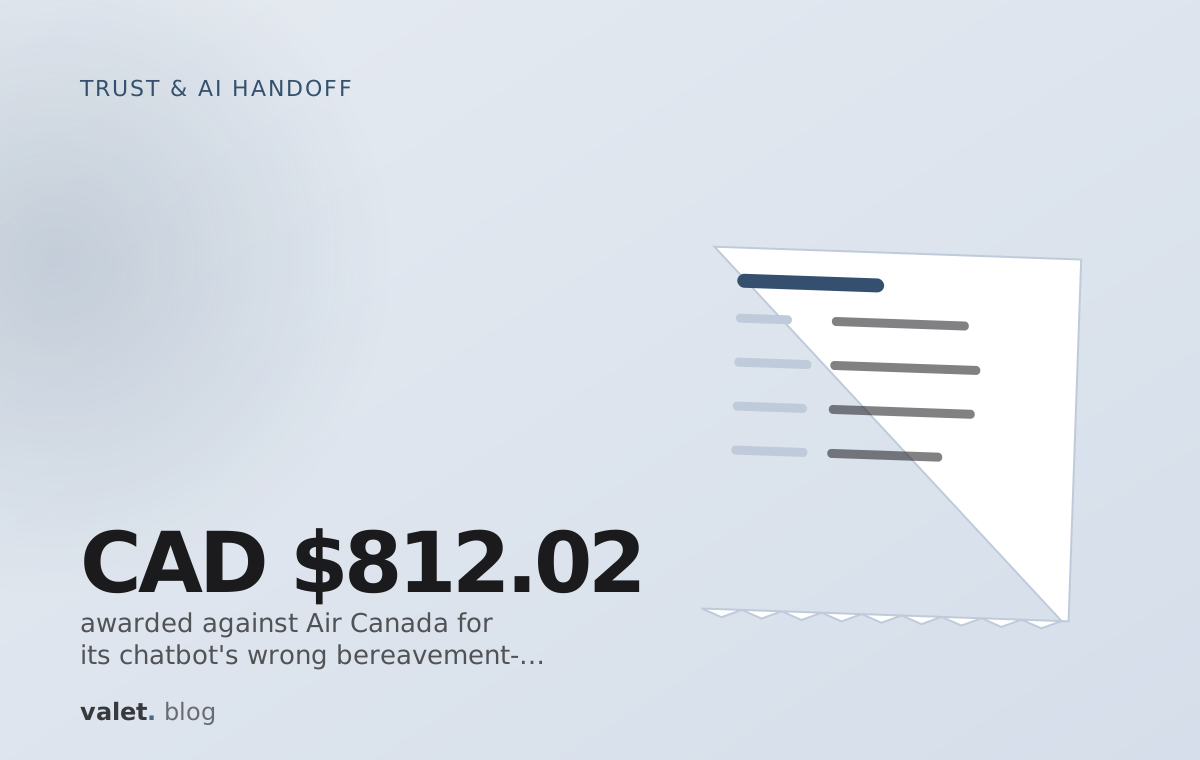
Read the vendor's terms, not the sales page. Intercom's Additional Product Terms, last updated 18 March 2026, are plain about it: "Customer is responsible for its use of the AI Product(s) and Output." They add that Intercom "makes no representations or warranties and provides no indemnities with respect to Output."15 Tribunals have taken the same line. In 2024 a British Columbia tribunal held Air Canada responsible for its chatbot's answer and awarded the passenger CAD $812.02.16
12. Does my insurance cover it?#
This one is for your broker, but the vendor should expect you to ask. MoneyGeek reports that three optional ISO exclusions for generative AI (CG 40 47, CG 40 48 and CG 35 08) took effect on 1 January 2026.17 PYMNTS reported in May 2026 that "small to mid-sized firms, often without specialized coverage, face the greatest exposure."18 Ask whether any of those form numbers appear on your policy.
The vendor checklist: 12 questions and what a good answer sounds like#
The checklist below fits on one page. Print it, take it to the demo and fill in the right-hand column yourself.
| # | Ask the vendor | A good answer sounds like | Walk away if you hear |
|---|---|---|---|
| 1 | Where do answers about prices, discounts and policies come from? | "Only from the price list and policies you write. Nothing else." | "The model knows your business from your website." |
| 2 | What happens when the answer is not in my facts? | "It says it doesn't know, sends it to you, and tells the customer when you'll reply." | "It handles almost everything." |
| 3 | Can a customer talk it into a discount or a match? | "It has no authority to change a price. Those go to you." | "We have strong guardrails in the prompt." |
| 4 | What makes it stop and hand off? Can I add triggers? | A written list (money, complaints, contracts, deposits, "a person") that you can edit. | "It detects frustration automatically." |
| 5 | What does the customer hear after a handoff? | A message naming who will reply and by what time. | "Someone will be in touch." Or silence. |
| 6 | What do I receive at handoff? | The full conversation, what it already said or held, and reply options. | "A summary." (Ask how long, and how consistent.) |
| 7 | Can I see each reply with the rule and source used? | "Every reply has a record: asked, rule, sources, sent from." | "You can see totals in the dashboard." |
| 8 | Can I see real transcripts of hard cases? | Samples of a price match, a refund and an angry customer, plus a trial on your own inbox. | Only scripted demo conversations. |
| 9 | Does every reply say it is AI? | "Yes, signed as your business's AI assistant." | "Customers can't tell the difference." |
| 10 | How do I pause a topic and correct a fact? | One control per topic, plus a correction that fixes the source. | "Open a support ticket with us." |
| 11 | What do your terms say about responsibility for output? | The clause, quoted, and what you would cover. | "Don't worry about that." |
| 12 | What should I ask my insurer? | "Check for CG 40 47, CG 40 48 and CG 35 08 on your policy." | "Insurance isn't relevant to chat." |
The checklist will not tell you whether your customers will like writing to an AI. Some will not. One commenter in that Hacker News thread wrote: "I would rather just be sent to a regular old answering machine."1 What the checklist can tell you is whether a customer who wants a person will reach one, and whether you can see what was said before they did.
For the handoff itself, our page on what "never stuck with a bot" has to mean has a contract you can copy.
Where Valet fits#
Valet is an AI assistant for written inquiries: email, website forms, listing leads and a free Valet page. Here is how its defaults answer the list. It answers only from the owner's price list, packages, calendar and policies, and never invents prices, discounts or policies (1 to 3). Money, complaints, contracts, deposits and health, legal or safety questions go to the owner with one-tap replies, and the customer is told when the owner will reply (4 to 6). The Valet receipt records what was asked, the rule, the sources and where the reply was sent from, with "Correct this" and "Pause topic" (7 and 10). Every reply is signed as the business's assistant and says it is AI (9). Valet makes no insurance claim, so question 12 stays with your broker. The free lead check starts with 10 to 20 of your recent inquiries.
Questions people ask
What should I ask an AI customer service vendor before buying?
Ask what the AI may say about prices, discounts and policies, and where those facts come from; when it stops and hands off; what the customer is told and by when; whether you can see each reply with the rule and source used; whether it says it is AI; how you pause or correct it; and who is responsible under the vendor's terms when it is wrong.
How do I evaluate an AI chatbot for my small business?
Skip the polished demo and test the edges. Send it a price-match request, a complaint, a question that is not in your facts and a request for a person. Then look at what the customer was told, what you received and whether you can see why it answered the way it did.
Who is responsible if an AI vendor's chatbot tells my customer something wrong?
Usually you. A Canadian tribunal held Air Canada responsible for its chatbot's answer in 2024, and Intercom's AI terms (updated March 2026) say the customer is responsible for its use of the output and that Intercom provides no indemnities for it. Read your vendor's terms, and check with counsel; this is not legal advice.
Does business insurance cover mistakes made by an AI assistant?
Not always. MoneyGeek reports that optional ISO generative-AI exclusions (CG 40 47, CG 40 48, CG 35 08) took effect on 1 January 2026. Ask your broker whether any of those form numbers appear on your policy.
Sources
Confidence: H primary source checked · M credible secondary or reported · L vendor claim or single report. Reddit and forum items are quoted from public threads and summarised, not endorsed.
- "I built an AI receptionist for a mechanic shop" (story 47487536, comment by jofzar) · Hacker News · 2026-03-23 H
- Comment by CodingJeebus on story 47487536 · Hacker News · 2026-03-23 H
- State of Small Business AI Confidence 2026 · Bluehost · 2026 H
- Deployment of AI in businesses outpaces trust, study finds (SAS/IDC) · Semafor · 2026-09-02 M
- "What I actually want from an AI customer support tool" (Google snippet) · Reddit, r/CRMSoftware · 2026-09-29 M
- "Finally figured out how to stop our AI chatbot from giving customers wrong info" (snapshot) · Reddit, r/AiForSmallBusiness · 2026-02-27 H
- BMW dealer forced to pay $5,000 extra for used X3 over AI chatbot error · The Drive · 2026-06-20 H
- Group 1 tops annual Pied Piper Service Telephone Effectiveness study as some stores lean into AI tools · Auto Remarketing · 2025 H
- Meta Business Agent: known limitations · 360dialog docs · 2026 H
- Smith.ai AI Receptionist reviews · G2 · 2025-10 to 2026-09 H
- "Best AIs for customer support? Tested a bunch." (60+ comments; Google snippet) · Reddit, r/CRM · c. 2026-03 M
- HubSpot Breeze pricing change · Resolve247 · 2026 M
- Cursor AI support bot invents fake policy and triggers user uproar · Ars Technica · 2025-04-17 H
- Article 50, checked (EU AI Act transparency obligations) · Scrutineyes · 2026 H
- Additional Product Terms: AI Products, section 5 "Accuracy" (last updated 18 March 2026) · Intercom · 2026-03-18 H
- A word of caution: company liable for misrepresentations made by chatbot (Moffatt v. Air Canada, 2024 BCCRT 149) · McMillan LLP · 2024-02 H
- Generative AI exclusion in general liability insurance · MoneyGeek · 2026 M
- Big insurance backs away from AI risk, and startups rush in · PYMNTS · 2026-05-01 M
How to cite this page
Cite this page
Valet, "What to ask an AI vendor before it talks to your customers: 12 questions", valet.team, October 2026.
Keep reading
 Trust & AI handoffThe customer who fired a contractor over a bot: what "never stuck with a bot" has to meanA homeowner dropped a plumber because the AI receptionist could not pass him to a person. The public cases since then show where handoffs break, and what a working one has to promise.Field reports · 11 min · 1 October 2026
 Trust & AI handoffCan a quote from my AI be binding? What BMW Toronto taught every business that prices by emailA chatbot at a Toronto BMW dealer offered a customer about CAD $7,000 more than the dealer meant to pay. The number came from the dealer's own records, in the wrong place. Here is what that means for any business that quotes in writing, and a policy you can copy.From the Valet team · 9 min · 1 October 2026
 Trust & AI handoffIs my business responsible for what my AI tells a customer? Air Canada, BMW Toronto, Cursor "Sam": the case timeline, and whether you have to honour itA passenger, a car trader and a software developer each took an AI at its word. In every public case so far, the business ended up owning the answer.People at work · 8 min · 1 October 2026