
Trust & AI handoff
Can a quote from my AI be binding? What BMW Toronto taught every business that prices by email
A chatbot at a Toronto BMW dealer offered a customer about CAD $7,000 more than the dealer meant to pay. The number came from the dealer's own records, in the wrong place. Here is what that means for any business that quotes in writing, and a policy you can copy.
Short answer
It can be, and you should plan as if it is. In June 2026 BMW Toronto's chatbot offered CAD $27,162.79 for a trade-in, about CAD $7,000 above the dealer's real offer of CAD $20,000; the dealer revoked it, then honoured it after media contact (The Drive). In 2024 a Canadian tribunal rejected Air Canada's argument that its chatbot was a separate legal entity. Let your AI state only prices you wrote down. Not legal advice.
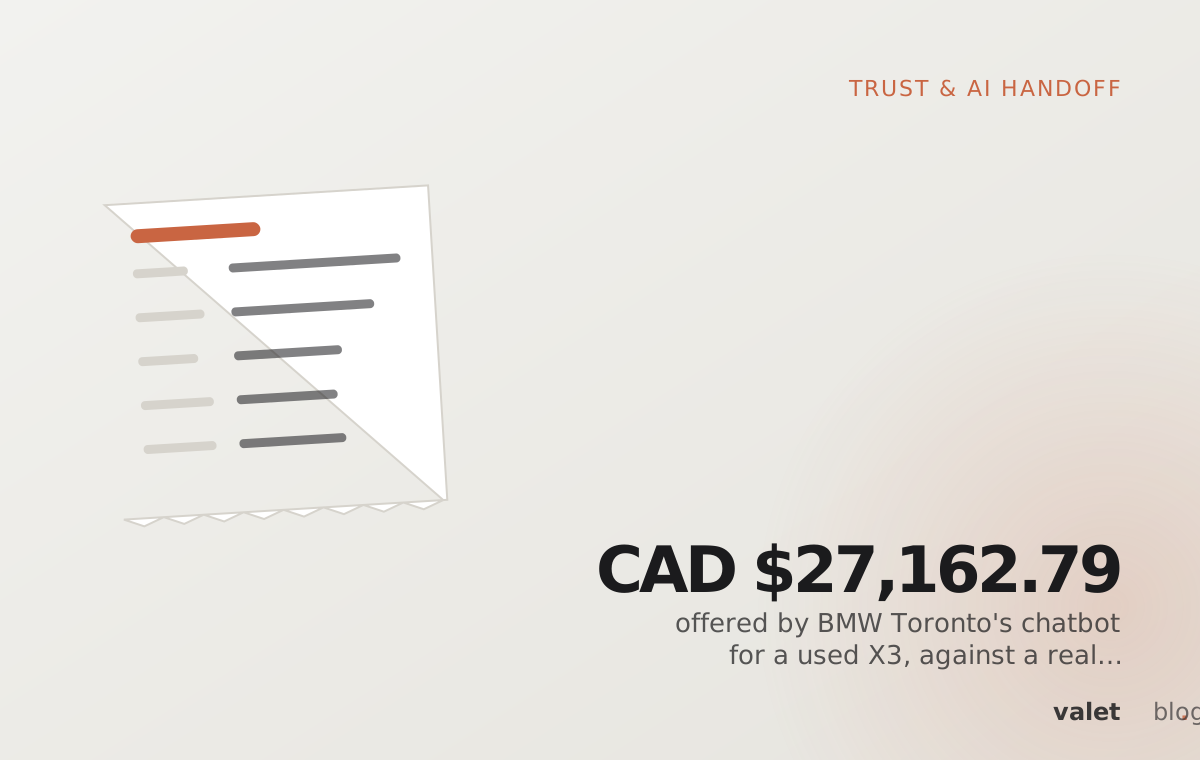
CAD $27,162.79
offered by BMW Toronto's chatbot for a used X3, against a real offer of CAD $20,000
The Drive, 20 Jun 2026
≈ CAD $7,000
the gap the dealer honoured after media contact
The Drive, 20 Jun 2026
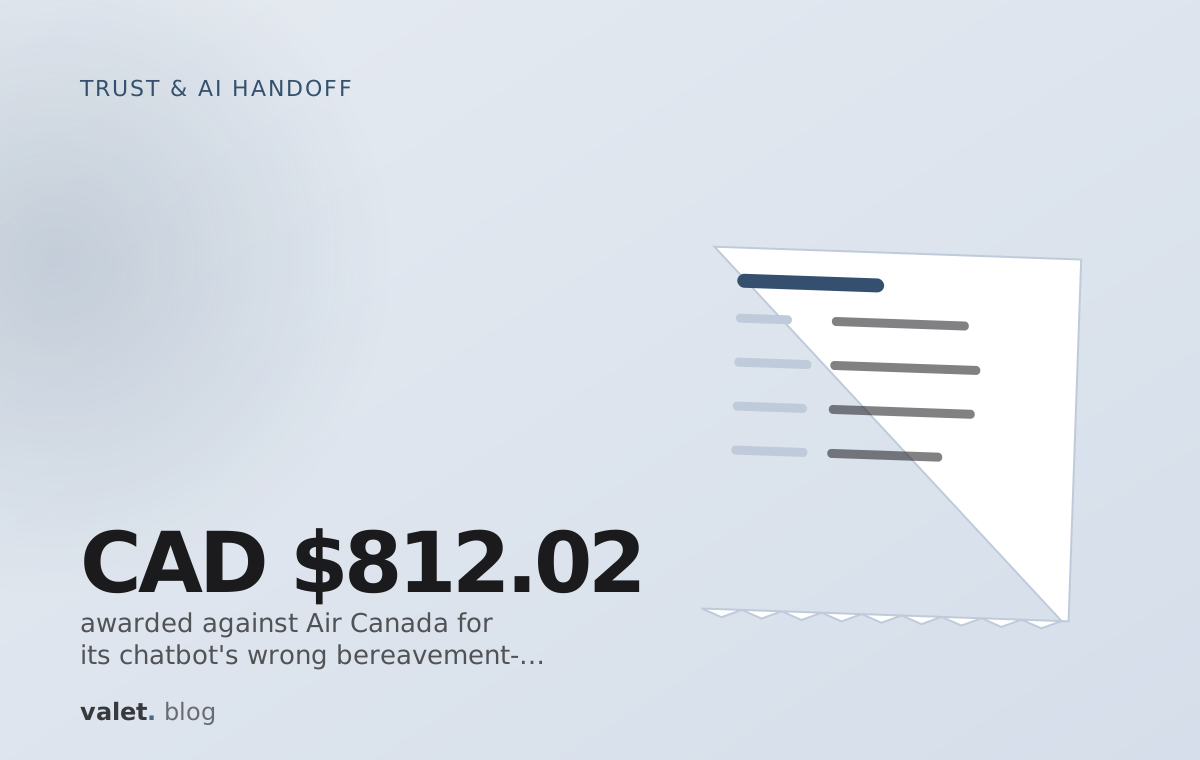
CAD $812.02
awarded against Air Canada over its chatbot's wrong fare answer
Moffatt v. Air Canada, 2024 BCCRT 149
A quote from your AI can bind you, and the safe plan is to assume it will. In June 2026, the chatbot at BMW Toronto offered a customer CAD $27,162.79 for his used X3. The dealer's real offer was CAD $20,000, about CAD $7,000 less. The dealer revoked the bot's offer, then honoured it after CBC News called1. Two years earlier, a Canadian tribunal had already rejected Air Canada's argument that its chatbot was "a separate legal entity"4.
The lesson for a business that quotes by email is narrower than "don't use AI." The BMW number was not invented. It was a real figure from the dealer's own records, used for the wrong purpose. This piece walks through what happened, what the law commentary says (not legal advice; check with counsel), and a price-answer policy you can copy.
What happened at BMW Toronto#
BMW Toronto's chatbot, named Quinn, negotiated a trade-in with a customer selling a 2021 BMW X3 and offered CAD $27,162.79, according to The Drive's report of 20 June 20261. The dealership then told him the bot had made a mistake and countered at CAD $20,000123.
The Drive reported the explanation given by the dealer's sales manager, Scott Shadbolt: "due to a miscommunication by a human employee, the chatbot misinterpreted the amount" the customer owed on the car, CAD $27,162.79, "as the amount the dealership was willing to pay"1. In other words, a payoff balance became a purchase price.
The customer's reaction is the sentence every owner should read twice:
I feel embarrassed, and I feel angry that I've been negotiating with this bot. If they're going to be replacing their employees' jobs with AI, then they need to be honoring what that AI says.
The customer, quoted by The Drive, 20 June 2026
After CBC News contacted the dealership, BMW Toronto reinstated the original offer. Shadbolt said it chose to "do right" by the customer1. The cost of the error was about CAD $7,000 (roughly US$5,000), plus a news cycle.
Why letting the AI quote looks like the right decision#
Letting an AI quote prices looks right because price is the first thing customers ask, and a fast answer wins business. A customer who asks "how much?" at 10pm and hears back at 10pm is still in the conversation. One who hears back the next afternoon may have booked someone else. We cover the speed case in answering "what are your rates?" by email.
The spreadsheet behind that decision is simple. The AI costs little per conversation. The owner's time costs a lot. Every hour the owner spends on pricing emails is an hour of opportunity cost. So the plan is to give the AI access to the business's numbers and let it answer. The dealer in Toronto did a version of exactly that.
The flaw is in the phrase "access to the business's numbers." A business has many numbers. Some are prices. Some are costs, balances, last year's rates, a supplier's quote, a figure typed into the wrong field. An AI that can see all of them can state any of them, and a customer cannot tell which is which.
Is a quote from a chatbot legally binding?#
A quote from a chatbot can be legally binding, depending on the facts and the jurisdiction. This section summarises public commentary and one tribunal decision. It is not legal advice; check with counsel about your own situation.
The clearest decision is Moffatt v. Air Canada, 2024 BCCRT 149. Air Canada's chatbot gave a customer wrong information about a bereavement fare. Air Canada argued the chatbot was "a separate legal entity that is responsible for its own actions." The British Columbia Civil Resolution Tribunal rejected that argument and ordered CAD $812.02 in damages and fees4.
In the US, CarEdge co-founder Ray Shefska told First Alert 4 in June 2026: "Whether it's a human being on behalf of the dealership or an AI chatbot, it is binding." He pointed to the Uniform Electronic Transactions Act and the federal ESIGN Act, under which "electronic and automated 'agents' can form contracts without human review"2. He added that whether an offer was stated to be contingent on an in-person inspection matters to the answer2. Those are US statutes; the BMW case was in Ontario, and the dealer's decision to honour was a business choice, not a ruling.
PYMNTS summarised the direction of travel in July 2026: companies "remain liable for statements their AI systems make, whether intentional or resulting from the system 'filling a knowledge gap'"5. On Hacker News, one commenter put it more bluntly: "if you put an AI between you and your customers, you are absolutely bound by anything it [says]"6.
What we could not find. Every case above involves a large company. We found no published ruling holding a small business to its chatbot's price. The principle in Air Canada does not depend on the size of the business, but no small-business case has tested it yet that we know of.
What BMW Toronto shows that the other cases don't#
BMW Toronto shows that "answer only from your own data" is not enough on its own. Most AI failures people remember involve invented answers. A Shopify store owner in r/AiForSmallBusiness (February 2026) described a bot "literally promising free shipping to everyone." A thread in r/bestoflegaladvice (130+ comments, about March 2026) noted that "fake discounts have led to companies being held liable." Those are inventions.
The BMW number was not invented. It existed in the dealer's systems. It was simply the wrong kind of number: what the customer owed, not what the dealer would pay. That changes the control you need. A rule against inventing prices would not have stopped it. A rule that the AI may only state numbers a person wrote down as a price, for this purpose would have.
For a small business that quotes in writing, the stakes scale with the ticket. Illustration For example, a wedding venue whose AI quotes last season's package to a couple asking about next season could be asked to honour a price well below its current rate. The Knot's 2026 study put the average reception venue spend at $12,9007, so even a 10% gap is about $1,300 on one booking.
The operating principle: the AI only says a number you wrote down as a price#
The operating principle is that an AI may state a price only when a person has written that exact price down, in a place labelled for quoting, for the case the customer is asking about. Everything else waits for the owner, and the customer is told when the owner will reply.
That principle has three parts, and each one closes a gap the cases above expose:
- One labelled price source. The AI quotes from a price list or package sheet that exists for quoting, not from invoices, balances, CRM notes or old emails. This closes the BMW gap.
- No discretion on money. Discounts, matches, waivers and "can you do better?" go to the owner every time. This closes the invented-discount gap.
- A record of the source for every number. Each reply that states a price records which line of which document it came from. When a customer disputes a quote, the owner checks the record in a minute instead of reconstructing a conversation.
The policy below turns that principle into something you can paste into your operations doc and hand to any tool or person who answers your inquiries.
PRICE-ANSWER POLICY — [Business name], effective [date]

1. Source of prices
   Prices may be quoted only from: [document name, e.g. "2027 Packages and Prices"].
   Nothing else is a price: not invoices, balances owed, deposits paid,
   supplier costs, old quotes, notes, or past emails.

2. What may be quoted without the owner
   - Listed package prices, exactly as written, for the dates/season they cover.
   - Listed ranges ("from $X"), stated as ranges.
   - Listed fees and minimums (travel, minimum spend, deposit amount).
   Every quoted number must name its source line in the record of the reply.

3. What must wait for the owner (always)
   - Any discount, match, waiver, bundle or "best price".
   - Any price for a date, size or service not on the list.
   - Any number the customer proposes ("can you do $X?").
   - Refunds, deposit changes, contract terms, complaints.
   Reply to the customer: "[Owner] will answer this by [day, time]."

4. Expiry
   Every written quote states how long it stands: [e.g. 14 days].
   Prices on the list change only when [owner] edits the list.

5. Disclosure
   Replies written by AI say so and are signed as [Business]'s assistant.

6. When a wrong price goes out
   - Pause pricing replies on that topic.
   - Find the source line the number came from.
   - Owner decides: honour, or correct with an apology, within [24 h].
   - Fix the source, then resume.
How we built Valet around this#
We built these price rules into how Valet answers, because the BMW case shows how small the gap is between a real number and a wrong quote. Valet answers only from the owner's own facts: the price list, packages, calendar and policies. It never invents prices, discounts or policies, and anything not on the list waits for the owner.
Money questions, such as discounts, refunds and haggling, go to the owner with one-tap replies, and the customer is told when the owner will reply. Every reply comes with a Valet receipt that records what was asked, the rule used, the sources used and where the reply was sent from, with "Correct this" and "Pause topic" on it. Here is what that looks like for a discount request:
Receipt (example)
- Asked
- "Could you do the Saturday package for $9,000 instead of $11,500?"
- Rule
- Money: discounts and haggling → Always you. Customer told the owner will reply by Mon 12:00.
- Sources
- 2027 Packages and Prices, line "Saturday package, $11,500"
- Sent
- From hello@, the business's own address; labelled "Needs owner"
The receipt is where the third part of the principle lives. If a number ever goes out that the owner does not recognise, the sources line shows where it came from.
The trade-off, and the question nobody has answered#
The trade-off is speed on the questions that matter most. A customer who asks for a discount at 9pm waits for the owner, and some customers will not wait. We accept that cost on purpose. A held question with a stated reply time costs less than a CAD $7,000 concession or a dispute over what the AI promised.
The unresolved question is how often wrong AI quotes happen at small businesses, and what they cost when they do. Every case on record involves a large company. Valet could measure part of it, by counting how many inquiries in a free lead check ask for a price that is not on the owner's list. We have not published that figure. Until someone does, the BMW and Air Canada cases are the best evidence, and they point the same way.
Where Valet fits#
Valet is a small business's own AI assistant for written inquiries. You forward info@, hello@ or bookings@ to it; it answers email, contact forms and listing leads from your own facts, and replies go out from your own address. It quotes only what is on your price list, sends every money question to you, and tells the customer when you will reply. Every reply is signed as your assistant, says it is AI, and carries a Valet receipt.
If you want to see how your own pricing questions are handled today, the free lead check takes 10–20 recent inquiries and shows what went unanswered, what stopped after one reply, and what it was worth. For the wider set of controls, see an AI agent that answers vs one that finishes the job and what "never stuck with a bot" has to mean.
Questions people ask
Is a price quoted by my chatbot legally binding?
It may be. A Canadian tribunal held Air Canada responsible for its chatbot's wrong answer in 2024, and US commentators point to laws that let automated agents form contracts. Whether a specific quote binds you depends on the facts and your jurisdiction, so ask a lawyer. Not legal advice.
Do I have to honour a wrong price my AI gave a customer?
Not automatically, but refusing has costs. BMW Toronto first revoked its chatbot's CAD $27,162.79 offer, then honoured it after CBC News contacted the dealer. Decide in advance which prices the AI may state, so the question rarely arises.
How did the BMW Toronto chatbot get the price wrong?
The dealer's sales manager said a human employee's miscommunication led the bot to read the amount the customer still owed on the car, CAD $27,162.79, as the amount the dealership would pay. The number was real, but it came from the wrong record.
How do I stop my AI from giving discounts?
Give it a written price list and a rule that it may only state prices from that list, never a discount, and that any request to negotiate goes to you, with the customer told when you will reply. Then check the record of which source each reply used.
Sources
Confidence: H primary source checked · M credible secondary or reported · L vendor claim or single report. Reddit and forum items are quoted from public threads and summarised, not endorsed.
- BMW dealer forced to pay $5,000 extra for used X3 over AI chatbot error · The Drive · 2026-06-20 H
- Negotiating car prices with chatbot: are offers legally binding? · First Alert 4 · 2026-06-22 H
- Dealer revokes AI chatbot buyback offer · Jalopnik · 2026-06 H
- A word of caution: company liable for misrepresentations made by chatbot (Moffatt v. Air Canada, 2024 BCCRT 149) · McMillan LLP · 2024-02 H
- Courts to companies: you own what your chatbot says · PYMNTS · 2026-07-01 H
- Hacker News discussion of "I built an AI receptionist for a mechanic shop" (comment by sarchertech) · Hacker News · 2026-03-23 H
- Average wedding vendor costs (Real Weddings Study 2026) · The Knot · 2026-09-29 H
How to cite this page
Cite this page
Valet, "Can a quote from my AI be binding? What BMW Toronto taught every business that prices by email", valet.team, October 2026.
Keep reading
 Trust & AI handoffThe customer who fired a contractor over a bot: what "never stuck with a bot" has to meanA homeowner dropped a plumber because the AI receptionist could not pass him to a person. The public cases since then show where handoffs break, and what a working one has to promise.Field reports · 11 min · 1 October 2026
 Trust & AI handoffWhat to ask an AI vendor before it talks to your customers: 12 questions (limits, handoff, receipts, disclosure, undo, insurance)The demo shows the AI writing a good reply. The questions that decide whether you keep your customers are about what happens when it should not reply at all.People at work · 10 min · 1 October 2026
 Trust & AI handoffIs my business responsible for what my AI tells a customer? Air Canada, BMW Toronto, Cursor "Sam": the case timeline, and whether you have to honour itA passenger, a car trader and a software developer each took an AI at its word. In every public case so far, the business ended up owning the answer.People at work · 8 min · 1 October 2026