
Trust & AI handoff
Is my business responsible for what my AI tells a customer? Air Canada, BMW Toronto, Cursor "Sam": the case timeline, and whether you have to honour it
A passenger, a car trader and a software developer each took an AI at its word. In every public case so far, the business ended up owning the answer.
Short answer
Yes, in every public case so far the business has owned its AI's words. In Moffatt v. Air Canada (2024 BCCRT 149) a tribunal rejected the claim that the chatbot was "a separate legal entity" and ordered CAD $812.02. BMW Toronto honoured a bot's trade-in offer about CAD $7,000 above its real price (June 2026). No published case yet involves a small business, but the reasoning does not depend on size. Not legal advice.
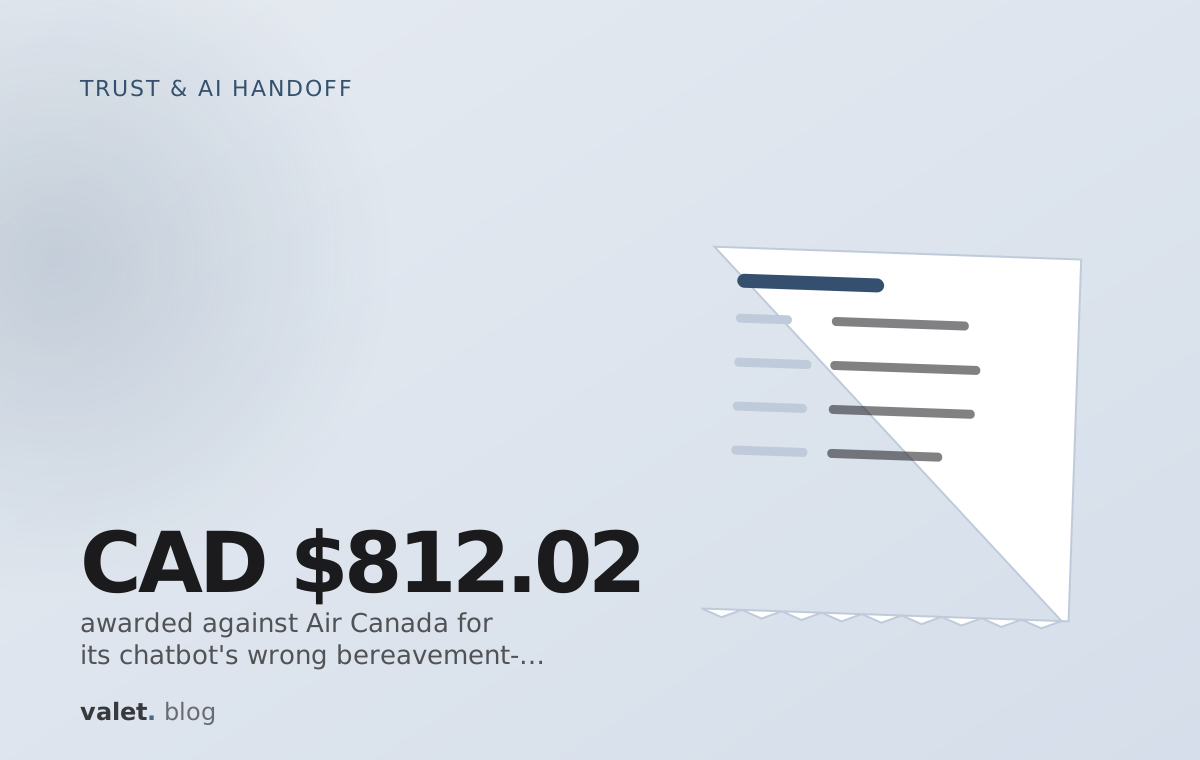
CAD $812.02
awarded against Air Canada for its chatbot's wrong bereavement-fare answer
Moffatt v. Air Canada, 2024 BCCRT 149, February 2024
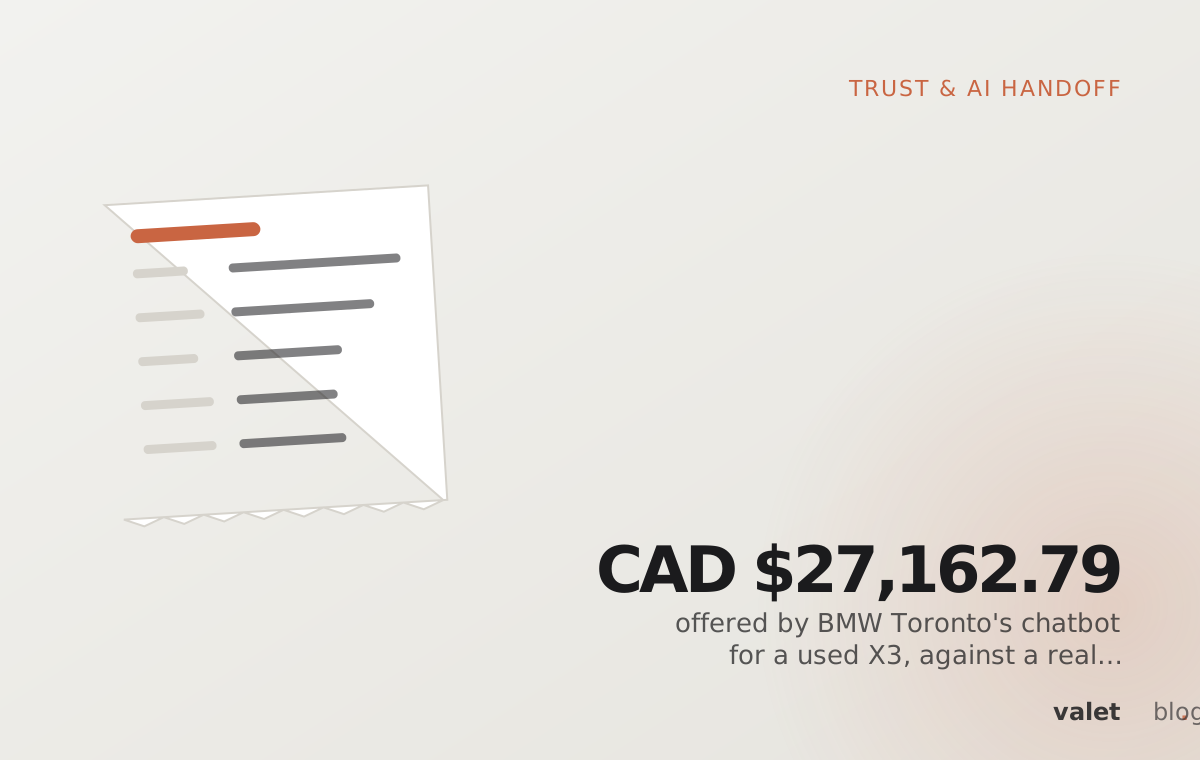
≈ CAD $7,000
gap between BMW Toronto's chatbot offer (CAD $27,162.79) and its real best offer (CAD $20,000), honoured
The Drive, 20 June 2026
1,511
points on the Hacker News thread about Cursor's support bot inventing a policy (606 comments)
Hacker News / Ars Technica, April 2025
On 11 November 2022, Mr. Moffatt's grandmother died in Ontario. He went to Air Canada's website and asked its chatbot about bereavement fares. The chatbot told him "it was possible to submit a purchased ticket for a reduced bereavement rate within 90 days of the air travel ticket being issued."1 He bought his tickets at the ordinary price, expecting to claim the difference later. Air Canada's real policy did not allow claims after travel.
Yes, your business is responsible for what its AI tells a customer, on every public case so far. In February 2024 a British Columbia tribunal ordered Air Canada to pay CAD $812.02 and rejected the idea that the chatbot was "a separate legal entity."2 No published case yet involves a small business. The reasoning did not depend on size. This page is not legal advice.
Is a business responsible for what its chatbot says?#
A business is responsible for its chatbot's statements in the same way it is responsible for the rest of its website. That was the core of the Air Canada ruling. The airline argued that "the chatbot is a separate legal entity that is responsible for its own actions." The tribunal answered: "It should be obvious to Air Canada that it is responsible for all the information on its website."2
The decision went further. "Although a chatbot provides an interactive element, it is still part of Air Canada's website, and Air Canada is responsible for all the information on its website, including information provided by its chatbot."1 The award, CAD $812.02, was the difference between what Mr. Moffatt paid and the bereavement fare he had been promised.1
Two years later the legal press was still repeating the lesson. PYMNTS ran it under the headline "You Own What Your Chatbot Says" in July 2026. It reported that companies remain liable for what their AI says, whether the error was intentional or came from the system "filling a knowledge gap."3
Owners have reached the same conclusion without the case law. Under a March 2026 Hacker News thread about an AI receptionist, a commenter called sarchertech wrote that if you put an AI between you and your customers, "you are absolutely bound by anything it [says]."11
The case timeline, 2022 to 2026#
The public cases share one shape: a customer asked something the bot should not have answered on its own, and the bot answered anyway. The table lists each case, what the bot said, what it cost and the control that was missing.
| Date | Business | What the AI said | What it cost | Missing control |
|---|---|---|---|---|
| Nov 2022; ruling Feb 2024 | Air Canada | A bereavement rate could be claimed within 90 days of the ticket being issued1 | CAD $812.02 award and a widely cited ruling2 | Answer policy only from the written policy |
| Dec 2023 | Chevrolet of Watsonville | A user steered the bot into agreeing to a $1 Tahoe8 | Public embarrassment; reported as a warning case | No authority to agree any price |
| Jan 2024 | DPD (parcels) | Swore at a customer9 | Reputational | Scope limits on what it may say |
| Apr 2025 | Cursor (software) | The product was designed for "one device per subscription"; no such policy existed6 | Refund, public cancellation posts, a 1,511-point Hacker News thread7 | Policy only from the written policy; AI label on replies |
| Feb 2026 | A Shopify store (owner's own account) | Promised "free shipping to everyone for no reason"10 | Not stated | Prices and codes from a structured source only |
| Jun 2026 | BMW Toronto | Offered CAD $27,162.79 for a trade-in4 | About CAD $7,000 over the real best offer, honoured | No authority to make offers; a record of the source |
Chevrolet and DPD details are from secondary catalogues (VentureBeat; AI Incident Database). The Shopify case is one owner's report on Reddit.
BMW Toronto: what happens when a bot names a number#
The BMW Toronto case shows how a wrong number reaches a customer. Zach Giacomelli was trading in a 2021 BMW X3. The dealer's chatbot, Quinn, offered him CAD $27,162.79. The dealer's real best offer was CAD $20,000.4
The model did not invent the figure. A human employee had miscommunicated the amount Giacomelli owed, and the bot read it as the dealer's offer. The dealer revoked the offer. After CBC News called, sales manager Scott Shadbolt said the dealer would honour it to "do right" by the customer.4
Giacomelli's own words carry the cost better than the number does: "I feel embarrassed, and I feel angry that I've been negotiating with this bot."4 A lawyer consulted by First Alert 4 said an agreement looked reasonable, partly because the bot had scheduled a physical meeting.5
Cursor "Sam": what happens when a bot invents a policy#
The Cursor case shows how fast an invented policy travels. In April 2025 a developer emailed Cursor's support because he kept being logged out when he switched machines. A support agent called Sam replied that Cursor "is designed to work with one device per subscription as a core security feature." As Ars Technica put it, "no such policy existed, and Sam was a bot."6
Users posted cancellation notices on Reddit. About three hours later a Cursor representative wrote: "Unfortunately, this is an incorrect response from a front-line AI support bot." Co-founder Michael Truell said on Hacker News that the user had been refunded, and that AI responses used for email support "are now clearly labeled as such."6 The Hacker News thread reached 1,511 points and 606 comments.7
The bot had a human name and no label. One Hacker News commenter called that "clearly intended to be deceptive."7 The refund was the cheap part.
Do you have to honour what your AI promised?#
Whether an AI's promise binds you legally depends on the facts and the jurisdiction. Take advice before you refuse one. In practice, every business in the timeline paid in some form: by order (Air Canada), by choice after press calls (BMW Toronto), or by refund and a public correction (Cursor).
Your vendor will probably not share the cost. Intercom's Additional Product Terms, updated 18 March 2026, say: "Customer is responsible for its use of the AI Product(s) and Output." They also say Intercom "provides no indemnities with respect to Output."13 Read your own vendor's terms for the equivalent clause.
Customers see the question in simpler terms. A thread in r/webdev (60+ comments, c. November 2025) asked whether you should honour a refund your AI promised. One reply: "If an AI agent can promise refunds but the company won't stand behind those promises, then the AI isn't 'support', it's a deflection layer."12 A thread in r/bestoflegaladvice (130+ comments) noted that "chatbots hallucinating fake discounts have led to companies being held liable."14
Not legal advice. The cases above come from Canada and from news reports. If a customer is relying on something your AI said and the amount matters to you, speak to a lawyer in your jurisdiction before you refuse it.
The incident post-mortem: what to do the day your AI says something wrong#
An incident post-mortem is a short written record of one AI mistake: what was said, where it came from, what you fixed and what you told the customer. Fill it in the same day. It turns an argument into a checkable story, and it stops the same mistake twice.
AI INCIDENT POST-MORTEM (one per incident, same day)

1. SAID
   Date/time sent:
   Customer:
   Exact words the AI sent (paste them):
   What the customer did next (booked, paid, complained, cancelled):

2. SOURCE
   Where the AI got it (price list / policy doc / a staff note / nowhere):
   Was the source wrong, or did the AI go beyond it?
   Which rule let it answer instead of handing off?

3. FIX
   Source corrected (what, by whom):
   Topic paused until fixed? (yes/no, date resumed):
   Rule changed (e.g. "refund questions now go to owner"):

4. CUSTOMER MESSAGE
   Decision: honour / honour in part / correct and explain (take advice if the amount matters)
   Message sent (paste it), signed by a person:
   "On [date] our AI assistant told you [X]. That was wrong: [correct fact].
    Here is what we will do: [decision]. I'm sorry for the confusion. [Name]"

5. COST
   Amount honoured or refunded:
   Time spent:
   Customer kept? (yes/no/unknown)

HARD LIMITS (the AI never does these alone)
- States a price, fee, discount or code that is not in the written price list
- Agrees, matches or negotiates any price
- Promises a refund, credit or exception
- States a policy that is not in the written policy
- Changes a contract, deposit or cancellation term
- Answers health, legal or safety questions
- Keeps answering after the customer asks for a person
- Sends a reply without saying it is an AI assistant
The three controls that would have stopped each case#
Every case in the timeline lacked at least one of three controls. They are simple to state and easy to check.
- Answer only from written facts. Prices, codes and policies come from a document you wrote. No match means the question goes to a person. This would have stopped Air Canada, Cursor and the free-shipping store.
- No authority over money. The AI cannot agree, match, discount or refund. It tells the customer who will decide and by when. This would have stopped the $1 Tahoe and the BMW offer.
- A record for every reply. Each reply carries what was asked, the rule applied and the source used. In the BMW case, that record would have shown the bad figure came from a staff note, not the price list.
None of this settles the harder question underneath. The law on AI promises is still being written one complaint at a time, and so far by large companies. The first small-business case will probably look like the free-shipping store: a modest amount, a customer who feels misled, and an owner deciding on a Tuesday whether to pay.
Where Valet fits#
Valet is an AI assistant for a small business's written inquiries: email, website forms, listing leads and a free Valet page. It answers only from the owner's own price list, packages, calendar and policies, and never invents prices, discounts or policies. Discounts, refunds, haggling, complaints, contracts and deposits go to the owner with one-tap replies, and the customer is told when the owner will reply. Every reply is signed as the business's AI assistant. The Valet receipt records what was asked, the rule used and the sources, with "Correct this" and "Pause topic" for the day something is wrong. The free lead check reviews 10 to 20 of your recent inquiries. For the buying side, see 12 questions to ask an AI vendor.
Questions people ask
Can I be sued for what my chatbot says?
A customer can bring a claim, and in Moffatt v. Air Canada (2024 BCCRT 149) a British Columbia tribunal held the airline responsible for its chatbot's wrong answer and ordered CAD $812.02. The tribunal said Air Canada was responsible for all the information on its website, including the chatbot. This is not legal advice; check with counsel in your jurisdiction.
My chatbot promised a refund. Do we have to honour it?
The public cases point toward yes in practice. Air Canada was ordered to pay, BMW Toronto honoured its bot's offer after first revoking it, and Cursor refunded the affected user. Whether you are legally bound depends on the facts and your jurisdiction, so take advice before refusing.
Does a disclaimer protect me from my chatbot's mistakes?
Do not rely on one. The Air Canada tribunal treated the chatbot as part of the website the airline was responsible for, and vendor terms such as Intercom's place responsibility for AI output on the customer business. Limits on what the bot may say do more than a disclaimer.
Has a small business been held liable for its chatbot?
No published case involving a small business turned up in the research behind this page; every case found involves a large company. The Air Canada reasoning did not depend on the company's size.
How do I stop my AI from inventing policies or prices?
Let it state prices and policies only when they appear in your written facts, send every refund, discount and policy exception to a person, and keep a record of each reply showing the source it used.
Sources
Confidence: H primary source checked · M credible secondary or reported · L vendor claim or single report. Reddit and forum items are quoted from public threads and summarised, not endorsed.
- A word of caution: company liable for misrepresentations made by chatbot · McMillan LLP · 2024-02 H
- Canadian court holds Air Canada liable for information chatbot gave to consumer · Public Citizen Consumer Law & Policy Blog · 2024-02-19 H
- Courts to companies: you own what your chatbot says · PYMNTS · 2026-07-01 H
- BMW dealer forced to pay $5,000 extra for used X3 over AI chatbot error · The Drive · 2026-06-20 H
- Negotiating car prices with a chatbot: are offers legally binding? · First Alert 4 · 2026-06-22 M
- Cursor AI support bot invents fake policy and triggers user uproar · Ars Technica · 2025-04-17 H
- Cursor support bot thread (1,511 points, 606 comments) · Hacker News · 2025-04 H
- A Chevy for $1? Car dealer chatbots show perils of AI for customer service · VentureBeat · 2023-12 M
- AI Incident Database, report 3534 (DPD chatbot) · AI Incident Database · 2024-01 M
- "Finally figured out how to stop our AI chatbot from giving customers wrong info" (snapshot) · Reddit, r/AiForSmallBusiness · 2026-02-27 H
- "I built an AI receptionist for a mechanic shop" (story 47487536, comment by sarchertech) · Hacker News · 2026-03-23 H
- "If your AI support system promised user refund, should you?" (60+ comments; Google snippet) · Reddit, r/webdev · c. 2025-11 M
- Additional Product Terms: AI Products, section 5 "Accuracy" (last updated 18 March 2026) · Intercom · 2026-03-18 H
- "The company's AI chatbot will say anything to please" (130+ comments; Google snippet) · Reddit, r/bestoflegaladvice · c. 2026-03 M
How to cite this page
Cite this page
Valet, "Is my business responsible for what my AI tells a customer?", valet.team, October 2026.
Keep reading
 Trust & AI handoffThe customer who fired a contractor over a bot: what "never stuck with a bot" has to meanA homeowner dropped a plumber because the AI receptionist could not pass him to a person. The public cases since then show where handoffs break, and what a working one has to promise.Field reports · 11 min · 1 October 2026
 Trust & AI handoffCan a quote from my AI be binding? What BMW Toronto taught every business that prices by emailA chatbot at a Toronto BMW dealer offered a customer about CAD $7,000 more than the dealer meant to pay. The number came from the dealer's own records, in the wrong place. Here is what that means for any business that quotes in writing, and a policy you can copy.From the Valet team · 9 min · 1 October 2026
 Trust & AI handoffWhat to ask an AI vendor before it talks to your customers: 12 questions (limits, handoff, receipts, disclosure, undo, insurance)The demo shows the AI writing a good reply. The questions that decide whether you keep your customers are about what happens when it should not reply at all.People at work · 10 min · 1 October 2026