
The owner's inbox
You've answered that question a hundred times: FAQ page vs answering emails vs answering from a facts sheet
Owners treat the FAQ page as the asset and the replies as the chore. Both are copies of something most small businesses never write down: one maintained list of facts that a person, a page or an AI can quote.
Short answer
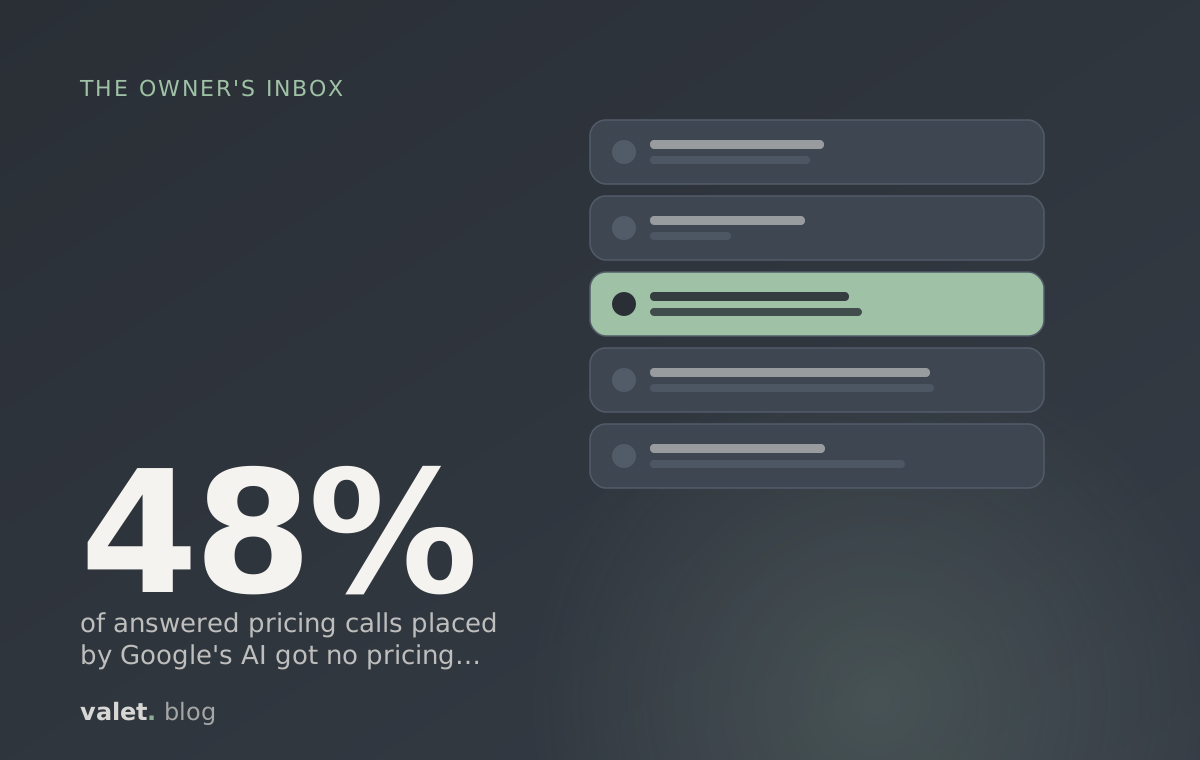
Write one facts sheet and answer every repeat question from it, in the reply itself. An FAQ page only helps the prospects who read it, and hand-written replies drift from the page over time. The facts are what matter: Invoca found 48% of businesses that answered Google's AI pricing calls gave no price (December 2025), and Google says no special schema is needed to appear in its AI features.
48%
of answered pricing calls placed by Google's AI got no pricing information
Invoca, December 2025
77%
of couples say pricing is the most important factor before contacting a vendor
WeddingPro, From Hello to Hired
40%
of 1,050 home-service owners name communicating with customers among their most time-consuming tasks
Jobber Home Service Trends Report, 2026
Write one facts sheet and answer every repeat question from it, inside the reply, instead of choosing between an FAQ page and typing answers by hand. The FAQ page reaches only the prospects who read it. Hand-written replies reach everyone but cost your time and drift from the page. Both fail on the same missing input. When Google's AI phoned businesses for prices, 48% of the calls that were answered got no pricing information (Invoca, December 2025)4. The question was ordinary. The facts were not written down.
Why do owners write an FAQ page to stop the repeat questions?#
The standard fix for repeat questions is an FAQ page, and the reasoning behind it is sound enough that its strongest advocates deserve a fair hearing before anyone argues with them. In an r/smallbusiness thread on answering the same customer questions (40+ comments, early 2026), the original poster asks "how much time goes into repeating the same information", and the top answer is an FAQ document1. In a larger thread on handling support at scale (90+ comments, early 2026), one owner advises you to "map your top 8-10 recurring questions", adding that "it's the same handful over and over - pricing, availability"7.
The advice has a real success story behind it. A commenter on an Ask a Manager post about "pick your brain" requests (April 2026) wrote: "I wrote up an FAQ that I just provide to everyone who contacts me…Shockingly (not), nobody has ever sent me a new question to add."2 The set of questions is small. It is stable. Writing it once looks like the obvious move.
The owner's incentives point the same way. An FAQ page costs an afternoon, needs no tool, and creates no new risk, because nothing is sent to anyone without the owner's say. Jobber's 2026 survey of 1,050 home-service owners found 40% name communicating with customers among their most time-consuming daily tasks3, so any change that promises fewer emails gets tried first. The FAQ page is a reasonable local optimum. It is still a local optimum.
Why does answering each email by hand feel safer?#
Owners who skip the FAQ page and answer every email by hand are not being lazy about documentation; they are protecting a judgement call that a page cannot make. A couple asking "how much for 120 guests on a Saturday in June?" wants the price applied to their date, their headcount and their season. A page that lists a range forces them to do the arithmetic, and a reply that does it for them books more often. The owner sees this every week.
Hand replies also keep control. The owner decides when to mention the minimum spend, whether a Friday discount exists this year, and which questions mean "call me". Nothing goes out that the owner did not write.
The cost is the one in the first thread: the same information, typed again. The less visible cost is drift. The reply sent in March quotes last year's deposit; the page still shows the old package names; the assistant who covers a holiday week answers from memory. Each copy is correct on the day it was written. The copies stop agreeing.
The cracked assumption: the page and the replies are separate jobs#
Both camps assume the work is the output, a page in one case and a stream of replies in the other, when the work is the input both outputs copy from, and most small businesses never write that input down. The FAQ page is one rendering of the facts. Each email is another. A booking platform profile is a third. Without a single source, every rendering is maintained by hand, and the coordination cost grows with each channel you add.
The principal-agent problem sharpens this the moment anyone else answers. A virtual assistant, a receptionist service or a partner covering for a week can only be as accurate as what you gave them. A Trustpilot reviewer of the receptionist service Smith.ai wrote in April 2023: "Receptionists do not read instructions...scheduling telephone consults without offering in-person or virtual options"8. That is one review, and it says nothing about the service in general. It does describe the mechanism: instructions written as prose for a person get skimmed, while facts written as a list get quoted.
The alternative fits in one sentence. Repeat questions stop costing you time when the answers live in one facts sheet that every reply quotes, in the reply, and anything not on the sheet waits for you. The FAQ page then becomes a by-product of the sheet. It is no longer the place where the facts are kept.
What does the evidence say about facts, pages and AI readers?#
Three lines of evidence support the facts-first reading, ordered from weakest to strongest.
Prospects filter on facts before they ever write#
WeddingPro reports that "77% of couples say pricing is the most important factor they consider before contacting a vendor"5. The figure describes couples, not every customer, and WeddingPro is a marketplace with an interest in vendors replying well. The direction still matters: the first question is usually a fact you already know, and the prospect wants it before investing a call. If the page hides it and the reply delays it, the prospect writes to the next business. For pricing replies in particular, see answering "what are your rates?" by email.
AI readers need the facts, not new markup#
Google's own guidance for site owners on AI Overviews and AI Mode is blunt: "You don't need to create new machine readable files, AI text files, or markup to appear in these features. There's also no special schema.org structured data that you need to add."6 The answer to "what information should be on my website for AI" is therefore the same answer a customer would give: prices or ranges, packages, service area, availability and policies, in plain text that matches what you say in replies. Answerable beats gamed.
When an AI asked for a price, half the answers had none#
The strongest line comes from Invoca's December 2025 study of pricing-request calls placed by Google's AI on behalf of consumers. Such calls rose 324% from October to November 2025; 26% went unanswered, and 48% of the calls that were answered "did not provide pricing information"4. The businesses had staff on the phone. They did not have a price the staff could say. No FAQ page fixes that, because the failure happened in a live answer. A facts sheet does, because the person or system answering can quote it.
FAQ page vs email replies vs facts sheet: how do they compare?#
The three approaches differ on who does the reading, how fast the answer drifts, and what happens when the question is not covered. The table compares them for an owner-run service business answering pre-sale questions.
| Dimension | FAQ page | Answering each email by hand | Answering from a facts sheet |
|---|---|---|---|
| Who reads the facts | The prospect, if they find the page | The owner, from memory | Whoever replies, from one list |
| Applied to this customer's date or scope | No | Yes | Yes, within the sheet's terms |
| Owner time per repeat question | None after setup | Every time | None for covered questions |
| Drift between page and replies | Page ages quietly | Each reply can differ | One place to update; page and replies copy it |
| Question not covered | Prospect writes anyway | Owner answers | Waits for the owner; prospect is told when |
| Usable by a VA, a colleague or an AI | Partly | No | Yes |
The second-order effect is the one to watch. Once the sheet exists, the FAQ page, the booking-site profile and the email replies can all be regenerated from it, and the cost of a price change drops from "find every copy" to "edit one line".
The facts sheet template: what to write down#
The facts sheet below is a starting structure, with the rows most service businesses need and the variant rows for four common business types. Keep it to one or two pages. Every line should be a fact a stranger could quote without asking you what it means.
FACTS SHEET: [Business name]
Owner: [name]          Last checked: [date]          Next check: [date + 90 days]

CORE (every business)
- What we do, in one line:
- Who we do it for / who we don't:
- Service area or shipping zones:
- Prices or price ranges, with what changes the price:
- What is included / not included:
- Minimums (spend, hours, guests, order size):
- How to book or buy, and what happens next:
- Deposit or payment terms:
- Cancellation / refund policy, in exact terms:
- Typical lead time:
- Where availability comes from (calendar link or "ask the owner"):

VENUE
- Capacity (seated / standing), by room:
- Day-of-week and season pricing; minimum spend by day:
- Hours of access, curfew, noise limits:
- Catering and bar rules (in-house only / outside allowed / fees):
- Tour process and length:

VENDOR (photographer, florist, DJ, planner)
- Packages by hours or scope, with prices:
- Travel fee and radius:
- Delivery time for the finished work:
- How many events per day:

CONSULTANT / SOLO PRO
- Engagement types (project, retainer, hourly) and starting prices:
- What the first call covers, and whether it is paid:
- Current start date for new work:
- What you need from the client before a quote:

ONLINE STORE
- Processing time and order cutoff:
- Shipping prices and countries:
- Returns window, condition rules, who pays return postage:
- Sizing or compatibility method:

NEVER ANSWER FROM THIS SHEET (owner only)
- Discounts, exceptions, refunds outside policy
- Complaints, contracts, deposits not listed above
- Anything health, legal or safety related
- Any question whose answer is not written above
Two rules make the sheet work. First, write numbers, not adjectives: "from $4,500 for Saturdays in June, 100 guests" can be quoted; "competitive pricing" cannot. Second, keep the "never answer" block. A sheet without a boundary invites whoever replies to guess, and a guess sent from your address is your answer. For wedding vendors, the ten questions couples ask are mapped in build the facts sheet once; for stores and SaaS, the hard limits are covered in the facts sheet and limits to set before any AI answers.
Where the FAQ page still wins, and where this argument would be wrong#
The FAQ page still wins in three places. It wins for prospects who self-serve before writing, who never show up in your inbox at all and whom you cannot count. It wins as the public rendering that AI search tools read, provided it matches the sheet. And it wins when sent as the reply, as in the Ask a Manager case, where the questions were generic and the document arrived in the thread2.
The argument here would be wrong if your repeat questions are mostly about the customer's own order or account rather than your offer. In that case the missing input is the customer's record, not your facts; see why your FAQ page doesn't reduce support emails. It would also be wrong for a business whose prices change daily, where a sheet goes stale faster than a person can maintain it.
The Monday-morning decision is small. Take the last 20 inquiries, list the questions in them, and check how many your current page answers with a number. Whatever is missing goes on the sheet first. For what those inquiries cost in your own time, see the "36% of the week on admin" number, traced.
Where Valet fits#
Valet answers written inquiries from your own facts sheet: your price list, packages, calendar and policies. You forward an address such as hello@ or bookings@ to a private Valet address, and replies go out from your own address once the domain is verified. Valet quotes the facts in the reply rather than linking to a page, offers real times from your calendar, and never invents a price, discount or policy; anything not on the sheet waits for you, and the customer is told when you will reply. Each reply is signed as your AI assistant and comes with a Valet receipt listing the question, the rule used and the sources. To see which questions your inbox is answering by hand, start with the free lead check: forward 10 to 20 recent inquiries and see what went unanswered or stopped after one reply.
Questions people ask
How do I stop answering the same customer questions?
Write the answers once as a facts sheet (prices or ranges, what is included, availability, minimums, deposits, policies) and answer every repeat question from it, inside the reply. Linking to an FAQ page moves the reading back to the customer, and many will write again.
Is an FAQ page better than answering emails?
An FAQ page is cheaper per answer but only reaches people who read it. Email replies reach everyone who writes but cost your time and drift from the page. A facts sheet feeds both, so the page and the replies say the same thing.
What information should be on my website for AI assistants?
The same facts a customer asks for: prices or price ranges, packages, service area, availability, minimums and policies, in plain text. Google's guidance says there is no special schema.org markup or AI text file needed to appear in its AI features.
What is a facts sheet for a small business?
A one- or two-page list of the facts customers ask about, written in exact terms with numbers and conditions, with an owner and a date it was last checked. Anything not on it is answered by the owner, not guessed.
Sources
Confidence: H primary source checked · M credible secondary or reported · L vendor claim or single report. Reddit and forum items are quoted from public threads and summarised, not endorsed.
- "How do you handle answering the same customer [questions]" (40+ comments; Google snippet) · Reddit, r/smallbusiness · c. 2026-03 M
- How to respond to requests to pick your brain · Ask a Manager · 2026-04-01 H
- Blue Collar Strong: The 2026 Home Service Trends Report (1,050 owners, surveyed December 2025) · Jobber · 2026 H
- New Invoca study finds pricing request phone calls from Google's AI surged over 300% in November · Invoca · 2025-12-10 H
- From Hello to Hired: your guide to lead replies · WeddingPro · undated H
- AI features and your website · Google Search Central · 2026 H
- "How are you handling customer support at scale? (50+…)" (90+ comments; Google snippet) · Reddit, r/smallbusiness · c. 2026-02 M
- Receptionists do not read instructions (Smith.ai review, page 9) · Trustpilot · 2023-04-26 H
How to cite this page
Cite this page
Valet, "You've answered that question a hundred times: FAQ page vs answering emails vs answering from a facts sheet", valet.team, October 2026.
Keep reading
 The owner's inboxThe contact-form leak: why 42.6% of website inquiries never get a reply, and how to prove you repliedSome form leads die in the spam folder. Most arrive safely and nobody answers. Here is how to check both in ten minutes, and how to prove a reply went out.People at work · 10 min · 1 October 2026
 The owner's inboxWhat does it actually cost to answer one customer inquiry? Receptionist vs VA vs AI (2026 numbers)Every price list in this market counts contacts, minutes or seats. Owners who wrote reviews about the bill were counting something else: what each booking ended up costing. Here are 12 dated prices and the calculator that converts them.Field reports · 8 min · 1 October 2026
 The owner's inboxHire a VA, a receptionist, or software? VA vs AI receptionist vs AI inquiry handler: what each actually does with an inquiryMost comparisons line up hourly rates against monthly plans. The data that predicts lost customers is elsewhere: who follows up, who hands off, and whether a human is reachable at all.Data desk · 8 min · 1 October 2026