
Weddings & events
The 10 questions every couple asks every wedding vendor: build the facts sheet once
Couples' inquiries are converging on the same handful of questions, and the next people asking them may be AI assistants. The vendor who has the answers written down is ready for every version of that future.
Short answer
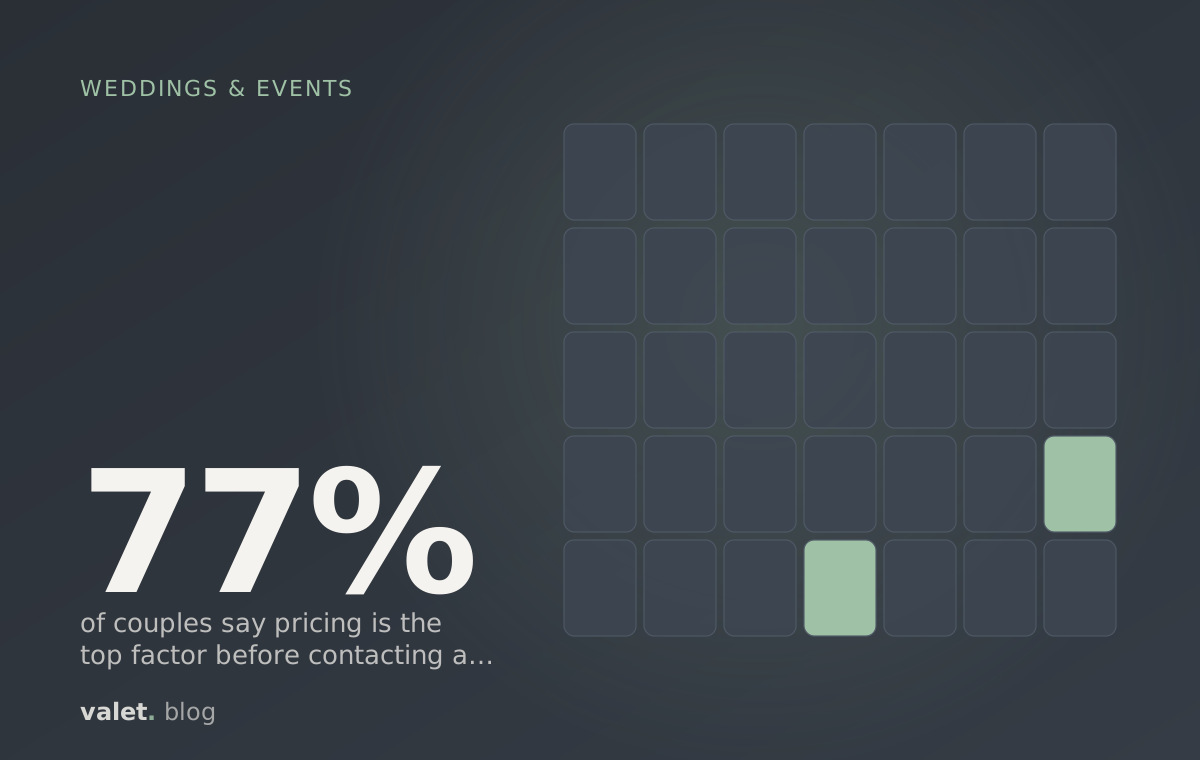
Couples ask wedding vendors the same ten questions: is the date open, what it costs, what is included, guest or hour limits, minimums, travel, date holds, deposit and payments, cancellation, and what happens next. 77% of couples rank pricing first before contacting a vendor (WeddingPro). Write the answers once as a facts sheet, with a rule for anything not on it, and every reply gets faster and more consistent, whoever or whatever sends it.
77%
of couples say pricing is the top factor before contacting a vendor
WeddingPro, From Hello to Hired (updated Aug 2026)
45%
of US consumers used AI tools for local recommendations, up from 6%
BrightLocal Local Consumer Review Survey, 2026
48%
of answered Google-AI pricing calls got no price
Invoca, December 2025
Couples ask wedding vendors the same ten questions: is the date open, what does it cost, what is included, how many guests or hours, are there minimums, do you travel, can you hold the date, what is the deposit, what if we cancel, and what happens next. Pricing leads the list; 77% of couples call it the most important factor before contacting a vendor3. Writing the answers once, as a facts sheet with a rule for anything not on it, makes every reply faster and consistent, whether you send it, a colleague sends it, or software does.
The signal vendors misread: repetitive inquiries look fake#
The signal most wedding vendors misread is repetition. When ten inquiries in a week ask the same three questions in the same words, many vendors conclude the leads are bots. The Knot Worldwide addressed this directly in April 2025, explaining that templated couple messages "can seem repetitive or lack specifics, which can be misinterpreted as a fake lead"1.
Read as a trend, the repetition says something else: the inquiry is being standardised. Directory forms prefill the questions. Couples reach out to about five vendors per category3. Couples' own planning guides now sort questions by vendor type, from venues and planners to florists, caterers and transport6. The vendor's side has not standardised to match. ShootQ, a photographer-software company, summed up the result in January 2026: "Answering the same question for the fifth time this week"2.
If the questions keep converging, the advantage moves to whoever has the answers written down. That holds however the questions arrive.
The 10 questions every couple asks every vendor#
The ten questions below are our compilation, drawn from published venue FAQ pages, couples' vendor-question guides and WeddingPro's research on what couples weigh; they are not the result of a survey. Each is phrased the way couples write it, followed by the field on your facts sheet that answers it.
- "Is [date] available?" Your calendar, plus blackout dates and any day-of-week rules.
- "What does it cost?" Package prices, a starting price, or a range with the details that move it. Alan Berg, the industry's best-known sales speaker, advises giving "a price range" and asking "for more details"5.
- "What's included?" Inclusions per package, in the order couples compare them.
- "How many guests / how many hours?" Capacity, coverage hours, time blocks.
- "Is there a minimum?" Minimum spend, hours or guest count, and when each applies.
- "Do you travel to [place]?" Service area, travel fees, overnight rules.
- "Can you hold the date?" Hold policy: whether, for how long, and what ends a hold.
- "What's the deposit?" Deposit amount, payment schedule, accepted methods.
- "What if we cancel or postpone?" Cancellation and date-change policy, in plain words.
- "What's the next step?" Tour or call slots, and the booking sequence from hold to contract.
Public venue FAQs show how standard the set already is. One regional-park venue's FAQ, read in October 2026, answers most of the ten in writing, including "You may hold a date free of charge for 7 days", a "$1,000" security deposit, an "8 hour minimum block of time" and a "maximum capacity of 230 guests seated"4. Those answers took someone an afternoon to write once. Every couple who reads them is one fewer email.
Historical base rates: why a FAQ page has not stopped the emails#
The base rate for "publish the answers and the questions stop" is poor. A thread in r/smallbusiness asking owners "How do you manage FAQ?" (9 comments, about two years old) captured the pattern in one line: "We have a FAQ and still the same questions". A larger one, "How do you handle answering the same customer questions" (40+ comments, about seven months old), described "how much time goes into repeating the same information".
The reason is structural, not a failure of the FAQ. A couple's question is about their date, their guest count and their venue. A public page gives general answers; the couple wants the answer applied. That is why a facts sheet is a different object from a FAQ page: it is the internal source every reply is written from, and it includes rules for combining the facts, such as which package fits 140 guests on a Friday.
The cost of answering by hand is mostly latency, not hours. As an assumption rather than a measurement: 300 inquiries a year at 15 minutes each is about 75 hours of first replies. The bigger cost is that those hours happen in the evening and at the weekend, after the event. Leadferno's 2024 test of 225 small-business contact forms found an average first human reply of 17 hours 49 minutes10. A written answer does not wait for the owner to be free.
The bottlenecks: what stops vendors writing the sheet#
Three bottlenecks stop most vendors from writing a facts sheet, and none of them is technology. The first is pricing hesitancy: many vendors prefer not to put numbers in writing, and the industry's own advice splits between ranges and exact prices. The sheet can hold either, but it has to hold something, or every pricing question waits for the owner.
The second is policy that exists only in the owner's head. Holds, deposits and date changes are often decided case by case. Couples ask about them in the first message anyway, and an improvised answer becomes a commitment once it is in writing.
The third is decay. Prices change each season, packages are renamed and travel fees move. A facts sheet without a review date is wrong within a year. The fix is a named owner and a date at the top of the sheet.
Three scenarios for who asks the ten questions by 2028#
Three scenarios describe who will be asking these questions over the next two years. In each, the ten questions stay the same; only the asker changes.
Base case: couples keep writing, through forms. Couples keep using directory and website forms, and the questions grow more uniform as forms prefill them. The Knot Real Weddings 2025 Vendor Report says 90% of wedding planning happened online, with couples spending about six hours a week researching vendors11. If that holds, the vendor who answers the ten questions accurately within minutes keeps the advantage, and the sheet is the tool that makes it possible.
Acceleration: AI assistants ask on the couple's behalf. The pattern exists outside weddings. Invoca measured Google-AI pricing-request calls to businesses up 324% in November 2025 over October, and found 48% of answered calls did not provide pricing8. BrightLocal's 2026 survey found 45% of US consumers used AI tools for local recommendations, up from 6% in 20257. There is no wedding-specific evidence yet. If it arrives, the questions an assistant asks will be the same ten, and a vendor who cannot state a price in writing will look like the 48%. More on that in Google's AI agent in Business Profile messages.
Structural stall: platforms keep the conversation in-house. Marketplaces could keep more of the exchange inside their own inboxes. The Knot Worldwide's March 2025 CEO letter promised "new tools to help you respond faster" and "a new feature that encourages couples to close out conversations with vendors"9, and its April 2025 update announced "AI-powered automation tools for faster vendor responses"1. If platform tools answer first, they will answer from whatever the vendor's profile says. The facts sheet becomes the input to someone else's assistant, which raises the cost of leaving it vague.
The common thread is the commoditization of the first answer. In all three scenarios, the answer itself becomes cheap to deliver. What stays scarce is an accurate, current set of facts, and the judgement about what to do when a question falls outside them.
Leading indicators to watch in your own inbox#
Your own inbox will show which scenario you are in before any industry report does. Check these quarterly; the first two are lagging indicators, the rest lead.
| Indicator | Type | How to read it |
|---|---|---|
| Median first-reply time on weekends | Lagging | If it is over a day, written answers will help before anything else does |
| Share of inquiries you could answer fully from the sheet | Lagging | Under half means the sheet is missing fields, usually price or holds |
| Share of inquiries that arrive as prefilled form text | Leading | Rising means the base case: questions are standardising |
| Inquiries that mention ChatGPT, Gemini or "my assistant" | Leading | Any at all means the acceleration scenario has reached you |
| Share of leads that arrive and stay inside a platform inbox | Leading | Rising means the stall scenario: your profile text is your facts sheet |
The facts sheet template, by vendor type#
The facts sheet template below turns the ten questions into fields. Fill the core ten for every vendor type, then add your type's rows. The last column is the rule that matters most: what happens when a couple asks for something the sheet does not cover.
| # | Couples ask | Your field | Your entry | If it's not on the sheet |
|---|---|---|---|---|
| 1 | Is [date] available? | Calendar link; blackout dates; day-of-week rules | Check the calendar, never memory | |
| 2 | What does it cost? | Package prices or starting price; what moves the price | Owner quotes; no discounts without owner | |
| 3 | What's included? | Inclusions per package | Owner confirms custom add-ons | |
| 4 | Guests / hours? | Capacity seated and standing; coverage hours; time blocks | Owner decides exceptions | |
| 5 | Is there a minimum? | Minimum spend, hours or guests; when each applies | Owner decides | |
| 6 | Do you travel? | Service area; travel fee; overnight rule | Owner quotes travel outside area | |
| 7 | Can you hold the date? | Hold length; what ends a hold; fee if any | No hold beyond policy without owner | |
| 8 | What's the deposit? | Amount; payment schedule; methods | Payment-plan changes go to owner | |
| 9 | What if we cancel or postpone? | Policy text in plain words | Every refund question goes to owner | |
| 10 | What's next? | Tour or call length; available slots; steps from hold to contract | Offer two real times | |
| V | Venues add | Rain plan; outside caterers; alcohol and music rules; accessibility; storage | ||
| P | Photographers and videographers add | Delivery time; second shooter; engagement session; raw files policy | ||
| F | Florists, caterers, DJs add | Setup and teardown times; tastings or consults; substitutions; equipment | ||
| R | Review | Sheet owner; last reviewed; next review date |
Once the sheet exists, every template can draw from it. The four-message wedding inquiry template uses these fields as merge fields, and why couples ghost after pricing covers what to send when the answer to question 2 is followed by silence.
What this means for each kind of vendor, and when to revisit#
The implications differ by vendor type. A venue gains most from fields 4, 7 and 10, because holds and tours are where its inquiries stall. A photographer gains most from fields 1, 2 and 6, because date, price and travel decide the shortlist. A planner or florist gains most from field 2 written as a range with clear drivers, because their prices vary with every brief.
This forecast expires on 1 April 2027, after the next engagement season. Revise it sooner if any of three things happens: a wedding platform publishes data on AI-sent inquiries, an AI assistant is shown booking wedding vendors directly, or your own inbox shows the leading indicators above moving.
Where Valet fits#
The facts sheet is the first thing Valet asks for. Valet is an AI assistant for a small business's written inquiries, and it answers only from the owner's own price list, packages, calendar, policies and documents. It never invents a price, discount or policy; anything not on the sheet waits for the owner, and the couple is told when the owner will reply. It answers whoever writes, including AI assistants acting for a customer, and every reply says it is AI and has a receipt listing the sources used.
To see how many of your recent inquiries the ten questions would have answered, start with the free lead check: forward 10 to 20 recent inquiries and see what went unanswered, what stopped after one reply, and what it was worth.
Questions people ask
What questions do couples ask wedding vendors?
Nearly every inquiry is some combination of ten: date availability, price, inclusions, guest count or hours, minimums, travel, date holds, deposit and payment schedule, cancellation or postponement, and the next step. Vendor types add a few of their own, such as a rain plan for venues.
Should a wedding vendor have a FAQ page or a facts sheet?
Both, but they do different jobs. A FAQ page answers browsers; a facts sheet is the internal source every reply is written from, including rules for what is not on it. Owners report that a FAQ alone does not stop the same questions arriving by email.
Should I put exact prices on my wedding facts sheet?
Put whatever you are willing to say in writing: exact package prices, a starting price, or a range with the details that move it. The sheet's rule is that replies quote only what is on it, so anything else waits for you.
Will AI assistants send wedding inquiries for couples?
There is no wedding-specific evidence yet. In other industries, Invoca measured a 324% month-on-month jump in Google-AI pricing calls in November 2025, and BrightLocal found 45% of consumers used AI for local recommendations in 2026. Written facts answer a person and a machine equally well.
Sources
Confidence: H primary source checked · M credible secondary or reported · L vendor claim or single report. Reddit and forum items are quoted from public threads and summarised, not endorsed.
- Taking action on feedback · WeddingPro (The Knot Worldwide) · 2025-04-02 H
- When your wedding business lives in your inbox, everything slows down · ShootQ · 2026-01-07 L
- From Hello to Hired: your guide to lead replies · WeddingPro · 2026-08-28 H
- The Atrium at Meadowlark: frequently asked questions · NOVA Parks · accessed 2026-10-01 H
- Lead reply questions with Alan Berg · WeddingPro · 2023-06-23 M
- Questions to ask wedding vendors before booking · Mike Staff Productions · 2022-05-25 M
- Local Consumer Review Survey 2026 · BrightLocal · 2026 H
- New Invoca study finds pricing request phone calls from Google's AI surged over 300% in November · Invoca · 2025-12-10 H
- CEO letter: we're raising the bar · WeddingPro (The Knot Worldwide) · 2025-03-13 H
- Research: website contact forms and lead management, uncovering costly mistakes · Leadferno · 2024-06-28 H
- The Knot Real Weddings 2025 Vendor Report · WeddingPro · 2026-08-28 H
How to cite this page
Cite this page
Valet, "The 10 questions every couple asks every wedding vendor: build the facts sheet once", valet.team, October 2026.
Keep reading
 Weddings & eventsWhy couples ghost after you send pricing, and what the second message should sayThe usual answers are price, a hidden price list, or a slow reply. The bigger leak is that most vendors send one reply and stop, while the couple is still choosing between five of you.Strategy desk · 12 min · 1 October 2026
 Weddings & events"Our leads from The Knot / WeddingWire never respond": ghost leads, fake leads, or leads nobody followed up?Vendors say the leads are fake. The Knot says they are templated and ghosted. A U.S. senator has asked the FTC to look. None of them has published what happened to each inquiry, and that is the only record that settles it for your listing.Policy desk · 10 min · 1 October 2026
 Weddings & eventsHow many times should you follow up with a couple who hasn't replied? (And when the lead is dead)Wedding advice runs from "one more time than you are now" to "as many times as it takes". Nobody says when to stop. Here is a stop rule, a list of lost reasons, and the three messages that sit between the first reply and the end.People at work · 11 min · 1 October 2026