
Weddings & events
Wedding inquiry response template, and the two messages after it that nobody templates
The first reply is the message every template pack covers and most software now sends automatically. The offer of a time, the nudge and the close are where bookings are decided, and they need rules as much as wording.
Short answer
A wedding inquiry response should answer the couple's question from your real prices and calendar, ask one open question, and stay under about 150 words (WeddingPro). Then send three more messages, each tied to a state: offer two real times, nudge once with a held date and its expiry, and close by releasing the date. Anything only you can decide, such as a discount, waits for you, and the couple is told when you will reply.
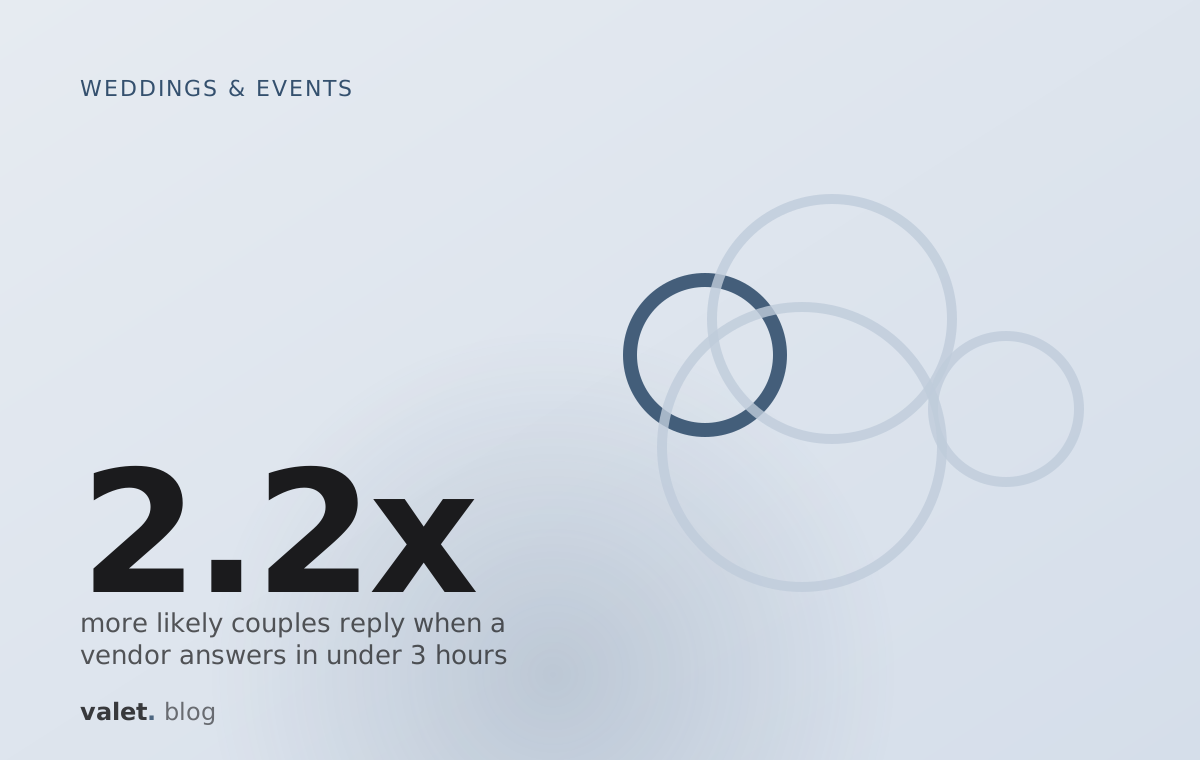
2.2x
more likely couples reply when a vendor answers in under 3 hours
WeddingPro, From Hello to Hired (updated Aug 2026)
2.7x
more likely couples reply to open-ended questions
WeddingPro, From Hello to Hired
28%
of home-services inquiries were offered an appointment
Pied Piper PSI, 3,211 inquiries, Apr 2026
A wedding inquiry response should answer the couple's question from your real prices and calendar, ask one open question, and stay under about 150 words3. That first reply is the easy part; template packs have covered it since at least 20141, and venue software now sends it automatically14. The bookings are decided in the three messages after it: an offer of two real times, one nudge carrying a held date and its expiry, and a close that releases the date. Each message belongs to a state, and each has rules about what it must, should and may contain.
How to respond to a wedding inquiry: the four-message set at a glance#
The four-message set ties each email to the state the inquiry is in, so you always know which message comes next and when to stop. The table below is the summary; the full wording follows.
| Message | Sent when | Job | State after sending |
|---|---|---|---|
| 1. The answer | Within 3 hours of the inquiry, ideally minutes | Answer what was asked; one open question | Answered |
| 2. The time offer | With message 1, or as soon as the couple replies | Two real times for a call or tour; hold the date if policy allows | Time offered, then Time held |
| 3. The nudge | 2 to 3 days after the last message, if no reply | Something new: the hold's expiry, a missing detail, an answer to a likely question | Followed up |
| 4. The close | About a week after the nudge, if no reply | Release the date, leave the door open, log a reason | Closed with a reason |
What the first reply must contain, and what older templates left out#
The first reply must answer the inquiry, and the best-known older templates mostly confirm availability and stop there. Rock n Roll Bride's 2014 template pack, which still ranks for this query, opens its standard reply with: "I'm currently free on the 20th and would love to be involved in your day." It closes with: "if this is within your budget then let's talk some more"1. The couple learns the date is free. They do not learn what happens next, or when.
Later guidance tightened the format. Easy Weddings advised in 2017 that a reply should "start your email with a clear request" and run to about 125 words2. WeddingPro's current lead-reply report recommends replying within three hours and before the 24-hour mark, keeping replies under 250 words and ideally under 150, and asking open-ended questions, which it says make couples 2.7x more likely to reply3. On price, the industry's best-known sales speaker, Alan Berg, advises giving "a price range" and asking "for more details"4.
Channel is the first applicability question. For leads that arrive through The Knot or WeddingWire, WeddingPro has called it "best practice to reply to a lead via the same channel they reached out to you on"5. A couple who wrote through a directory should get message 1 there, not in a new email thread they may never see.
Message 2: offering a time is the message nobody templates#
Offering a time is the step most businesses skip, and it is the one that turns an answered inquiry into a meeting. In Pied Piper's 2026 mystery shop of 3,211 home-services inquiries, only 28% were offered an appointment6. That is not a wedding study, but nothing suggests wedding vendors do better. Indigo Digital's response-time benchmark for venues puts the site visit "in the first response, with live availability where possible"7.
Two specific times work better than "let me know when suits" because they turn a planning task into a choice. If your policy allows holds, message 2 should say how long the hold lasts. An open-ended hold is not a hold; it is an undated promise you will have to unwind later.
Message 3: the nudge, and the stop rule#
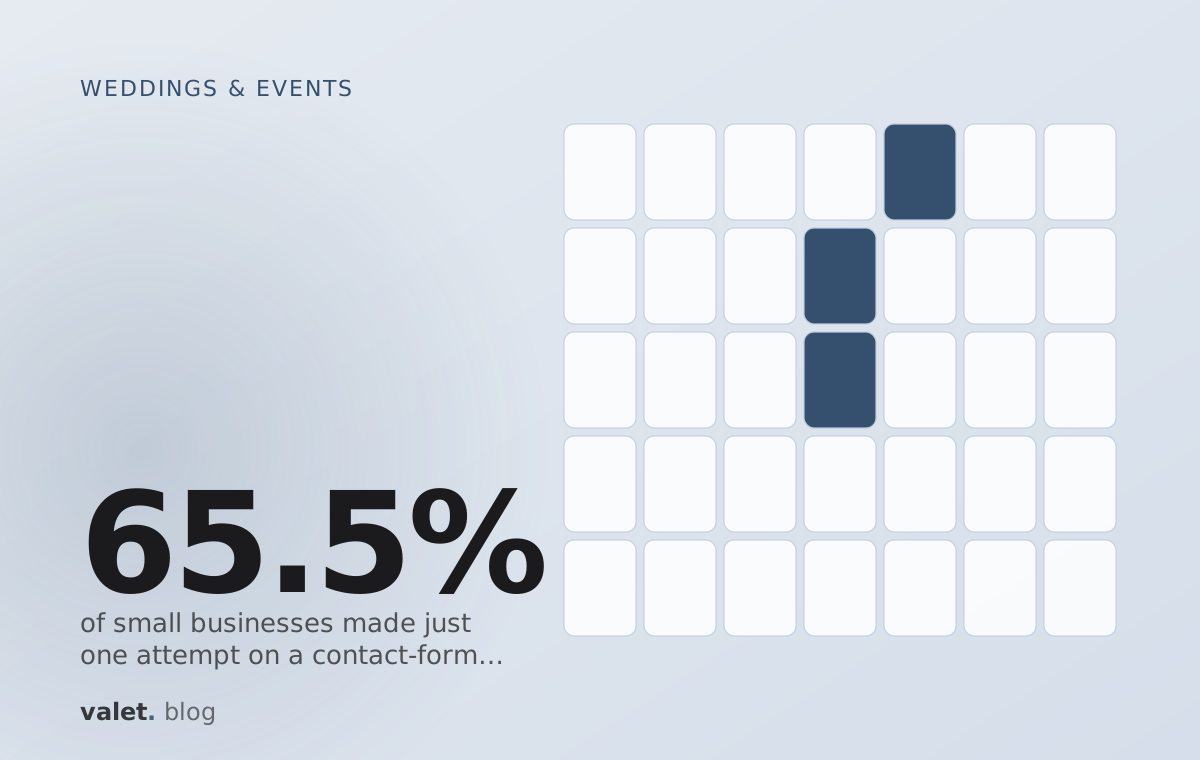
The nudge is legitimate only when it carries something the couple did not have before, and it needs a stop rule because the published advice has none. Easy Weddings told vendors in 2019 to follow up "As many times as it takes"8. Alan Berg advises following up "at least one more time than you are now"9. WeddingPro's current report suggests three to five times in the first 30 days3. Meanwhile, Leadferno reported in 2024 that 65.5% of small businesses made one attempt on a contact-form lead and stopped10.
Between "once" and "until they answer" sits a workable rule: two follow-ups, each with substance, then a close. The substance is the hold expiry, a missing detail you need to quote properly, or an answer to the question couples usually ask next. "Just checking in" fails that test. The case for the cap, with data, is in how many times to follow up with a lead; situation-by-situation wording after a pricing reply is in why couples ghost after pricing.
The four-message wedding inquiry template set#
The template set below uses merge fields in square brackets. Each field should come from a written facts sheet, not from memory, so the same question gets the same answer every time. The field list is in the 10 questions every couple asks every vendor.
MESSAGE 1 - THE ANSWER                         State: New → Answered
Subject: [Date] at [business name]: yes, it's open

Hi [names],

[Date] is [open / open for an evening event only / taken - closest
open dates are X and Y]. For [guest count / hours] the [package] is
[price or range], which includes [3 main inclusions]. [One policy
they will need next: travel / minimum spend / hold policy.]

[One open question, e.g. "What matters most to you about the day?"]

[Message 2 can go here directly - see below.]

[Your name], [business name]


MESSAGE 2 - THE TIME OFFER          State: Answered → Time offered
Subject: Two times to [see the venue / talk] about [date]

Hi [names],

I have [day, time] or [day, time] for a [30-minute call / 45-minute
tour]. Reply with the one that works and I'll send an invite.

I can hold [date] for you until [day, hold expiry] while you decide.
[Only if your hold policy allows it.]

[Your name]


MESSAGE 3 - THE NUDGE (2-3 days later, no reply)   State: Followed up
Subject: [Date] is held until [day]

Hi [names],

A quick note: your hold on [date] runs until [day, time]. [New item:
the answer to a question couples usually ask next / the one detail I
need to give you an exact price.]

If the times I sent don't suit, reply with a day that does.

[Your name]


MESSAGE 4 - THE CLOSE (about a week later)   State: Closed - [reason]
Subject: Releasing [date]

Hi [names],

I haven't heard back, so I'll release [date] on [day]. No need to
reply. If plans change, write back here and I'll check the calendar.

Congratulations again, and good luck with the planning.

[Your name]
(Log the reason: no reply / booked elsewhere / budget / date taken.)


HANDOFF LINE - use in any message when the question is yours alone
"[Owner name] will answer your question about [discount / contract
change / deposit / refund] personally by [day, time]."


DISCLOSURE LINE - use if software writes or sends these messages
"This reply was written by [business name]'s AI assistant from our
price list and calendar. [Owner name] reviews anything it can't
answer."
Must, should, may: the rules behind each message#
The rules behind each message matter more than the wording, because a template sent with a wrong price or a hold you never meant to give creates an obligation you then have to honour or unwind. The distinction below follows the usual legal grammar: must means the message fails without it, should means best practice, may means optional.
| Message | Must | Should | May |
|---|---|---|---|
| 1. Answer | State date availability from the calendar; quote only prices on your list; reply on the channel the couple used | Arrive within 3 hours; stay under about 150 words; ask one open question | Include a range instead of an exact price; attach a brochure |
| 2. Time offer | Offer only times that are free; state any hold's expiry | Offer two specific times; send a calendar invite on reply | Combine with message 1 |
| 3. Nudge | Carry something new; be true (no invented scarcity) | Restate the hold expiry; ask for one missing detail | Mention a smaller package that already exists |
| 4. Close | Release the date when you say you will; log a reason | Leave the door open; ask for nothing | Skip it if the couple has already said no |
| Any message | Send money, contract and complaint questions to the owner, with a reply-by time | Disclose AI if software wrote the reply | Sign with a named person |
When software sends the template: disclosure and liability#
When software sends these messages, two legal points apply, and both are narrower than vendor marketing suggests. This is not legal advice; check with counsel for your jurisdiction.
The business owns what the message says. In Moffatt v. Air Canada, 2024 BCCRT 149 (February 2024), a tribunal rejected the airline's argument that its chatbot was a separate legal entity responsible for its own actions and ordered it to pay CAD $812.0211. A template that quotes a price or a hold is the business quoting a price or a hold, whoever pressed send. That is why "quote only prices on your list" sits in the must column.
Disclosure obligations are arriving in stages. In the EU, Article 50(1) of the AI Act has applied since 2 August 2026: people interacting with an AI system must be informed of it, unless that is already obvious to a reasonably well-informed person12. In the US, a July 2026 state-law guide reports that Colorado (HB 26-1263), Oregon (SB 1546) and Washington have chatbot-disclosure laws taking effect on 1 January 2027, with Colorado and Oregon providing $1,000 per violation13. That guide is secondary; confirm the statute text before relying on it. For a US wedding vendor today, a one-line disclosure in the signature is a prudent practice that costs nothing, and in some states it will soon be a statutory mandate.
The ambiguity worth noting: whether a reply drafted by software and approved by a person counts as "interacting with an AI system" is not settled in any of these texts. A disclosure line removes the question.
Where Valet fits#
Valet is an AI assistant that runs this four-message pattern for a small business's written inquiries: email, website forms, directory lead emails and the owner's free Valet page. It answers from your price list, packages, calendar and policies, offers and holds real times, follows up at most twice by default with something useful each time, then stops and tells you why. Discounts, deposits, contracts and complaints go to you with one-tap replies, and the couple is told when you will reply. Every reply says it is AI and has a receipt showing the rule and sources used.
To see which of the four messages your inquiries are missing, start with the free lead check: forward 10 to 20 recent inquiries and see what went unanswered, what stopped after one reply, and what it was worth.
Questions people ask
How should I respond to a wedding inquiry email?
Answer what the couple asked in the first lines: whether the date is open, the price or range, and what is included. Ask one open question back, offer a next step, and keep it short; WeddingPro recommends under 250 words and ideally under 150.
What should the second message to a couple say?
Offer two specific times for a call or tour and, if your policy allows, hold the date for a stated number of days. A second message that only asks whether they received the first one adds nothing.
How many follow-ups should a wedding vendor send?
Advice ranges from 'as many times as it takes' to three to five times in 30 days. A defensible rule is two follow-ups that each carry something new, then a close that releases the date and logs a reason.
Do I have to say a reply was written by AI?
In the EU, Article 50(1) of the AI Act has required since 2 August 2026 that people be told they are interacting with an AI system unless it is obvious. Several US state laws are reported to take effect on 1 January 2027. This is not legal advice; check with counsel for your state.
Sources
Confidence: H primary source checked · M credible secondary or reported · L vendor claim or single report. Reddit and forum items are quoted from public threads and summarised, not endorsed.
- Shed inbox guilt! 8 email templates for wedding suppliers · Rock n Roll Bride (Kathryn Williams) · 2014-01-14 M
- How to write the perfect email response to an enquiry · Easy Weddings Pro · 2017-07-11 M
- From Hello to Hired: your guide to lead replies · WeddingPro · 2026-08-28 H
- Lead reply questions with Alan Berg · WeddingPro · 2023-06-23 M
- How to respond to wedding leads on The Knot and WeddingWire · WeddingPro · 2021-10-18 M
- Precision Garage Door Ranked #1 in Customer Lead Handling Effectiveness Home Services Study · Pied Piper Management Company via BusinessWire · 2026-04-12 H
- The venue enquiry response time benchmark · Indigo Digital · 2026-07-14 M
- Following up leads · Easy Weddings Pro · 2019-11-29 M
- Your questions about lead replies, answered · WeddingPro (Alan Berg) · 2023 M
- Research: website contact forms and lead management, uncovering costly mistakes · Leadferno · 2024-06-28 H
- A word of caution: company liable for misrepresentations made by chatbot (Moffatt v. Air Canada, 2024 BCCRT 149) · McMillan LLP · 2024-02 H
- Article 50, checked · Scrutineyes · 2026 H
- AI chatbot human disclosure laws: a state guide · beancount.io · 2026-07-19 M
- First Reply: automated responses to new inquiries · Perfect Venue Help Center · 2026 H
How to cite this page
Cite this page
Valet, "Wedding inquiry response template, and the two messages after it that nobody templates", valet.team, October 2026.
Keep reading
 Weddings & eventsWhy couples ghost after you send pricing, and what the second message should sayThe usual answers are price, a hidden price list, or a slow reply. The bigger leak is that most vendors send one reply and stop, while the couple is still choosing between five of you.Strategy desk · 12 min · 1 October 2026
 Weddings & events"Our leads from The Knot / WeddingWire never respond": ghost leads, fake leads, or leads nobody followed up?Vendors say the leads are fake. The Knot says they are templated and ghosted. A U.S. senator has asked the FTC to look. None of them has published what happened to each inquiry, and that is the only record that settles it for your listing.Policy desk · 10 min · 1 October 2026
 Weddings & eventsHow many times should you follow up with a couple who hasn't replied? (And when the lead is dead)Wedding advice runs from "one more time than you are now" to "as many times as it takes". Nobody says when to stop. Here is a stop rule, a list of lost reasons, and the three messages that sit between the first reply and the end.People at work · 11 min · 1 October 2026