
Startups & support@
Why your FAQ page doesn't reduce support emails (customers ask about their order or account), and what does
The FAQ answers the category. The email asks about one customer's case. Until the reply can apply your facts to that case, the same questions keep arriving, however good the FAQ is.
Short answer
An FAQ page rarely cuts support email because most emails ask about the customer's own order or account, which a generic page cannot answer. Gorgias platform data shows stores still receive 19 to 46 tickets per 100 orders (March 2026),. What cuts volume is a reply that applies your written facts to that customer's case, an allowed action, and a hand-off with a stated reply time.
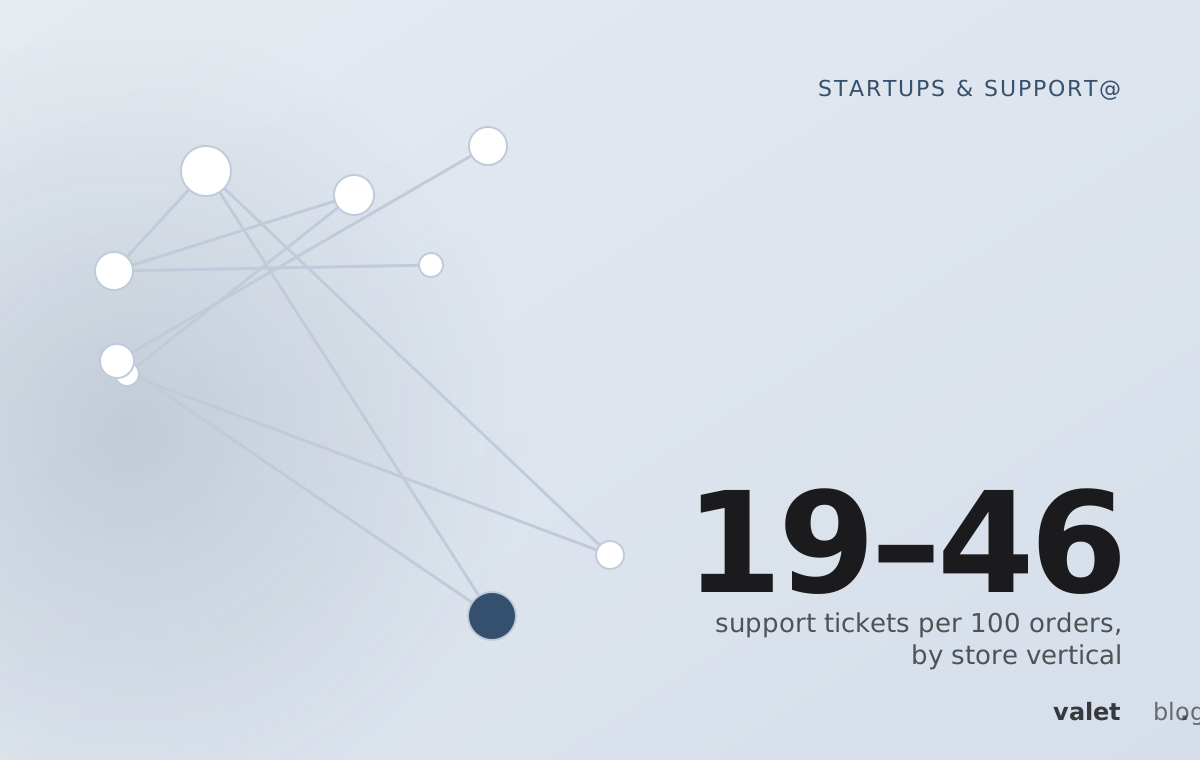
19–46
support tickets per 100 orders, by store vertical
Gorgias Ecom Lab platform data, March 2026
~50%
of one support lead's inbound was already written out in plain language in an FAQ
Hacker News comment by a former support lead, June 2026
$12.18–12.40
estimated cost of one human-handled support ticket
Gorgias, 2023
An FAQ page rarely cuts support email, because most of that email is about the customer's own order or account, and a generic page cannot answer a personal question. Stores in Gorgias's platform data still receive 19 to 46 support tickets per 100 orders (March 2026)2. What cuts volume is different. It is a reply that applies your written facts to this customer's case, a short list of actions the replier may take, and an honest hand-off with a reply time for the rest.
Why doesn't an FAQ page reduce support emails?#
The standard advice for repeat support email is to write a better FAQ, pin it, link it in every auto-reply and wait for the volume to fall. The advice is sensible and cheap, and it rests on one assumption: that the customer's question is the same question the page answers. Usually it is not.
Owners keep reporting the same result. In r/smallbusiness, a 2024 thread asking owners how they manage their FAQ (9 comments) carries the line "We have a FAQ and still the same questions". A 2026 thread from an owner whose business went viral (90+ comments) describes "answering the same questions over and over (our pinned post has all of the answers)". The page exists. The email keeps coming.
The mechanism is narrower than "customers don't read". It is also more useful. Customers ask about their case. The page answers the category.
Why do smart owners keep rewriting the FAQ?#
Owners keep investing in the FAQ because the evidence for it looks strong, and on its own terms it is. A former support lead who ran Fin implementations wrote on Hacker News in June 2026: "People don't read… ~50% of the inbounds I receive are fully written out in plain language in an FAQ."1 If half the answers already exist, better placement looks like a cheap way to halve the queue.
The community agrees. The top answer in an r/smallbusiness thread on answering the same customer questions (40+ comments, early 2026) is a FAQ document. The top answer in an r/ecommerce thread on the time sink of customer service (100+ comments, 2025) is to update the FAQ. A popular reply in r/SaaS (August 2026) puts product first: "Repeated questions -> think about product design first, then if not add FAQs."
All three answers are rational for the person giving them. An FAQ costs an afternoon, needs no new tool and creates no new risk. It is a local optimum. It improves the page without touching the reason the email was sent.
The cracked assumption: the customer is asking about their own case#
The FAQ assumes a generic question, and the email is usually a personal one. "How long does shipping take?" is generic. "Where is my order, it's been six days?" is personal. "Do you refund annual plans?" is generic. "Can I get a refund, I was charged twice?" is personal and needs an action.
Even the generic-looking emails are often personal underneath. A customer who asks "what's your return policy?" usually means "can I return this item, which I bought on this date, in this condition?" The page states the rule; the customer wants the rule applied. Reading the FAQ, finding the right line and working out whether it covers them is a coordination cost. Emailing moves that cost from the customer to you, at no price to them. Customers who write in are acting rationally too.
The alternative mechanism fits in one sentence. Support email falls when the reply applies your facts to the customer's case and can take the small action the case needs; it does not fall when the facts are published somewhere the customer must find and interpret them.
What is the evidence that support email is personal, not generic?#
Three lines of evidence support the personal-question reading, from weakest to strongest.
Tracking pages have not ended "where is my order" email#
"Where is my order" (WISMO) email persists in stores that already send tracking links. Gorgias put WISMO at 18% of incoming requests in its 2023 data, and its own worked example assumes 150 WISMO requests a month for a store with 1,000 orders4. An owner in r/shopify (September 2026) describes wanting a "'check your order status page instead of contacting me' overall flow". The page exists. The customer still wants their parcel answered in their thread.
The cost of silence here is not just a ticket. A Hacker News commenter in April 2026 explained why stores send so many shipping emails: without them, "they'll have people filing credit card disputes and BBB complaints"5 over a short shipping delay.
Ticket volume per order has not collapsed#
Gorgias's platform data for March 2026 shows support tickets per 100 orders ranging from about 20 in Food & Beverages and 22 in Apparel & Accessories to 46 in Electronics23. These are stores on a modern helpdesk platform, where help centers are a standard feature. If public FAQs absorbed most questions, these ratios would be far lower. The vertical spread also points to personal cases: electronics plausibly generates more setup, compatibility and fault questions per order than food does.
The practitioners who build AI support say the same thing#
The strongest line comes from the same former support lead quoted above. That person rejects the conclusion that a bot reading the FAQ solves the problem. An automated answer "will fail the second it needs to take action or deliver personalized information based on client's account data."1 Another commenter in the thread described a good AI support experience: "I never have to repeat myself and if it's tied in with your account specifically, it's like getting escalated to a level 3 support rep immediately."1 The FAQ was never the missing ingredient. The account context and the permission to act were.
What does the FAQ gap cost a small store or SaaS?#
The cost of the FAQ gap is the time spent answering personal versions of questions the page already covers. For stores, published figures let you estimate it. For SaaS, you have to count.
Stores. Illustration Take a store with 1,000 orders a month at the Apparel rate of 22 tickets per 100 orders: 220 tickets2. Apply Gorgias's 2023 WISMO share of 18% and its estimate of $12.18 to $12.40 per human-handled ticket4. That gives about 40 WISMO emails, or roughly $480 a month, about $5,800 a year. Gorgias's own example, at 150 WISMO requests per 1,000 orders, gives about $1,860 a month, about $22,000 a year4. The two figures mix 2023 and 2026 data, so treat the range as an order of magnitude.
SaaS. A solo founder on Ask HN in 2022 reported 15 to 20 user emails a day8. Illustration At six minutes each, 15 emails is 90 minutes a day. If half are FAQ-shaped, as the support lead above found, that is 45 minutes a day of a founder's time. Multiply by your own hourly value.
The second-order cost is worse. When an AI tool is added on top of an FAQ, it inherits the gap. In Gorgias data from October 2025 to April 2026, 55% of AI-touched tickets ended in a human hand-off, and one-third of those never got a human reply7. A bot that can only restate the FAQ hands off every personal case, and a hand-off nobody owns is worse than a slow human reply.
The 200-email sort: find out which problem you have#
The 200-email sort is a one-afternoon test that tells you whether a better FAQ will help or whether your email is mostly personal. Pull the last 200 inbound support emails, or 90 days if that is fewer. Put each one in exactly one bucket.
| Bucket | Test | Example shapes | What an FAQ does | What fixes it |
|---|---|---|---|---|
| 1. Generic | Answer is identical for every customer | Shipping countries, plan limits, "do you integrate with X" | Helps, if the customer finds it | Product or page change first; then a reply that quotes the fact in full, not a link |
| 2. Personal | Answer needs this customer's order, plan, invoice or history | "Where is my order", "which plan am I on", "why was I charged" | Nothing | A replier who can see the record, or a hand-off to someone who can, with a reply time |
| 3. Needs action | Answer requires changing something | Resend invoice, change address, cancel, refund, reset access | Nothing | A written list of allowed actions and limits; everything else to the owner |
Tally (fill in):
Generic:       ___ / 200   Top 5 questions: ________________
Personal:      ___ / 200   Record needed: order / plan / invoice / history
Needs action:  ___ / 200   Actions requested: ________________
               Of these, within written policy: ___   Outside policy: ___

Decision:
- Generic above 60%  -> fix the product or page, and put the full answer in replies.
- Personal + action above 50% -> the FAQ is not your lever. Give the replier
  the record, the facts and a short allowed-actions list. Hand off the rest
  with a reply-by time.
- Re-count in 30 days. Same top 5 generic questions? That is a product signal.
The thresholds are starting points, not findings. Nobody has published this split for small stores or seed-stage SaaS, so your own count is the first data point you will have. Valet could run the same sort across many inboxes, but no such dataset exists yet. A related method for sales inquiries is the Lost Lead Audit.
Where the FAQ still wins, and where this argument would be wrong#
The FAQ still wins in three situations, and they are worth protecting. First, when it is sent as the reply. A commenter on an Ask a Manager post about "pick your brain" requests (April 2026) wrote: "I wrote up an FAQ that I just provide to everyone who contacts me…Shockingly (not), nobody has ever sent me a new question to add."6 That probably works because the questions are generic and the FAQ arrives in the thread. Second, when the product has a defect that generates the question: fixing it beats any page. Third, as the source for whoever writes replies. A good FAQ is the start of a facts sheet; see the facts sheet and hard limits to set before any AI answers.
The argument here would be wrong if your 200-email sort comes back mostly generic and the generic share does not fall after you put full answers in replies. In that case your customers are not finding the page, and placement is the fix. It would also be wrong for businesses whose customers have no order or account, such as a pure content site. Monday-morning decision: run the sort before you rewrite the FAQ again.
For a full support@ routine built on these buckets, see how to handle support@ as a solo or 3-person SaaS founder.
Where Valet fits#
Valet covers the generic bucket and the hand-off for the rest. You forward support@ or hello@ to a private Valet address; replies go out from your own address once the domain is verified. Valet answers only from your own facts (price list, policies, docs) and puts the answer in the reply rather than linking to a page. A question that needs a record or a decision Valet does not have waits for you, with one-tap replies, and the customer is told when you will reply. Every reply says it is AI and comes with a Valet receipt showing the question, the rule used and the sources. To see what your own inbox contains, start with the free lead check: forward 10 to 20 recent emails and see what went unanswered or stopped after one reply.
Questions people ask
Why don't customers read the FAQ?
Many do, and still write, because their question is about their own order, charge or account. An FAQ can say shipping takes 3 to 5 days; it cannot say where this parcel is. Emailing is also faster for the customer than searching, so the cost of the search moves to you.
How do I reduce repetitive support tickets at a small SaaS?
Sort 200 recent emails into generic, personal and needs-action. Fix generic ones in the product or in the reply itself, answer personal ones from account facts, and give a short list of safe actions to whoever or whatever answers. Re-count after a month.
Does an FAQ page help at all?
Yes, as a source for replies and for people who self-serve before writing. One Ask a Manager commenter sends a written FAQ to everyone who asks and reports nobody has sent a new question to add. The FAQ works best inside the reply, not as a link instead of one.
What is WISMO?
WISMO stands for 'where is my order'. Gorgias put it at 18% of incoming requests in its 2023 data. It persists even when stores send tracking links, because the customer wants an answer about their own parcel, in their own thread.
Sources
Confidence: H primary source checked · M credible secondary or reported · L vendor claim or single report. Reddit and forum items are quoted from public threads and summarised, not endorsed.
- Hacker News discussion thread, item 48540126 (Salesforce and Fin) · Hacker News · 2026-06 H
- Stop benchmarking against the average · Gorgias Ecom Lab · 2026-04-01 H
- Ticket volume · Gorgias · 2026-05-22 H
- Automate WISMO requests · Gorgias · 2023-11-13 M
- Hacker News comment, item 47695357 (One item purchased, ten emails) · Hacker News · 2026-04-08 H
- How to respond to requests to pick your brain · Ask a Manager · 2026-04-01 H
- The cheapest ticket is the one a human never touches · Gorgias Ecom Lab · 2026 H
- Ask HN: Solo founders - How are you handling customer support? · Hacker News · 2022-07-22 M
How to cite this page
Cite this page
Valet, "Why your FAQ page doesn't reduce support emails (customers ask about their order or account), and what does", valet.team, October 2026.
Keep reading
 Startups & support@Should a startup use AI for customer support? What founders who lost customers say, and the three missing controlsCustomers accept AI support when they can reach a person. The failures that cost startups customers trace to three missing controls, not to the model.Data desk · 11 min · 1 October 2026
 Startups & support@How to handle support@ as a solo or 3-person SaaS founder (without hiring, and without a bot that traps people)Sort support@ into four categories, give each a written promise and an automation level, and check the handoffs every week. Here is the runbook, plus the six ways it breaks.Playbooks · 12 min · 1 October 2026
 Startups & support@An AI agent that answers vs one that finishes the job: what "acts" means for a small business, and the four controls that make it safeMost AI tools sold to small businesses answer the first message and stop. This piece defines what it means for an agent to finish the job, traces where answer-only tools lose the inquiry, and sets out the four controls that make acting safe.Technical desk · 11 min · 1 October 2026