
The owner's inbox
What an inquiry costs you in your own time: the "36% of the week on admin" number, traced and applied to a solo professional
The figure travels as "Xero says owners spend 36% of the week on admin". Followed hop by hop, it leads to a 2023 survey of 251 entrepreneurs that left out freelancers and sole traders. Here is the chain, what it does and does not support, and how to measure your own number instead.
Short answer
The "36% of the week on admin" figure is not Xero's research. It traces to a Time etc survey run by Censuswide on 22–28 September 2023: 251 US entrepreneurs, 45.5-hour average week, about 16.4 hours of admin. That survey excluded freelancers and sole traders. A 2024 UENI survey of 837 businesses with five or fewer staff found 22.4%. For a solo professional, measure your own inquiry minutes instead.
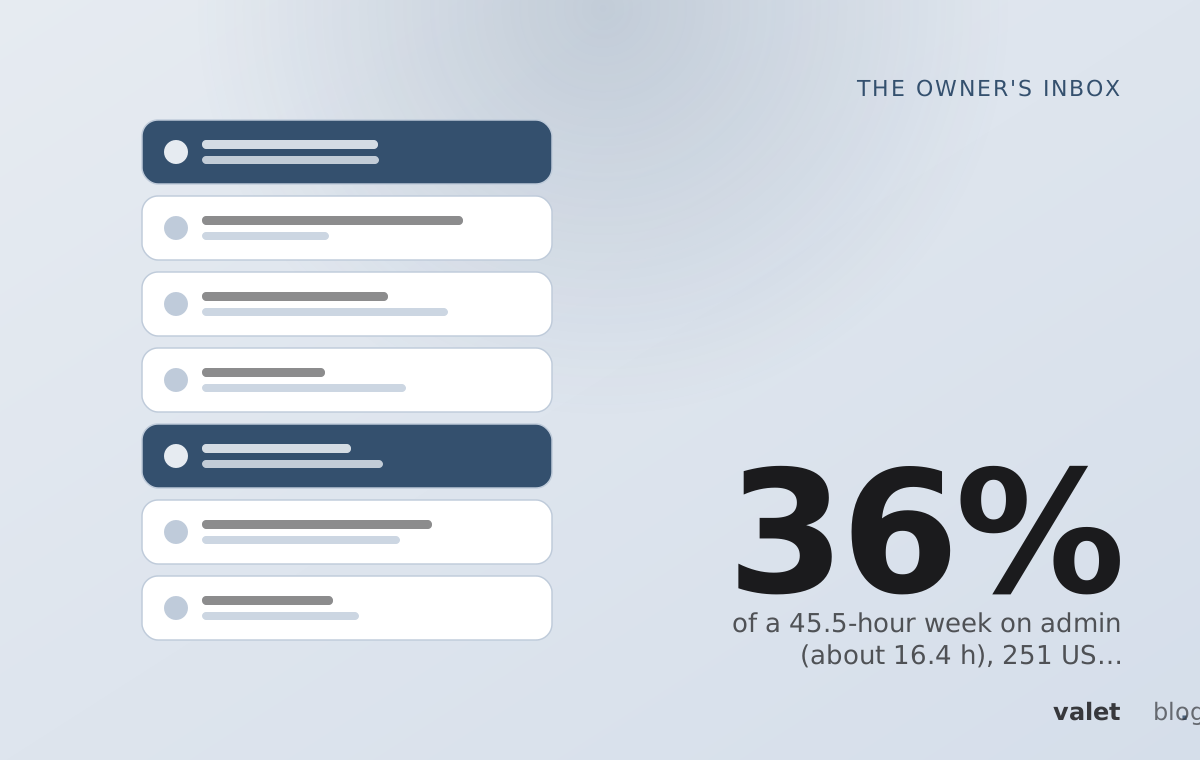
36%
of a 45.5-hour week on admin (about 16.4 h), 251 US entrepreneurs, freelancers and sole traders excluded
Time etc / Censuswide, September 2023
22.4%
of owner time on administration plus legal and compliance, 837 US businesses with 5 or fewer staff, median 60-hour week
UENI, May 2024
40%
of 1,050 home-service owners name communicating with customers among their most time-consuming tasks
Jobber Home Service Trends Report, 2026
The "36% of the week on admin" figure is not Xero's research, and it was not measured on solo professionals. It traces to a survey Time etc commissioned from Censuswide on 22–28 September 2023: 251 US entrepreneurs, a 45.5-hour average week, about 16.4 hours of admin, with freelancers and sole traders excluded3. A 2024 UENI survey of 837 businesses with five or fewer employees put administration plus legal and compliance at 22.4% of owner time4. For a consultant or freelancer, your own inquiry minutes are the better input.
Where does the "36% of the week on admin" statistic come from?#
The statistic usually arrives as "Xero says owners spend 36% of their week on admin". That attribution is the symptom. Xero's guide on the "time tax" on small businesses, dated 20 August 2026, does contain the number, but it attributes it elsewhere: "According to a Forbes survey, the average entrepreneur spends roughly 36% of their working week on administrative tasks."1 The guide then gives an opportunity-cost example: 15 hours a week of admin at a $150 billing rate is $2,250 a week.
So the first hop points away from Xero. The page is a guide, not a study, and the number is cited, not measured. That alone does not make it wrong. It means the population, the dates and the definition of "admin" have to be found further down the chain.
How the citation chain is built: three hops and one gap#
The chain for this figure has three documented hops and one undocumented one. The table records each hop as fetched on 1 October 2026.
| Hop | Document | Date | What it says | Attribution it gives |
|---|---|---|---|---|
| 1 | Xero guide1 | 20 Aug 2026 | "roughly 36% of their working week on administrative tasks" | "a Forbes survey" |
| 2 | Forbes survey | Not found | We could not locate a Forbes survey with this figure | n/a |
| 3 | Stealth Agents statistics digest2 | 8 Sep 2026 | 36% of a 45.5-hour week; "16.38 hours a week" | Time etc and Censuswide, 2023; does not mention Forbes |
| 4 | Time etc survey page3 | Survey 22–28 Sep 2023 | "36% of their work weeks doing administrative tasks like invoicing, data entry, and ordering office supplies" | Primary: Censuswide fieldwork, 251 US entrepreneurs |
Hop 2 is the gap. A Forbes article may well have reported the Time etc result, which would explain the attribution, but we did not find it, so this page does not claim it. What the chain does establish is that the number is older than the 2026 pages repeating it, and that it comes from a vendor-commissioned survey. A survey commissioned by a company that sells time-saving services has an interest in admin looking large, which is one more reason to keep its boundary conditions attached.
Three hypotheses that did not survive the trace#
Three readings of the 36% figure circulate. Each fails on a specific, checkable point.
Hypothesis 1: Xero measured it#
Xero's guide cites Forbes, not its own data1. Xero's own research, as reported by Insightful Accountant, measured something different: a study of 300 US owners found about 22 hours a month spent on financial management, and estimated that stress drains about 33 working days a year5. That is financial admin, monthly, from a different sample. It cannot be converted into "36% of the week".
Hypothesis 2: it is a general measure of owner workload#
The Time etc survey defines admin by example: "invoicing, data entry, and ordering office supplies"3. Its task list reports the share of respondents doing each task: logging expenses 59%, research 49%, managing schedules 45%, creating invoices 44%, data entry 43%, ordering supplies 40%, chasing late payments 27%. Answering customer inquiries is not on the list. Scheduling is. So the 36% neither includes nor excludes inquiry handling cleanly. It measures a bundle defined by the survey author.
Hypothesis 3: it applies to a solo professional#
This is the hypothesis that fails hardest. The Time etc page states that freelancers and sole traders were excluded3. The sample was 251 US entrepreneurs, 60 of whom the survey labels "expert delegators". A one-person consultancy is outside the population by design. Applying 36% of 45.5 hours to a solo practice is extrapolation, not measurement.
Root cause: a sampled number became a universal one#
The root cause is not a false number. It is a number that lost its boundary conditions as it moved through secondary pages. At hop 4 it carries a sample size (251), a fieldwork window (22–28 September 2023), a population (US entrepreneurs, sole traders excluded) and a task definition. By hop 1 it carries none of them and a different brand name.
The nearest primary for small operators gives a different value. UENI surveyed 837 US businesses with five or fewer employees on 6–13 May 2024. Administration plus legal and compliance took 22.4% of owner time; the median owner week was 60 hours, and 62% worked more than 50 hours4. At the median, 22.4% of 60 hours is about 13.4 hours a week. The Stealth Agents digest notes the two surveys "did not ask the same population or use the same task definition"2. Both are self-reported.
Neither survey isolates inquiries. The closest measurement of customer communication comes from Jobber's 2026 report: of 1,050 US home-service owners surveyed in December 2025, 40% named communicating with customers among their most time-consuming daily tasks, ahead of quoting at 37% and admin or paperwork at 31%6. That is a ranking, not a duration. Owners in r/smallbusiness describe the same load without numbers: "just me, no employees, and I'm spending way too much time on admin" (40+ comments, early 2026)7. In r/consulting, a thread titled "40 to 60 emails a day" (20+ comments) shows the volume end of it8.
The fix: measure your own inquiry minutes#
The fix is to replace a borrowed percentage with a measured duration from your own week. The inquiry share of admin breaks into three tasks with different fixes: the first reply, the scheduling back-and-forth, and chasing quiet leads. Time each for two weeks, then run the calculator.
MEASURE (two-week log, then average per week)
N   New inquiries per week:                          ____
M1  Minutes per first reply (read, look up, write):  ____
M2  Minutes per inquiry on scheduling back-and-forth:____
M3  Minutes per inquiry on follow-ups and chasing:   ____
R   Your hourly value ($):                           ____
    (billing rate if you have unsold hours;
     a lower figure if you are fully booked)
W   Working weeks per year:                          ____

COMPUTE
Minutes per inquiry      M  = M1 + M2 + M3
Hours per week           H  = N x M / 60
Cost per week            $  = H x R
Cost per year            $  = H x R x W

SPLIT (which minutes could leave your desk?)
M1 from a written facts sheet:     ____ min
M2 with real times offered up front: ____ min
M3 with a capped follow-up rule:    ____ min
Minutes that need you (scoping, exceptions, pricing
outside the sheet):                  ____ min
Illustration A consultant receives 10 inquiries a week. Each takes 8 minutes for the first reply, 6 for scheduling and 4 for follow-ups: 18 minutes, or 3 hours a week. At $150 an hour and 48 working weeks, that is $450 a week and $21,600 a year. The rate is not exotic for the field: in Consulting Success's 2026 study of about 1,000 consultants, 52% of specialists charged $10,000 or more per project9. Your minutes will differ; that is the point of logging them.
The split section matters more than the total. "Batch your email twice a day" changes when you spend M1, M2 and M3. It does not remove any of them. The minutes that can leave your desk are the first reply from written facts, the scheduling round-trip, and the follow-up chase. The minutes that should stay are scoping and anything priced outside your sheet. A template for that sheet is in FAQ page vs facts sheet.
Trade-offs and residual risk in your own number#
A measured number has its own failure modes. A two-week log samples a short window, so a launch week or a holiday week skews it; log a typical fortnight or two separate ones. Self-timing undercounts the minutes lost re-reading a thread before replying, so round up. The hourly value R is a judgement, not a measurement: a fully booked consultant should not price inquiry time at the full billing rate, because no sold hour was displaced.
Removing minutes also moves risk. A first reply sent from a facts sheet by anyone other than you can be wrong, and a follow-up sent by rule can be badly timed. The controls are a closed list of facts, a topic list that always comes to you, and a record of what was sent. For a calculation of what a wrong answer can cost, see what an AI mistake with a customer costs. For the money side of inquiry handling, see what it costs to answer one inquiry.
Reproduction notes: how to check this chain yourself#
Every hop above is a public page; each was fetched on 1 October 2026. To reproduce the trace:
- Open the Xero guide. Search the page for "36%" and note the attribution text and the page date1.
- Search for the cited Forbes survey. Record whether you find a survey with a sample size and fieldwork dates. We did not.
- Open the Time etc survey page. Record the sample (251), fieldwork dates (22–28 September 2023), average week (45.5 hours) and the exclusion of freelancers and sole traders3.
- Open the UENI page. Record the sample (837), size limit (five or fewer employees), dates (6–13 May 2024) and the 22.4% figure4.
- Compare populations before comparing numbers. If your business is a sole practice, neither survey sampled you directly. Your two-week log did.
How we got this: each source in the chain was fetched on 1 October 2026 and quoted from the page text. The Forbes hop could not be located and is reported as a gap, not a finding. No Valet data is used.
Where Valet fits#
Valet takes the three removable parts of inquiry time off your desk for written inquiries. It sends the first reply from your own facts sheet, offers real times from your calendar and books them, and follows up at most twice by default, each time with something useful. Pricing exceptions, contracts and anything not on your sheet come to you with one-tap replies, and the customer is told when you will reply. Every reply is signed as your AI assistant and has a Valet receipt. To see how many of your recent inquiries went unanswered or stopped after one reply, start with the free lead check: forward 10 to 20 of them.
Questions people ask
How much time do small business owners spend on admin?
Two surveys give different answers. Time etc and Censuswide (September 2023, 251 US entrepreneurs, sole traders excluded) found 36% of a 45.5-hour week, about 16.4 hours. UENI (May 2024, 837 US businesses with five or fewer employees) found 22.4% of owner time on administration plus legal and compliance, with a median 60-hour week.
Is the 36% admin statistic from Xero?
No. A Xero guide dated 20 August 2026 cites it as coming from 'a Forbes survey'. The earliest primary source we could find is a Time etc survey conducted by Censuswide in September 2023. Xero's own research cited elsewhere measures financial admin, at about 22 hours a month.
How much is my time worth as a consultant?
Use your billing rate if you have unbilled capacity, or a lower figure if you are fully booked and the time would otherwise be rest. Multiply it by the hours you spend on inquiries: first replies, scheduling and follow-ups. At $150 an hour, 3 hours a week is about $21,600 over 48 working weeks.
Does the 36% figure apply to freelancers?
Not directly. The Time etc survey that produced it excluded freelancers and sole traders. The UENI survey of businesses with five or fewer employees is closer to a solo professional, and your own time log is closer still.
Sources
Confidence: H primary source checked · M credible secondary or reported · L vendor claim or single report. Reddit and forum items are quoted from public threads and summarised, not endorsed.
- The hidden 'time tax' costing small business owners hours every week · Xero · 2026-08-20 H
- Small Business Owner Administrative Time Statistics 2026 · Stealth Agents · 2026-09-08 M
- The Big Price Of Small Tasks: How Entrepreneurs May Be Unwittingly Keeping Their Businesses Small, Hurting Bottom Lines And Compromising Wellbeing · Time etc (survey by Censuswide, 22–28 Sep 2023) · 2023 H
- Does 'AI' Mean 'Absolute Inequality' in American Business? (how microbusiness owners spend their time) · UENI · 2024-05 H
- Xero study finds stress drains 33 workdays per year from US SMB owners · Insightful Accountant · undated M
- Blue Collar Strong: The 2026 Home Service Trends Report (1,050 owners, surveyed December 2025) · Jobber · 2026 H
- "How did you reduce admin time as a solo business owner?" (40+ comments; Google snippet) · Reddit, r/smallbusiness · c. 2026-03 M
- "40 to 60 emails a day" (20+ comments; Google snippet) · Reddit, r/consulting · c. 2024 M
- Consulting Fees Study 2026 · Consulting Success · 2026-09-07 H
How to cite this page
Cite this page
Valet, "What an inquiry costs you in your own time: the '36% of the week on admin' number, traced and applied to a solo professional", valet.team, October 2026.
Keep reading
 The owner's inboxThe contact-form leak: why 42.6% of website inquiries never get a reply, and how to prove you repliedSome form leads die in the spam folder. Most arrive safely and nobody answers. Here is how to check both in ten minutes, and how to prove a reply went out.People at work · 10 min · 1 October 2026
 The owner's inboxYou've answered that question a hundred times: FAQ page vs answering emails vs answering from a facts sheetOwners treat the FAQ page as the asset and the replies as the chore. Both are copies of something most small businesses never write down: one maintained list of facts that a person, a page or an AI can quote.Strategy desk · 10 min · 1 October 2026
 The owner's inboxWhat does it actually cost to answer one customer inquiry? Receptionist vs VA vs AI (2026 numbers)Every price list in this market counts contacts, minutes or seats. Owners who wrote reviews about the bill were counting something else: what each booking ended up costing. Here are 12 dated prices and the calculator that converts them.Field reports · 8 min · 1 October 2026