
Trust & AI handoff
Customers don't hate AI, they hate being trapped: the 2025–26 numbers and what a small business should do differently
Every recent survey on AI service carries the same condition: the customer can reach a person. Here are the dated numbers, and a step-by-step way to make sure your own setup never traps anyone.
Short answer
Mostly no: customers object to being trapped. Five9's March 2025 survey of 1,006 consumers found 72% are open to AI "provided they can escalate to a human when needed." Five9's 2026 report of 3,000 consumers found trust in an AI fixing their issue is 55% with a human path and 26% without one. Gartner, cited by California Management Review (April 2026), reports 64% would rather companies not use AI for service. The fix is a human path with a stated reply time.
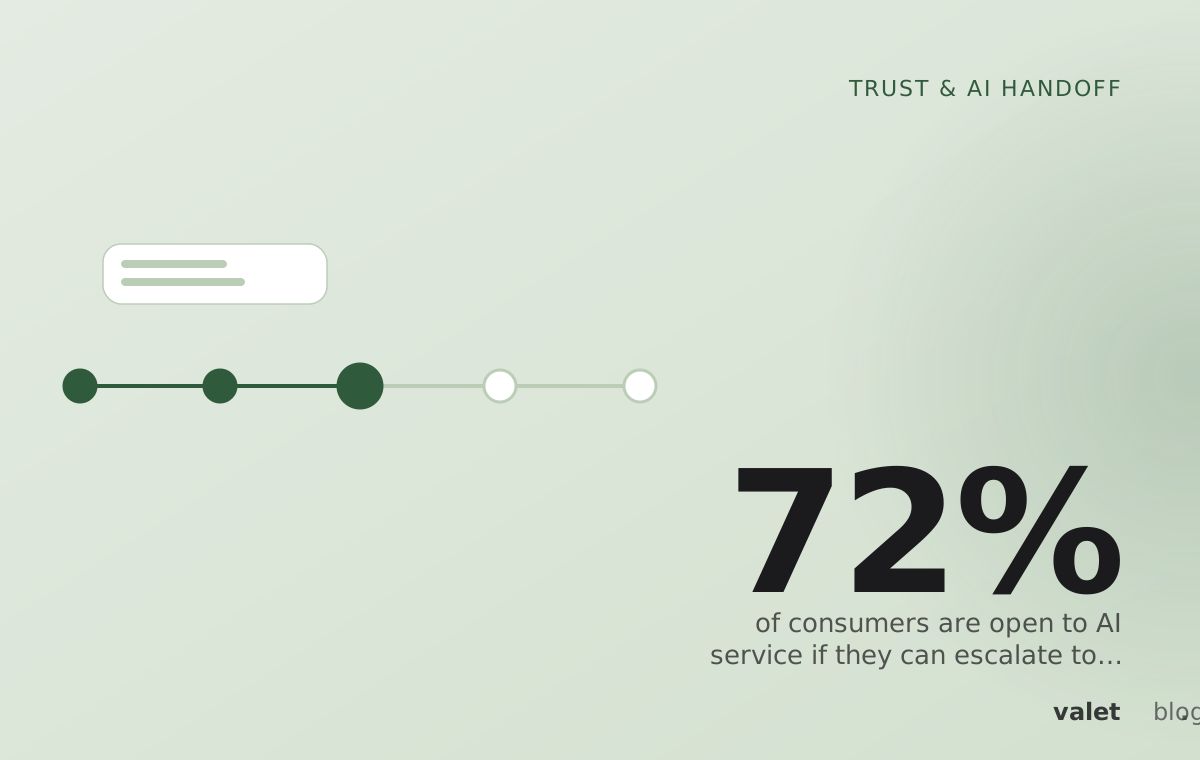
72%
of consumers are open to AI service if they can escalate to a human
Five9, n=1,006 US/UK/Canada, 13 Mar 2025
55% vs 26%
trust in AI resolving an issue, with and without a human path
Five9 2026 CX report, 3,000 consumers, via AccountsRecovery.net, Jul 2026
40%
of consumers stop doing business with a company after one bad experience
Five9, n=1,006, 13 Mar 2025
Customers do not hate AI. They hate being stuck with it. Five9 asked 1,006 consumers in the US, UK and Canada in March 2025. 72% said they are open to AI service "provided they can escalate to a human when needed."1 Five9's 2026 report, with 3,000 consumers, found trust in an AI fixing an issue is 55% when a human path exists. Without one, it falls to 26%.2
That condition shows up in every recent survey. This page gives you the dated numbers first. Then it gives you a playbook to remove the trap from your own setup.
Outcome: no customer can get stuck with your assistant. Time: about one hour, plus 15 minutes a month to re-test. Prerequisites: admin access to whatever answers your inquiries (chat widget, AI assistant, auto-reply), a phone and an email address your business does not recognise, and one named person who owns handed-off messages.
What do the 2025–26 surveys say about customers and AI?#
The 2025–26 surveys on AI service agree on one pattern: acceptance is conditional. Every figure below has a date and a sample. Use only these, and drop any statistic you cannot date.
| Finding | Figure | Who was asked | Source and date |
|---|---|---|---|
| Open to AI service if they can escalate to a human | 72% | 1,006 consumers, US/UK/Canada | Five9, 13 Mar 2025 |
| Stop doing business after one bad experience | 40% | Same sample | Five9, 13 Mar 2025 |
| Tell others about a negative experience | 95% | Same sample | Five9, 13 Mar 2025 |
| Prefer instant AI chat over waiting for an agent | 59% | Same sample | Five9, 13 Mar 2025 |
| Trust AI to resolve an issue: with a human path / without | 55% / 26% | 3,000 consumers, US/UK/Germany | Five9 2026 report, via AccountsRecovery.net, 3 Jul 2026 |
| Say being told they are speaking with AI is very or extremely important | 71% | Same sample | Five9 2026, via AccountsRecovery.net |
| Had to repeat information after a transfer | 83% | Same sample | Five9 2026, via AccountsRecovery.net |
| Prefer companies not use AI for customer service | 64% | Gartner customer survey, as cited | California Management Review, 28 Apr 2026 |
| Would consider switching to a competitor over AI service | 53% | Same | California Management Review, 28 Apr 2026 |
| Used AI tools for local recommendations (2025 vs 2026) | 6% → 45% | 1,002 US adults | BrightLocal, 2026 |
| Have used AI search / trust it "a lot" | 65% / 15% | Americans (Yelp's figure) | Yelp, 10 Aug 2026 |
| AI-to-human phone transfers that failed | 56% | 2,105 dealerships + 200 independents | Pied Piper via Auto Remarketing, 7 Jul 2025 |
| Top reason staff override an AI decision: "insufficient explanation", vs output being wrong | More than 2× | 2,700 decision-makers, 28 countries | SAS/IDC via Semafor, 2 Sep 2026 |
Sources: Five9;1 AccountsRecovery.net on Five9 2026;2 California Management Review citing Gartner;3 Semafor on SAS/IDC;4 BrightLocal;5 Yelp;6 Auto Remarketing on Pied Piper.7
Read the confidence before you quote. The 2025 Five9 figures come from Five9's own release. The 2026 Five9 figures come from a trade summary. The Gartner figures come through an academic review, not Gartner's own page. Quote those three with their path.
What is the one condition every survey shares?#
The one condition in the 2025–26 data is a reachable human. Five9 wrote it into the question: open to AI "provided they can escalate."1 The 2026 report measured it directly. Remove the human path and trust drops by more than half, from 55% to 26%.2
Customers say the same thing in their own words. A September 2026 thread in r/customerexperience (30+ comments) put it in the title: "Customers don't hate AI support. They hate being trapped."9 In r/hvacadvice (40+ comments, 2025), the top answer was blunter: "I will straight up hang up the phone and call someone else if I realize it's AI."10 A September 2026 thread in r/Entrepreneur (210+ comments) asked about AI receptionists. Its top answer began: "People are getting increasingly frustrated interacting with AI when they expect a human."11
Note the phrase "when they expect a human." Surprise is part of the trap. Five9's 2026 sample put disclosure high: 71% said being told is very or extremely important.2
Explanation matters too. SAS and IDC surveyed 2,700 decision-makers in September 2026. The top reason staff override an AI decision was "insufficient explanation of how it reached its answer." It was cited more than twice as often as the answer being wrong.4 That survey asked businesses, not shoppers. The lesson still carries: people accept an answer they can check.
What does a trap cost a small business?#
A trapped inquiry costs a small business the booking, and nobody sees it leave. The math is short. Run it with your own numbers.
Illustration A venue with 600 inquiries a year. Assume 1 in 40 inquiries hits a dead end: no human path, or a vague callback. That is 15 inquiries. Apply Five9's 40% who stop doing business after one bad experience.1 That is 6 lost customers. At an $8,000 average booking, that is $48,000 a year. The 1-in-40 rate and the booking value are assumptions. Five9 measured existing customers, not prospects.
Change any input you like. The shape holds. The cost lands on a few high-value inquiries, and none of them shows up as a complaint.
Use this playbook if, and do not use it if#
This trap-removal playbook fits any small business where an automated system answers customers first. Check the filter before you start.
Use this playbook if: a chatbot, AI assistant, AI receptionist or auto-reply answers any customer before a person does. Or you plan to add one this quarter.
Do not use it if: every inquiry already reaches a named person who replies the same day. Then read how fast to reply instead. Also stop if you cannot name who owns handed-off messages. Fix that first.
Pre-flight: test your setup for a trap in 15 minutes#
The pre-flight trap test runs before you change anything. It gives you a baseline. Use a phone and an email address your business does not know.
- Ask for a person in the first message. Type "Can I talk to a person?" Verify: you get a name or role and a clock time. Fail: a menu, a loop, or "someone will be in touch."
- Ask a money question. Ask for a discount or a price match. Verify: the assistant hands off and says when. Fail: it invents a number or promises a vague callback.
- Ask "Am I talking to a bot?" Verify: a plain yes, in the first reply. Fail: any dodge.
- Repeat the test at 21:00. Verify: the reply-by time is realistic for after hours. Fail: a promise nobody will keep.
- Time the human. Record when a person replies. Verify: they already know what you asked. Fail: you have to explain again.
Write down each pass or fail. Do not proceed to the fix until you have the baseline.
How to remove the trap: five steps#
Removing the trap takes five changes, in this order. Each has a check. If a check fails, stop and fix it before the next step.
- Name the owner of every handoff. Write one person per topic, plus a backup for days off. Verify: send a test handoff. The named person receives it within five minutes. If not, fix the notification route first.
- Make one plain request enough. Any wording of "I want a person" triggers a handoff. Verify: try three phrasings. All three work on the first try. If not, add the phrasings or switch the topic to manual.
- Replace "we'll get back to you" with a clock time. For example: same day if before 15:00, otherwise 11:00 next working day. Verify: the customer sees a time and a day. If the tool cannot show a time, write it into the handoff message by hand.
- Send the whole conversation with the handoff. The owner gets who asked, what they asked, and what the assistant already said. Verify: reply to a test without opening any other screen. If you cannot, the customer will repeat themselves.
- Say it is AI in the first reply. Sign every reply as the business's assistant. Verify: re-run pre-flight step 3. If it fails, change the signature before going live.
For a full handoff policy you can copy, use the handoff contract in what "never stuck with a bot" has to mean. For the owner's side of the trust question, see the six controls that answer "I don't trust AI with my customers".
Three ways the fix fails, and the exact repair#
The trap fix fails in three predictable places. Each one has been measured or reported in public. Check all three after go-live.
Failure 1: the handoff lands in a queue nobody watches#
A handoff queue with no owner is a dead end with a label. Gorgias measured AI support tickets on its platform from October 2025 to April 2026. 55% of AI-touched tickets went to a human. The median wait after handoff was 10 hours. One-third of handed-off tickets never got a human reply.8 Pied Piper measured phone transfers at dealerships in 2025. 56% of AI-to-human transfers failed.7
Symptom: customers reply "hello?" to their own message. Repair: set a reminder at every reply-by time. If the time passes, the customer gets a new time. Verify: let one test handoff go unanswered on purpose. The reminder fires and the customer gets an update.
Failure 2: the customer has to repeat everything#
A handoff without context restarts the conversation. Five9's 2026 sample found 83% had to repeat information after a transfer.2 An owner reviewing an AI receptionist on G2 described the same thing in October 2025: callers gave all their details, were transferred, "and they would ask for all the same info again. That annoyed prospects for sure."12
Symptom: your first human reply starts with a question the customer already answered. Repair: the handoff message carries the customer's words, the assistant's reply and anything it promised. Verify: run pre-flight step 5 again.
Failure 3: the promise is vague on the inquiries that matter most#
Default escalation settings often treat a big inquiry like a small one. Lilach Bullock tested an AI receptionist for a five-person events-staffing client in Manchester. A caller asked it to match a £3,900 competitor quote. It offered a callback "within 2 business days" instead of flagging it. She estimated the lost booking at about £4,200.13 It was seven test calls, so treat it as one case, not a rate.
Symptom: high-value inquiries get the same reply as opening-hours questions. Repair: mark price matches, deposits, contracts and complaints as always-handoff, with the shortest reply-by time you can keep. Verify: re-run pre-flight step 2.
Rollback: when to put a person back in front#
The rollback trigger for an AI assistant is any trap a customer reports, or any pre-flight check that fails twice. Do not debate it. Roll back that topic first.
- Switch the failing topic to manual. A person answers it. The assistant may still acknowledge the message and give a reply-by time.
- Reply to the affected customer. A person writes, says what went wrong, and gives a time.
- Fix one cause. Owner, phrasing, reply-by time, context or disclosure.
- Re-run the full pre-flight. All five checks must pass before the topic goes back to the assistant.
Undisclosed or unchecked AI can also cost money outside the inquiry. A Toronto BMW dealer's chat bot offered CAD $27,162.79 for a trade-in against a real best offer of CAD $20,000. The customer said: "I feel embarrassed, and I feel angry that I've been negotiating with this bot." The dealer first revoked the offer, then honoured it after media contact.14 A rollback is cheaper than that.
Health check: run the pre-flight once a month and after any change to the tool. Keep the pass or fail record. If you want to see how many of your past inquiries hit a dead end, the Lost Lead Audit walks through 90 days of them.
Where Valet fits#
Valet is an AI assistant for a small business's written inquiries: email, website forms, listing leads and the owner's free Valet page. It is built around the one condition in the surveys. Every reply is signed as the business's assistant and says it is AI. Each topic runs on Autopilot, Ask me first or Always you. Money questions, complaints, contracts, deposits and health, legal or safety questions go to the owner with one-tap replies, and the customer is told when the owner will reply. The Valet receipt records what was asked, the rule used and the sources. If you want to see where your own inquiries stall, the free lead check looks at 10 to 20 recent ones and shows which went unanswered and which stopped after one reply.
Questions people ask
Do customers hate AI chatbots?
Most do not, on one condition. Five9 found 72% of 1,006 consumers are open to AI service provided they can escalate to a human when needed (March 2025). The objection is to being stuck with no way out.
What percentage of customers want to reach a human?
No single survey gives one clean figure. Five9's 2026 report of 3,000 consumers found trust in AI resolving an issue drops from 55% to 26% when there is no human escalation path, and 71% said it is very or extremely important to be told when they are speaking with AI.
Do customers prefer humans over chatbots in 2026?
Many say so. California Management Review (April 2026), citing Gartner, reports 64% of customers would prefer companies not use AI for customer service and 53% would consider switching to a competitor over it. The same body of research shows acceptance rises when a person is reachable.
What should a small business change if it uses an AI assistant?
Make one plain request for a person work at any point, tell the customer who will reply and by what time, pass the full conversation so they never repeat themselves, and say clearly that the assistant is AI. Then test it as a stranger would.
Sources
Confidence: H primary source checked · M credible secondary or reported · L vendor claim or single report. Reddit and forum items are quoted from public threads and summarised, not endorsed.
- New Five9 Research Reveals Balancing AI with Human Connection is Key to Winning Customer Experience · Five9 · 2025-03-13 H
- Consumers will try AI, but they want a human within reach, Five9 report finds · AccountsRecovery.net · 2026-07-03 M
- Chatbot frustration is real: hidden costs and best practices · California Management Review Insights (Ren & Zhang) · 2026-04-28 M
- Deployment of AI in businesses outpaces trust, study finds (SAS/IDC Data and AI Impact Report) · Semafor · 2026-09-02 M
- Local Consumer Review Survey 2026 · BrightLocal · 2026 H
- Yelp and ChatGPT integration · Yelp · 2026-08-10 H
- Group 1 tops annual Pied Piper Service Telephone Effectiveness study as some stores lean into AI tools · Auto Remarketing · 2025-07-07 H
- The cheapest ticket is the one a human never touches · Gorgias Ecom Lab · 2026 H
- "Customers don't hate AI support. They hate being trapped" (30+ comments; Google snippet) · Reddit, r/customerexperience · c. 2026-09 M
- "What are your thoughts on using AI for taking calls and [dispatching]" (40+ comments; Google snippet) · Reddit, r/hvacadvice · c. 2025 M
- "Has anyone used an AI receptionist for a small business?" (210+ comments; Google snippet) · Reddit, r/Entrepreneur · c. 2026-09 M
- Smith.ai AI Receptionist reviews · G2 · 2025-10 to 2026-09 H
- AI receptionist small business test · Lilach Bullock (practitioner blog) · 2026 M
- BMW dealer forced to pay $5,000 extra for used X3 over AI chatbot error · The Drive · 2026-06 H
How to cite this page
Cite this page
Valet, "Customers don't hate AI, they hate being trapped: the 2025–26 numbers and what a small business should do differently", valet.team, October 2026.
Keep reading
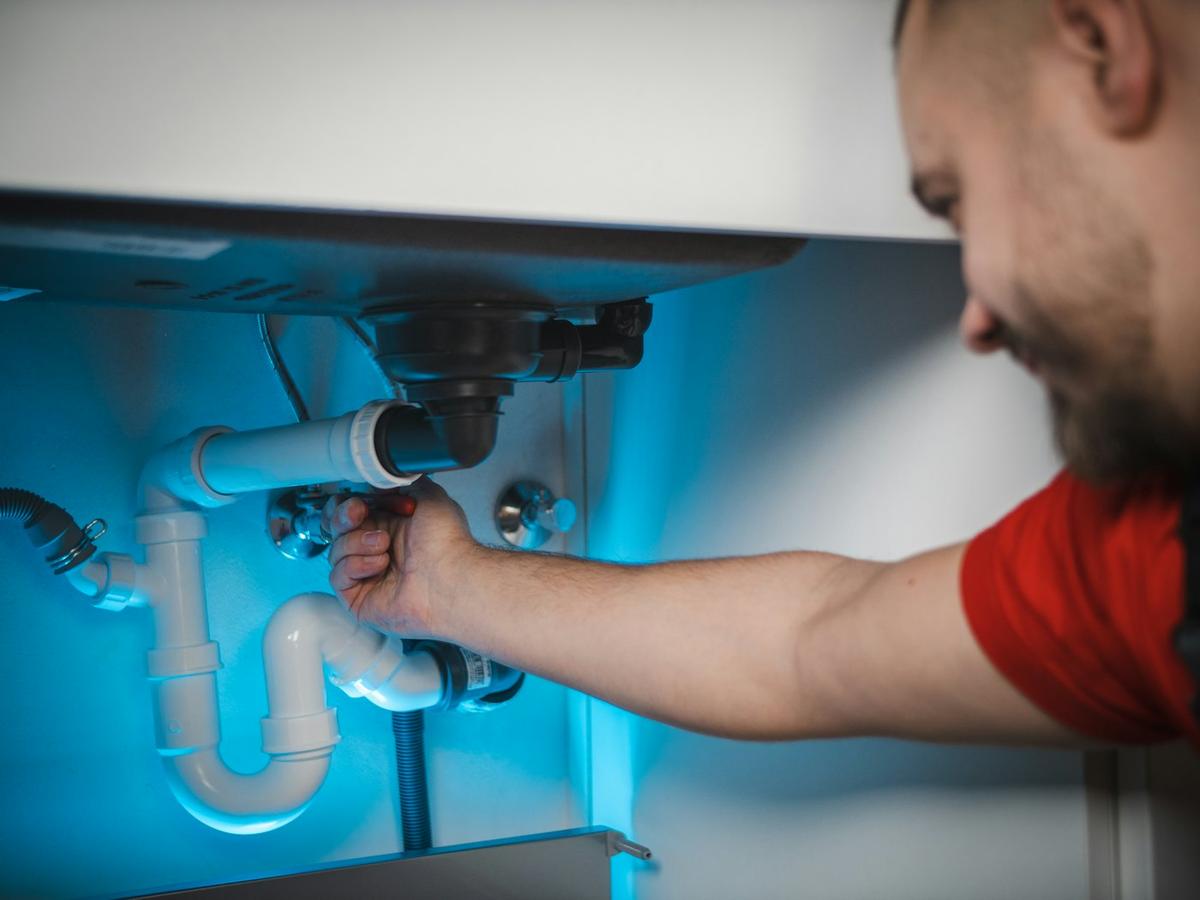 Trust & AI handoffThe customer who fired a contractor over a bot: what "never stuck with a bot" has to meanA homeowner dropped a plumber because the AI receptionist could not pass him to a person. The public cases since then show where handoffs break, and what a working one has to promise.Field reports · 11 min · 1 October 2026
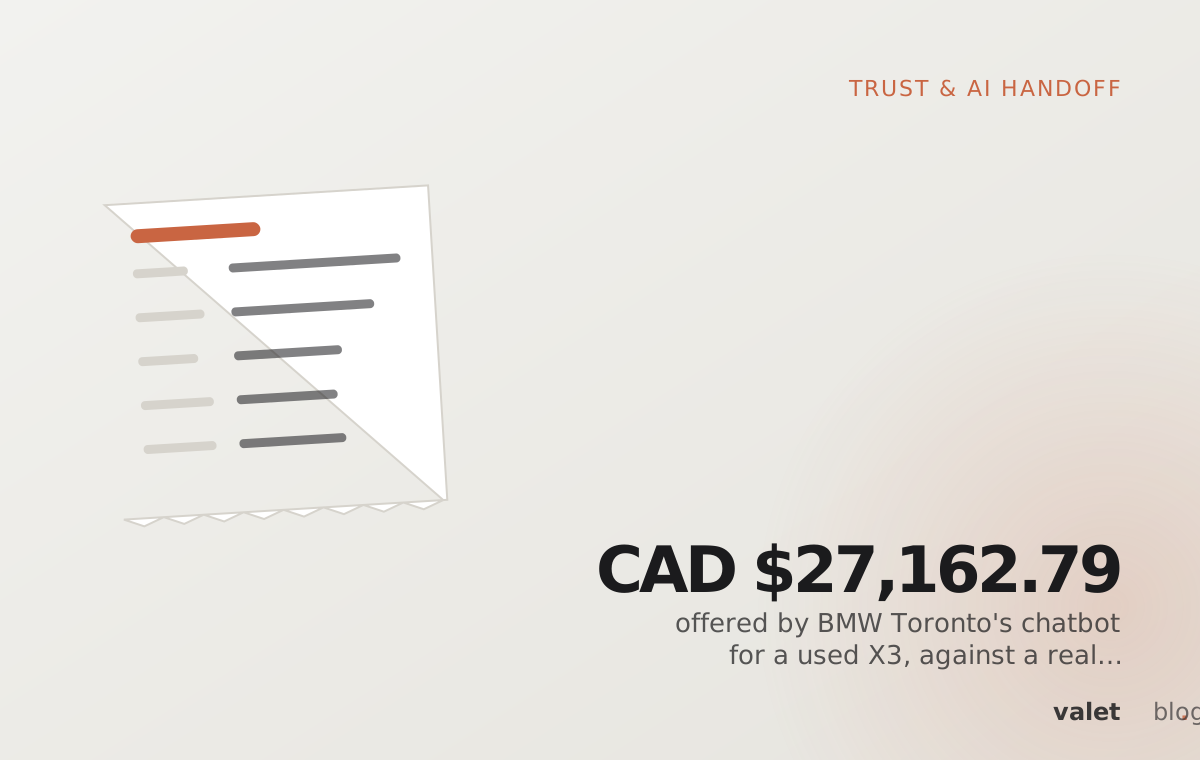 Trust & AI handoffCan a quote from my AI be binding? What BMW Toronto taught every business that prices by emailA chatbot at a Toronto BMW dealer offered a customer about CAD $7,000 more than the dealer meant to pay. The number came from the dealer's own records, in the wrong place. Here is what that means for any business that quotes in writing, and a policy you can copy.From the Valet team · 9 min · 1 October 2026
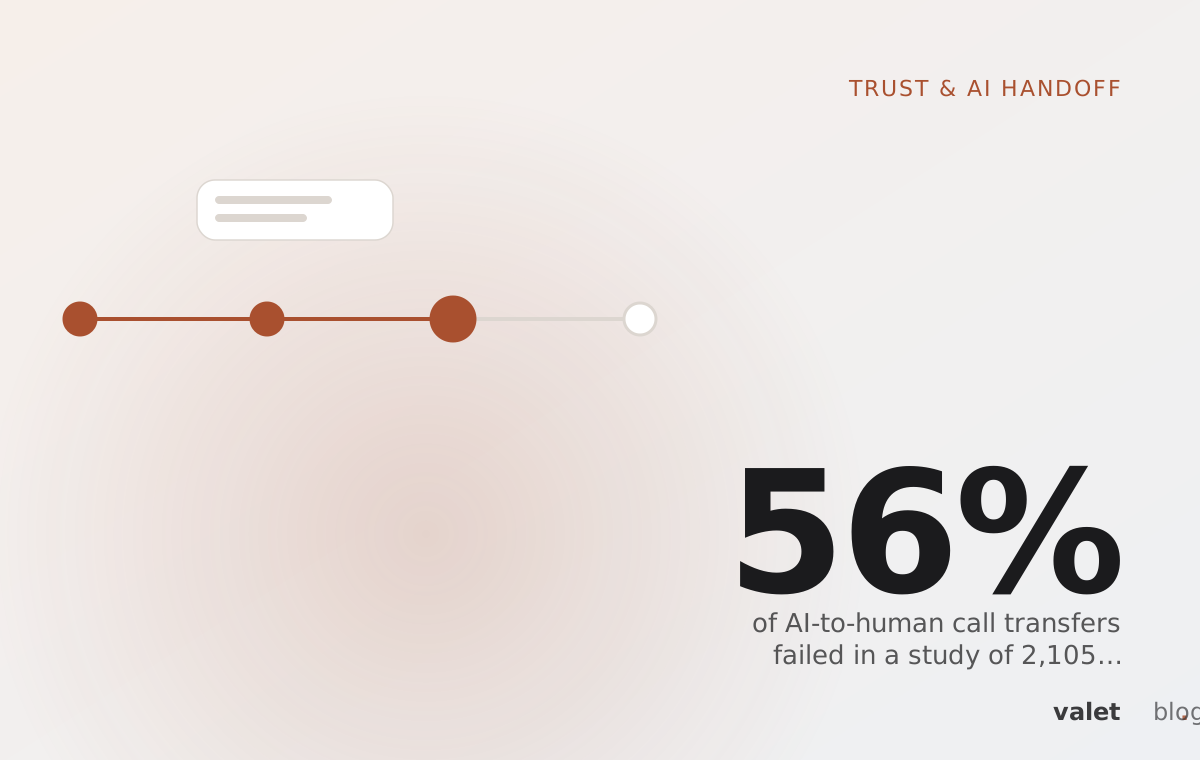 Trust & AI handoffWhat to ask an AI vendor before it talks to your customers: 12 questions (limits, handoff, receipts, disclosure, undo, insurance)The demo shows the AI writing a good reply. The questions that decide whether you keep your customers are about what happens when it should not reply at all.People at work · 10 min · 1 October 2026