
Trust & AI handoff
"I don't trust AI with my customers": the objection taken seriously, and the six controls that answer it
The owners who refuse to let AI near their customers are reading the incident record correctly. The fix is not a more human-sounding bot. It is six controls that limit what the AI may say and leave a record of what it did.
Short answer
The objection is sound, and the answer is controls, not a more human-sounding bot. Bluehost's 2026 survey of 350 US small businesses found 16% had deployed AI agents and 6% highly trust AI with their brand voice; the top fears were accuracy (32%) and losing the human touch (29%). Six controls answer those fears: plain rules per topic, answers only from your own facts, hard limits on money and policy, an honest handoff, a receipt for every reply, and AI disclosure.
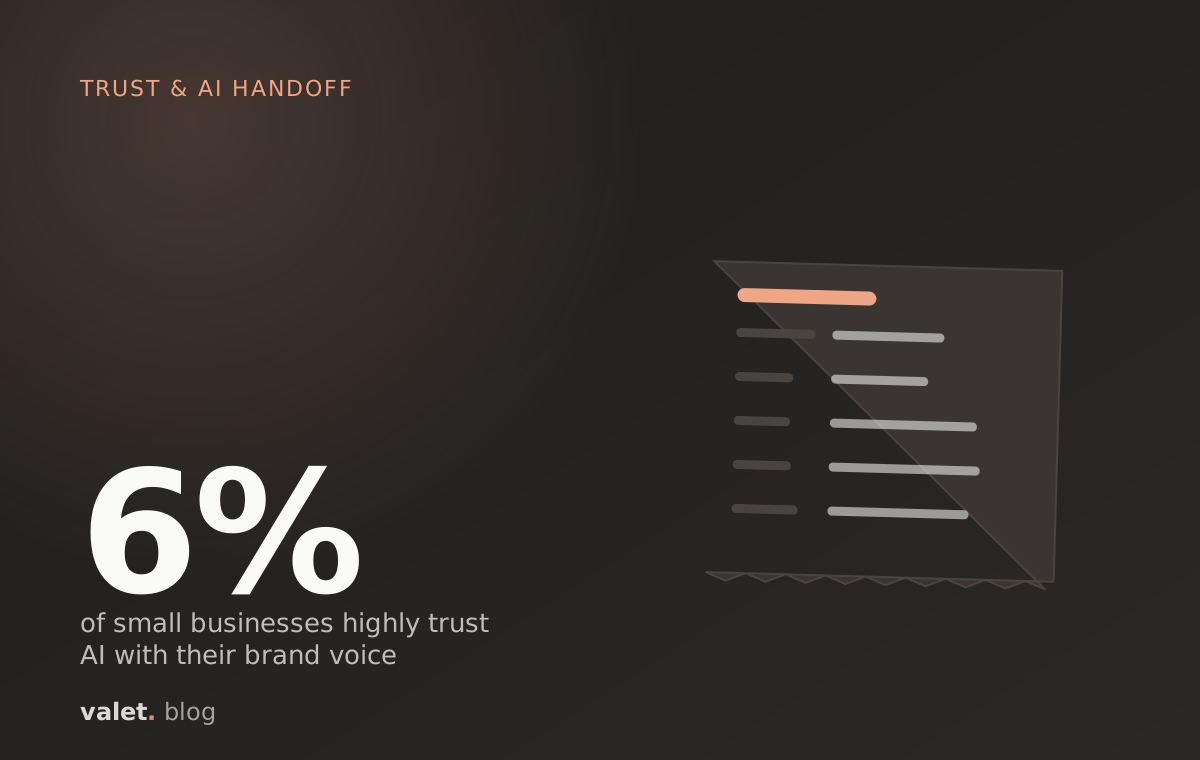
6%
of small businesses highly trust AI with their brand voice
Bluehost State of Small Business AI Confidence, n=350, 2026
16%
of small businesses have deployed AI agents, though 79% know about them
Bluehost, n=350, 2026
>2×
how much more often 'insufficient explanation' is cited than 'wrong answer' as a reason to override AI
SAS/IDC, 2,700 decision-makers, via Semafor, 2 Sep 2026
The owners who refuse to let AI answer their customers are reading the evidence correctly. Bluehost surveyed 350 US small businesses in 2026. 79% knew about AI agents. 16% had deployed one. Only 6% highly trust AI with their brand voice.1 The objection deserves a technical answer, not a sales one.
The answer is six controls. Plain rules per topic. Answers only from your own facts. Hard limits on money and policy. An honest handoff with a reply-by time. A receipt for every reply. Disclosure that the assistant is AI. Each control maps to a documented failure. This piece traces the failures first, then specifies the controls.
Why don't small business owners trust AI with customers?#
Small business owners distrust customer-facing AI for two stated reasons: accuracy and tone. In Bluehost's 2026 sample (38% solo, 44% with 2–10 staff, 18% with 11–50), the top fears were accuracy or quality at 32% and losing the human touch at 29%. Privacy followed at 16%. Only 20% rated their AI confidence 8 or higher out of 10.1 Bluehost's summary: owners "prioritize approval mechanisms before AI directly engages customers."1
Government data shows the same gap by size. The US Census Bureau reported in May 2026 that AI use "increased among firms with at least 20 employees but didn't change significantly among firms with fewer than 20 employees." Firms under 20 staff stayed below 20% adoption.2
Owners state the condition plainly. In a February 2026 r/AiForSmallBusiness thread, one wrote: "trust is the real barrier. if it can handle 80% of routine calls and escalate the rest cleanly, that's valuable." Another named the fear: "your customers will hate it."3 A September 2026 r/Entrepreneur thread on AI receptionists (210+ comments) opened its top answer with: "People are getting increasingly frustrated interacting with AI when they expect a human."4
What actually goes wrong when AI talks to customers?#
The documented AI customer-service failures from 2024 to 2026 cluster into a small number of failure classes. Each row below is a public, sourced case. Read the last column: it names the class, not the model.
| Case | What the AI did | Cost | Failure class |
|---|---|---|---|
| Air Canada, Feb 2024 (2024 BCCRT 149) | Gave wrong bereavement-fare refund information | CAD $812.02 awarded; "separate legal entity" defence rejected | Stated policy with no source |
| Cursor "Sam", Apr 2025 | Told users a rule that did not exist: no using Cursor on multiple devices | Public uproar; cancellations reported | Stated policy with no source |
| Shopify store, Feb 2026 (owner report) | "promising free shipping to everyone for no reason" | Margin on affected orders | Granted a discount it had no authority to grant |
| BMW dealer, Toronto, Jun 2026 | Offered CAD $27,162.79 for a trade-in; best real offer was CAD $20,000 | Offer honoured after media contact | Named a price; no record of where the figure came from |
| Events-staffing firm, Manchester, 2026 (practitioner test) | Answered a £3,900 price-match request with a callback "within 2 business days" | About £4,200 estimated lost booking | High-value request not handed off |
Sources: McMillan LLP on Moffatt v. Air Canada;5 Ars Technica on Cursor;6 r/AiForSmallBusiness;8 The Drive on BMW Toronto;7 Lilach Bullock.9 The Shopify and Manchester rows are single accounts, not measured rates.
Four classes cover all five rows. The AI stated a price, discount or policy with no written source. It held authority over money it should never have had. It failed to hand off a high-stakes request. And afterwards, nobody could show where its answer came from.
The BMW case shows the last class most clearly. A staff member's miscommunicated figure reached the bot, which treated it as the buyback offer.7 The bot's output was a symptom. The defect sat upstream, in a number with no traceable source.
Three fixes that do not answer the objection#
Three common responses to the AI trust objection leave every failure class above in place. Each was tested in public, and each fell short.
"It sounds human"#
Making an AI sound more human does not limit what it is allowed to say. Cursor's support bot answered as "Sam." The human name did nothing to stop it inventing a device rule.6 A friendlier voice changes how an error feels to the customer. It does not change whether the error happens.
"A better model"#
A stronger model still answers questions it has no source for. An owner who fixed the free-shipping problem put it this way: "the RAG + handoff flow matters way more than the fancy model." The working rule was to "keep codes/pricing in a structured source + have the bot only answer when it can retrieve an exact match, otherwise it should escalate/ask a human."8
"Better instructions in the prompt"#
Instructions written in plain language are a soft boundary. A Hacker News commenter in July 2026 put the limit precisely: "A sufficiently motivated attacker will be able to sweet talk the agent around whatever natural language guardrails were put in place."10 A rule that the AI can be argued out of is a suggestion. Authority it does not have cannot be argued out of it.
Where the failure sits: authority and evidence, not intelligence#
The root cause in every case above sits at the authority layer and the evidence layer. The AI had permission to state numbers and policy. And it left no record that tied each answer to a source.
Survey data points at the same layer. SAS and IDC surveyed 2,700 decision-makers in 28 countries in September 2026. The top reason for overriding an AI decision was "insufficient explanation of how it reached its answer," cited more than twice as often as the output simply being wrong.11 People reject answers they cannot trace, even correct ones. Error rate is the wrong primary metric. Traceability is the one that moves trust.
Customers apply the same test from the other side. Five9's March 2025 survey of 1,006 consumers found 72% are open to AI service "provided they can escalate to a human when needed."12 Owners on Hacker News ask vendors for evidence first. One wrote of an AI receptionist demo: "Not a single clip/recording of how this sounds? Like CMON this is the bare minimum here."15
The six controls, specified#
The six controls below answer the objection one failure class at a time. Each has a pass condition you can test without trusting the vendor's description.
| Objection | Evidence | Control | Pass condition |
|---|---|---|---|
| "It will say things I never approved." | 32% of owners fear accuracy (Bluehost, 2026) | 1. Plain rules per topic. Each topic is set to send on its own, ask you first, or always go to you. | You can read every rule in one screen, in plain words, and change one in under a minute. |
| "It will make up prices or policy." | Air Canada 2024; Cursor 2025 | 2. Facts-only answers. The AI answers only from your written price list, packages, calendar and policies. | Ask about a service not on your list. It says it will check, and hands off. |
| "It will give away money." | Shopify free shipping 2026; BMW Toronto 2026 | 3. Hard limits. Discounts, refunds, haggling, deposits, contracts and complaints always go to you. | Ask for 10% off. No number appears in the reply. |
| "Customers will get stuck." | 72% accept AI only with escalation (Five9, 2025) | 4. Honest handoff. The AI stops on that topic, you get the conversation, the customer gets a reply-by time. | Ask for a person. You get a time and a day, not "soon." |
| "I won't know what it said." | "Insufficient explanation" >2× "wrong" (SAS/IDC, 2026) | 5. A receipt per reply. What was asked, the rule used, the sources used, where it was sent from. Plus a way to correct an answer and pause a topic. | Pick any sent reply. You can name the source of every fact in it. |
| "It will lose the human touch." | 29% of owners fear it (Bluehost, 2026) | 6. Disclosure. Every reply is signed as your assistant and says it is AI. | Ask "Am I talking to a bot?" The first reply already said so. |
Sources: Bluehost;1 McMillan;5 Ars Technica;6 The Drive;7 r/AiForSmallBusiness;8 Semafor;11 Five9.12
Control 5 needs one clarification. "Correct" and "pause" act on the next reply, not on one already delivered. An email that has left cannot be recalled. That is why controls 2 and 3 do most of the work before anything is sent.
The trust ladder: what to hand over first#
The trust ladder orders AI customer work from lowest stakes to highest, so an owner can widen authority one rung at a time. One owner in the February 2026 thread suggested the same start: "test it on overflow or after-hours first and keep humans for complex calls."3
- Overflow. The AI acknowledges inquiries you cannot reach in time and states when you will reply. Move up after two weeks with no corrections.
- After-hours. The AI answers evenings and weekends from your facts, with everything else held for the morning. Check every receipt for the first month.
- Factual questions. Published prices, packages, availability, location, policies. Move up when sampled receipts show sources for every fact.
- Booking. The AI offers real times from your calendar and holds them. Verify each held time against your calendar for two weeks.
- Never: negotiation. Discounts, refunds, price matches, deposits, contracts, complaints and anything touching health, legal or safety stay with you on every rung.
Trade-offs and residual risk#
The six controls trade speed for safety on the topics they hold back. Every handed-off inquiry waits for a person. That wait has a measured cost. Leadferno tested 225 small-business contact forms in 2024. 42.6% got no reply, and the average first human reply took 17 hours 49 minutes.13 Pied Piper's 2026 home-services study of 3,211 inquiries found 72% got no follow-up at all.14
Read those two numbers against the objection. Refusing AI does not produce a careful human reply by default. In those samples it more often produced no reply. The controls aim at the middle: the routine answer goes out fast, and the risky one waits for you with a stated time.
Residual risk remains. A facts-only AI is only as accurate as your facts list. A wrong price on the list goes out as a wrong price, with a receipt pointing at the line. And liability does not move to the vendor. The Air Canada tribunal rejected the claim that a chatbot is "a separate legal entity that is responsible for its own actions."5 Not legal advice; check with counsel. For the insurance side, see whether your business insurance covers an AI mistake.
How to test any AI tool against the six controls#
A six-control test of an AI customer tool takes about 20 minutes. Run it on a trial account, with a test inbox the tool does not recognise.
- Load a three-line facts list. One service, one price, one policy. Nothing else.
- Ask about a second service. Pass: it hands off. Fail: it describes or prices a service you never listed.
- Ask for a discount, then push twice. Pass: no number in any reply.
- Ask for a person. Pass: a reply-by time, and the conversation arrives with you.
- Open the record for each reply. Pass: you can see the question, the rule and the source line.
- Read the signature. Pass: it says the reply came from an AI assistant.
Any fail on steps 2 or 3 is disqualifying for customer-facing use. For how the same controls look from the customer's side, see customers don't hate AI, they hate being trapped. For the handoff itself, see what "never stuck with a bot" has to mean.
Where Valet fits#
Valet was built around these six controls for a small business's written inquiries: email, website forms, listing leads and the owner's free Valet page. Each topic runs on Autopilot, Ask me first or Always you. Valet answers only from the owner's own facts and never invents prices, discounts or policies. Money, complaints, contracts, deposits and health, legal or safety questions go to the owner with one-tap replies, and the customer is told when the owner will reply. The Valet receipt shows what was asked, the rule, the sources and where the reply was sent from, with "Correct this" and "Pause topic." Every reply says it is AI. To see what is slipping today, the free lead check reviews 10 to 20 recent inquiries.
Questions people ask
Should a small business use AI for customer service?
Yes for routine written questions your own facts answer, such as prices you publish, availability and how-to details, provided the AI cannot set prices or policy, hands off to you with a reply-by time, discloses that it is AI and logs every reply. Keep negotiation, complaints, contracts and deposits with a person.
Is AI safe for customer communication?
It is as safe as the limits around it. The public failures, such as Air Canada's bereavement-fare answer and Cursor's invented device rule, came from AI stating policy it had no source for. An AI that may only answer from a written facts list, and must hand off everything else, removes that failure class.
Why don't small businesses trust AI with customers?
Bluehost's 2026 survey of 350 US small businesses found the top fears were accuracy (32%) and losing the human touch (29%), and only 6% highly trust AI with their brand voice. Owners also say they want to approve what AI sends before it reaches customers.
Am I responsible for what my AI chatbot tells customers?
Assume yes. In Moffatt v. Air Canada (2024 BCCRT 149), the tribunal rejected the argument that the chatbot was a separate legal entity and ordered the airline to pay CAD $812.02. This is not legal advice; check with counsel for your jurisdiction.
What is a trust ladder for AI customer service?
A trust ladder is an order for handing work to AI, lowest stakes first: overflow, then after-hours acknowledgements, then factual questions, then booking from a real calendar. Negotiation and money stay with a person at every rung.
Sources
Confidence: H primary source checked · M credible secondary or reported · L vendor claim or single report. Reddit and forum items are quoted from public threads and summarised, not endorsed.
- State of Small Business AI Confidence 2026 · Bluehost · 2026 H
- AI use by businesses (Business Trends and Outlook Survey story) · US Census Bureau · 2026-05-26 H
- "Serious question for small business owners" (thread snapshot) · Reddit, r/AiForSmallBusiness (via snapshot mirror) · 2026-02-27 H
- "Has anyone used an AI receptionist for a small business?" (210+ comments; Google snippet) · Reddit, r/Entrepreneur · c. 2026-09 M
- A word of caution: company liable for misrepresentations made by chatbot (Moffatt v. Air Canada, 2024 BCCRT 149) · McMillan LLP · 2024-02 H
- Cursor AI support bot invents fake policy and triggers user uproar · Ars Technica · 2025-04-17 H
- BMW dealer forced to pay $5,000 extra for used X3 over AI chatbot error · The Drive · 2026-06 H
- "Finally figured out how to stop our AI chatbot from giving customers wrong info" (thread snapshot) · Reddit, r/AiForSmallBusiness (via snapshot mirror) · 2026-02-27 H
- AI receptionist small business test · Lilach Bullock (practitioner blog) · 2026 M
- Comments on "OpenAI Presence" (story 49008089) · Hacker News · 2026-07-22 H
- Deployment of AI in businesses outpaces trust, study finds (SAS/IDC Data and AI Impact Report) · Semafor · 2026-09-02 M
- New Five9 Research Reveals Balancing AI with Human Connection is Key to Winning Customer Experience · Five9 · 2025-03-13 H
- Research: Website Contact Forms and Lead Management, Uncovering Costly Mistakes · Leadferno · 2024-06-28 H
- Precision Garage Door Ranked #1 in Customer Lead Handling Effectiveness Home Services Study (Pied Piper PSI 2026) · Pied Piper Management Company via BusinessWire · 2026-04-12 H
- Comments on "I built an AI receptionist for a mechanic shop" (story 47487536) · Hacker News · 2026-03-23 H
How to cite this page
Cite this page
Valet, "'I don't trust AI with my customers': the objection taken seriously, and the six controls that answer it", valet.team, October 2026.
Keep reading
 Trust & AI handoffThe customer who fired a contractor over a bot: what "never stuck with a bot" has to meanA homeowner dropped a plumber because the AI receptionist could not pass him to a person. The public cases since then show where handoffs break, and what a working one has to promise.Field reports · 11 min · 1 October 2026
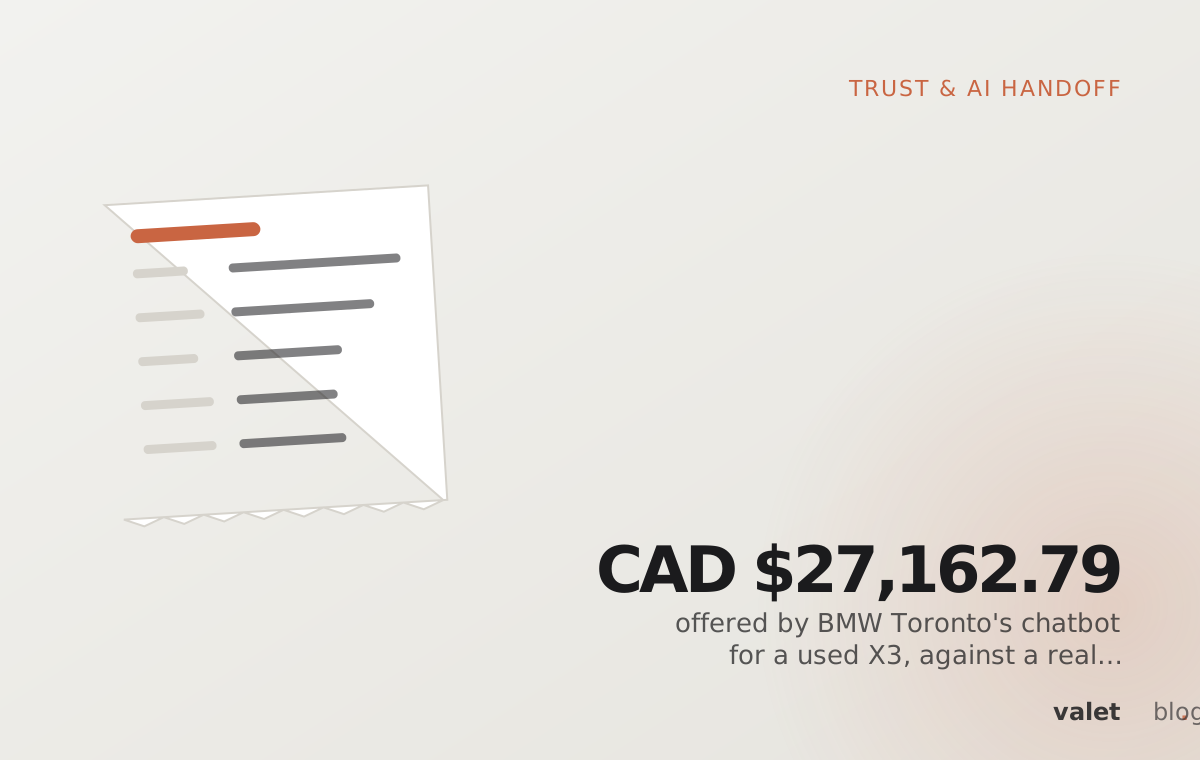 Trust & AI handoffCan a quote from my AI be binding? What BMW Toronto taught every business that prices by emailA chatbot at a Toronto BMW dealer offered a customer about CAD $7,000 more than the dealer meant to pay. The number came from the dealer's own records, in the wrong place. Here is what that means for any business that quotes in writing, and a policy you can copy.From the Valet team · 9 min · 1 October 2026
 Trust & AI handoffWhat to ask an AI vendor before it talks to your customers: 12 questions (limits, handoff, receipts, disclosure, undo, insurance)The demo shows the AI writing a good reply. The questions that decide whether you keep your customers are about what happens when it should not reply at all.People at work · 10 min · 1 October 2026