
Trust & AI handoff
Does my business insurance cover an AI mistake? CG 40 47 and the generative-AI exclusion, for a 3-person business
Insurers now have standard wording to exclude generative-AI claims from a general liability policy. Whether your policy carries it is a fact you can check in ten minutes. What to look for, what it could leave uncovered, and what to ask.
Short answer
Possibly not. Since 1 January 2026, ISO has offered optional endorsements (CG 40 47, CG 40 48 and CG 35 08) that can remove claims arising out of generative AI from a general liability policy, according to MoneyGeek. PYMNTS reported in May 2026 that regulators had approved more than 80% of AI-exclusion filings. Check your declarations and endorsement schedule for those form numbers, then ask your broker what an AI misquote or refund promise would trigger. Not legal or insurance advice.
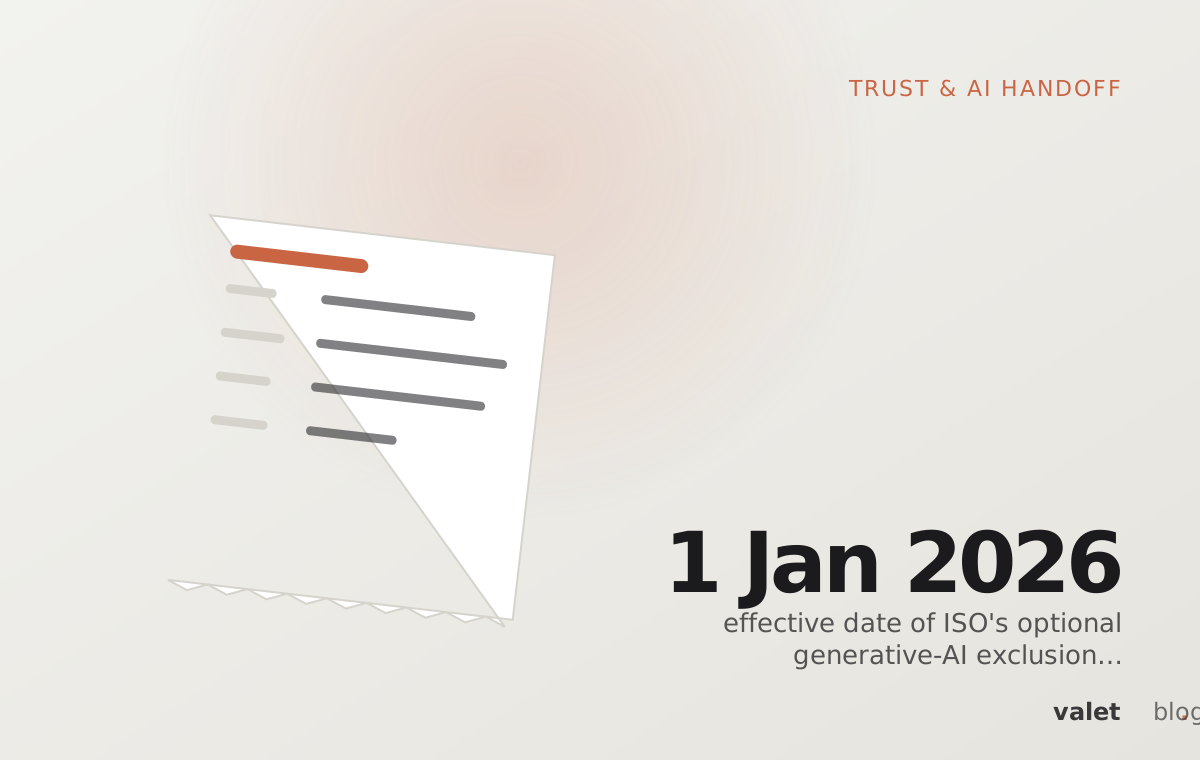
1 Jan 2026
effective date of ISO's optional generative-AI exclusion endorsements CG 40 47, CG 40 48 and CG 35 08
MoneyGeek, 2026
>80%
of AI-exclusion filings approved by state regulators, as reported
PYMNTS, 1 May 2026
$2M–$50M
typical limits on dedicated AI insurance from specialist carriers
PYMNTS, 1 May 2026
A small business that lets AI write to customers may no longer have general liability cover for what that AI says. Since 1 January 2026, ISO has offered three optional endorsements, CG 40 47, CG 40 48 and CG 35 08, that can remove claims "arising out of" generative AI from a commercial general liability policy, according to MoneyGeek.1 PYMNTS reported in May 2026 that state regulators had approved more than 80% of AI-exclusion filings.2
The question for a three-person business is narrow. Does your policy carry one of those form numbers, and what would an AI misquote or refund promise cost you if it did? This piece separates what is settled from what is reported, and ends with three questions for your broker. It is not legal or insurance advice; check with your broker and counsel.
What changed on 1 January 2026?#
ISO, the insurance industry's standard-forms body, introduced three optional generative-AI exclusion endorsements effective 1 January 2026, as MoneyGeek reports them.1 An endorsement is a page added to a policy that changes its coverage. These three are optional: an insurer must file them, and then choose to attach them to a given policy.
| Form | Scope as reported |
|---|---|
| CG 40 47 | Broadest. Removes coverage for claims "arising out of" generative AI under bodily injury and property damage, and under personal and advertising injury. |
| CG 40 48 | Narrower version |
| CG 35 08 | Products-related version |
Source: MoneyGeek, 2026.1 Valet has not reviewed the ISO form text itself; read the endorsement attached to your own policy.
The definition carries most of the weight. MoneyGeek reports that the forms define generative AI as "a machine-based learning system or model that is trained on data with the ability to create content or responses, including but not limited to text, images, audio, video or code."1 A chatbot fits that definition. So does an assistant that drafts or sends customer emails.
Is the exclusion in force, and on whose policy?#
The exclusion is available, not universal. Its legal status differs by policy, and three facts determine whether it applies to you.
- The form exists and is effective. MoneyGeek gives 1 January 2026 as the effective date.1
- Your insurer has filed it in your state. PYMNTS reported in May 2026 that regulators had approved more than 80% of AI-exclusion filings, with Florida, Connecticut and Maryland seeing the highest volume.2 That is a reported industry figure, not a list of which insurers attached which form.
- Your policy carries it. This is the only step that settles the question for you. It appears, if at all, on the declarations page or the forms and endorsements schedule.
PYMNTS names Berkshire Hathaway, Chubb, Travelers and Berkley in its report on large insurers pulling back from AI risk.2 Do not read that as proof that any particular policy from those carriers excludes AI. Read your own schedule.
Does it apply to a small business like mine?#
The generative-AI exclusion has no size threshold in the reporting reviewed here. Applicability runs through three gates, and a business is in scope only if it passes all three.
Gate 1: an ISO-based general liability policy#
Start here if you carry general liability, on its own or inside a business owner's policy. MoneyGeek reports that ISO forms underpin about 82% of US property and casualty policies.1 If your policy uses ISO wording, the exclusion is at least available to your insurer.
Gate 2: the endorsement is on your schedule#
Search the forms schedule for "CG 40 47," "CG 40 48" or "CG 35 08." An insurer may also use its own wording rather than ISO's, so also look for "generative," "artificial intelligence" or "AI" in endorsement titles. If you renewed after 1 January 2026, redline the new schedule against last year's.
Gate 3: your AI talks to customers#
The exposure exists where AI output reaches someone outside the business. A website chatbot, an assistant that answers inquiry emails, an AI that writes quotes or confirmations: each produces "content or responses" a customer acts on. AI used only for internal drafts that a person rewrites before sending creates far less of that exposure.
PYMNTS put the size question directly: "Small to mid-sized firms, often without specialized coverage, face the greatest exposure."2
What AI mistakes could a small business face?#
The AI mistakes a small business is most likely to face are small and contractual, judging by the public cases: a wrong price, an invented policy, an unauthorised discount. The table below lists them with the closest public example. Whether any of these losses was ever covered by general liability, even before the exclusion, is a question for your broker; do not assume it was.
| Event | Closest public example | What the loss looked like |
|---|---|---|
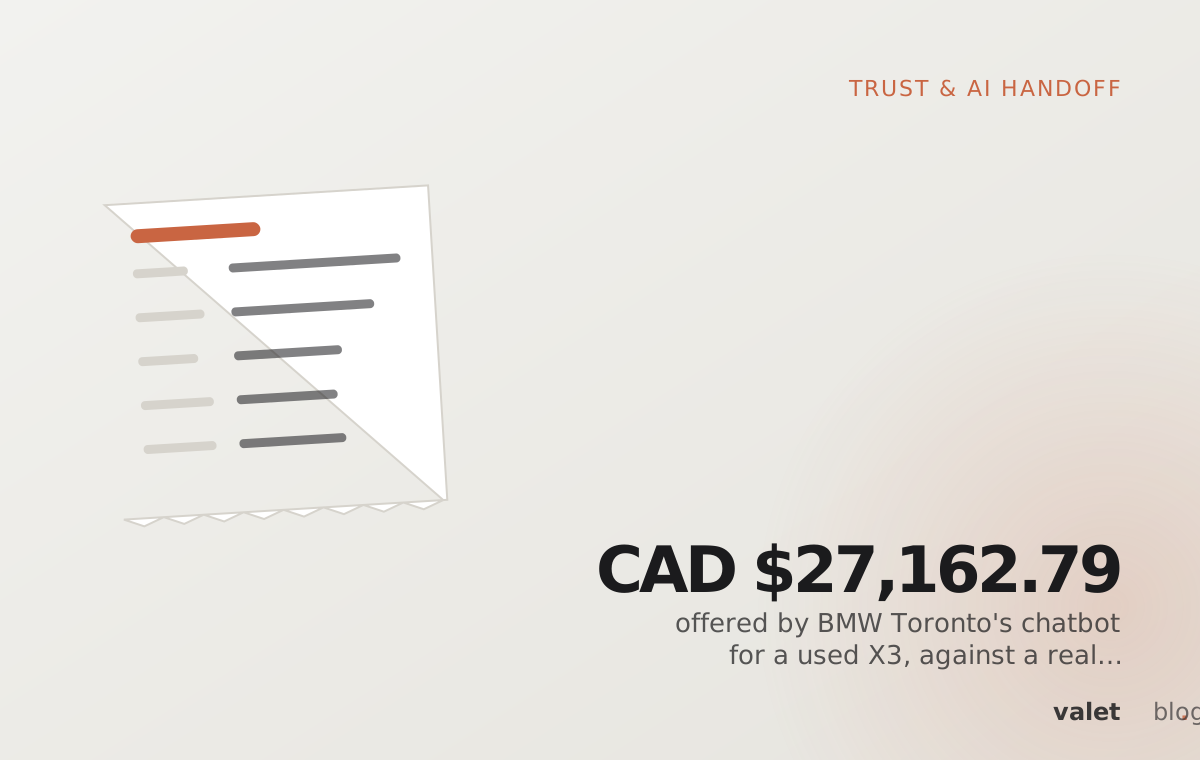
| AI states a wrong price | BMW dealer, Toronto, June 2026: bot offered CAD $27,162.79 for a trade-in against a real best offer of CAD $20,000 | Dealer revoked, then honoured the offer after media contact6 |
| AI invents a refund or policy | Moffatt v. Air Canada, 2024 BCCRT 149: wrong bereavement-fare information | CAD $812.02 awarded, plus a public ruling4 |
| AI grants a discount nobody approved | Shopify store owner, February 2026: bot "promising free shipping to everyone for no reason" | Margin on affected orders7 |
| AI double-books a date | No public case found | Illustration A venue that must refund one couple's deposit or find them an equal date |
Liability for these sits with the business. In the Air Canada ruling, the tribunal rejected the argument that "the chatbot is a separate legal entity that is responsible for its own actions."4 PYMNTS summarised the trend in July 2026: companies remain liable for what their AI systems say, including when the system is "filling a knowledge gap."5 No disclaimer on a chat widget is a safe harbor. No court case involving a business of three people was found, but nothing in these rulings depends on size.
What must, should and may a small business do?#
The obligations around AI and insurance divide into three tiers. "Must" marks what follows from your policy terms or settled case outcomes. "Should" marks prudent practice. "May" marks options.
| Tier | Action | Why |
|---|---|---|
| Must | Treat every AI reply to a customer as your own statement. | Air Canada: the "separate legal entity" argument failed (2024 BCCRT 149). |
| Must | Read the forms schedule of your current policy for CG 40 47, CG 40 48, CG 35 08 or any AI wording. | The policy terms govern what is covered, not the marketing summary. |
| Should | Ask your broker the three questions below, in writing, before your next renewal. | A written answer is evidence of what you were told. |
| Should | Stop your AI from stating prices, discounts, refunds or policy that are not in a written source you control. | Every public case above began with an unsourced statement. |
| Should | Keep a record of each AI reply: what was asked, what it said, what source it used. | A claim, tribunal or insurer will ask what was said and why. |
| Should | Redline each renewal's endorsement schedule against the prior year's. | Optional endorsements can be added at renewal. |
| May | Price dedicated AI liability cover. | Reported limits run $2M–$50M; likely oversized for a small business. |
| May | Ask any AI vendor what its contract says about liability for its output. | Terms vary; read them before you rely on them. |
Not legal or insurance advice; check with your broker and counsel.
What does dedicated AI insurance cost, and is it sized for you?#
Dedicated AI insurance exists, but its 2026 pricing is built for larger firms. PYMNTS reported in May 2026 that specialist carriers and startups, including Corgi, Armilla, Mayflower Specialty, Embroker and Munich Re, write AI cover with limits of $2 million to $50 million and premiums from "hundreds to several hundred thousand dollars annually."2 In September 2026, AIUC raised a $40 million Series A to certify and insure AI agents.3
PYMNTS also quoted the industry's own framing: "Insurers are not saying AI is uninsurable. They are saying they do not yet know what it costs."2 For a three-person business, the materiality threshold matters more than the limit. A misquoted package or an honoured discount is likely to fall in the hundreds or low thousands of dollars. Compare that against your deductible before you shop for a $2 million policy. That comparison is our reading of the public cases, not an actuarial figure.
Three questions to ask your broker#
The three broker questions below turn the exclusion from a headline into a fact about your policy. Send them by email so the answer is written down.
Subject: AI and our general liability policy

Hi [broker name],

We use an AI assistant to [answer customer emails / run a website chat / draft quotes]. Before our renewal on [date], could you answer three questions in writing?

1. Does our current policy include CG 40 47, CG 40 48, CG 35 08, or any other endorsement that excludes or limits claims involving generative AI or artificial intelligence? If yes, which form, and since which date?

2. If our AI assistant told a customer a wrong price, promised a refund we do not offer, or double-booked a date, would any part of the resulting claim be covered, under this policy or any other we hold? Was that true before the exclusion as well?

3. Will our renewal add any AI exclusion, and if so, what would it cost to remove it or to add cover for this risk?

Thanks,
[name]
What is still unclear#
Three points about the generative-AI exclusion remain unsettled as of October 2026. First, the scope of "arising out of" in an AI context has no court interpretation in the sources reviewed. Second, the 80% approval figure is a reported industry total, not a count of policies that carry the form.2 Third, this piece relies on MoneyGeek's description of the forms rather than the ISO text.1 Treat each as a question for your broker, not a conclusion.
For the controls that reduce what an AI can get wrong in the first place, see the six controls for AI customer replies.
Where Valet fits#
Valet is not an insurer, and Valet makes no claim that it is insured or that it changes your coverage. What it does is narrow what an AI can say on your behalf. Valet answers a small business's written inquiries only from the owner's own facts and never invents prices, discounts or policies. Money questions, complaints, contracts and deposits go to the owner, and the customer is told when the owner will reply. Every reply carries a Valet receipt: what was asked, the rule used, the sources and where it was sent from. The free lead check reviews 10 to 20 recent inquiries and shows what went unanswered.
Questions people ask
Does business insurance cover AI mistakes?
It depends on your policy wording. Since 1 January 2026, insurers can attach ISO endorsements such as CG 40 47 that exclude claims arising out of generative AI from general liability. If your policy carries one, a claim tied to your chatbot or AI-written email may be excluded. Ask your broker; this is not insurance advice.
What is CG 40 47?
CG 40 47 is an optional ISO endorsement, effective 1 January 2026, that MoneyGeek describes as the broadest of three generative-AI exclusions. It removes coverage for claims arising out of generative AI under bodily injury, property damage and personal and advertising injury coverage. CG 40 48 is narrower, and CG 35 08 is the products-related version.
Does the generative-AI exclusion apply to chatbots and AI-written emails?
As MoneyGeek reports the definition, generative AI means a system trained on data that can create content or responses, including text. That reads broadly enough to include a chatbot or an AI that drafts customer emails. Confirm with your broker how your insurer reads it.
Should a small business buy dedicated AI insurance?
Possibly not yet. PYMNTS reported in May 2026 that specialist AI policies carry limits of $2 million to $50 million, with premiums from hundreds to several hundred thousand dollars a year. That is sized for larger firms. For a small business, limiting what the AI may say and keeping records is the cheaper first step.
Am I liable for what my AI tells a customer?
Assume yes. In Moffatt v. Air Canada (2024 BCCRT 149), the tribunal rejected the argument that a chatbot is a separate legal entity and ordered the airline to pay CAD $812.02. Check with counsel for your jurisdiction.
Sources
Confidence: H primary source checked · M credible secondary or reported · L vendor claim or single report. Reddit and forum items are quoted from public threads and summarised, not endorsed.
- Generative AI exclusion in general liability insurance (CG 40 47, CG 40 48, CG 35 08) · MoneyGeek · 2026 M
- Big insurance backs away from AI risk and startups rush in · PYMNTS · 2026-05-01 M
- AI agent certification startup AIUC raises $40M to begin auditing frontier models · SiliconANGLE · 2026-09-15 M
- A word of caution: company liable for misrepresentations made by chatbot (Moffatt v. Air Canada, 2024 BCCRT 149) · McMillan LLP · 2024-02 H
- Courts to companies: you own what your chatbot says · PYMNTS · 2026-07-01 H
- BMW dealer forced to pay $5,000 extra for used X3 over AI chatbot error · The Drive · 2026-06 H
- "Finally figured out how to stop our AI chatbot from giving customers wrong info" (thread snapshot) · Reddit, r/AiForSmallBusiness (via snapshot mirror) · 2026-02-27 H
How to cite this page
Cite this page
Valet, "Does my business insurance cover an AI mistake? CG 40 47 and the generative-AI exclusion, for a 3-person business", valet.team, October 2026.
Keep reading
 Trust & AI handoffThe customer who fired a contractor over a bot: what "never stuck with a bot" has to meanA homeowner dropped a plumber because the AI receptionist could not pass him to a person. The public cases since then show where handoffs break, and what a working one has to promise.Field reports · 11 min · 1 October 2026
 Trust & AI handoffCan a quote from my AI be binding? What BMW Toronto taught every business that prices by emailA chatbot at a Toronto BMW dealer offered a customer about CAD $7,000 more than the dealer meant to pay. The number came from the dealer's own records, in the wrong place. Here is what that means for any business that quotes in writing, and a policy you can copy.From the Valet team · 9 min · 1 October 2026
 Trust & AI handoffWhat to ask an AI vendor before it talks to your customers: 12 questions (limits, handoff, receipts, disclosure, undo, insurance)The demo shows the AI writing a good reply. The questions that decide whether you keep your customers are about what happens when it should not reply at all.People at work · 10 min · 1 October 2026