
Stores & orders
Who answers support@ when a one-person store or startup takes a holiday? Pause vs keep selling with cover (the holiday math)
Pausing the store and leaving an auto-reply on support@ look like the two safe options. Run the numbers for a 14-day absence and both leave money and customers waiting. Here is the arithmetic, its limits, and the checklist for a third option.
Short answer
For a one-person store, pausing for 14 days forgoes about 3.8% of a year's revenue if sales are even across the year: roughly $11.5k on a $300k store. Staying open with only an auto-reply keeps orders coming but leaves about 30 support emails on a 300-order-a-month apparel store unanswered for up to two weeks (Gorgias ratio of ~22 tickets per 100 orders, 2026). Cover that answers from your facts and gives a reply-by date sits between the two.
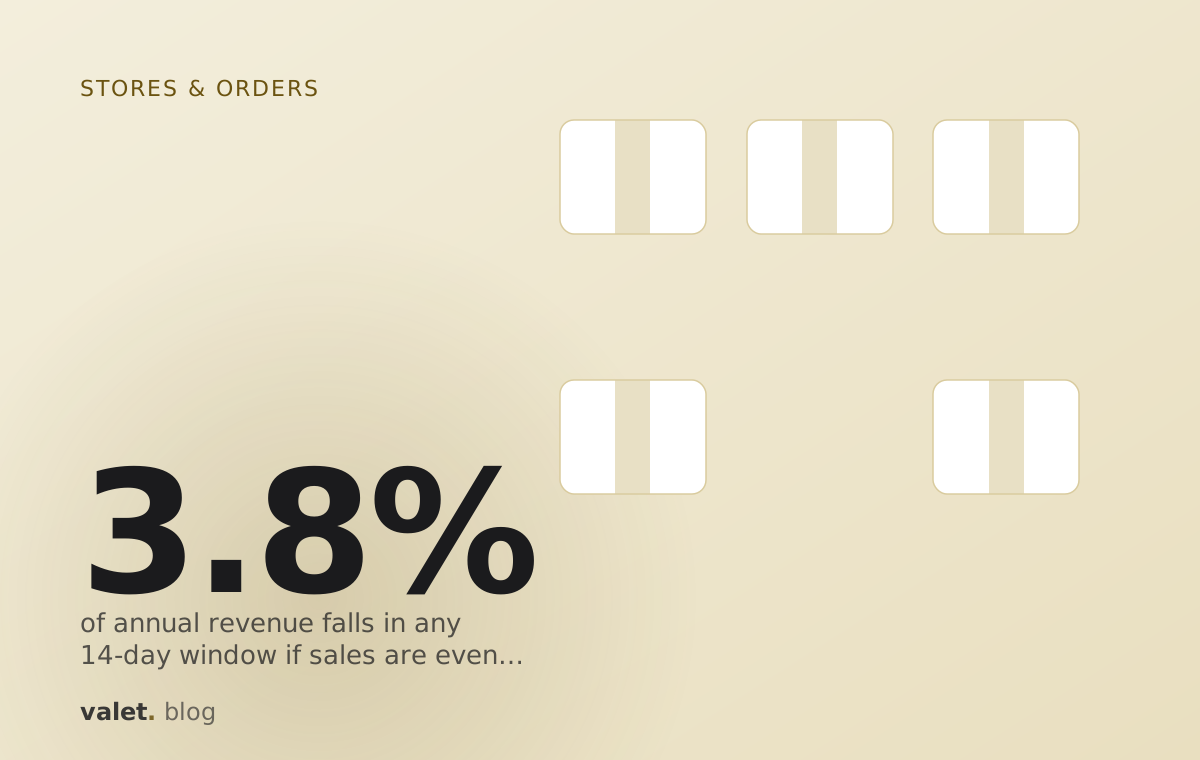
3.8%
of annual revenue falls in any 14-day window if sales are even across the year (14 ÷ 365)
Valet arithmetic
19–46
support tickets per 100 orders, by vertical
Gorgias Ecom Lab, platform data, Mar 2026
30%
of email handoffs to a human never got a human reply
Gorgias Ecom Lab, accounts with 200+ AI-touched tickets, Oct 2025 to Apr 2026
A 14-day pause forgoes about 3.8% of a year's revenue, if sales are spread evenly across the year. On a $300k store that is roughly $11.5k. Staying open with only an auto-reply keeps the orders but parks the support inbox: a 300-order-a-month apparel store generates about 30 support emails in two weeks, at Gorgias's ratio of roughly 22 tickets per 100 orders (March 2026)1. Each waits up to 14 days. A third option, cover that answers from your facts and gives a reply-by date for the rest, sits between the two.
The holiday number that changes the question#
The headline figure is 3.8%. It is 14 days divided by 365. It assumes your revenue is flat across the year, which it almost certainly is not. It is still the right first number, because it is the one most owners never write down.
The second number matters more. Pausing the store does not pause the inbox. Customers whose orders shipped before you left still write about tracking, damage and returns. The question is not "pause or stay open". It is "who answers support@ for 14 days, and with what?"
The owners asking it are, by definition, alone. A thread in r/shopify titled "What do store owners do when they go on holiday?" (60+ comments, around November 2025) includes the line "4 years now, but it's only me as the single company employee"7. A founder in r/EntrepreneurRideAlong (20+ comments, around June 2026) put the startup version plainly: "I am one person. I write code, I do support, I handle billing issues"8.
Why "pause or auto-reply" is an incomplete choice#
The consensus advice offers two options. Both are defensible.
Pause. Stop taking orders. Nothing ships late, nobody waits for a parcel that is not coming, and the owner returns to a quiet backlog. The cost is the revenue in the window, minus whatever share of customers come back later.
Stay open with an auto-reply. Keep taking orders, ship them through a helper or a fulfilment service, and set an out-of-office on support@. The revenue continues. The cost is every customer question that waits until return.
The missing option is cover: something or someone that answers support@ from the facts you have written down, does the small actions your rules allow, and tells the customer the real date a person will reply to the rest. For services businesses, the sibling piece on who answers inquiries when you're away makes the case in detail. This piece is the store and startup arithmetic.
The holiday math, sliced by store size and vertical#
The table below runs a 14-day absence through three store sizes. Every row uses the same assumptions so the columns can be compared: an average order value of about $83, revenue spread evenly through the year, and Gorgias's March 2026 tickets-per-100-orders ratios for apparel (about 22) and electronics (about 46)12.
| Store size | Orders in 14 days | Revenue in 14 days (cost of pausing) | Support tickets, apparel (22/100) | Support tickets, electronics (46/100) | Pre-purchase questions (1 in 9, apparel) |
|---|---|---|---|---|---|
| 100 orders/mo, ~$100k/yr | ~46 | ~$3,800 | ~10 | ~21 | ~1 |
| 300 orders/mo, ~$300k/yr | ~138 | ~$11,500 | ~30 | ~64 | ~3 |
| 1,000 orders/mo, ~$1M/yr | ~460 | ~$38,400 | ~101 | ~212 | ~11 |
Orders = monthly orders × 12 × 14 ÷ 365. Tickets = orders × ratio ÷ 100. Pre-purchase share: Gorgias, May 20265. Ratios: Gorgias platform data, March 20261.
Read across the middle row. Pausing the 300-order store forgoes about $11,500 of orders in the window. Staying open with an auto-reply keeps those orders and leaves 30 to 64 support emails waiting for up to two weeks, depending on what the store sells.
What sits inside those emails matters more than the count. In Gorgias's 2023 data, 18% of incoming requests were "where is my order" questions6. That share is old and comes from a vendor, so treat it as a rough guide: about 5 of the 30. About 3 are customers who have not bought yet5, and in Gorgias's July 2026 data 53% of such questions arrive outside business hours anyway4. The rest are returns, damage, sizing, and the requests with a deadline: cancel this, change that address. No public dataset gives a reliable split for those. Your own inbox does.
The startup version: the denominator is emails per day#
A software founder counts differently. There are no orders, only users writing in. In a July 2022 Ask HN thread, a solo founder reported receiving an average of 15 to 20 user emails a day9. Over 14 days that is 210 to 280 emails. That is a single founder's report from 2022, not a benchmark. It does show why "check email twice a day from the beach" stops working at a few hundred messages.
Competing explanations and confounding variables#
Four variables can move the answer a long way. Each is worth checking against your own numbers before you decide.
- Seasonality. The 3.8% figure assumes a flat year. A store that sells half its volume in November and December loses far more by pausing then than in August. Use the revenue for the actual weeks you plan to be away, from last year's reports.
- Deferred demand. Some customers who find a paused store will come back. Some will not. No public study measures that share for small stores, so the pause cost above is an upper bound, not a forecast.
- Fulfilment. Staying open only makes sense if orders ship, or if you state an honest dispatch date and customers accept it. If neither is true, pausing is the honest choice, whatever the arithmetic says.
- Platform pause features. Store platforms offer different ways to pause, some with their own fees or limits. We have not verified current terms for any platform; check yours before relying on one.
One more confounder sits in the data itself. Gorgias's ratios come from stores on its own platform, and its vertical study used stores in the $10M GMV band with at least 30 tickets1. That is selection bias in a plain form: those stores are larger than most one-person shops. Smaller stores may get more questions per order, because customers know less about them, or fewer. The ratio is a starting point, not your number.
What the wait costs: median versus tail#
Averages hide the part of a wait that loses customers. Gorgias's data on handoffs makes the point well. Across accounts with at least 200 AI-touched tickets, October 2025 to April 2026, the median wait after a ticket was handed to a human was 10 hours. The 90th percentile was 71 hours. One-third of handed-off tickets never got a human reply. By channel, 30% of email handoffs and 42% of contact-form handoffs were abandoned3.
Those are stores with staff, on a normal week. A one-person store with the owner away for 14 days has no median of 10 hours. Its median is days, and its tail is the full fortnight. The relevant comparison is not between fast and slow, but between a reply with a date and no reply at all.
Customers accept help that leads somewhere. Five9's 2025 survey of 1,006 consumers found 72% were open to AI help if they could reach a person, and 40% would leave a business after one bad experience10. The denominator there is consumers in general, not shoppers at small stores, so read it as direction rather than size.
The holiday calculator and the cover checklist#
The first artifact is the calculator: fill in your own numbers in the right-hand column. The second is the checklist for the cover option, if the calculator points that way.
| Line | Formula | Example (300 orders/mo, apparel) | Yours |
|---|---|---|---|
| A. Days away | Input | 14 | |
| B. Revenue in those weeks last year | From your reports (or annual revenue × A ÷ 365) | ~$11,500 | |
| C. Orders in the window | Monthly orders × 12 × A ÷ 365 | ~138 | |
| D. Tickets per 100 orders | Your last month (Gorgias range 19–46) | 22 | |
| E. Support emails in the window | C × D ÷ 100, plus emails about orders shipped before you left | ~30+ | |
| F. Emails answerable from written facts | Count last month's that a policy or chart answered | Your count | |
| G. Emails only you can answer | E − F (refunds, complaints, exceptions) | Your count | |
| Pause | Cost ≈ B × (1 − share who return later) | Up to ~$11,500 | |
| Open, auto-reply only | Keeps B; E emails wait up to A days | ~30 waiting | |
| Open, with cover | Keeps B; F answered now; G told the date you reply | Only G waits, with a date |
ONE WEEK BEFORE
[ ] Decide: pause, or open with a stated dispatch date.
[ ] If open: confirm who ships, and the last collection before you leave.
[ ] Put the dispatch date on the site and in the order confirmation.
[ ] Write the facts sheet: shipping times by country, dispatch date,
    returns window, sizing notes, stock due back, billing terms.
[ ] Write the allowed actions, with limits (e.g. resend tracking;
    cancel before the label prints; nothing involving money).
[ ] List the "always me" topics: refunds, discounts, complaints,
    chargebacks, anything legal or safety-related.
[ ] Set the reply-by date for held items: your first working day back.
[ ] Send yourself a test email at 9pm and read what comes back.

WHILE AWAY
[ ] One channel for genuine emergencies; define what counts.
[ ] No checking the inbox "just in case".

FIRST DAY BACK
[ ] Read the list of every reply sent, with the rule and sources used.
[ ] Answer held items first, oldest first, before the reply-by date.
[ ] Correct any reply that used a fact that has since changed.
[ ] Note which questions came up that the facts sheet didn't cover,
    and add them.
What would change the answer#
The arithmetic points one way for most stores that can keep shipping: stay open, with cover. Three findings in your own data would reverse it.
- Your revenue in those weeks is small. If last year's sales for the same fortnight were a fraction of the average, the pause cost is small too, and pausing is simple.
- Most of your support emails need you. If line G is close to line E, cover answers little, and the cover option collapses into the auto-reply option with extra steps.
- Your customers return after a pause. If past closures show customers ordering in the week you reopened at well above normal levels, demand was deferred, not lost.
How we got this: the figures are arithmetic on published Gorgias platform ratios (tickets per 100 orders, March 2026; pre-purchase share, May 2026; after-hours share, July 2026; handoff waits, October 2025 to April 2026) and one 2023 Gorgias figure for order-status questions. No Valet customer data is used; Valet does not yet hold a dataset on holiday absences. The store sizes and the $83 average order value are illustrations.
For what the first reply should say during the absence, see the auto-reply teardown and replacement template. For reply-time targets once you are back, see how fast an online store should reply. For founders running support@ year-round, how to handle support@ as a solo SaaS founder covers the weekly routine.
Where Valet fits#
Valet is one way to run the cover option. You forward support@ to it before you leave, and it answers from the facts you give it: shipping times, dispatch date, returns policy, sizing notes. Replies go out from your own address once your domain is verified. Refunds, discounts, complaints and anything else you set to "Always you" wait for you, and the customer is told the date you will reply. Follow-ups stop at two by default. Every reply is signed as your assistant, says it is AI, and has a Valet receipt, so the first-day-back list is already written. The free lead check reviews 10–20 recent inquiries, including any from your last time away, and shows what went unanswered and what it was worth.
Questions people ask
Should I pause my online store while I'm on vacation?
Pause if nobody can ship orders while you are away and you cannot give a later dispatch date you are sure of. If orders can ship, or customers will accept a stated dispatch date, staying open usually keeps more revenue, provided someone or something answers the support inbox from your facts.
Does pausing the store stop customer emails?
No. Customers whose orders shipped before you left still write about tracking, returns and damage. Pausing removes new orders, not the support inbox, so you need a plan for support@ either way.
Is an out-of-office auto-reply enough while I'm away?
It tells customers you are away, but answers nothing. Every question about an order, a size or a return waits until you are back, and a cancel request can miss the dispatch it was meant to stop.
How many support emails will arrive while I'm away?
Multiply your orders in the period by your tickets per 100 orders. Gorgias's March 2026 platform data ranges from about 19 per 100 orders in toys and games to 46 in electronics; apparel is about 22. Your own last month is a better guide than any average.
What should I check when I come back?
The list of every reply sent while you were away, with the rule and sources used, and the list of items that were held for you. Answer the held items first, in the order received, and correct any reply that used an outdated fact.
Sources
Confidence: H primary source checked · M credible secondary or reported · L vendor claim or single report. Reddit and forum items are quoted from public threads and summarised, not endorsed.
- Stop benchmarking against the average · Gorgias Ecom Lab · 2026-04-01 H
- Ticket volume · Gorgias · 2026-05-22 H
- The cheapest ticket is the one a human never touches · Gorgias Ecom Lab · 2026 H
- Your team is sleeping on 53% of shopper questions · Gorgias Ecom Lab · 2026-07-30 H
- Pre-purchase speed is a revenue lever most brands treat as a cost · Gorgias Ecom Lab · 2026-05 H
- Automate WISMO requests · Gorgias · 2023-11-13 M
- "What do store owners do when they go on holiday?" (60+ comments; Google snippet) · Reddit, r/shopify · c. 2025-11 M
- "how do you actually maintain twitter presence when [solo]" (20+ comments; Google snippet) · Reddit, r/EntrepreneurRideAlong · c. 2026-06 M
- Ask HN: Solo founders - How are you handling customer support? · Hacker News, item 32191924 · 2022-07-22 M
- New Five9 research reveals balancing AI and human connection is key to winning customers · Five9 · 2025-03-13 H
How to cite this page
Cite this page
Valet, "Who answers support@ when a one-person store or startup takes a holiday? Pause vs keep selling with cover", valet.team, October 2026.
Keep reading
 Stores & orders"Will this fit?" "Do you ship to Ireland?" The 53% of pre-sales questions that arrive after hours, and what they're worthGorgias's 2026 data puts a number on the shopper who asks at 10pm and buys elsewhere. Here is a worksheet to price that wait for your own store, and three ways the next 12 months could change it as AI shopping assistants start asking the questions.Trends desk · 11 min · 1 October 2026
 Stores & ordersHow to handle "where is my order" emails in a small store: answer from the order, act on it, stay until deliveredA tracking link answers the question a store expects. The email asks a different one: what is happening to my parcel, and what will you do about it. Here are the base rates, the five states behind the question, and the reply each one deserves.Trends desk · 8 min · 1 October 2026
 Stores & ordersThe 48 hours after "order confirmed": why the status page didn't stop the emails, and the three silent states behind themStores answer the post-purchase silence with a status page or a stream of automatic emails. Both are broadcasts. The emails keep coming because the customer is asking about one parcel in one of three states the page cannot explain.Trends desk · 8 min · 1 October 2026