
Stores & orders
"We'll be back within 24 hours": a teardown of small-business auto-replies, and what the first reply should do instead
The auto-reply is the most-sent email in many small businesses, and almost nobody reads it twice. Here is what each of its stock sentences tells a customer at 9pm, and a first reply that answers instead.
Short answer
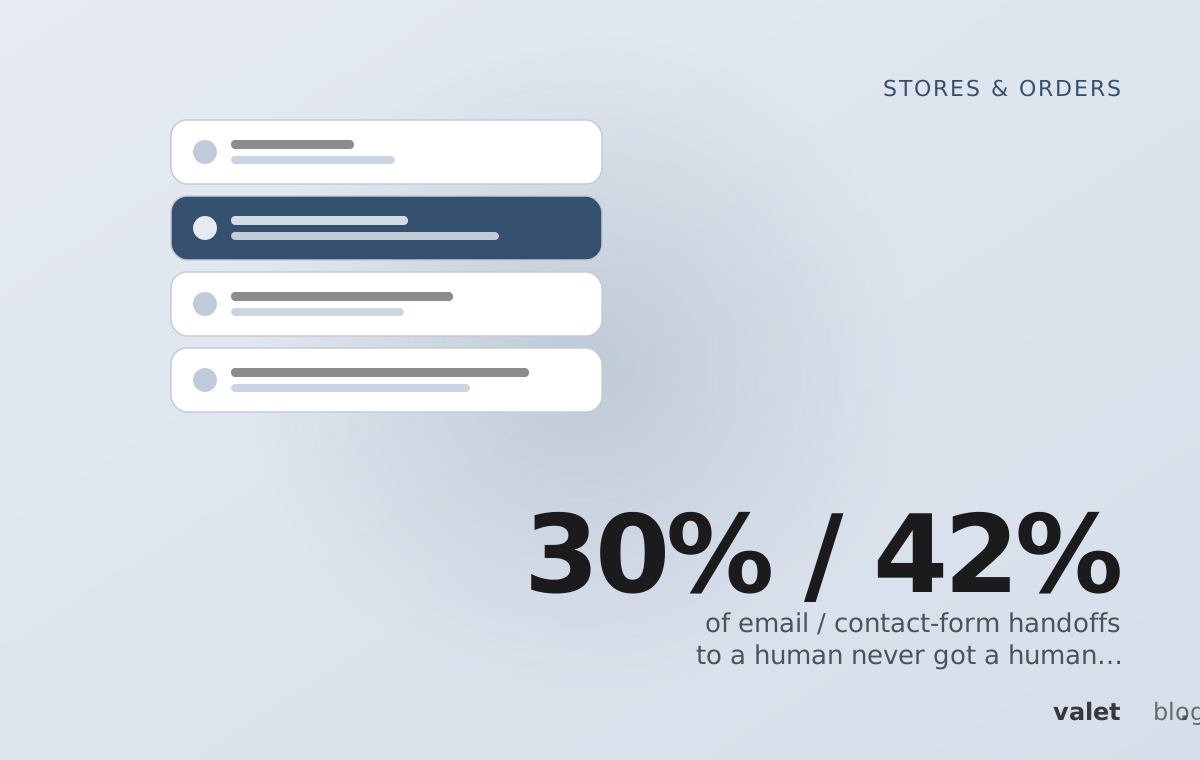
An auto-reply is not enough for customer service: it confirms the email arrived and answers nothing. The first reply should answer what can be answered from your written facts, say plainly what it cannot answer, and give a real time when a person will reply. The cost of skipping that is measurable: in Gorgias data (Oct 2025 to Apr 2026), 30% of email handoffs to a human never got a human reply, and contact forms fared worse at 42%.
30% / 42%
of email / contact-form handoffs to a human never got a human reply
Gorgias Ecom Lab, accounts with 200+ AI-touched tickets, Oct 2025 to Apr 2026
15.6%
of small-business contact forms sent only an automatic confirmation
Leadferno, 225 forms, Jun 2024
~15 h
median first reply to after-hours pre-purchase questions
Gorgias Ecom Lab, Jul 2026
An auto-reply is not enough for customer service. It confirms the email arrived and answers nothing. A first reply that works does three things: it answers what can be answered from your written facts, it says plainly what it cannot answer, and it gives a real time when a person will reply. Skipping that has a measured cost. In Gorgias's data from October 2025 to April 2026, 30% of email handoffs to a human never got a human reply, and contact forms were worse at 42%2.
What a customer sees at 9:40pm#
Illustration The scene below is a composite, not a real customer. The auto-reply wording in it is quoted from a real store owner's description.
The kitchen light is still on. A woman sits at the counter with her phone propped against the fruit bowl, a half-full mug going cold beside it. Two tabs are open, two stores, two near-identical linen shirts. One store's size chart stops at L. She types to the support address: does the L run generous, and would it arrive by Saturday?
Eleven seconds later her phone buzzes. The reply says the issue is received and someone will be back within 24 hours. She reads it once. She looks at the other tab, which has a longer size chart, and closes the first one. The dishwasher clicks into its drying cycle. By the time the first store's owner opens the inbox at 8am, the question has already been answered somewhere else.
That wording is not invented. A lone founder described their setup in r/shopifymerchantgrowth (8 comments, around August 2026): an "auto responder on our support email, informing the sender that issue is received and we will be back in 24 hours"1. They were asking how to do better. Most owners who set one up are.
Why owners rely on the auto-reply#
Nobody writes an auto-reply out of laziness. They write it at the end of a long day, often late, because a customer once complained about silence. It is a small act of courtesy built for the hours when the owner is asleep, at a school pickup, or packing boxes in a spare room with the radio on.
It also does one useful job. It tells the customer the email reached somebody. Against the wider baseline, that counts for something: Leadferno's June 2024 test of 225 small-business contact forms found 42.6% of inquiries never got any reply at all, and 15.6% of forms sent only an automatic confirmation4. An owner with an auto-reply is ahead of the ones with nothing.
The friction is what the auto-reply cannot carry. An owner answering by hand at 8am knows things the template does not: that the L runs a size big, that the Thursday courier collects at 2pm, that the blue one is back in stock next week. That knowledge is the craft of the job. The morning reply is often excellent. It is just eleven hours late.
Customers have said for years what that gap feels like. One thread in r/Entrepreneur, "If I have to email you to purchase your product and…" (100+ comments), took aim at exactly this: "an automated response on a contact form…"5. The sentence trails off in the snippet. The thread title finishes the thought.
The auto-reply teardown: what each stock sentence tells a customer#
The sentences below are typical of the genre: the lines that recur in support auto-replies and Gmail vacation responders. We have not counted how often each appears; treat the list as a field guide, not a survey. The middle column is what a customer at 9:40pm actually hears.
| The sentence | What the customer hears | What it costs | Write instead |
|---|---|---|---|
| "We've received your message." | The email worked. Nothing else. | Nothing, on its own. It is the only line that does no harm. | Keep it, then answer the question below it. |
| "We'll be back within 24 hours." | Tomorrow night, maybe. | At 9pm, the after-hours median wait is already ~15 h3. The customer has a cart open now. | An answer now, plus "[Name] will reply by 10am Tuesday" for the rest. |
| "Our team is experiencing high volumes." | You are in a long queue. | Tells the customer other stores might be quicker. | Say nothing about volume. Give the reply time. |
| "In the meantime, check our FAQ." | Go and find it yourself. | The FAQ answers the general question; the customer asked about their order. Owners report "We have a FAQ and still the same questions…"8. | Quote the one relevant line from the FAQ in the reply. |
| "Your ticket number is #48213." | You are a number. | Useful only if someone will ever ask for it. | Drop it unless your process needs it. |
| "Our hours are Mon–Fri, 9–5." | Nobody until Monday. | Sent at 9pm on a Friday, it promises a wait of about 60 hours. | The exact day and time a person will reply. |
| "Please do not reply to this email." | The conversation is closed. | Any follow-up detail the customer has goes nowhere. | "Reply here with any detail; it goes to the same thread." |
| "For urgent matters, please call." | Call a phone nobody answers at night. | Moves the problem to another channel that is also closed. | Define urgent (e.g. "wrong address on an order shipping tomorrow") and say how it is handled tonight. |
Read down the third column and a pattern shows. Every line spends the customer's time to save the owner's. The cost lands on the customer who was ready to buy tonight, which is the one the auto-reply was supposedly written for.
What should the first reply do instead?#
The first reply has four jobs. Answer what can be answered from facts you have already written: sizes, shipping times, return windows, stock. Act on anything your rules allow. Say plainly what it cannot answer. And name a real time when a person will reply to the rest.
Software vendors now pitch the speed part loudly. InboxAI's home page puts it in one line: "Give every customer a fast first response"7. Fast is the easy half. The harder half is what happens after the first response, and owners who run inboxes for a living say the same. In r/CRMSoftware (20+ comments, 29 September 2026), the top answer on after-hours leads was "Automation for the first touch, real person for the follow-up has been the sweet spot for us"6. That works only if the real person's follow-up has a time attached and actually arrives.
Here is the same 9:40pm question, answered two ways.
The second reply is not warmer. It is more useful, and it is honest about its limits: it says it is an assistant, it says it is AI, and it names who decides the part it cannot. A receipt for that reply would read like this.
Receipt (example)
- Asked
- Fit of linen shirt in L; delivery by Saturday
- Rule
- Sizing and shipping: Autopilot. Express shipping: Ask me first
- Sources
- Size notes (linen shirt), shipping policy (2pm collection, 2–3 days)
- Sent
- From the store's own support@ address; labelled "Pre-purchase"
The customer may still buy elsewhere. But she now has a reason to wait until 10am, which the auto-reply never gave her.
A first-reply template you can use tonight#
The template works whether a person, an assistant or a carefully written auto-reply sends it. If you can only send a fixed message, fill the facts block with your five most-asked answers.
Subject: Re: [their subject]

Hi [first name],

[ONE LINE THAT ANSWERS THEIR QUESTION FROM YOUR FACTS]
e.g. "Yes, we ship to Ireland: 5–7 working days, tracked."

[ONE LINE OF USEFUL DETAIL THEY DIDN'T ASK FOR BUT WILL NEED]
e.g. "Orders placed before 2pm on weekdays leave the same day."

[IF ANYTHING CAN'T BE ANSWERED FROM FACTS]
"[Owner name] will reply about [the open part] by [weekday, time]."

[IF THEY'RE MID-ORDER AND THE CLOCK MATTERS]
"If you need to change or cancel order #[number], reply before
[cutoff time, day] and it will be caught before it ships."

Reply to this email with anything else; it goes to the same thread.

[Name], [business]
[If an assistant or AI is writing: "[Business]'s assistant (AI)"]

---
FALLBACK (only if nothing above can be answered):
"Thanks, [first name]. [Owner name] will reply personally by
[weekday, time]. Our most-asked answers: [shipping line],
[returns line], [sizing line]."
Two rules make the template work. Never write "within 24 hours" without a weekday and a time; a customer can plan around "10am Tuesday" but not around a window. And keep the reply-by promise, or update it before it passes. A missed promise is worse than no promise, because the customer waited for it.
The wider pattern behind the auto-reply#
The auto-reply is one visible piece of a larger gap: the distance between a first touch and a real answer. Gorgias measured that gap for stores on its platform. After hours, pre-purchase questions waited a median of about 15 hours for a first reply, against 2.2 hours during business hours3, and Gorgias calls such a question "not a support ticket. It is an undecided purchase"10. When an AI agent handed a ticket to a person, the median wait was 10 hours, the 90th percentile 71 hours, and one-third of handed-off tickets never got a human reply at all; for email the abandonment was 30%, for contact forms 42%2.
Customers do not object to automation as such. Five9's 2025 survey of 1,006 consumers found 72% were open to AI help if they could reach a person, and 40% would leave a business after one bad experience9. The auto-reply fails both tests at once. It is not quite a person and not quite an answer.
For how fast the real reply should come, see how fast an online store should reply to customer emails. For the handoff promise in detail, see what "never stuck with a bot" has to mean.
None of this makes the night shorter for the owner. The boxes still need packing in the morning, and some customers will always want to hear from the person whose name is on the label. Whether a better first reply wins back the woman at the kitchen counter is not something any template can promise. It only gives her a reason to wait.
Where Valet fits#
Valet replaces the auto-reply with a first reply that answers. You forward your support or hello address to it; it replies from your own address once your domain is verified, using only your facts: price list, shipping and returns policies, size notes. Anything it cannot answer, and any money question or complaint, waits for you, and the customer is told when you will reply. It follows up at most twice by default, each time with something useful, then stops and tells you why. Every reply is signed as your assistant, says it is AI, and has a receipt. The free lead check reviews 10–20 recent inquiries and shows how many got only an auto-reply.
Questions people ask
Is an auto-reply enough for customer service?
No. It tells the customer the message arrived, which is useful, but it answers no question and books nothing. A customer deciding between stores at 9pm reads it as "not tonight". Use it only as a fallback when nothing can be answered.
What should a customer service auto-reply say?
If you must use one, it should say who is writing, answer the most common questions in a line each, state the exact day and time a person will reply, and give one route for urgent problems. Avoid "within 24 hours" without a time, and avoid "do not reply".
Should I use Gmail's vacation responder for my business inbox?
It sends one fixed message, the same to every customer, whatever they asked. That is fine for a short absence with a stated return date. For a support or sales inbox it leaves every question unanswered until you are back.
How fast should the first real reply come?
For pre-purchase questions, within an hour at any hour. For order changes, before your next fulfilment cutoff. For everything else, the same business day. Gorgias's 2026 benchmarks treat under 12 hours as excellent for email and under 1 hour as best-in-class.
Sources
Confidence: H primary source checked · M credible secondary or reported · L vendor claim or single report. Reddit and forum items are quoted from public threads and summarised, not endorsed.
- "Handling customer service as a lone founder" (8 comments; Google snippet) · Reddit, r/shopifymerchantgrowth · c. 2026-08 M
- The cheapest ticket is the one a human never touches · Gorgias Ecom Lab · 2026 H
- Your team is sleeping on 53% of shopper questions · Gorgias Ecom Lab · 2026-07-30 H
- Research: Website contact forms and lead management, uncovering costly mistakes · Leadferno · 2024-06-28 H
- "If I have to email you to purchase your product and…" (100+ comments; Google snippet) · Reddit, r/Entrepreneur · c. 2020 M
- "How are you handling leads that come in after business [hours]" (20+ comments; Google snippet) · Reddit, r/CRMSoftware · 2026-09-29 M
- InboxAI home page · InboxAI · 2026-10 H
- "Small business owners of reddit! How do you manage FAQ?" (9 comments; Google snippet) · Reddit, r/smallbusiness · c. 2024 M
- New Five9 research reveals balancing AI and human connection is key to winning customers · Five9 · 2025-03-13 H
- Pre-purchase speed is a revenue lever most brands treat as a cost · Gorgias Ecom Lab · 2026-05 H
How to cite this page
Cite this page
Valet, "We'll be back within 24 hours: a teardown of small-business auto-replies", valet.team, October 2026.
Keep reading
 Stores & orders"Will this fit?" "Do you ship to Ireland?" The 53% of pre-sales questions that arrive after hours, and what they're worthGorgias's 2026 data puts a number on the shopper who asks at 10pm and buys elsewhere. Here is a worksheet to price that wait for your own store, and three ways the next 12 months could change it as AI shopping assistants start asking the questions.Trends desk · 11 min · 1 October 2026
 Stores & ordersHow to handle "where is my order" emails in a small store: answer from the order, act on it, stay until deliveredA tracking link answers the question a store expects. The email asks a different one: what is happening to my parcel, and what will you do about it. Here are the base rates, the five states behind the question, and the reply each one deserves.Trends desk · 8 min · 1 October 2026
 Stores & ordersThe 48 hours after "order confirmed": why the status page didn't stop the emails, and the three silent states behind themStores answer the post-purchase silence with a status page or a stream of automatic emails. Both are broadcasts. The emails keep coming because the customer is asking about one parcel in one of three states the page cannot explain.Trends desk · 8 min · 1 October 2026