
Stores & orders
How fast should an online store reply to customer emails? 2026 benchmarks, and the "9pm test"
One reply-time target for every email is the wrong unit. A question asked before checkout, a cancel request before the label prints and a sizing complaint after delivery each have their own clock. Here are the 2026 numbers and a test you can run on your own store tonight.
Short answer
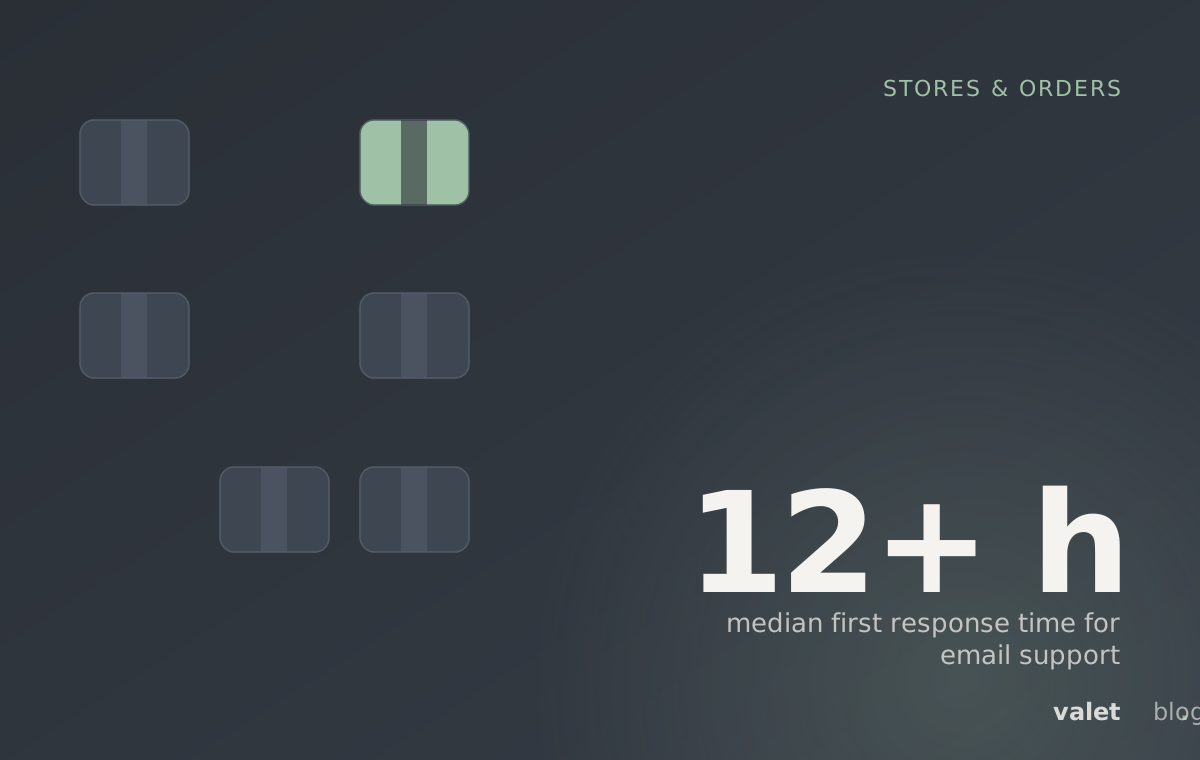
Reply to pre-purchase questions within an hour, at any hour; reply to cancel and address-change requests before your next fulfilment cutoff; reply to everything else the same business day. For context, Gorgias (May 2026) puts the median email first response at "12+ hours", calls under 12 hours excellent and under 1 hour best-in-class. After hours, its July 2026 data shows a median wait of about 15 hours versus 2.2 hours in business hours.
12+ h
median first response time for email support
Gorgias customer service benchmarks, May 2026
~15 h vs 2.2 h
median first response after hours vs in business hours
Gorgias Ecom Lab, platform data, Jul 2026
736 min
average response time at brands automating close to 0% of tickets
Gorgias, May 2026
Reply to pre-purchase questions within an hour, at any hour of the day. Reply to cancel and address-change requests before your next fulfilment cutoff. Reply to everything else the same business day. For context, Gorgias's May 2026 benchmarks put the median first response for email support at "12+ hours", call under 12 hours excellent, and treat under an hour as best-in-class1. After hours the gap widens: a median wait of about 15 hours against 2.2 hours in business hours (Gorgias, July 2026)2.
The question you're actually asking#
When you search "how fast should I reply", you are usually asking two things at once. First: what is normal, so you know whether you are behind. Second: what is fast enough that a customer does not leave. Those have different answers, and the benchmarks mostly answer the first one.
Google's own suggestions show the confusion. The search "how fast should a business respond to an inquiry email" brings up related questions such as "How long should it take for a business to reply to an email?" and "How fast is too fast to respond to an email?". Both are fair. The second one has a short answer, which comes later.
Store owners ask it from the other side of the inbox. A September 2026 thread in r/ecommerce titled "E-commerce owner with lots of support emails" (130+ comments) opens with the familiar guess: "Is it all just the typical 'Where is my order?'"9. Volume is the reason replies slow down. It is not a reason the customer will wait.
What the 2026 benchmarks say#
The most recent public numbers for online stores come from Gorgias, a helpdesk used by e-commerce brands, which publishes aggregates from its own platform. Read them as the habits of stores that already pay for a helpdesk, not as the habits of every small shop.
| Measure | Value | Who was measured |
|---|---|---|
| Median first response, email | "12+ hours" | Gorgias benchmark page, May 20261 |
| Benchmark target, email | "Under 24 hours (excellent: under 12 hours)" | Gorgias, May 20261 |
| Best-in-class, email | Under 1 hour (baseline 12 hours) | Gorgias ticket-volume page, May 20265 |
| Brands automating close to 0% of tickets | 736-minute average response (about 12 h 16 m) | Gorgias, May 20261 |
| First response time by vertical | 1.6 h fastest to 9.1 h slowest; all-industry median 6.3 h | Gorgias platform data, March 2026, 14 verticals at the $10M GMV band4 |
| In hours vs after hours | 2.2 h vs ~15 h median | Gorgias platform data, last 90 days to July 20262 |
| Pre-purchase questions in human queues | 11 h average; 61% wait over 2 h; 22% wait a day or more | Gorgias, May 20263 |
| Small-business contact forms (all sectors) | 17 h 49 m average first human reply; 42.6% never answered | Leadferno test of 225 forms, June 20246 |
Two patterns stand out. The typical email reply takes about half a day. And the hour of the day matters more than almost anything else: an email sent at 9pm waits roughly seven times longer than one sent at 11am.
Why one reply-time target is the wrong unit#
A support inbox is a queue, and every message in it has a timeout: the moment after which a reply no longer changes anything. The mistake is giving every message the same timeout. In plain English, different questions go stale at different speeds.
Pre-purchase questions go stale in minutes to hours#
"Does this run small?" "Do you ship to Ireland?" The customer has a cart open, maybe in two tabs. Gorgias calls this kind of message "not a support ticket. It is an undecided purchase"3. It found 1 in 9 support inquiries is pre-purchase, and 53% of pre-purchase questions arrive outside business hours32. The timeout here is the customer's patience, and the store has no control over it.
Order changes go stale at the fulfilment cutoff#
"Can I still cancel?" "I put the wrong address." These have a hard timeout you do control: the moment the label prints. Before it, the fix is a click. After it, the fix is a return, a reship and another email. A 15-hour after-hours median is longer than many same-day cutoffs, so a 9pm request can miss the next morning's dispatch.
After-sale questions go stale slowly#
"How do I wash this?" "Where is my order?" (when it is on time). These can wait until the next business day without losing anything except goodwill. They are also the bulk of the volume, which is why stores that answer in arrival order end up making the urgent questions wait behind the slow ones.
The catch is that a single "average first response time" mixes all three queues. A store can post a good average while every pre-purchase question that arrived at night waited until morning.
A worked example: what the after-hours gap means for a 300-order store#
The numbers below combine Gorgias's published ratios into one store. The arithmetic is ours; the store is an illustration.
| Step | Value | Basis |
|---|---|---|
| Orders per month | 300 | Assumption |
| Support tickets per month | ~66 | Apparel: about 22 tickets per 100 orders5 |
| Pre-purchase questions per month | ~7 | 1 in 9 inquiries3 |
| Pre-purchase questions arriving after hours | ~4 | 53%2 |
| Typical wait for those 4 without cover | ~15 hours | After-hours median2 |
Four questions a month sounds small. Each one is a customer who had something in their basket and asked a question instead of buying. Gorgias reports that AI-influenced pre-purchase orders carried an average order value 45% above the site average, and made up 1.5% to 2.7% of GMV3. Those are correlations inside one vendor's platform, not proof that speed caused the sale. They do tell you which four emails to answer first.
The strongest causal evidence on delay comes from outside retail. A Management Science study of Fiverr, reported by Entrepreneur in July 2026, found that a one-hour delay in replying cut a freelancer's odds of being hired by 46%, and a delay of 24 hours or more cut them by 90%7. A marketplace with sellers side by side is harsher than a store's inbox, so treat it as an analogue. The direction matches what owners describe. A thread in r/CRMSoftware (20+ comments, 29 September 2026) summed it up: "a lead asks a question at night, but the first useful reply comes the next morning. By then, the conversation…"8.
How fast is too fast to respond to an email?#
Speed on its own does not annoy customers. Empty speed does. An instant reply that says "We've received your message and will be back within 24 hours" arrives in seconds and answers nothing. To the customer it reads like a door closing politely.
An instant reply that says "Yes, we ship to Ireland. Delivery is 5–7 working days, and orders placed before 2pm leave the same day" is not too fast. It is the reply the customer wanted, sooner. The question is never "how many minutes?" but "did the first reply answer the question?" The companion piece on what "we'll be back within 24 hours" costs takes the auto-reply apart line by line.
There is one honest case for slowing down: a reply that would need judgement you have not written down. A sizing question you can answer from a chart is safe at 9pm. A request for a discount is not, and should get a reply that says who decides and when.
The 9pm test: measure your own store tonight#
Benchmarks tell you what other stores do. The 9pm test tells you what your customer experiences. It takes ten minutes to set up and runs overnight.
THE 9PM TEST
When: a weekday, between 8:45pm and 9:15pm local time.
From: a personal address the store has never seen.

1. Send ONE real pre-purchase question to the store's support email,
   e.g. "Do you ship to [country], and how long does it take?"
2. Submit the SAME question through the website contact form.
3. If there's a chat widget, note whether it answers or takes a message.
4. Do not reply to anything. Wait 72 hours.

SCORECARD (fill one row per channel)
Channel:                         email / form / chat
First message of any kind at:    [time]  (auto-reply?  Y / N)
What the auto-reply promised:    [quote it]
First reply that ANSWERED at:    [time]  -> hours since 9pm: [ ]
Did it answer from facts?        Y / N   (or did it say "we'll check")
Did anyone follow up unasked?    Y / N
Never answered after 72h?        Y / N

READING YOUR RESULT
Answered under 1h:      best-in-class (Gorgias: under 1 hour)
Answered next morning:  typical (Gorgias after-hours median ~15h)
Auto-reply only, 24h+:  the customer has probably bought elsewhere
Never answered:         check the address and form actually deliver
Run the test on five competitors too, and you have a small benchmark of your own niche. The method scales: run across 50 to 100 small stores, the same protocol would show how often the first message is an auto-reply, what those auto-replies promise, and how many questions are never answered at all. No one has published that for small stores yet. It is a study Valet could run; for now, your own five rows are more useful than any vendor average.
If the "never answered" row comes back yes, the problem may be delivery rather than effort. Why contact-form leads never get a reply covers how to check that form notifications actually land.
Where the benchmarks stop being true#
Every number in the table above comes with limits worth knowing before you set a target from it.
- Who was measured. Gorgias's data comes from stores on Gorgias. Its vertical study used the $10M GMV band and accounts with at least 30 tickets4. A two-person store is not in that group, and may be faster or slower.
- What counts as a response. Benchmarks often count the first reply of any kind. An automatic acknowledgement can make a slow store look fast.
- What happens after the first reply. Reply time says nothing about what happens next. In Gorgias's data on AI-touched tickets, handoffs to a human by email went unanswered 30% of the time and took 32 hours to resolve10. A fast first reply followed by silence is still silence.
- Retail is not a marketplace. The Fiverr effect is measured on freelancers competing on the same page7. Your customer has to go and find the next store; the penalty for delay is probably smaller, though not zero.
The overall answer holds up under those limits: answer the questions that decide a purchase in minutes, answer the questions with a cutoff before the cutoff, and make sure the first reply is an answer. For the broader small-business version across services and marketplaces, see how fast a small business should reply to an inquiry, and for what the after-hours share is worth in revenue, the 53% of pre-sales questions that arrive after hours.
Where Valet fits#
Valet is built for the 9pm row. You forward your support or hello address to it, and it answers questions in minutes from your own facts: shipping matrix, sizing notes, policies. Replies go out from your own address once your domain is verified. If the customer goes quiet, it follows up at most twice by default, each time with something useful. Anything not in your facts, and anything involving money or a complaint, waits for you, and the customer is told when you will reply. Every reply says it is your AI assistant and comes with a receipt. The free lead check reviews 10–20 recent inquiries and shows which went unanswered, which stopped after one reply, and what they were worth.
Questions people ask
How long should it take a business to reply to an email?
For an online store, the same business day for routine questions, under an hour for pre-purchase questions, and before the fulfilment cutoff for order changes. Gorgias's 2026 benchmark treats under 24 hours as acceptable for email, under 12 hours as excellent and under 1 hour as best-in-class.
How fast is too fast to respond to an email?
Speed only hurts when the fast reply says nothing. An instant template that promises a reply later answers no question and can read as a brush-off. An instant reply that answers the question correctly, from your own policies, is not too fast.
What is a good first response time for a small online store?
Gorgias's April 2026 data put the all-industry median first response time at 6.3 hours, ranging from 1.6 to 9.1 hours by vertical. A small store that answers pre-purchase questions within an hour and everything else the same day is ahead of those medians.
Does replying faster actually increase sales?
Gorgias found 1 in 9 support inquiries is a pre-purchase question and that AI-influenced pre-purchase orders carried 45% higher order values than the site average (May 2026). That is correlation inside one vendor's platform, not a controlled test, but it shows where speed is most likely to matter.
Is an auto-reply enough to count as a response?
Most benchmarks count the first reply of any kind, which flatters stores that send an automatic acknowledgement. Measure the time to the first reply that answers the question instead; that is the number the customer experiences.
Sources
Confidence: H primary source checked · M credible secondary or reported · L vendor claim or single report. Reddit and forum items are quoted from public threads and summarised, not endorsed.
- Customer service benchmarks · Gorgias · 2026-05-15 H
- Your team is sleeping on 53% of shopper questions · Gorgias Ecom Lab · 2026-07-30 H
- Pre-purchase speed is a revenue lever most brands treat as a cost · Gorgias Ecom Lab · 2026-05 H
- Stop benchmarking against the average · Gorgias Ecom Lab · 2026-04-01 H
- Ticket volume · Gorgias · 2026-05-22 H
- Research: Website contact forms and lead management, uncovering costly mistakes · Leadferno · 2024-06-28 H
- Companies are tracking response time delays for freelance jobs (Management Science study of Fiverr) · Entrepreneur · 2026-07-16 M
- "How are you handling leads that come in after business [hours]" (20+ comments; Google snippet) · Reddit, r/CRMSoftware · 2026-09-29 M
- "E-commerce owner with lots of support emails" (130+ comments; Google snippet) · Reddit, r/ecommerce · c. 2026-09 M
- The cheapest ticket is the one a human never touches · Gorgias Ecom Lab · 2026 H
How to cite this page
Cite this page
Valet, "How fast should an online store reply to customer emails? 2026 benchmarks, and the 9pm test", valet.team, October 2026.
Keep reading
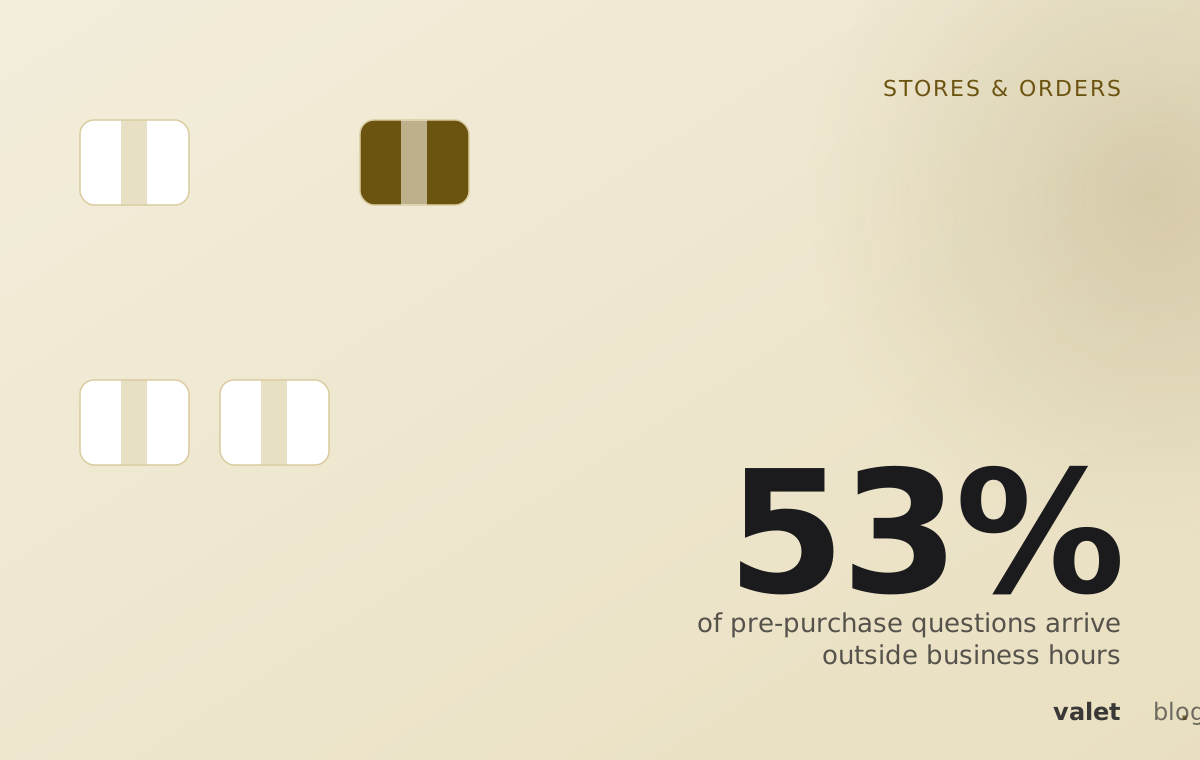 Stores & orders"Will this fit?" "Do you ship to Ireland?" The 53% of pre-sales questions that arrive after hours, and what they're worthGorgias's 2026 data puts a number on the shopper who asks at 10pm and buys elsewhere. Here is a worksheet to price that wait for your own store, and three ways the next 12 months could change it as AI shopping assistants start asking the questions.Trends desk · 11 min · 1 October 2026
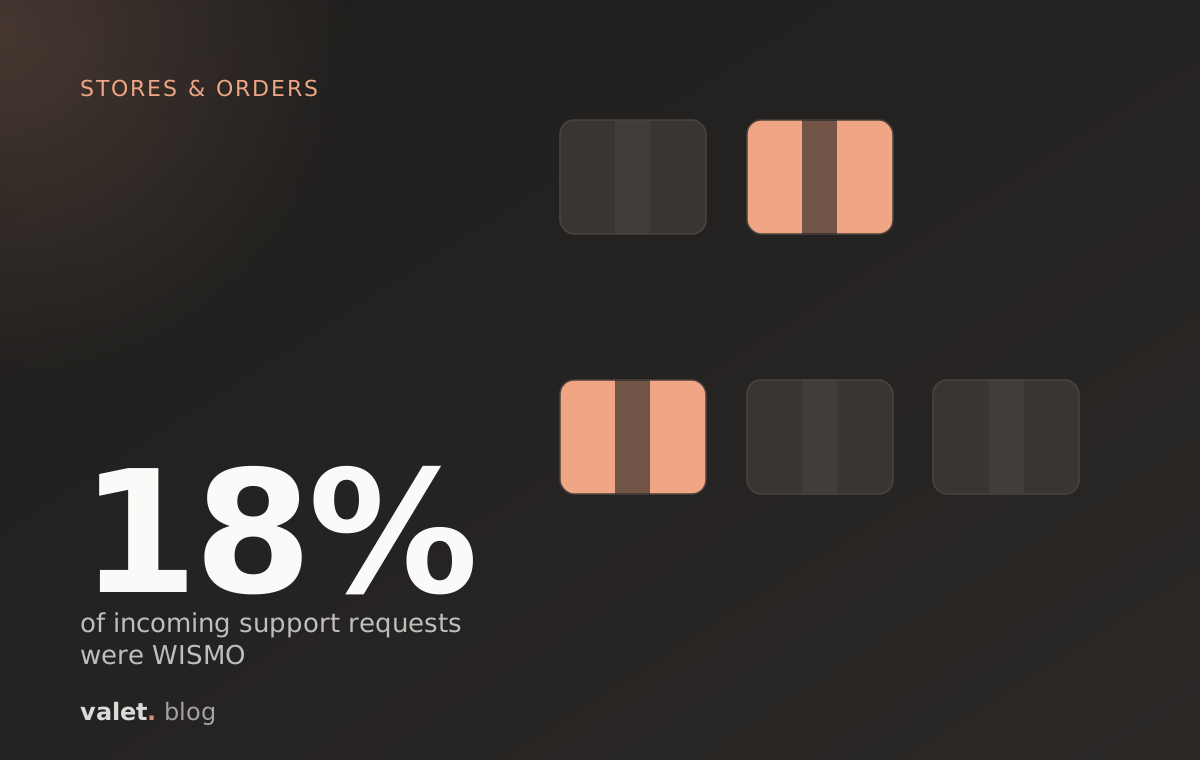 Stores & ordersHow to handle "where is my order" emails in a small store: answer from the order, act on it, stay until deliveredA tracking link answers the question a store expects. The email asks a different one: what is happening to my parcel, and what will you do about it. Here are the base rates, the five states behind the question, and the reply each one deserves.Trends desk · 8 min · 1 October 2026
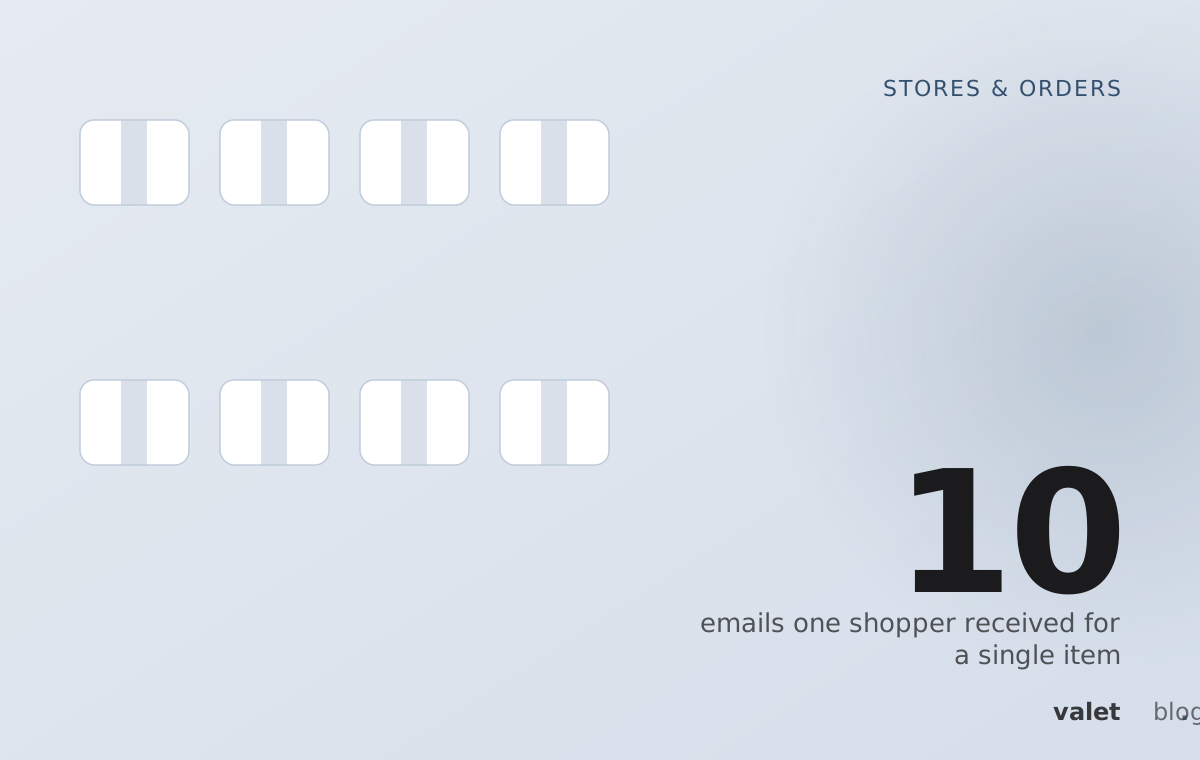 Stores & ordersThe 48 hours after "order confirmed": why the status page didn't stop the emails, and the three silent states behind themStores answer the post-purchase silence with a status page or a stream of automatic emails. Both are broadcasts. The emails keep coming because the customer is asking about one parcel in one of three states the page cannot explain.Trends desk · 8 min · 1 October 2026