
Independent professionals
How to qualify leads before a call without an intake form that scares people off (and without a sales team)
The standard advice is to add friction: a longer form, a shorter free call, a paid consult. It works, and it has a cost that rarely gets counted. The alternative is to qualify by answering, and to let prospects rule themselves out.
Short answer
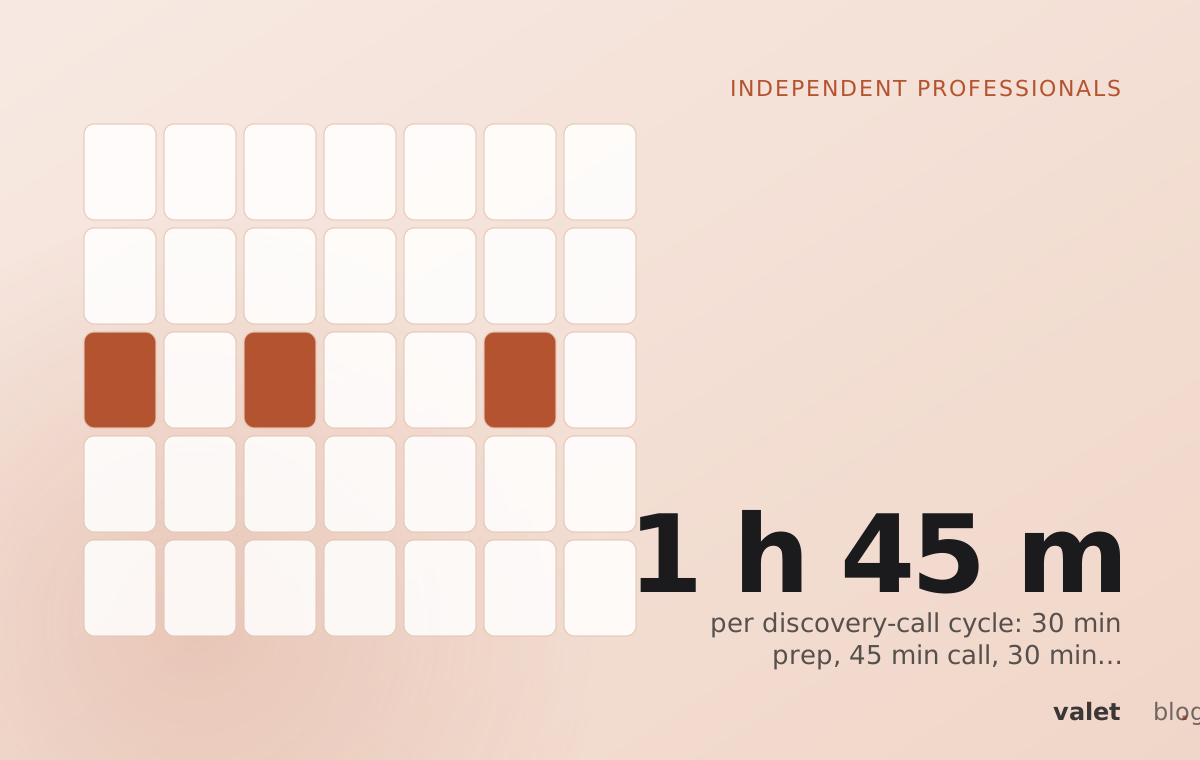
Qualify by answering, not by interrogating. Put your minimum, price range, lead time and service area in the first reply, ask one or two questions only you need answered, and offer a time to those who still fit. Prospects who cannot meet your terms rule themselves out without a call. Each unqualified call costs about 1 h 45 m of prep, call and proposal time (Freelancing Females, 2026).
1 h 45 m
per discovery-call cycle: 30 min prep, 45 min call, 30 min proposal
Freelancing Females, Apr 2026
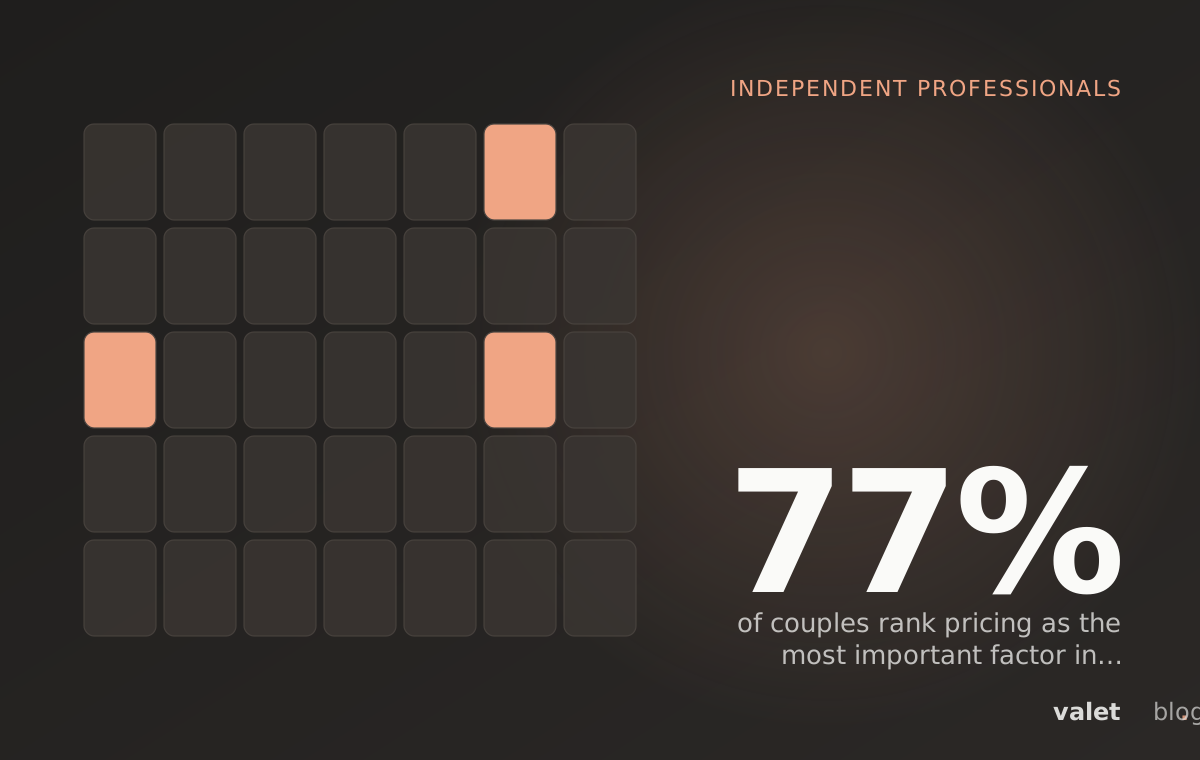
77%
of couples say pricing is the most important factor before contacting a vendor
WeddingPro, From Hello to Hired
48%
of answered Google-AI pricing calls got no price from the business
Invoca, Dec 2025
Qualify by answering, not by interrogating. Put your minimum or price range, lead time and service area in the first reply, ask the one or two questions only you need answered, and offer a time to the people who still fit. Prospects who cannot meet your terms rule themselves out before a call, and the ones who remain arrive knowing what you charge. Freelancing Females estimates each discovery-call cycle at about 1 h 45 m of prep, call and proposal1. Every call that should not have happened costs that much.
What is the usual advice for qualifying leads before a call?#
The usual advice is to add friction, and it deserves a fair statement. Freelancing Females, writing in April 2026, estimates freelancers lose about five hours a week to unproductive calls and recommends three filters: an intake form before booking, a 15-minute cap on free calls, and paid consultations for anything longer1. In r/smallbusiness, a thread on discovery calls with people who are clearly not a fit (20+ comments, around May 2026) reaches the same rule: "a free discovery call should be limited to 15 minutes"2.
Founders say the same thing about demo requests. An Indie Hackers post from May 2026 argues that a heavier booking step is worth its cost: "The friction isn't a bug; it's doing qualification work your demo call would have done anyway"3.
The logic is internally consistent. A call is the most expensive thing a solo practice gives away. A form costs the prospect five minutes and saves the owner nearly two hours. If some prospects abandon the form, they were probably the ones who would have wasted the call.
Why intake forms and short calls make sense#
Intake forms persist because they solve a real coordination cost. Without them, the owner learns basic facts on the call itself: the budget is a tenth of the minimum, the project starts next week, the client is in a region you do not serve. Each of those discoveries costs the full 1 h 45 m1. Scheduling adds its own drag: a thread in r/Entrepreneur about clients who are difficult to set meetings with (30+ comments, around 2023) describes owners who "set a time, then have to reschedule a few times"10.
Forms also scale without staff. The Indie Hackers founder who wrote "How I automated my first sales without hiring anyone" (May 2025) reports roughly 280 form submissions in three months, 61 tagged warm and 25 paying customers, run on about 30 minutes a week of founder time4. That is one founder's report, and commenters questioned some of its claims, but it shows a system doing the screening a salesperson would otherwise do.
And forms protect the owner from a particular kind of inquiry. Ask a Manager's April 2026 thread on "pick your brain" requests is full of professionals who give away hours to people who never intended to hire them5. Friction is how they stopped.
Why do long intake forms scare good leads off?#
The cracked assumption is that qualification runs in one direction. The form asks the prospect to disclose budget, timeline, company size and goals before the owner has disclosed anything, including the price. But the prospect is also qualifying the owner, and the first thing most prospects want to know is the thing the form withholds.
Across segments, pricing comes first. WeddingPro reports that 77% of couples say pricing is the most important factor they consider before contacting a vendor7. When Google's AI began calling local businesses on customers' behalf to ask for prices, Invoca found in December 2025 that 48% of the answered calls ended without a price8. The pattern is the same in both: the buyer asks the price, the seller asks for more information first.
That creates a perverse incentive at the form. A prospect asked for a budget before seeing a range has three options: guess low and hope, guess high and overpay, or leave. The good-fit prospect with other options tends to leave, because the competitor who answered the price question directly is one tab away. The form filters, but it filters on patience, which is a different trait from fit.
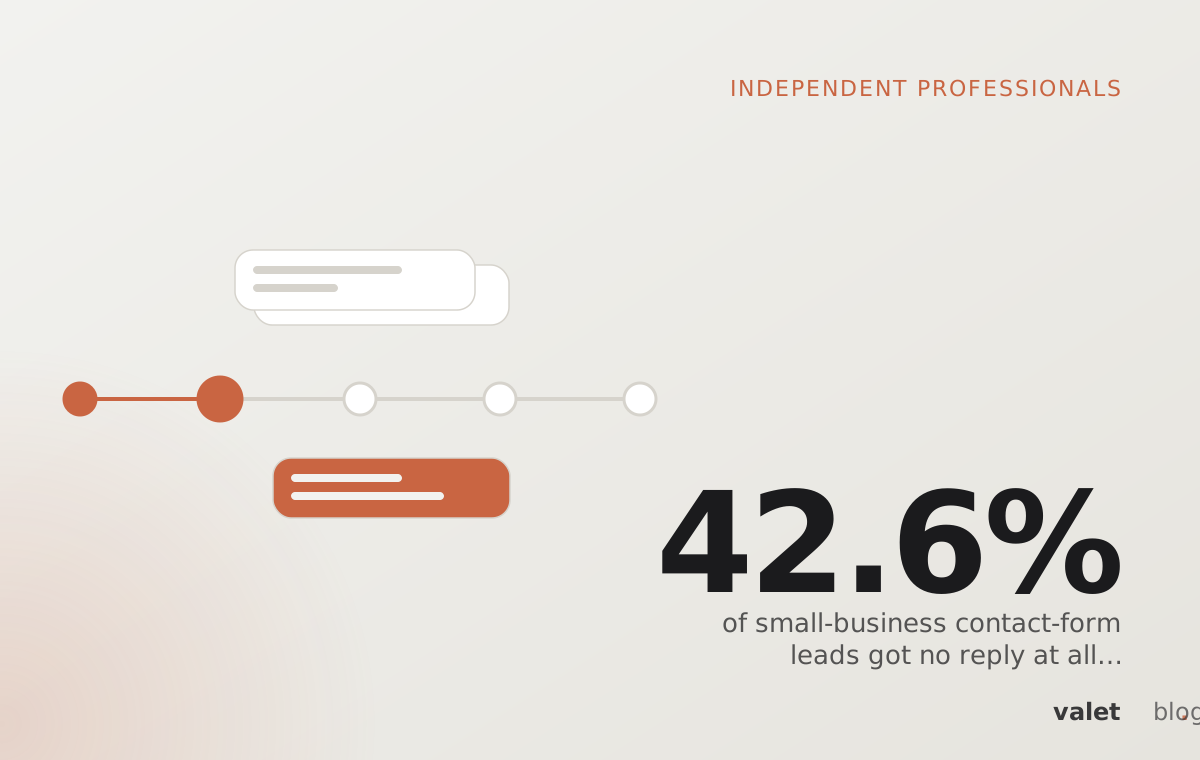
There is a second-order effect too. A form produces a submission, not a conversation, and submissions are easy to leave unanswered. Leadferno's 2024 test of 225 small-business contact forms found 42.6% of submissions never got a reply, and about one form in twenty was broken9. A form that collects ten fields and then waits a day for the owner to read them has qualified nobody.
What is answer-first qualification?#
The mechanism in one sentence: tell the prospect the facts that decide fit before you ask them anything, and ask only what your answer still depends on.
In practice the first reply carries your minimum or range and what it includes, your current lead time, where you work, and what you do not do. Then it asks one or two questions and offers a specific time. The prospect reads it and does one of three things: books, asks a follow-up question, or quietly decides you are not for them. All three are qualification. Only the first costs you a call, and that one arrives informed.
| Typical form field | What it costs the prospect | Answer-first replacement |
|---|---|---|
| "What is your budget?" (dropdown) | Asks them to bid blind; invites a low guess | "Projects like this start at [minimum]; most land between [range]. Does that work?" |
| "Describe your project" (long text box) | Ten minutes of writing before any sign of interest | Answer what they already wrote, then ask the one detail that changes the price |
| "Timeline" (dropdown) | No way to know whether you can meet it | "My next start is the week of [date]. Is that in time?" |
| "Company size / revenue" | Feels like a credit check; often irrelevant | Drop it unless it changes your price; if it does, say how |
| "How did you hear about us?" | Effort for the owner's benefit only | Drop it from the form; note the source from the email |
The fields are common patterns, not a review of any particular business's form.
What evidence supports qualifying by answering?#
Three lines of evidence support the alternative, from weakest to strongest.
First, practitioners who publish their answers stop getting the same questions. In the Ask a Manager thread, one commenter wrote: "I wrote up an FAQ that I just provide to everyone who contacts me…Shockingly (not), nobody has ever sent me a new question to add"5. Another sends a link to book a paid hour "starting at $500/hr"5. Both are answer-first: the price and the terms go out before the call.
Second, the replies that convert in small trades already look like this. On the musicteacher.com forum, a teacher shared his standard reply to student enquiries: prices per lesson, availability, and a note that "contacting via my website is indirect and can get delayed." The same thread holds that "the speed a which a teacher replies to an enquiry is critical to getting that enquiry booked in"6. Fast, factual, priced. No form.
Third, the buyer's first question is price, and most sellers do not answer it. This is the strongest line because it is measured on both sides. On the buyer side, 77% of couples put pricing first7. On the seller side, nearly half of answered price requests in Invoca's December 2025 study got no price8. A business that answers the price question in its first reply is doing something most of its competitors do not, at the moment the buyer is deciding whom to keep talking to.
When should you still use an intake form?#
The consensus still wins in four situations.
- Volume is high. The Indie Hackers founder had about 280 submissions in three months4. At that scale, structured fields make sorting possible. A practice with eight inquiries a month does not have that problem.
- The work requires facts you cannot price without. A conflict check for a lawyer, a site address for a contractor, a file inventory for a bookkeeper. Ask for those; they are qualification, not friction.
- The call is the product. If you sell paid consultations, the booking page is a checkout, and a form is appropriate.
- Your prices change by project so much that a range would mislead. Then say what moves the price and give one worked example. If you cannot do even that, the form will not help either.
The zero-sum trade-off is real: every fact you publish in the first reply loses you some prospects who would have booked a call and then balked. Answer-first accepts that loss in exchange for not paying 1 h 45 m to discover it.
How to qualify without a sales team: the checklist#
The checklist below is the Monday-morning version for a solo practice or a founder handling inbound alone. The inquiry states at the end replace a CRM for most practices under a few dozen inquiries a month.
1. WRITE YOUR FIT FACTS ONCE
Minimum engagement:        [$ / scope]
Typical range:             [$–$] for [what's included]
Next available start:      [week of date]
Where you work:            [regions / remote]
What you don't do:         [list]
What needs you personally: discounts, custom terms, contracts,
                           anything legal, health or safety

2. FIRST REPLY (send within the hour if you can)
Hi [name], thanks for the details on [their project].
Projects like this usually run [range], which covers [inclusions].
My minimum is [minimum]. My next start is the week of [date],
and I work [where].
Two questions so I can be specific:
- [the one detail that changes the price]
- [timing or location, only if it matters]
If that all fits, I can do [day, time] or [day, time] for a
[20]-minute call. Reply with one and I'll send the invite.

3. ASK ONLY WHAT YOUR ANSWER DEPENDS ON
Keep:  scope detail that moves the price; start date; location.
Drop:  budget dropdown; company revenue; "how did you hear about us".

4. TRACK EACH INQUIRY IN ONE OF THESE STATES
New -> Answered -> Time held -> Followed up -> Booked
or Closed with a reason (not a fit / price / timing / no reply)
or Needs me (anything on the "needs you personally" list)

5. FOLLOW UP TWICE, THEN CLOSE
Each follow-up adds something: a held time, the detail they
asked about, an expiry. After two, close with a reason.
The first reply carries the qualification; the follow-up rules are covered in how many times to follow up with a lead, and what to do when a booked call does not happen is in discovery-call no-shows.
Where this argument would be wrong: if, after 30 days of sending your range in the first reply, the number of calls that end in a proposal falls rather than rises, your market wants the conversation before the number. Count calls held and proposals sent for a month before and a month after. Illustration For a founder spending an hour a day on inbound triage, five days a week for 49 weeks, at a $150 opportunity cost per hour, that is about $37,000 a year of time worth measuring.
Where Valet fits#
Valet does answer-first qualification on inquiries you forward to it. It replies from your own facts (price list, minimums, packages, calendar and policies), never invents a price or a discount, and offers real times from your calendar to the people who fit. Each inquiry moves through the Valet Inquiry States (New, Answered, Time held, Followed up, Booked, or closed with a reason logged). Topics you mark "Always you", such as discounts or contracts, come to you with one-tap replies, and the customer is told when you will reply. Every reply carries a Valet receipt showing what was asked and which of your facts it used. The free lead check looks at 10–20 recent inquiries and shows what went unanswered, what stopped after one reply, and what it was worth.
Questions people ask
How do you qualify leads before a discovery call?
State your minimum or price range, lead time and service area in your first reply, ask the one or two questions that decide fit, and offer a specific time only to those who still fit. The prospect does most of the screening by reading your answer.
Should I use an intake form or a discovery call?
Use a short form or an email reply to collect only what decides fit, and keep the call for scoping. A long form before the prospect has seen your price asks them to invest first, which filters out some good leads along with the poor ones.
How do I qualify inbound leads without a sales team?
Write your facts once (ranges, minimums, availability, what you don't do), answer every inquiry from them quickly, and track each inquiry through a few states: new, answered, time held, followed up, booked, or closed with a reason.
What questions should I ask to qualify a potential client by email?
Ask only what your answer depends on: usually timing and scope, sometimes location. Budget is better handled by stating your own range and asking whether it works, rather than asking theirs.
Is it rude to put my prices in the first reply?
No. Prospects who ask about price usually want the number, and a range with what it includes respects their time. If a price depends on details, give the range and the details that move it.
Sources
Confidence: H primary source checked · M credible secondary or reported · L vendor claim or single report. Reddit and forum items are quoted from public threads and summarised, not endorsed.
- Are discovery calls worth it? · Freelancing Females (Substack) · 2026-04-07 M
- "How do you handle discovery calls with people who clearly [aren't a fit]" (thread, 20+ comments; Google snippet) · Reddit, r/smallbusiness · c. 2026-05 M
- The 'Book a Demo' button was killing my pipeline · Indie Hackers · 2026-05-12 M
- How I automated my first sales without hiring anyone · Indie Hackers · 2025-05-29 M
- How to respond to requests to pick your brain · Ask a Manager · 2026-04-01 H
- Best ways to reply to student enquiries · musicteacher.com forum · undated M
- From Hello to Hired: your guide to lead replies · WeddingPro · undated H
- New Invoca study finds pricing request phone calls from Google's AI surged over 300% in November · Invoca · 2025-12-10 H
- Research: Website contact forms and lead management, uncovering costly mistakes · Leadferno · 2024-06-28 H
- "How do you deal with clients that are difficult to set [meetings with]" (thread, 30+ comments; Google snippet) · Reddit, r/Entrepreneur · c. 2023 M
How to cite this page
Cite this page
Valet, "How to qualify leads before a call without an intake form that scares people off", valet.team, October 2026.
Keep reading
 Independent professionals"What are your rates?" by email: answering pricing and pre-sales questions without a call, a lost lead or an invented discountThe person asking for your rates is not trying to trap you. They are trying to find out if you are in range before they spend a call on you. Answer that question, then give them one easy next step.Explainers · 9 min · 1 October 2026
 Independent professionalsDiscovery-call no-shows for consultants and coaches: real rates, why they happen, and what actually fixes themA no-show is the last visible failure in a booking path that broke earlier. This piece traces that path stage by stage, separates the sourced numbers from the recycled ones, and ends with a policy and recovery sequence you can copy.Technical desk · 11 min · 1 October 2026
 Independent professionalsWho answers your inquiries when you're on holiday, sick or on parental leave? Coverage without stranding customers with a botSolo owners describe two choices: switch on the out-of-office and hope, or check email from the beach. Both price your absence badly. Here is the case for a third arrangement, where it fails, and a checklist to set it up.Strategy desk · 10 min · 1 October 2026