
Startups & support@
Overnight and cross-time-zone support for a 3-person SaaS: what to automate at 3 a.m., what to promise, what never to let the bot decide
A 3-person SaaS cannot staff the night and should not hand it to a bot that decides refunds. The answer at 3 a.m. is a fact, or a reply time the customer can plan around.
Short answer
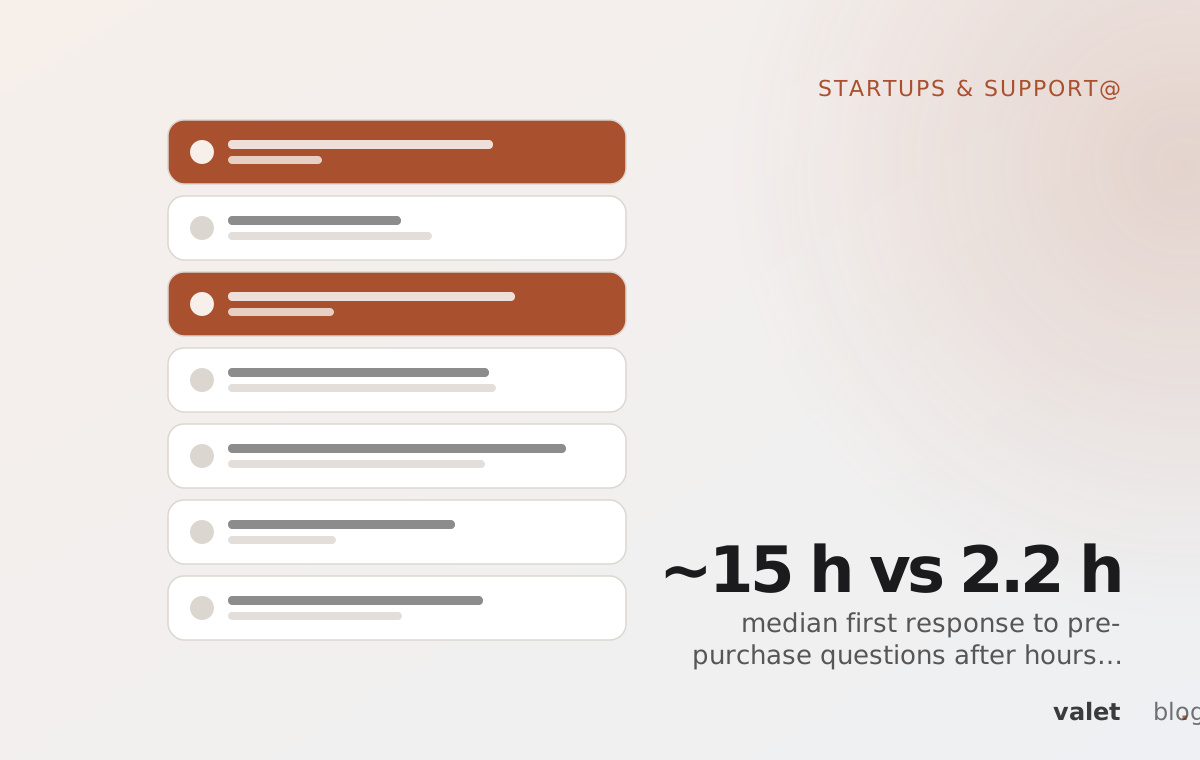
A 3-person SaaS does not need 24/7 humans. It needs three rules. Answer at any hour only what a written facts sheet covers. Give everyone else a specific reply time in their own time zone, and keep it. Never let software decide refunds, discounts, account deletion, security claims, outage causes or contract terms overnight. In Gorgias store data (July 2026), after-hours pre-purchase questions waited a median of about 15 hours, against 2.2 hours in business hours.
~15 h vs 2.2 h
median first response to pre-purchase questions after hours vs in hours
Gorgias Ecom Lab platform data, July 2026
30%
of AI-to-human hand-offs by email were abandoned, after a 32-hour resolution time
Gorgias Ecom Lab, Oct 2025 to Apr 2026
72%
of 1,006 consumers are open to AI if they can escalate to a human
Five9, March 2025
A 3-person SaaS does not need people awake all night. It needs three rules. First, answer at any hour only what a written facts sheet covers. Second, give every other customer a specific reply time in their own time zone, and keep it. Third, never let software decide refunds, discounts, account deletion, security claims, outage causes or contract terms while you sleep. The gap these rules close is measurable. In Gorgias e-commerce platform data from July 2026, pre-purchase questions asked after hours waited a median of about 15 hours for a first response, against 2.2 hours in business hours1. Those are store numbers, but the shape applies to any team that sleeps.
What should a small SaaS automate at 3 a.m.?#
The usual answer to "how do we cover nights" offers two respectable options and one cheap one. A team can hire or contract people in other zones. It can deploy a bot that answers everything around the clock. Or it can put an auto-reply on support@ and catch up in the morning. Each option looks reasonable, and each puts the cost in a different place.
The problem usually arrives with the first distant customer, not with growth. A founder's r/indiehackers thread titled "International expansion almost killed my startup" (10+ comments, late 2025) describes month three as "The Support Disaster" and opens with "Customer in Japan has problem at 3am". In that telling, the founder did not choose a support strategy; a customer in another time zone forced the question.
Why "24/7 coverage" looks like the only professional answer#
The case for round-the-clock answers is strong, and the people who make it are responding to real data. Customers do not wait politely. In a Management Science study of more than 11 million Fiverr transactions, as reported by Entrepreneur in July 2026, a one-hour response delay cut hiring odds by 46%, and a delay of 24 hours or more cut them by 90%7. That is a freelance marketplace rather than SaaS support, but the direction is hard to ignore. Gorgias reports that brands automating close to zero percent of tickets average 736-minute response times2.
Founders also report that customers accept the bot when it is quick. One Hacker News commenter wrote in June 2026 that most of their customers "prefer AI (per their feedback…) since they can get quick responses 24/7 rather than wait"5. Given that evidence, a 24/7 bot looks like the obvious move for a team with no night shift. An auto-reply looks like the honest minimum: "issue is received and we will be back in 24 hours", as one lone founder described theirs in r/shopifymerchantgrowth (August 2026).
The cracked assumption: the 3 a.m. customer needs a resolution at 3 a.m.#
The 24/7 argument assumes the overnight customer needs the problem solved before morning. Most do not. Most overnight emails need one of two things. Some need a fact the team already wrote down: a plan limit, a setting, an invoice copy. The rest need a time they can plan around. A customer in Tokyo who learns that the founder will reply by a stated hour on their afternoon can carry on with their day. A customer who gets "we'll be back in 24 hours" cannot, because 24 hours is a window, not a promise.
The bot-for-everything option fails for the opposite reason. It answers questions that should wait. One commenter in r/AI_Agents (40+ comments, mid-2026) put the trade in one line: "one hallucinated refund or commitment at 2am costs you the customer." In April 2025, Cursor's support bot told a user that one device per subscription was "a core security feature". No such policy existed, and users posted cancellations before the company corrected it6.
The alternative mechanism is simple. Overnight support works when the reply contains either a fact from your sheet or a specific human reply time in the customer's zone; it fails when it contains a guess, a decision, or a vague window. The second-order effect matters too. A reply time turns overnight waiting from an open-ended worry into a scheduled event, and that changes how the delay feels.
What does the evidence say about overnight hand-offs?#
Three lines of evidence support the "fact or time" model over both the auto-reply and the bot-for-everything. The weakest comes first.
Customers notice time zones#
Time-zone distance is a buying factor for some customers, not just a support detail. An r/devops thread, "Is support in the same time zone important to you?" (20+ comments, 2025), asked: "Have you ever dropped (or avoided) a tool because the vendor was on the 'wrong' side of the world for your team?" The top answer began "Yes". Forum threads are a self-selected sample, so read this as a signal, not a rate.
Customers accept AI when a person stays reachable#
In Five9's March 2025 survey of 1,006 consumers in the US, UK and Canada, 72% said they are open to AI interactions "provided they can escalate to a human when needed", and 40% said they would stop doing business with a company after one bad experience4. Klarna's CEO, explaining a return to human support in May 2025, said "it's so critical that you are clear to your customer that there will be always a human if you want"8. A stated reply time is the cheapest way to make that promise visible at 3 a.m.
Hand-offs without an owner fail, and email fails often#
The strongest evidence is what happens to hand-offs. In Gorgias platform data from October 2025 to April 2026, 55% of AI-touched tickets ended in a human hand-off. The median wait after hand-off was 10 hours, the 90th percentile 71 hours, and one-third of handed-off tickets never got a human reply. By channel, email hand-offs took 32 hours to resolve and 30% were abandoned3. An overnight bot that hands off to nobody in particular is not coverage. It shifts the overnight problem to an unowned queue.
The 3 a.m. rules: automate, promise, or never decide#
The 3 a.m. rules sort every overnight email into one of three lanes. The table is the policy. Write your own entries before you switch anything on.
| Lane | What goes here | What the customer receives at 3 a.m. |
|---|---|---|
| 1. Answer now | Anything on the facts sheet word for word: plan limits, pricing page facts, how-to steps with a doc, invoice copies, password-reset steps, status page link | The answer, in full, plus the reply time for anything else they asked |
| 2. Promise a time | Bugs, setup help that needs a look at their account, pre-sales questions the sheet does not cover, trial blockers | "A person will reply by [time] [their zone]." Plus any safe fact that helps meanwhile |
| 3. Never decided overnight | Refunds or credits outside written policy; discounts or custom pricing; account or data deletion; security or compliance claims not already published; outage cause or fix time; contract, invoice or tax terms | A reply time, and the status page link for outages. No yes, no no, no estimate |
Reply-time promise (paste into lane 2 and 3 replies):

Thanks for writing. [Name], one of the founders, will reply by
[HH:MM] [customer's time zone] on [day]. That is [HH:MM] where we are.
[If lane 1 facts apply: Meanwhile, here is what we can confirm now: ...]
[If outage: Live status is at [status page URL]; we post updates there first.]

This reply was written by our AI assistant. A person reads every
message that needs a decision.
Three operating notes make the table work. Set the promised time from your real morning, not your hopeful one, and add a buffer. If founders live in two zones, split the queue by waking hours, not by topic, and hand over open threads with their promised times. Count missed promises weekly. A promise kept 9 times in 10 builds trust. One broken every day undoes the policy. The support@ runbook for solo and 3-person teams covers the weekly review.
What does the overnight gap cost a small SaaS?#
The overnight gap costs the most on pre-sales and trial-blocking email, because those are the threads that close or go cold. Nobody has published the overnight share for seed-stage SaaS, so the arithmetic below runs on stated assumptions.
Illustration A SaaS receives 500 inbound emails a month, and 30% arrive outside the founders' working hours: 150 threads. Assume 10% of those are pre-sales or trial-blocking: 15 a month. At a $2,000 annual contract value and a 20% close rate, those 15 threads are worth about $6,000 a month in expected contracts. If a 12-hour wait loses a quarter of them, the cost is about $1,500 a month, or roughly $18,000 a year. Every input is an assumption. Replace them with your own.
To get your own inputs, chart reply time by hour of arrival. Export 90 days of support@ with the timestamp of each inbound email and of the first reply. Group by hour of arrival in UTC, take the median wait for each hour, and mark which threads were pre-sales or trial blockers. If overnight email is your problem, the chart shows it as a flat line through your working day and a cliff for everything that lands after it. Valet could publish an aggregate of this chart from many audited inboxes; that dataset does not exist yet. The Lost Lead Audit uses the same export for sales inquiries.
Where the 24/7 consensus still wins, and where this argument would be wrong#
The 24/7 consensus still wins in three places. Customers with contracts that set response times need staffed or contracted coverage, and the contract decides, not this page. Products where downtime stops the customer's own business, such as payments or infrastructure, need a human on call for incidents, whatever the size of the team. And at high volume, a person in another zone becomes cheaper than the morning backlog.
This argument would be wrong if your own hour-by-hour chart showed overnight customers churning even when every reply carried a kept promise. It would also be wrong if lane 1 is too thin to matter: if the facts sheet answers almost nothing, the night becomes a list of promises, and a part-time contractor in another zone may be the better buy. Monday-morning decision: write lane 3 first. Deciding what the bot must never decide is the cheapest protection a small team can buy.
For weekends and holidays, the same rules apply with longer promised times; see who answers your inquiries when you're away. For the hand-off itself, see what "never stuck with a bot" has to mean.
Where Valet fits#
Valet runs the 3 a.m. rules on email. You forward support@ to a private Valet address; replies go out from support@ once your domain is verified. Valet answers at any hour only from your own facts and never invents a price, discount or policy. Each topic is set to Autopilot, Ask me first or Always you. Money, complaints, contracts and anything not on your list go to you with one-tap replies, and the customer is told when you will reply. Every reply says it is AI and comes with a Valet receipt, so in the morning you can see what was answered and why. To see what your overnight inbox looks like now, start with the free lead check: forward 10 to 20 recent emails and see what went unanswered.
Questions people ask
How do you provide 24/7 customer support with a small team?
Answer routine questions from a written facts sheet at any hour, and give every other customer a specific time a person will reply, stated in their time zone. Split the queue by waking hours if founders live in different zones. Keep money, security and outage decisions for humans.
Is an after-hours auto-reply enough for a startup?
A generic 'we'll be back in 24 hours' auto-reply answers nothing and promises a window, not a time. It is better than silence, but a reply that answers the routine question, or names the hour a person will reply in the customer's zone, does more for the same cost.
What should a support bot never decide overnight?
Refunds or credits outside written policy, discounts, account or data deletion, security and compliance claims, the cause or fix time of an outage, and contract or invoice terms. Each of these should wait for a person, with the customer told when.
Do customers care if support is in their time zone?
Some do. An r/devops thread (20+ comments) asked whether people had dropped a tool because the vendor was on the wrong side of the world, and the top answer began 'Yes'. A clear reply time reduces the cost of the gap.
Sources
Confidence: H primary source checked · M credible secondary or reported · L vendor claim or single report. Reddit and forum items are quoted from public threads and summarised, not endorsed.
- Your team is sleeping on 53% of shopper questions · Gorgias Ecom Lab · 2026-07 H
- Customer service benchmarks · Gorgias · 2026-05-15 H
- The cheapest ticket is the one a human never touches · Gorgias Ecom Lab · 2026 H
- New Five9 Research Reveals Balancing AI with Human Connection is Key to Winning Customer Experience · Five9 · 2025-03-13 H
- Hacker News discussion thread, item 48540126 (Salesforce and Fin) · Hacker News · 2026-06 H
- Cursor AI support bot invents fake policy and triggers user uproar · Ars Technica · 2025-04-17 H
- Companies are tracking response time delays for freelance jobs · Entrepreneur (reporting a Management Science study) · 2026-07-16 M
- Klarna changes its AI tune and again recruits humans for customer service · Customer Experience Dive · 2025-05-09 H
How to cite this page
Cite this page
Valet, "Overnight and cross-time-zone support for a 3-person SaaS: what to automate at 3 a.m., what to promise, what never to let the bot decide", valet.team, October 2026.
Keep reading
 Startups & support@Should a startup use AI for customer support? What founders who lost customers say, and the three missing controlsCustomers accept AI support when they can reach a person. The failures that cost startups customers trace to three missing controls, not to the model.Data desk · 11 min · 1 October 2026
 Startups & support@How to handle support@ as a solo or 3-person SaaS founder (without hiring, and without a bot that traps people)Sort support@ into four categories, give each a written promise and an automation level, and check the handoffs every week. Here is the runbook, plus the six ways it breaks.Playbooks · 12 min · 1 October 2026
 Startups & support@An AI agent that answers vs one that finishes the job: what "acts" means for a small business, and the four controls that make it safeMost AI tools sold to small businesses answer the first message and stop. This piece defines what it means for an agent to finish the job, traces where answer-only tools lose the inquiry, and sets out the four controls that make acting safe.Technical desk · 11 min · 1 October 2026