
After the first reply
One hour late = 46% fewer hires: what the Fiverr / Management Science study means off-platform
The headline number comes from a marketplace with a visible response-time badge and buyers comparing sellers side by side. Here is what carries over to a consultant's Gmail or a photographer's contact form, what doesn't, and how to measure your own reply times.
Short answer
Yes, response time matters, and the 2026 evidence is large. Entrepreneur's July 2026 report on a Management Science study of 11 million Fiverr transactions says a one-hour delay cut hiring chances by 46% on average, and replying after 24 hours or more made a freelancer 90% less likely to win than an immediate reply. The study covers one marketplace and was read here only through press coverage, so treat the size as directional for email and form inquiries.
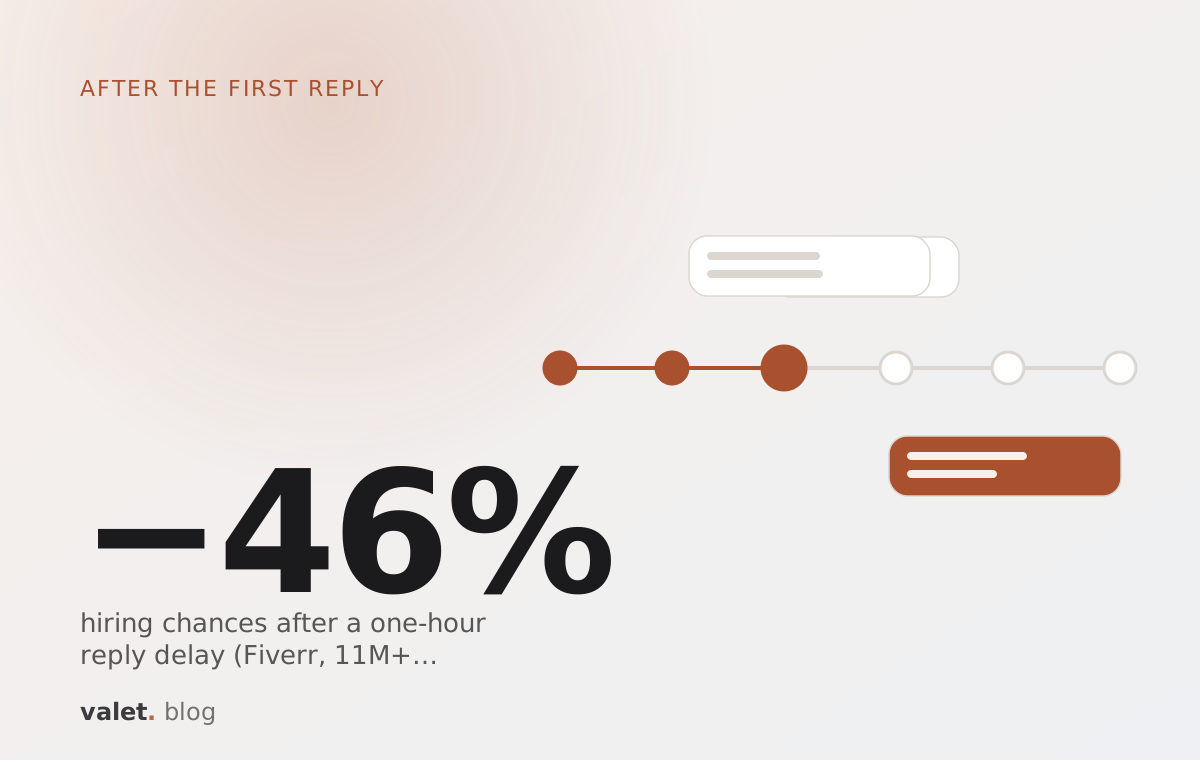
−46%
hiring chances after a one-hour reply delay (Fiverr, 11M+ transactions)
Management Science via Entrepreneur, 16 Jul 2026
−90%
likelihood of winning the job when the reply took 24 hours or more, vs immediate
Management Science via Entrepreneur, 16 Jul 2026
39 min vs 8 h 17 m
median vs average reply time to online property inquiries
DelPrete secret shop, 100+ shops, Aug 2024
The headline number is 46%. A Management Science study of more than 11 million Fiverr transactions, reported by Entrepreneur on 16 July 2026, found that a one-hour delay in replying cut a freelancer's chances of being hired by 46% on average1. At 24 hours or more, the freelancer was 90% less likely to win the job than a competitor who replied immediately1.
The usable number for an off-platform business is harder to state. Fiverr shows buyers a response-time badge and puts competing sellers on one screen. A consultant's Gmail, a venue's contact form and a photographer's listing emails have neither. This piece separates what the study measured from what it implies, slices it against five other datasets with their denominators, and ends with a worksheet for measuring your own reply times.
What did the Fiverr response-time study find?#
The Fiverr response-time study, as reported, has two parts with two different denominators. Each answers a different question.
| Part | Denominator | Reported finding |
|---|---|---|
| Observational | 11 million+ Fiverr transactions | One-hour delay: hiring chances down 46% on average. 24 hours or more: 90% less likely to win than immediate repliers. |
| Observational | Same data | An average freelancer taking three hours or more to reply was hurt as much as if their past-job ratings were 20% lower. |
| Experiment | 8,600+ participants choosing between hypothetical sellers | Participants picked "a caterer with a low-quality rating of 4.25 stars, provided that the person responded quickly" over higher-rated slow responders. |
Source: Entrepreneur's coverage1. The paper itself was not read for this article; the coverage does not name its authors.
Three wording details matter before anyone repeats the figure. The 46% is a fall in hiring chances, not a fall in revenue. The 90% is relative to competitors who replied immediately, not relative to a one-hour reply. And the coverage phrases the one-hour finding once as "when recruiters delayed their response," then describes freelancers' delays everywhere else1. The paper should settle which side's delay the 46% measures. Until it is read, quote the number as Entrepreneur's reporting of the paper.
Why the 46% is not your number#
The 46% describes a marketplace, and marketplaces change the base rate of comparison. On Fiverr, a buyer can see several sellers at once, see how fast each one typically answers, and message three of them in a minute. Delay is visible, and the alternative is one click away.
Off-platform, the comparison is still there but hidden. A couple sends the same inquiry to several vendors; WeddingPro reports couples reach out to 5 vendors per category on average3. A homeowner asks three plumbers. A founder emails two consultants. The customer still ranks replies by arrival, but nobody shows a badge, and the business never learns it lost on speed.
That difference cuts both ways. The penalty per hour may be smaller off-platform, because customers are not staring at a ranked list. Or it may be larger, because an off-platform business has no badge to earn trust before the first reply arrives. Neither direction has been measured for email and form inquiries. What has been measured is how slow those replies usually are.
How fast do businesses actually reply, by channel?#
Reply-time data for small businesses exists in five recent datasets. Each comes from a different channel, sample and year, and none is the same population as Fiverr.
| Dataset | Denominator | Speed finding | What it does not show |
|---|---|---|---|
| Management Science, Fiverr1 | 11M+ transactions; 8,600+ experiment participants | 1 h delay: −46% hiring chances. 24 h+: −90% vs immediate. | Off-platform effect; paper not read directly |
| Thumbtack Pro Summit, Nov 20252 | Thumbtack platform data (size not stated) | Replying within 30 min: "25% more likely to get hired" than within 3 h | Sample size; effect beyond 3 h |
| WeddingPro, "From Hello to Hired"3 | The Knot / WeddingWire platform data (size not stated) | Reply in under 3 h: couples 2.2× more likely to reply | Bookings (measures replies, not hires); date undated |
| Leadferno, Jun 20244 | 225 small-business website contact forms, tracked 3 weeks | 42.6% got no response; first human reply averaged 17 h 49 m | Median; outcome of the inquiry |
| DelPrete, Aug 20245 | 100+ secret shops, 25+ real-estate brokerages | 47% unanswered; average 8 h 17 m, median 39 min | Small-business services outside real estate |
| Jobber, 20266 | 1,050 US home-service owners (survey) | 20% of pros say they reply within the hour; over 70% of owners say customers expect same-day | Measured reply times (self-reported) |
Read across rows for direction, not for a single effect size. Only Fiverr and Thumbtack measure hiring; WeddingPro measures replies; Leadferno, DelPrete and Jobber measure speed without outcomes.
Two patterns survive the change of population. First, every dataset that links speed to an outcome points the same way: faster replies win more. Second, the businesses measured off-platform are slow. Leadferno's average first human reply of 17 hours 49 minutes4 sits closer to Fiverr's 24-hour penalty zone than to its one-hour zone.
Why the median and the average disagree#
DelPrete's real-estate shop is the clearest case of an average hiding a split. The median reply came in 39 minutes; the average was 8 hours 17 minutes5. That gap means most inquiries were answered fast and a long tail waited many hours, on top of the 47% that were never answered at all5.
The tail is where the Fiverr curve bites. A business with a fast median and a slow p90 loses the inquiries that arrive at 9 p.m., on Saturdays, or during a job. Leadferno reported an average without a median4, so its distribution is unknown. Your own inbox can tell you both.
What else could explain the speed effect?#
Speed correlates with several things that also win work, and observational data cannot fully separate them. Four confounding variables deserve a name.
- Availability. A freelancer who replies in ten minutes may simply have capacity. Buyers may be choosing open calendars, with speed as the visible proxy.
- Platform ranking. A marketplace may use responsiveness when it decides which sellers to show. If faster sellers are also shown more prominently, part of the measured effect is placement, not the buyer's preference.
- Seller quality. Organised sellers reply fast and also write better proposals. The ratings comparison in the coverage controls for some of this1, but ratings are a coarse measure.
- Buyer urgency. Urgent buyers hire whoever answers first; patient buyers wait. The penalty may be concentrated in urgent jobs.
The 8,600-person experiment addresses the second and third problems, because participants chose between hypothetical sellers with assigned ratings and assigned speeds1. It does not address stated versus real behaviour: choosing a caterer in a survey costs nothing.
Owner reports add a fifth caution. Speed is necessary, not sufficient. In an r/Thumbtack thread titled "Is thumbtack for pros a scam" (60+ comments), one pro describes "responding to 49 leads (all within minutes…)" and still questions the return. In r/WeddingPhotography, a thread asking "Has writing back to leads ASAP made a significant difference?" (40+ comments, about a year old) includes the reply that "It takes about two minutes to respond to an inquiry," with commenters split on how much speed alone decides a booking. A fast reply that does not answer the question, or never follows up, still loses.
How to measure your own reply time (p50, p90, and the 24-hour share)#
Your own reply-time distribution is the only number that applies to your business. Three figures describe it well enough to act on, and an afternoon with your sent folder will produce them.
- Pull 30–50 recent inquiries. Use every channel that lands in email: contact form notifications, direct emails, listing and marketplace lead emails. Note the received time of each.
- Record the first real reply time. Count only a reply a person or system sent that answers the question. An auto-acknowledgement does not count; Leadferno found 15.6% of forms sent one4.
- Mark the never-answered ones. Keep them in the denominator. Leaving them out is selection bias, and it flatters every average.
- Compute three numbers. The median (p50) reply time, the 90th-percentile (p90) reply time, and the share answered after 24 hours or never.
- Split by arrival time. Repeat the three numbers for inquiries that arrived outside your working hours. The split usually explains the tail.
Read the result against the cohort table. A p50 under an hour with a p90 of two days is DelPrete's shape5: fast most of the time, absent when it matters. A 24-hour-or-never share above a third puts a large slice of your inquiries in the zone where the Fiverr coverage reports a 90% penalty1, if anything like that curve applies off-platform.
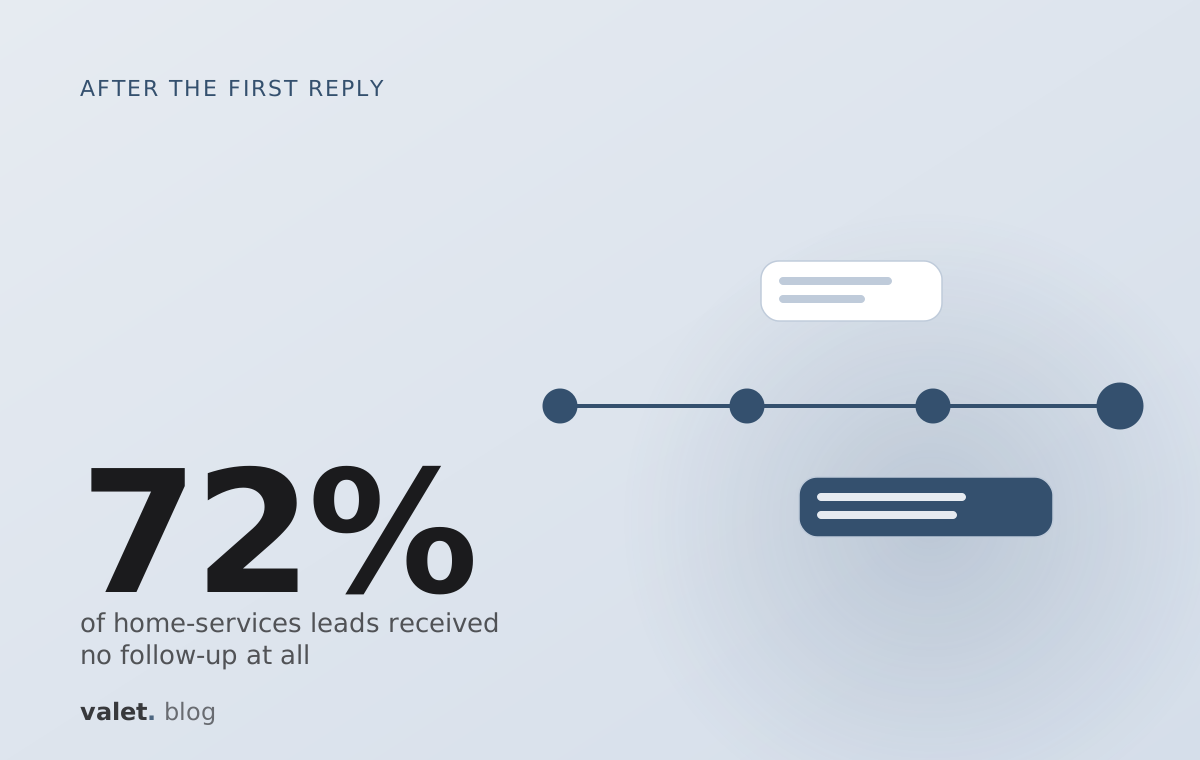
First reply is half the measurement. Speed to the first answer is one number. Whether anyone wrote again is the other. In Pied Piper's 2026 mystery shop of 3,211 home-services inquiries, 72% got no follow-up at all7. A fast first reply followed by silence is still a lost inquiry, which is the subject of why the first reply is free and follow-up is where leads die.
What would change this conclusion?#
The conclusion here is narrow: off-platform businesses are slow enough that a Fiverr-shaped penalty, at any fraction of its reported size, would cost them work. Three findings would weaken it.
- The paper says something different from the coverage. If the 46% turns out to measure buyer delays, or a narrow job category, the headline should be retired. The coverage states the preference "applies across all job categories on the platform"1; the paper should confirm it.
- Off-platform data shows a flat curve. If a measured sample of email and form inquiries showed similar booking rates at one hour and at one day, the marketplace effect would not travel. No such dataset has been published.
- The effect is mostly placement. If platform ranking explains most of the gap, the off-platform penalty would be smaller, because there is no ranking to lose.
Until one of those appears, the decision consequence is modest and cheap: measure your p90 and your 24-hour share, and shorten the tail before you work on the median. For where older, widely quoted speed statistics came from, see lead-response statistics, traced; for checking your forms and inbox end to end, see the Lost Lead Audit.
How we got this: the Fiverr figures come from Entrepreneur's 16 July 2026 article, re-read on 1 October 2026; the Management Science paper itself was not available to us. Other rows come from the primary pages listed in the sources, with sample sizes as each publisher states them. No Valet data is used in this article.
Where Valet fits#
Valet answers email, website-form and listing inquiries from the owner's own price list, packages, calendar and policies, offers real times from the calendar, and holds them. Anything not on the list, and anything about money, complaints or contracts, waits for the owner, and the customer is told when the owner will reply. Every inquiry moves through the Valet Inquiry States, and every reply comes with a time-stamped Valet receipt showing what was asked, the rule used and the sources used. That makes the time to first answer measurable per inquiry. Valet has not published this figure; it is something Valet could measure from free lead checks, with owners' consent.
To see your own p50, p90 and 24-hour share without the spreadsheet, the free lead check takes 10–20 recent inquiries and shows what went unanswered, what stopped after one reply, and what it was worth.
Questions people ask
Does response time matter for freelancers?
Yes. Entrepreneur's July 2026 coverage of a Management Science study of over 11 million Fiverr transactions reports that a one-hour delay cut hiring chances by 46% on average and a 24-hour-plus delay made a freelancer 90% less likely to win than an immediate reply.
What is the Fiverr response time study?
It is a Management Science paper, reported by Entrepreneur on 16 July 2026, that analysed more than 11 million Fiverr transactions and ran a follow-up experiment with over 8,600 participants choosing between hypothetical freelancers. The coverage does not name the authors.
Is response time more important than reviews?
On Fiverr, the coverage reports that freelancers taking three hours or more to reply were hurt as much as if their ratings were 20% lower, and that experiment participants chose a 4.25-star caterer who replied quickly over higher-rated slow responders. That is one platform; off-platform the trade-off has not been measured.
How fast should a consultant reply to an inquiry?
Within the hour where you can, and never the next day by default. Thumbtack reports pros replying within 30 minutes are 25% more likely to be hired than those replying within three hours, and the Fiverr study puts a 24-hour-plus delay at 90% less likely to win.
Does the Fiverr finding apply to email inquiries?
Partly. The direction (slower replies lose more work) matches every other 2024 to 2026 dataset we checked, but Fiverr shows buyers a response-time badge and competing sellers on one screen. Email and form inquiries have neither, so the size of the effect off-platform is unmeasured.
Sources
Confidence: H primary source checked · M credible secondary or reported · L vendor claim or single report. Reddit and forum items are quoted from public threads and summarised, not endorsed.
- Think Your Skills Will Get You Hired? Companies Are Tracking This Hidden Metric Too (Management Science study of Fiverr) · Entrepreneur (Sherin Shibu) · 2026-07-16 M
- 3 takeaways from the 2025 Pro Summit · Thumbtack · 2025-11-06 H
- From Hello to Hired: your guide to lead replies · WeddingPro · undated H
- Research: Website contact forms and lead management, uncovering costly mistakes · Leadferno · 2024-06-28 H
- Secret shopping: 47% of online property inquiries are ignored · Mike DelPrete · 2024-08 H
- 2026 Home Service Trends Report (1,050 US owners) · Jobber · 2026 H
- Precision Garage Door Ranked #1 in Customer Lead Handling Effectiveness Home Services Study (Pied Piper PSI 2026) · Pied Piper Management Company via BusinessWire · 2026-04-12 H
How to cite this page
Cite this page
Valet, "One hour late = 46% fewer hires: what the Fiverr / Management Science study means off-platform", valet.team, October 2026.
Keep reading
 After the first replyThe first reply is now free. The follow-up is where 72% of leads die.Meta, Google and the inquiry tools now answer the first message for you. The money is lost in the days after it, and almost nobody sells that part.From the Valet team · 11 min · 1 October 2026
 After the first replyHow many times should you follow up with a lead before you stop?A written standard for following up on inbound inquiries: what counts as a follow-up, what each nudge must contain, when the sequence must stop, and how to close a lead with a reason instead of letting it fade.Policy desk · 11 min · 1 October 2026
 After the first replyWhy leads go silent after you send a quote (and what it actually means)Silence after a quote is usually read as a verdict on price. The base rates say it is more often an unfinished conversation, and the thread itself carries signals that tell you which kind you have.Trends desk · 9 min · 1 October 2026