
After the first reply
How to revive old leads: re-engaging inquiries that went quiet 30, 60 or 90 days ago
An inbox full of quiet inquiries is mostly a record of messages nobody sent. A revival pass sorts the backlog by what actually decides whether a lead is live, reopens each one in its original thread, and closes the rest with a reason.
Short answer
It is usually not too late. Most quiet inquiries never got a second message: Pied Piper's 2026 mystery shop of 3,211 home-services locations found 72% of leads received no follow-up at all. Sort the backlog by who wrote last and whether the customer's date has passed, not by age alone. Reply inside the original thread with one thing that changed, such as a new date or the season, and an easy way to say no. Close the rest with a reason.
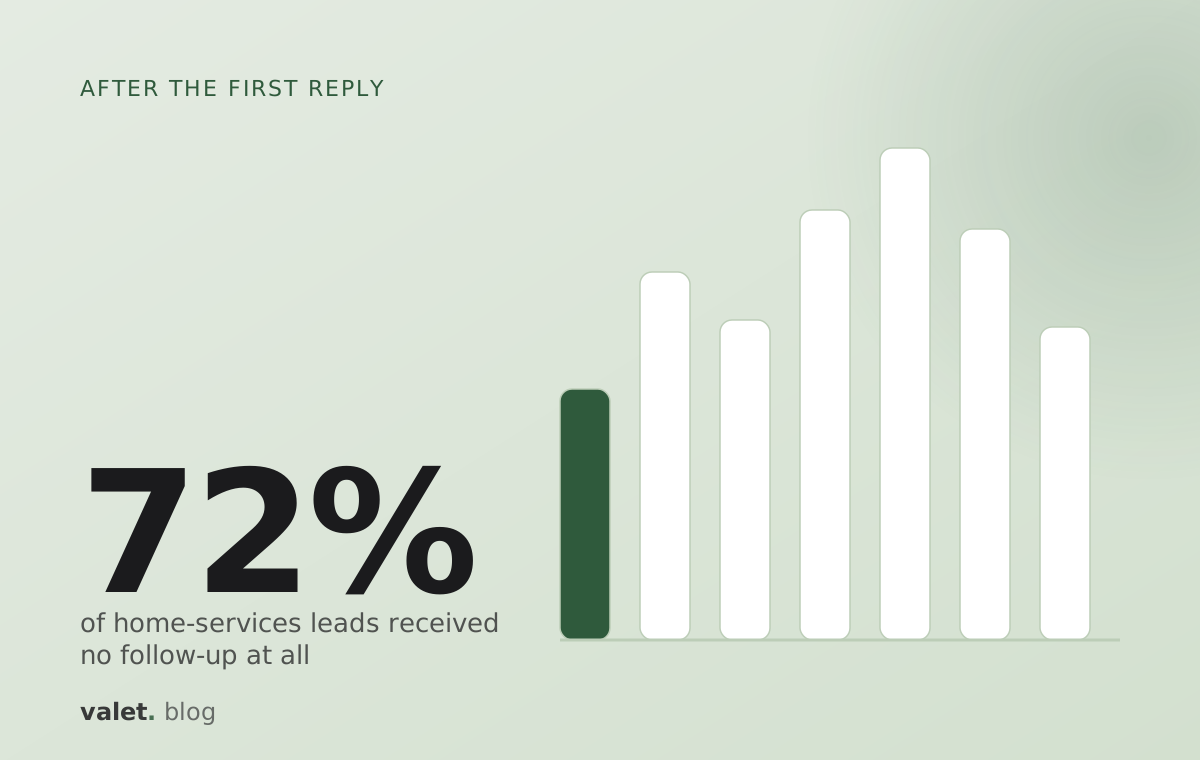
72%
of home-services leads received no follow-up at all
Pied Piper PSI, 3,211 locations, Apr 2026
42.6%
of small-business contact-form leads got no response
Leadferno, 225 forms, Jun 2024
10
business days to honour an opt-out on commercial email
FTC CAN-SPAM compliance guide, Jan 2024
It is usually not too late to follow up with an old lead, because most quiet leads were never followed up in the first place. Pied Piper's 2026 mystery shop of 3,211 home-services locations found 72% of leads received no follow-up at all1. A backlog of quiet inquiries is mostly a record of second messages nobody sent. Sort it by who wrote last and whether the customer's date has passed, not by age alone. Reply inside the original thread with one thing that changed and an easy way to say no. Close everything else with a reason.
Is it too late to follow up with an old lead?#
An old lead is too late only when the thing the customer wanted no longer exists: the date passed, the job got done, or they told you they chose someone else. Thread age is a weak proxy for any of those. A 90-day-old inquiry about a wedding next June is live. A 30-day-old inquiry about a leak that needed fixing that week is not.
The base rates say most backlogs are made of unfinished threads, not refusals. Leadferno's 2024 test of 225 small-business contact forms found 42.6% got no response at all, and reported that most businesses that did respond made only one attempt2. In those threads the customer never received a second message to answer or ignore. Their silence is a measurement of the seller's behaviour as much as the buyer's.
Practitioners already schedule a long-tail touch. The "2-2-2 rule" shared in the Jobber Community in August 2026 ends with a "seasonal check-in" at two months3. Belkins' 2026 study of 7.53 million B2B emails found that step 3 of a sequence produced 35.6% of email-sourced meetings4; that is outbound B2B data, so treat it as directional, but it is consistent with late messages carrying weight.
What is in your backlog? Pull the data before you write#
A revival pass starts with a table, not a message. Each quiet inquiry needs six fields before you can decide what to send, and all six are recoverable from the thread itself.
| Field | Where to find it | Why it matters |
|---|---|---|
| First message date | Top of the thread | Sets the age bucket (30, 60, 90 days) |
| Last message date and last sender | Bottom of the thread | If the customer wrote last, you owe them an answer, not a revival |
| Customer's date or deadline | Their first message | The single strongest signal of whether the lead is live |
| What you offered | Your replies | A quote, a time, a hold; each may have expired |
| Quote validity | Your quote | An expired quote must be re-checked before it is re-sent |
| Any stated reason | Anywhere in the thread | "Getting a few quotes", "after the holidays", "budget" |
In Gmail, older_than:30d newer_than:90d narrows a search to threads in a window, and adding the address inquiries arrive at (for example deliveredto:[email protected]) or your form's notification sender isolates inquiries from the rest of the inbox. The Lost Lead Audit has the full search recipe and a sheet with these columns.
Why thread age is the misleading signal#
The 30/60/90-day framing is the obvious way to slice a backlog, and on its own it misroutes leads. Age measures the seller's delay. Liveness depends on the customer's calendar. Two failure cases show up in almost every backlog.
The first is a recent thread whose date has already passed. Writing "are you still looking?" to someone whose event was last Saturday is worse than silence. The second is an old thread with a live date, often a large job planned far ahead, which gets written off because it "went cold" months ago. The second case is where revival pays.
A related failure runs the other way. A thread in r/smallbusiness titled "What would you do? Client ghosted after quote, popped…" (150+ comments, about two years old) concerns a client who went quiet after a quote and later reappeared. A reply visible in search results points out that "it's been 3 weeks since you've sent the quote" and that "there is no longer room on the calendar". Revival is not only about reaching out. It is about checking what you can still honour before you do.
Three revival approaches that fail#
Three approaches to old leads are common, and each fails in a predictable way.
Failure 1: a newsletter blast to every old inquiry#
A bulk promotional email to every past inquiry discards the one asset an old lead has, which is the context of what they asked. It arrives as a new, unthreaded message from a marketing tool, often from a different sending domain. If that domain is not aligned with your own under SPF, DKIM and DMARC, receiving servers have less reason to trust it. It is also clearly commercial, which brings opt-out obligations (see below), and Apollo reports that Google treats a spam-complaint rate of 0.1% as a threshold for senders7. One annoyed recipient in a small list is a large percentage.
Failure 2: one identical "still interested?" to everyone#
An identical message ignores the six fields above. It reaches customers whose date has passed, customers who told you they booked elsewhere, and customers who wrote last and never got an answer. Each of those sees evidence that nobody read their thread.
Failure 3: re-sending the old quote unchanged#
An old quote can be wrong in two directions. Prices may have changed, and the calendar may have filled, which is the situation in the r/smallbusiness thread above. Re-sending it unchecked creates a commitment you may not be able to keep.
Root cause: email has no state#
The underlying fault is at the protocol layer. An email thread is a sequence of messages and nothing more; there is no field for "quote sent, awaiting reply" or "lost: chose another provider". RFC 5322, the Internet Message Format standard published in October 2008, defines the In-Reply-To: and References: headers "used when creating a reply to a message", and notes that the References field "may be used to identify a 'thread' of conversation"5. That is the whole of email's memory: a chain of message IDs. Whether the thread is open, waiting on you, or finished lives only in the owner's head.
Two consequences follow. First, any backlog is a set of threads with unknown state, which is why the pull-the-data step above is unavoidable. Second, the one piece of state email does carry, the thread itself, is worth preserving. Replying inside the original thread keeps those headers intact, so the customer's mail client shows their own question and your quote above your new message. A fresh message from a different tool throws that away.
The revival pass, step by step#
The revival pass below routes each quiet inquiry by state, sends at most one message per lead, and closes every lead that does not answer. It is designed to be run once a quarter on the last 90 days.
| Condition (check in this order) | Action |
|---|---|
| Customer wrote last | Answer their message now, with a short apology for the delay. This is a late reply, not a revival. |
| Customer declined or said they booked elsewhere | Close as lost with their reason. Send nothing. |
| Customer's date has passed | Close as lost: date passed. Send nothing. |
| Customer named a later date ("after the holidays") | Send message A on or just after that date. |
| Live date, 30–60 days quiet | Re-check price and calendar. Send message A with a real time. |
| Live date, 60–90+ days quiet | Re-check price and calendar. Send message B. |
| No date given, any age | Send message B once. Close on no reply. |
| No reply 10–14 days after any revival message | Close as lost: no reply after revival. Do not send again. |
MESSAGE A (live date, something to offer). Reply in the original thread.
Hi [name], you asked about [job] for [their date]. I still have
[day, date] at [time] open and can hold it for you until [date].
The price is [current price from your list]. Reply "yes" to hold it,
or "no thanks" and I'll close this out.
[Your name], [business]

MESSAGE B (older or no date). Reply in the original thread.
Hi [name], back in [month] you asked about [job]. If it's still on
your list, I have openings from [date] and the current price is
[price from your list]. If you've sorted it already, just say so
and I'll close the file. Either answer helps.
[Your name], [business]

CLOSE-OUT (after a decline, if you reply at all)
Thanks for letting me know, [name]. I've closed this on my side.
If anything changes, reply to this email and it'll come straight to me.
The order of conditions matters. Checking "customer wrote last" first catches the threads that were never answered at all, which in Leadferno's test was 42.6% of form leads2; those people are owed an answer, not a nudge. The remaining rows only apply to threads where you spoke last.
Trade-offs and residual risk#
A revival pass carries three residual risks, and the routing table reduces each without removing it.
- Commercial-email rules. A reply to a fresh inquiry and a promotional message to an old one may be classified differently. The FTC's CAN-SPAM guide (updated January 2024) covers "all commercial messages" and says "You must honor a recipient's opt-out request within 10 business days"6. The "no thanks and I'll close this out" line works as an opt-out path; honour it at once. Canadian senders fall under a different statute, CASL, which this article does not cover. This is not legal advice; check with counsel.
- Annoyance. Some recipients will find any message about a months-old inquiry unwelcome. One message per lead, inside their own thread, with a stated close, keeps the cost to a single email.
- Stale commitments. A time or price in a revival message must be current. Re-check both before sending; never resend an old quote unread.
How to measure a revival pass#
A revival pass is only useful if you count the result with clear denominators. Record, per age bucket: inquiries in the bucket, inquiries routed to a message, replies, bookings, and closes by reason. Report replies and bookings as a share of messages sent, not of the whole bucket, because the routing table deliberately skips leads that should not be written to.
Illustration, not data. A business receiving 15 inquiries a month has about 45 in a 90-day backlog. If 5–10% of those revive and book (an assumption, not a measured rate), that is 2 to 4 bookings. At an average booking near The Knot's 2026 average photographer spend of $3,0008, one pass is worth roughly $6,000 to $12,000. Replace both inputs with your own numbers.
No public dataset reports revival rates for small-business inbound inquiries by age (30, 60 or 90 days silent, to reply, to booking). Valet is collecting those rates by bucket and will publish the method with the numbers. Until then, your own first pass is the best data you have. For the wording of follow-ups on fresher threads, see what to say when a customer doesn't respond to your quote.
Where Valet fits#
Valet addresses the root cause: it gives every inquiry a state, a next step and a time under the Valet Inquiry States (New, Answered, Time held, Followed up, Booked, or closed with a reason), so a backlog of unknown threads does not build up. The Valet follow-up cap sends at most two useful follow-ups by default, then stops and tells the owner why. Valet replies from the owner's own address once the domain is verified, answers only from the owner's price list and calendar, and never reads the rest of the inbox.
To see what is sitting in your own backlog, the free lead check takes 10–20 recent inquiries and shows what went unanswered, what stopped after one reply, and what it was worth.
Questions people ask
Is it too late to follow up with a lead after 30, 60 or 90 days?
Usually not, as long as the customer's date has not passed and you have something new to say. Most quiet leads simply never got a second message; Pied Piper's 2026 mystery shop found 72% of home-services leads received no follow-up at all.
Should I reply in the old email thread or start a new one?
Reply in the original thread. Mail clients use the In-Reply-To and References headers defined in RFC 5322 to group a reply with the earlier messages, so the customer sees their own question and your quote above your new message.
What should a follow-up email to an old lead say?
Name their original request in their terms, say what changed (a date opened, the season arrived, your price list was updated), offer one concrete next step, and include an easy way to say no. Keep it short and send it once per lead.
Do re-engagement emails to old leads need an unsubscribe option?
If a message's primary purpose is commercial, the FTC's CAN-SPAM guide requires honouring opt-outs within 10 business days. A revival message to an old inquiry is more likely to count as commercial than a reply to a fresh one. This is not legal advice; check with counsel.
Sources
Confidence: H primary source checked · M credible secondary or reported · L vendor claim or single report. Reddit and forum items are quoted from public threads and summarised, not endorsed.
- Precision Garage Door Ranked #1 in Customer Lead Handling Effectiveness Home Services Study (Pied Piper PSI 2026) · Pied Piper Management Company via BusinessWire · 2026-04-12 H
- RESEARCH: Website Contact Forms and Lead Management – Uncovering Costly Mistakes · Leadferno · 2024-06-28 H
- Why do clients disappear after asking for a quote? · Jobber Community · 2026-08 M
- Sales follow-up statistics · Belkins · 2026 M
- RFC 5322: Internet Message Format · IETF · 2008-10 H
- CAN-SPAM Act: A Compliance Guide for Business · U.S. Federal Trade Commission · 2024-01 H
- How to improve reply rates through strategic follow-up emails · Apollo · 2026 L
- Average cost of a wedding photographer (Real Weddings Study) · The Knot · 2026 H
How to cite this page
Cite this page
Valet, "How to revive old leads: re-engaging inquiries that went quiet 30, 60 or 90 days ago", valet.team, October 2026.
Keep reading
 After the first replyThe first reply is now free. The follow-up is where 72% of leads die.Meta, Google and the inquiry tools now answer the first message for you. The money is lost in the days after it, and almost nobody sells that part.From the Valet team · 11 min · 1 October 2026
 After the first replyHow many times should you follow up with a lead before you stop?A written standard for following up on inbound inquiries: what counts as a follow-up, what each nudge must contain, when the sequence must stop, and how to close a lead with a reason instead of letting it fade.Policy desk · 11 min · 1 October 2026
 After the first replyWhy leads go silent after you send a quote (and what it actually means)Silence after a quote is usually read as a verdict on price. The base rates say it is more often an unfinished conversation, and the thread itself carries signals that tell you which kind you have.Trends desk · 9 min · 1 October 2026