
After the first reply
When follow-up automation backfires: drip sequences, the fourth email, and spam complaints
A drip sequence keeps sending until its last step. A customer who already said no, booked by phone or asked a real question still gets the next email. What that costs, where Gmail draws the line, and what follow-up with judgement sends instead.
Short answer
Automated follow-up backfires when it ignores what the customer has already done: it emails someone who replied, booked by phone or said no, or sends a fourth reminder with nothing new in it. Apollo (May 2026) calls a fourth cold follow-up 'a net-negative investment' because replies fall while spam complaints rise, and Gmail asks every sender to keep reported spam below 0.3%. Cap follow-ups at two or three, stop on any reply, and close the lead with a reason.
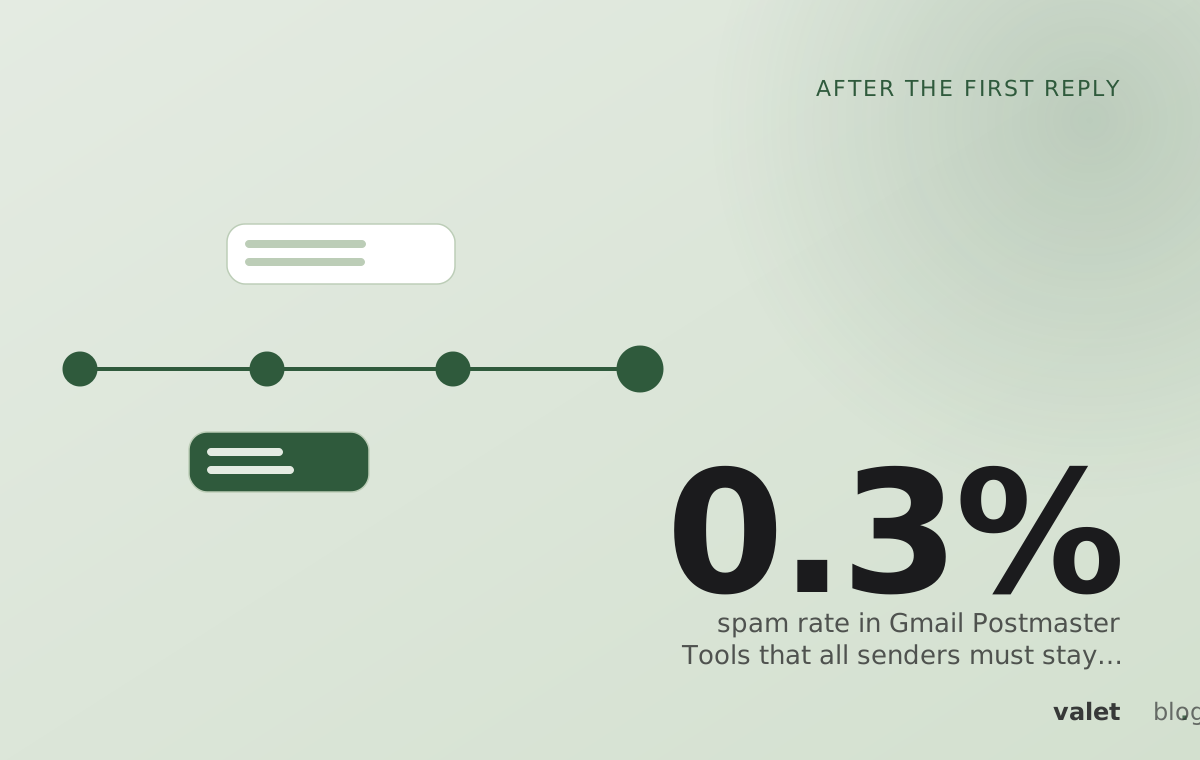
0.3%
spam rate in Gmail Postmaster Tools that all senders must stay below; 0.1% recommended
Google email sender guidelines, checked Oct 2026
58.6%
of replies came from follow-up steps 2–6, so stopping at one email forfeits most replies
Belkins, 7.53M B2B emails, 2026
72%
of home-services leads got no follow-up at all
Pied Piper PSI, 3,211 locations, Apr 2026
Automated follow-up backfires when it ignores what the customer has already done. The sequence emails someone who replied yesterday, booked by phone or said no, or it sends a fourth reminder with nothing new in it. Apollo's May 2026 guide calls a fourth cold follow-up "a net-negative investment: lower reply probability plus higher spam complaint risk"1, and Gmail asks every sender to keep reported spam below 0.3%2.
The answer is not to stop following up. Pied Piper's 2026 mystery shop found 72% of home-services leads got no follow-up at all5, which is the larger failure by far. The answer is follow-up with judgement: two or three messages, each with something new, that stop the moment the customer does anything.
What an over-eager follow-up looks like from the customer's side#
The customer's view of a runaway sequence is on the public record. In r/weddingplanning, a thread titled "Videographer won't leave me alone" drew more than 30 comments (2025). The poster's complaint was not that the vendor followed up. It was the mismatch: "I would understand the follow ups if we ghosted him after our initial call." The couple had answered. The messages kept coming.
On Weddingbee, couples discussing whether to reply to vendors they had not chosen gave each other a practical warning: "If you don't respond, he may keep sending you follow-up emails"8. Silence, in other words, had become a trigger for more email, and customers knew it.
The vendor side of the same pattern appears in r/weddingvideography (2019), where an answer to "How do you handle people who ghosted you?" reads: "I never stop contacting them until they say no." That rule has no exit except the customer's annoyance. A UK Business Forums thread on quote follow-ups shows how old the tension is. One member, in 2006: "I don't really want any pestering or further contact unless I ask for it in any business situation"9.
Why small businesses turn to drip sequences in the first place#
Small businesses adopt drip sequences because forgetting to follow up is expensive and remembering is tedious. Leadferno's 2024 test of 225 small-business contact forms reported that 65.5% of businesses made only one attempt to reach the lead4. Belkins' 2026 study of 7.53 million B2B emails found 58.6% of replies came from follow-up steps two to six, not the first message3. A business that writes once forfeits most of its replies.
So the owner buys a tool, writes five emails and sets them on a timer. In r/smallbusiness, a thread titled "Why don't people automate their email responses?" (30+ comments, 2025) starts from that logic: owners "get the exact same questions every day."
Then setup stalls, or it never quite finishes. In r/gohighlevel, a thread titled "Anyone here using GoHighLevel long-term?" (100+ comments, early 2026) includes a user who "did nothing with it for about six months." Another r/gohighlevel thread, "Conversation AI Agents don't follow up?" (10+ comments, 2025), got a blunt top answer: "Most AI agents won't follow up unless you set a specific step for that." Some tools go the other way and stop after one message: Perfect Venue's help centre says of its First Reply feature that "everything after that is you"7. Either way, a sequence built in a weekend tends to run as built, for months, with nobody reading what it sends.
The failure nobody configures for: the sequence cannot see the reply#
A common drip failure is blindness to replies that arrive somewhere the sequence does not watch. A sequence can stop only on replies it can see. If it watches its own email thread and nothing else, it does not know the customer phoned, wrote to a different address, booked through a marketplace, or told the owner "no thanks" in person.
Each message in that illustration is polite. Together they tell the customer that nobody is reading. The damage lands at the worst moment, after the booking, when the relationship should be at its strongest.
Owners who run a mix of automation and people often build their own check against this. In a Jobber Community thread from about August 2026, one firm described an automation that texts new leads at once, after which "our VA needs to thumbs up the message when they call them back"11. That thumbs-up is a hand-made receipt: proof that a person picked up where the machine stopped.
Handoffs between automation and people fail often enough to plan for. In Pied Piper's 2025 study of dealership service calls, 56% of transfers from AI to a person failed6. Those were phone calls, not emails, but the lesson carries: the moment a machine hands work to a person is where customers get dropped.
The fourth email and the spam complaint threshold#
The fourth unprompted email is where follow-up starts to cost more than it earns. Apollo reports that reply rates "drop with each subsequent follow-up, with the decline accelerating sharply after the third message," and that "beyond three touches, you're not improving your odds — you're damaging your sender reputation"1. Apollo also quotes a Reddit user: "a 4th email starts feeling creepy"1. Apollo's data covers cold outbound sequences. An inbound inquiry, where the customer wrote first, starts with more goodwill. That goodwill runs out faster when the emails stop being useful.
The deliverability side has a hard number. Google's email sender guidelines require every sender to "keep spam rates reported in Postmaster Tools below 0.3%," and recommend staying below 0.10% and never reaching 0.30%2. Apollo's metrics table lists "Keep below 0.1% (Google threshold)"1; Google's own page treats 0.1% as the target and 0.3% as the limit. Senders of more than 5,000 messages a day must also support one-click unsubscribe for marketing and subscribed messages2.
Why a small sender should care. A spam rate is a ratio, so small volumes do not protect you. As a ratio, three spam reports on 1,000 messages is 0.3%. Follow-up emails go out from the same domain as your quotes, invoices and booking confirmations. A sequence that annoys a few people can push the mail that matters toward spam folders.
US law adds a floor that a capped sequence clears easily. The FTC's CAN-SPAM guide says senders of commercial email "must honor a recipient's opt-out request within 10 business days"10. Whether a given follow-up counts as commercial depends on its primary purpose. This is not legal advice; check with counsel. The practical rule is simpler than the law: a "please stop" ends the sequence at once.
Drip sequence vs follow-up with judgement, day by day#
A drip sequence and follow-up with judgement differ less in timing than in what each one checks before sending. The comparison below follows one inquiry through three weeks. Timings follow the common 2-day, 7-day, 14-day pattern; your cap and timings may differ.
| Moment | Typical drip sequence | Follow-up with judgement | What the customer sees |
|---|---|---|---|
| Day 0: inquiry arrives | Template: "Thanks for reaching out, we'll be in touch" | Answers the question from the price list and offers two held times | Drip: a receipt. Judgement: an answer and a choice |
| Before every later step | Checks only for a reply to the drip email | Checks every channel for a reply, a booking, a decline or an expired hold | Drip may email after the customer has booked |
| Day 2 | "Just checking in" | Something new: the hold expires tomorrow, or the one detail needed to quote | Judgement: a reason to reply |
| Day 7 | "Spots are filling up" | The quote's expiry date and an easy way to say no | Judgement: a clear deadline and a clean exit |
| Day 14 | "Last chance" or a discount offer | Only if something changed (a date opened, a question can now be answered); says it is the last message | Drip may offer a discount the owner never approved |
| Day 21 and after | Moves to a monthly newsletter list | Stops. Lead closed with a reason; owner told why | Judgement: silence that was promised |
| Customer asks for a discount or complains | Next step fires on schedule | Sequence pauses; owner gets the message; customer told when the owner will reply | Judgement: a person, on a stated clock |
Day timings are a convention, not a measured optimum. The stop checks in row two are the part to copy.
Two rows carry the difference. Row two, the check before every send, prevents the email after a booking. The last row prevents automation from making money decisions. On r/AI_Agents, a thread titled "Stop building autonomous email agents" (40+ comments, about June 2026) put the risk in one line: "one hallucinated refund or commitment at 2am costs you the customer."
How to fix a follow-up sequence that is already running#
A follow-up sequence that is already running can be repaired in an afternoon. Start by reading what it actually sent last month, not what you remember writing.
- Read the last 30 sends. For each, check whether the customer had already replied, booked or declined anywhere. Count the mismatches.
- Cut to two or three steps. Delete any step whose only content is "checking in." Each remaining step must carry a held time, a missing detail or an expiry.
- Widen the stop conditions. Any reply on any channel, a booking, a decline, an opt-out or an expired quote ends the sequence. If the tool cannot see a channel, pause the sequence when that channel is used.
- Remove automated discounts. Price changes, refunds and complaints go to the owner, every time.
- Close with a reason. When the cap is reached, mark the lead lost with the best available reason instead of moving it to a newsletter list. The reasons are listed in how many times to follow up before you stop.
Nobody has yet published spam-complaint or opt-out rates for inbound small-business follow-up by step number. Valet has not published this figure; it is something Valet could measure from free lead checks, with owners' consent. The Lost Lead Audit will show you your own version sooner.
Where Valet fits#
Valet follows up with judgement by default. The Valet follow-up cap is two follow-ups per inquiry, each with something useful: a held time, a missing detail or a quote expiry. Then Valet stops and tells the owner why, and the inquiry closes with a reason under the Valet Inquiry States. The cap can be changed per topic. Discounts, refunds, complaints and contracts go to the owner with one-tap replies. Every reply has a Valet receipt with a "Pause topic" control.
If you want to see what your current follow-up actually does, the free lead check takes 10–20 recent inquiries and shows what went unanswered, what stopped after one reply, and what it was worth. For the opposite failure, see why the follow-up is where leads die.
Questions people ask
Do automated follow-up emails annoy customers?
They do when they ignore context: a reminder sent after the customer replied, booked another way or said no, or a fourth nudge with nothing new. Customers in public forums describe vendors who keep writing as pestering. Two or three follow-ups that each carry something useful rarely draw that reaction.
Is automated follow-up better than manual follow-up?
Automation is better at remembering to send; a person is better at knowing whether to send. The safest setup automates the timing and the stop rules, and keeps judgement calls such as discounts, complaints and contract questions with the owner.
Can follow-up emails hurt my email deliverability?
Yes, if recipients mark them as spam. Google's sender guidelines require every sender to keep the spam rate reported in Postmaster Tools below 0.3% and recommend staying below 0.1%. Each unwanted fourth or fifth nudge is a chance for a spam report against your domain.
How many automated follow-ups should I send?
Two, or three if the third carries something new, then stop and record why. Belkins' 2026 data shows most replies come after the first email, while Apollo reports the decline in replies accelerates after the third message.
What should stop an automated follow-up sequence?
Any reply on any channel, a booking, a decline or opt-out, the expiry of the quote or held time, and the cap. A sequence that cannot see replies on the phone or in another inbox should not run unattended.
Sources
Confidence: H primary source checked · M credible secondary or reported · L vendor claim or single report. Reddit and forum items are quoted from public threads and summarised, not endorsed.
- How to improve reply rates through strategic follow-up emails · Apollo · 2026-05-26 M
- Email sender guidelines · Google (Gmail Help) · checked 2026-10-01 H
- Sales follow-up statistics · Belkins · 2026 M
- Research: Website contact forms and lead management, uncovering costly mistakes · Leadferno · 2024-06-28 H
- Precision Garage Door Ranked #1 in Customer Lead Handling Effectiveness Home Services Study (Pied Piper PSI 2026) · Pied Piper Management Company via BusinessWire · 2026-04-12 H
- Group 1 tops annual Pied Piper Service Telephone Effectiveness study as some stores lean into AI tools · Auto Remarketing · 2025 H
- First Reply: automated responses to new inquiries · Perfect Venue Help Center · 2026-10 H
- Choosing whether to respond or not to a vendor's email? · Weddingbee boards · c. 2023 M
- Quote follow ups — how to? · UK Business Forums · c. 2006 M
- CAN-SPAM Act: A Compliance Guide for Business · U.S. Federal Trade Commission · 2024-01 H
- How fast do you pick up a phone call or call someone back after a missed call? · Jobber Community · c. 2026-08 M
How to cite this page
Cite this page
Valet, "When follow-up automation backfires: drip sequences, the fourth email, and spam complaints", valet.team, October 2026.
Keep reading
 After the first replyThe first reply is now free. The follow-up is where 72% of leads die.Meta, Google and the inquiry tools now answer the first message for you. The money is lost in the days after it, and almost nobody sells that part.From the Valet team · 11 min · 1 October 2026
 After the first replyHow many times should you follow up with a lead before you stop?A written standard for following up on inbound inquiries: what counts as a follow-up, what each nudge must contain, when the sequence must stop, and how to close a lead with a reason instead of letting it fade.Policy desk · 11 min · 1 October 2026
 After the first replyWhy leads go silent after you send a quote (and what it actually means)Silence after a quote is usually read as a verdict on price. The base rates say it is more often an unfinished conversation, and the thread itself carries signals that tell you which kind you have.Trends desk · 9 min · 1 October 2026