
Weddings & events
Venue tour no-shows: what a 70–85% show rate is worth and the reminder sequence that moves it
The show-rate benchmark every venue blog repeats comes from one vendor's worked example. The money behind it is real enough to act on, and so is the message almost nobody sends after a couple misses the tour.
Short answer
No neutral study measures wedding venue tour show rates. The widely repeated 70–85% 'healthy' range comes from a 2022 Everbridal blog post, which also suggests reminders 3 days, 1 day and 2 hours before the tour. Treated as an illustration, the money is still large: on 100 tours a year, moving from 70% to 85% attendance at a 40% tour-to-booking rate and The Knot's $12,900 average venue spend is about $77,000. A confirmation, three reminders and one honest recovery message cover most of it.
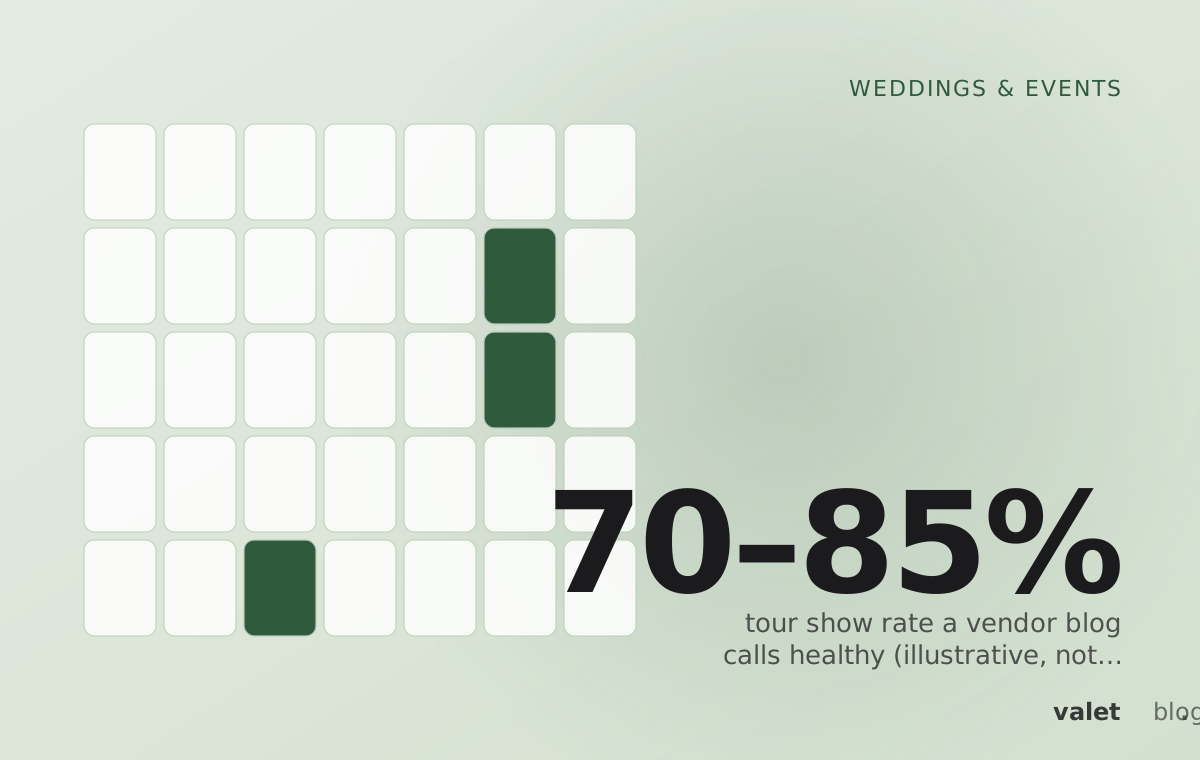
70–85%
tour show rate a vendor blog calls healthy (illustrative, not measured)
Everbridal, January 2022
$12,900
average couple spend on a reception venue
The Knot Real Weddings Study, n=10,474, 2026
3–5
venues a couple typically tours
Dual Spark, January 2026
No neutral study measures how often couples miss wedding venue tours. The 70–85% "healthy" show rate that venue blogs repeat comes from one 2022 post by Everbridal, a venue-software vendor, alongside a suggested reminder cadence of 3 days, 1 day and 2 hours before the tour.1 The figure is an illustration, not a measurement. The money behind it is still large: on 100 tours a year, moving from 70% to 85% attendance at a 40% tour-to-booking rate and The Knot's $12,900 average venue spend is worth about $77,000.2
This post sets out the evidentiary status of the benchmark, the arithmetic a venue should apply to its own counts, and a must/should/may reminder and recovery sequence, including the release message most venues never send.
Where does the 70–85% venue tour show rate come from?#
The 70–85% venue tour show rate comes from a single vendor source. Everbridal's January 2022 post states that "a healthy wedding venue show rate sits between 70-85%" and builds a worked example on it: 100 tours at a $20,000 average booking and 40% tour-to-booking, where moving from 70% to 85% attendance yields "$120,000 additional revenue."1 The post gives no sample, survey or dataset behind the range.
The status of the benchmark should therefore be stated precisely. It is a vendor's illustrative range. Other vendors that write about tour no-shows, including VenueXAI, Releventful and Dual Spark, publish no measured show rates in the material we reviewed.543 It is not an industry standard, and the $20,000 booking value in the original example is well above The Knot's 2026 national average of $12,900.2
Two adjacent figures should be excluded rather than borrowed. Reminder-effect figures of around 50% fewer no-shows, as compiled on scheduling-software sites, come from medical appointment research,6 where the visit is booked for a need and the patient has no competing clinic to compare. A frequently quoted 20–40% no-show figure for consultation calls circulates without a cited source. Neither transfers to a couple touring several venues in one month.
What is a 15-point show-rate gain worth to a venue?#
A 15-point show-rate gain is worth about $77,000 a year to a venue running 100 tours, on stated assumptions. The calculation multiplies the extra tours held by a tour-to-booking rate and an average booking value. Each input below is labelled with its status.
| Tours booked per year | Extra tours held (+15 pts) | Extra bookings at 40% | Value at $12,900 |
|---|---|---|---|
| 50 | 7.5 | 3 | $38,700 |
| 100 | 15 | 6 | $77,400 |
| 200 | 30 | 12 | $154,800 |
Assumptions: 70% and 85% show rates and 40% tour-to-booking are Everbridal's illustrative figures (2022);1 $12,900 is The Knot's 2026 average reception venue spend (n=10,474).2 Replace all three with your own counts.
The 40% tour-to-booking input carries the most risk. Dual Spark observes that couples tour "three to five venues,"3 which places an arithmetic ceiling on how many tours any one venue can convert. A venue that measures its own rate at 25% should cut every value in the table by more than a third.
Why do couples miss venue tours?#
Couples miss venue tours for reasons no published study has ranked, so this section identifies mechanisms rather than shares. Four are visible in the vendor literature and in the structure of how tours get booked.
- The tour was never confirmed as a commitment. A slot picked from a booking link in a moment of interest is a weaker commitment than a time agreed in a reply. A coaching-software vendor, CreatorFlow, argues that most discovery-call no-shows "are decided before the call is booked, not forgotten afterwards."8 That is a different market and a vendor view, but the mechanism plausibly carries over.
- A competing tour went well. A couple touring three to five venues3 may cancel the remaining ones silently after finding a favourite.
- The logistics were unclear. Parking, the right entrance, who to ask for and how long it takes are common reasons to postpone, and each is a fact the venue can supply in advance.
- Rescheduling cost more effort than not showing. If moving the tour requires a phone call during office hours, silence is the easier option for the couple.
Releventful puts the broader point well: the tour "starts from the initial inquiry and continues days after the visit."4 Attendance is decided in the messages around the tour, not on the day.
The venue tour reminder sequence: must, should, may#
The venue tour reminder sequence below separates what a venue must send, what the evidence suggests it should send, and what it may add. "Must" here is operational: the sequence fails without the item. No regulation sets tour reminder obligations. The reminder timings follow Everbridal's suggested cadence;1 the content of each message follows one rule, which is that every message carries something the couple can use.
TIER: MUST. On booking: confirmation
Subject: Your tour of [Venue] on [Day, Date] at [Time]
Hi [Names], you're booked for a tour of [Venue] on [Day, Date]
at [Time]. It takes about [45] minutes. [Name] will meet you at
[entrance]; parking is [where]. If the time stops working, reply
to this email and I'll offer two other slots.

TIER: SHOULD. 3 days before: reminder with one useful thing
Hi [Names], looking forward to [Day]. If you have a guest count
and a rough budget, bring them: [Name] can then price your
date on the spot. Need to move it? Reply and I'll send two times.

TIER: SHOULD. 1 day before: logistics
Tomorrow at [Time]. Parking: [where]. Ask for [Name] at [entrance].
Tours run about [45] minutes.

TIER: MAY. 2 hours before: short note
See you at [Time]. [Name] is at [entrance]. Running late?
Reply here and we'll hold the slot for [15] minutes.

TIER: MUST. Same day, after a no-show: release message
Hi [Names], we missed you today, no problem at all. I've released
the [Time] slot. If you'd still like to see [Venue], here are two
times this week: [Option 1] or [Option 2]. Reply with one and
it's yours.

TIER: SHOULD. 3 to 5 days later, if no reply: last message
Hi [Names], one last note from me. [Date] is still open on our
calendar as of today. [Our date-hold policy in one sentence.]
If you've chosen another venue, congratulations, and no reply
is needed.

(After this: close the inquiry with a reason. Do not send more.)
Three drafting rules govern the sequence. First, the release message must not invent pressure: if the date is not in fact in demand, it should not say so. Second, any statement about a date hold must match the venue's written hold policy. Third, the sequence stops after the last message; two attempts after a no-show is the same cap Valet applies to follow-ups, for the same reason: a third message without new information costs goodwill and teaches nothing. More on caps in how many times to follow up with a lead.
Channel note. The templates above are written for email to a couple who requested the tour. Text-message reminders raise consent and opt-out questions under federal and state rules that this post does not cover. If an AI assistant sends the reminders, several state chatbot disclosure laws are reported to take effect on 1 January 2027, per a secondary guide whose statute summaries we have not verified.9 This is not legal advice; check with counsel.
What to do with the no-show after the recovery message#
The no-show inquiry should end in one of two states: a new tour held, or closed with a reason. Leaving it open as "no-show, maybe" is how a venue's pipeline fills with inquiries nobody owns.
- Log the no-show the same day. Record the date, the reminder messages sent, and whether the couple opened a reschedule.
- Send the release message within hours. A message sent the same afternoon reads as service; one sent a week later reads as a chase.
- Offer two specific times. Two real slots from the calendar remove a round trip of scheduling messages.
- Close after the last message. Mark the inquiry lost with a reason (no reply, booked elsewhere, date taken) so the next audit can count it.
For the separate problem of couples who attend and then go quiet, see why couples ghost after pricing; the same capped-follow-up logic applies.
How to measure your own venue tour show rate#
Your own venue tour show rate is tours held divided by tours booked, over 12 months. Indigo Digital argues for reporting a small set of funnel numbers consistently, "the four numbers between an impression and a signed contract," rather than a dashboard of everything.7 Show rate belongs in that set once tours are a regular step.
- Count every tour booked in the window, including ones booked through a link.
- Mark each as held, rescheduled and held, rescheduled and missed, or no-show.
- Note which reminder messages each couple received.
- Compare the show rate for couples who got the full sequence with those who did not. That split, not the vendor benchmark, tells you whether the sequence works for your venue.
The full funnel worksheet, from inquiry to booking, is in what a good inquiry-to-booking rate is for a wedding venue.
How we got this: the benchmark and cadence come from the vendor sources cited, which we treat as illustrative. Valet does not yet publish a show-rate benchmark. Valet has not published this figure; it is something Valet could measure from free lead checks, with owners' consent.
Where Valet fits#
Valet is an AI assistant for a venue's written inquiries. It offers real tour times from your calendar, holds them, sends the invite, and only touches calendar events it created. It sends reminders and, after a missed tour, the honest release message with two new times, then stops after two follow-ups by default and tells you why. Date-hold exceptions, deposits and discounts wait for you. Every reply says it is AI, and each one has a receipt showing what was asked and which of your sources it used.
To see how many of your recent inquiries reached a tour at all, start with the free lead check: forward 10 to 20 recent inquiries and see what went unanswered, what stopped after one reply, and what it was worth.
Questions people ask
What is a normal no-show rate for wedding venue tours?
No neutral published study measures it. The commonly cited 'healthy' show rate of 70–85%, which implies 15–30% no-shows, comes from a 2022 Everbridal blog post and is illustrative. Measure your own over 12 months before setting a target.
When should I send venue tour reminders?
Send a confirmation when the tour is booked, then reminders about 3 days, 1 day and 2 hours before, the cadence Everbridal suggests. Each reminder should carry something useful, such as parking details or a one-tap reschedule, so it reads as service rather than pressure.
What should I send when a couple doesn't show up for a venue tour?
Send one short message the same day that says the slot was released, offers two new times, and asks nothing else. If there is no reply, send one more message later with a new reason to reply, then close the inquiry with a logged reason.
Should I charge a deposit to book a venue tour?
We found no published evidence that tour deposits improve show rates for wedding venues, and a deposit is a money decision the owner should make deliberately. Most venues rely on confirmation, reminders and easy rescheduling instead.
Sources
Confidence: H primary source checked · M credible secondary or reported · L vendor claim or single report. Reddit and forum items are quoted from public threads and summarised, not endorsed.
- Wedding venue show rate improvement · Everbridal · 2022-01-11 L
- Average wedding vendor costs (Real Weddings Study 2026, n=10,474) · The Knot · 2026-09-29 H
- Why couples aren't booking after the tour (and what to do about it) · Dual Spark Marketing · 2026-01-12 L
- Wedding venue tour booking · Releventful · 2026-07-08 L
- Reducing tour no-shows: proven tactics for event venues · VenueXAI · undated L
- Appointment no-show statistics · SchedulingKit · undated L
- Venue enquiry funnel metrics that matter · Indigo Digital · 2026-05-12 M
- Why coach discovery calls no-show from Instagram DMs · CreatorFlow · 2026-08-24 L
- AI chatbot human disclosure laws: a state guide · beancount.io · 2026-07-19 M
How to cite this page
Cite this page
Valet, "Venue tour no-shows: what a 70–85% show rate is worth and the reminder sequence that moves it", valet.team, October 2026.
Keep reading
 Weddings & eventsWhy couples ghost after you send pricing, and what the second message should sayThe usual answers are price, a hidden price list, or a slow reply. The bigger leak is that most vendors send one reply and stop, while the couple is still choosing between five of you.Strategy desk · 12 min · 1 October 2026
 Weddings & events"Our leads from The Knot / WeddingWire never respond": ghost leads, fake leads, or leads nobody followed up?Vendors say the leads are fake. The Knot says they are templated and ghosted. A U.S. senator has asked the FTC to look. None of them has published what happened to each inquiry, and that is the only record that settles it for your listing.Policy desk · 10 min · 1 October 2026
 Weddings & eventsHow many times should you follow up with a couple who hasn't replied? (And when the lead is dead)Wedding advice runs from "one more time than you are now" to "as many times as it takes". Nobody says when to stop. Here is a stop rule, a list of lost reasons, and the three messages that sit between the first reply and the end.People at work · 11 min · 1 October 2026