
Startups & support@
The support@ audit: what a seed-stage SaaS inbox contains (pre-sales vs support vs billing), and why the resolution rate is the wrong first number
Vendors quote AI resolution rates between roughly 30% and 76%. That spread is a measure of inbox mix and billing definitions, not of the tools. Nobody has published what a seed-stage support@ inbox contains, so here is how to measure your own.
Short answer
No public dataset shows what a seed-stage SaaS support@ inbox contains, so the AI resolution rates vendors quote (Help Scout's calculator assumes 73%; practitioners report about 30% to 50%) cannot be applied to you. The rate depends on your mix of pre-sales, how-do-I, billing and bug email, and on whether "resolved" means confirmed or merely silent. Audit 90 days of support@ by category, hour and outcome before you compare tools.
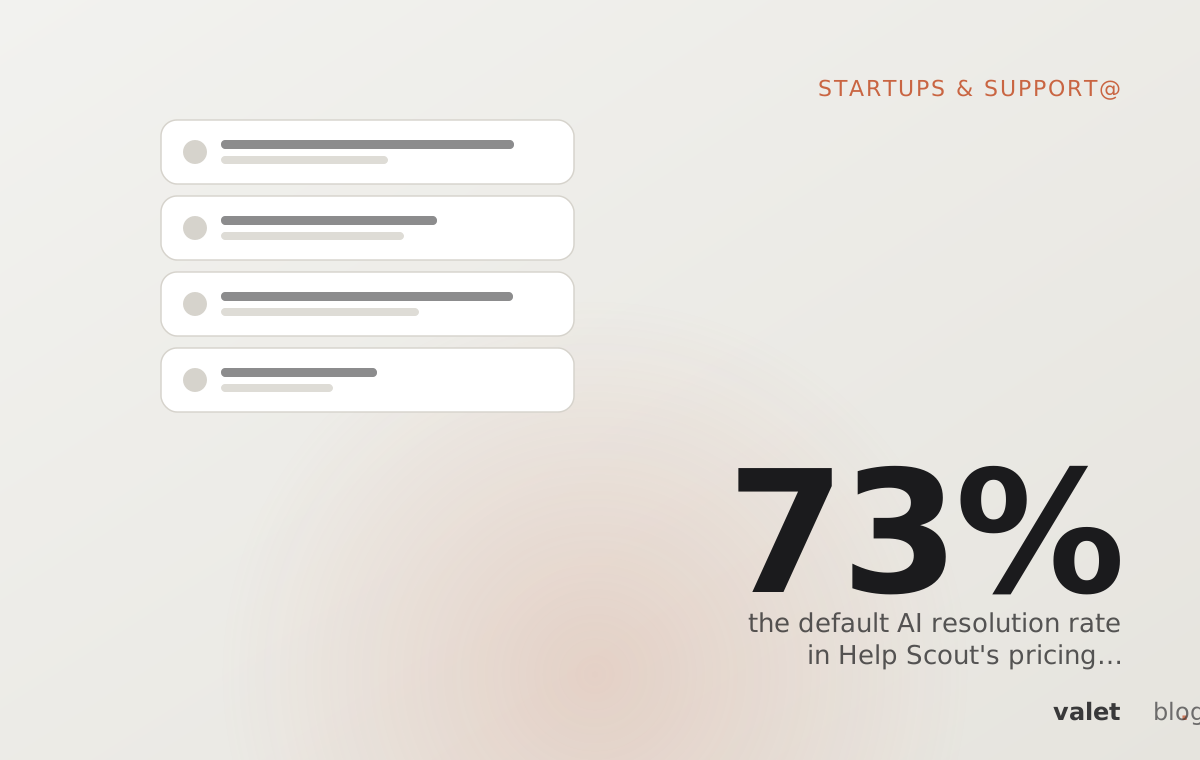
73%
the default AI resolution rate in Help Scout's pricing calculator
helpscout.com/pricing, checked 1 Oct 2026 (vendor assumption)
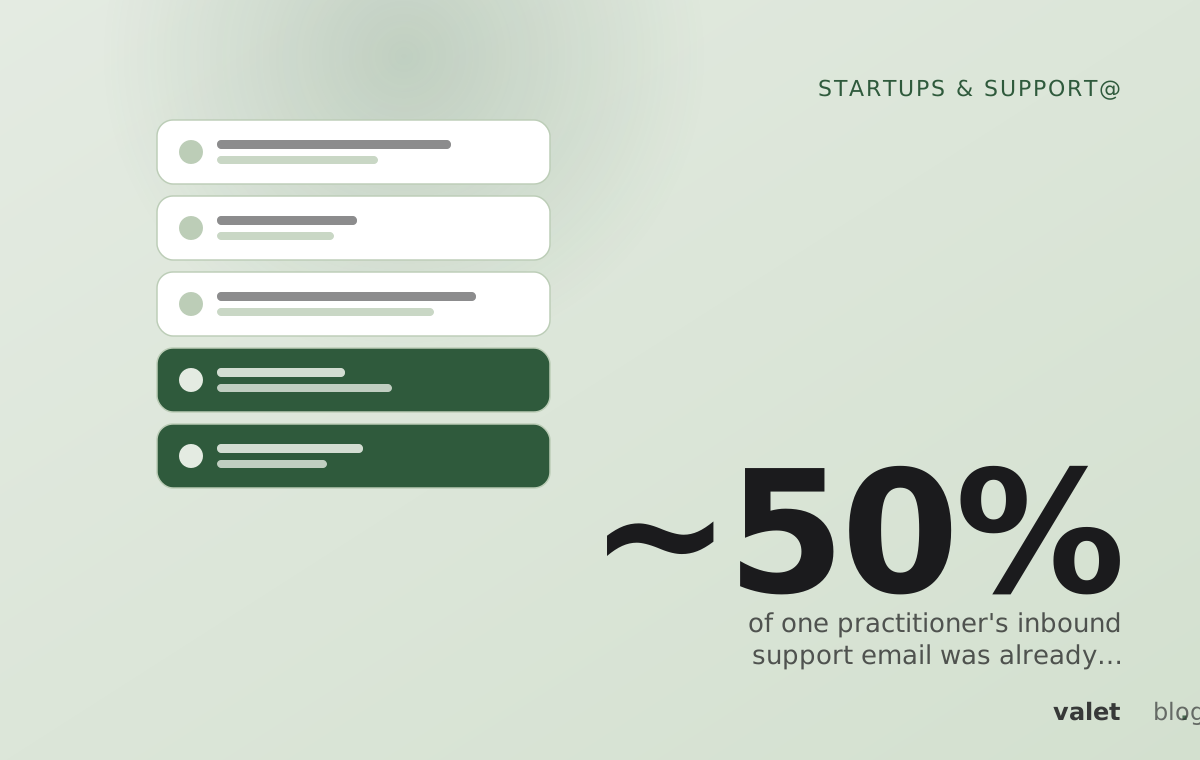
~50%
of one former support lead's inbound already written out in the FAQ
Hacker News comment, June 2026
55%
of AI-touched tickets handed to a human, a third of those never answered
Gorgias Ecom Lab, Oct 2025–Apr 2026
Nobody has published what a seed-stage SaaS support@ inbox contains: the share that is pre-sales, how-do-I, billing or bugs, when it arrives, and how much ends resolved rather than handed off. Founders choosing an AI tool therefore compare vendor resolution rates instead, and those rates span from a practitioner's rough 30% to a calculator default of 73%12. That spread measures inbox mix and billing definitions, not tool quality. Audit 90 days of your own support@ before you compare anything.
What do founders assume about AI resolution rates?#
The common view among early-stage founders is that an AI support tool should be judged by its resolution rate, because the rate predicts both the hours saved and the bill. Vendors supply the figures. Help Scout's pricing calculator states "The average resolution rate is 73%"1. An Intercom search ad seen on 1 October 2026 claimed a "76% Avg Resolution Rate." Klarna, the largest public case, reported in May 2025 that its chatbot "still handles two-thirds of all customer inquiries"3.
On that view the decision is arithmetic. Take monthly volume, multiply by the advertised rate, multiply by the per-resolution price, and compare the result with an hourly wage. Several Valet posts run that arithmetic, and the arithmetic is not wrong. The input is.
Why do sensible founders trust the vendor number?#
Founders trust the vendor resolution rate for good reasons, and the reasons deserve a fair statement before any objection. The rate is the only comparable figure on offer, since no founder has the time to run three tools side by side on the same inbox. It is tied to price, which makes it look audited. And at a seed-stage company the coordination cost of measuring anything is high: the person who would count the inbox is the person answering it.
The rate also matches lived experience at first. A founder who turns on any competent tool sees the easy questions vanish within a week. That early drop feels like proof of the advertised figure. It is proof of something narrower.
Where does the resolution-rate assumption break?#
The resolution-rate assumption breaks on two points: the rate is a property of the inbox, and the definition of "resolved" is written by the party paid per resolution. Both points are visible on public pages.
On the first point, the published figures are not measuring the same thing. A commenter in a May 2025 Hacker News thread, describing ten years in contact-centre AI, put typical chatbot deflection at roughly 30% of inbound contacts (wording as reported in that thread)2. A former support lead who ran Fin rollouts wrote in June 2026 that "~50% of the inbounds I receive are fully written out in plain language in an FAQ"4. Another practitioner in the same thread wrote that "Containment from the bot alone shot up past 50%" once the bot had "account awareness"4. Those are different inboxes, with different shares of routine questions, producing different ceilings.
On the second point, Fin's pricing FAQ counts a resolution when "No further help is requested after Fin's last answer"5. A customer who gives up and a customer who was helped look identical under that rule. A commenter in the June 2026 thread called it "A very soft resolution metric"4. This is a principal-agent problem in its textbook form. The agent that bills per unit also defines the unit.
What decides how much of your support@ an AI can answer?#
The share of your support@ that software can truly finish equals the share of email answerable from your written facts, minus whatever the billing definition counts as silence. Everything else in the decision follows from that sentence. A tool cannot resolve a billing exception that your policy never wrote down, and it should not try.
Three lines of evidence, weakest first#
Evidence 1: the published rates span too wide to describe tools#
Published AI resolution figures run from about 30% to 76%, a range too wide to be a property of software. The low end is a practitioner's estimate across contact centres2. The middle is one support lead's FAQ share and one Sierra rollout4. The top is a vendor calculator default and a search ad1. Klarna's two-thirds is a single fintech at very large volume3. A seed-stage SaaS with a heavy share of bugs and billing could sit below all of them. One with a plain product and a good FAQ could sit above. Neither founder learns which from a vendor page.
Evidence 2: vendors define the unit differently#
Vendor definitions of a resolution differ in ways that move the rate. Fin counts the customer not asking again5. Help Scout counts a resolution "only if the customer receives an AI response and doesn't use escalation, search the knowledge base, ask more questions, or indicate that they need more help," and does not charge when the customer clicks "I still need help"1. Same inbox, two definitions, two rates. Intercom itself declined to price its sales agent on closed revenue, writing that the purest model "breaks down" on attribution and measurement8. If the vendor cannot measure the outcome, the founder should not assume the rate measures it either. Our side-by-side of seven definitions is in what counts as an AI resolution.
Evidence 3: handoffs, not resolutions, are where outcomes split#
Handoff data shows the outcome a resolution rate hides. In Gorgias platform data from accounts with 200+ AI-touched tickets (October 2025 to April 2026), 55% of AI-touched tickets went to a human, and about a third of those never got a human reply. The median wait after handoff was 10 hours; the 90th percentile was 71 hours6. Those are e-commerce brands, not SaaS, and the cohort is self-selected by tool choice. The second-order effect still transfers: a tool can report a respectable resolution rate while a third of its handoffs end in silence. Only a record of each conversation's end state separates "resolved," "stopped asking" and "handed off and dropped."
What would a support@ audit of a seed-stage SaaS show?#
A support@ audit counts every thread in a window by category, arrival hour, first-reply time and end state. The nearest published counts come from other sectors. Gorgias found that about 1 in 9 e-commerce support inquiries is a pre-purchase question10, and that 53% of pre-purchase questions arrive outside business hours, with a median first reply of about 15 hours against 2.2 hours in hours (July 2026)7. Leadferno's 2024 test of 225 small-business contact forms found 42.6% got no reply at all9. Both state their n and method. No equivalent exists for seed-stage SaaS.
Founders describe the mix in fragments. "I write code, I do support, I handle billing issues," wrote one in r/EntrepreneurRideAlong (20+ comments, mid-2026). A thread in r/smallbusiness (10+ comments, September 2026) asked how much of the day goes to "the same 20 questions." Those fragments suggest a large routine share, but a fragment is not a denominator.
Valet could run this audit across many small inboxes and publish a quarterly aggregate, with n, method and per-segment tables. No such dataset exists today, and this page reports none. The method below lets any founder produce the same numbers for one inbox.
| Column | Values | Rule |
|---|---|---|
| Thread ID / date | From the mailbox | Count threads, not messages |
| Arrival hour | Your local time; note the customer's time zone if known | Mark "out of hours" against your stated working hours |
| Category | Pre-sales · How-do-I · Billing (routine) · Billing (money exception) · Bug · Security/legal · Other | One category per thread; if "Other" passes 10%, split it |
| Answerable from written facts? | Yes (name the doc line) · Partly · No | "Yes" only if a written line answers it word for word |
| First human or automated reply | Minutes from arrival | Auto-acknowledgements do not count as a reply |
| End state | Confirmed resolved · Stopped replying · Handed off, answered · Handed off, never answered · Still open | "Confirmed" needs the customer's words or a completed action |
Summary (fill after tagging):
Routine share      = threads "Answerable = Yes" / all threads
Out-of-hours share = threads out of hours / all threads
Pre-sales share    = Pre-sales threads / all threads
Silent share       = "Stopped replying" / all threads
Dropped handoffs   = "Handed off, never answered" / all handoffs
Your honest ceiling for automation ~= Routine share
Compare any vendor rate with Routine share, not with each other.
For the five-outcome version of this method applied to leads rather than support, see the Lost Lead Audit. For a runbook that uses the audit's categories, see how to handle support@ as a solo or 3-person SaaS founder.
When is the vendor rate still the right number?#
The vendor resolution rate remains a reasonable planning input in three cases. When the inbox is high-volume and uniform, as in stores where order-status questions dominate, the mix varies less between companies and a published rate travels better. When the definition is strict, as with Help Scout's, the rate is closer to a confirmed outcome1. And when a founder needs only a ceiling for a budget line, the advertised rate works as a worst case for cost, since a higher rate means a higher bill under per-resolution pricing.
| If your audit shows | Then the vendor rate | Decision |
|---|---|---|
| Routine share above the vendor's rate | Understates what your facts can answer | Pick on handoff behaviour and records, not rate |
| Routine share well below the rate | Overstates; the gap will be billed silence or handoffs | Write the missing facts first, or keep those categories human |
| High silent share already, before any AI | Will count those customers as resolved | Prefer a strict definition; check every "resolved" sample |
| Dropped handoffs above zero | Hides the cost that matters | Fix ownership and reply-by times before automating more |
Where this argument would be wrong, and what to do on Monday#
The case against vendor rates fails if a published, denominated study shows seed-stage SaaS inboxes are similar enough that one rate fits most of them, or if vendors move to definitions that require confirmed resolution. Either would make the vendor number a usable prior. Neither exists as of October 2026.
Until then the local optimum, picking the tool with the best advertised rate, carries a perverse incentive the founder pays for. The Monday decision is small: export 90 days of support@, tag it with the sheet above, and compute the routine share. That one number tells you more about your tool choice than any vendor page.
Where Valet fits#
Valet keeps the end state that this audit asks for. You forward support@ to a private Valet address; replies go out from your own address once the domain is verified, with nothing to migrate. Valet answers only from your own facts, and anything not on them waits for you. Every inquiry has a state and a next step, and every reply has a Valet receipt: what was asked, the rule used, the sources used and where it was sent from, so "resolved" and "handed off" are separate records. Money, complaints and legal questions come to you with one-tap replies, and the customer is told when you will reply. To start smaller, the free lead check: forward 10 to 20 recent emails and see what went unanswered or stopped after one reply.
Questions people ask
What percentage of support tickets are pre-sales at an early-stage SaaS?
No public dataset answers this for seed-stage SaaS. The nearest published figure is from e-commerce: Gorgias reports that about 1 in 9 support inquiries is a pre-purchase question (2026). Count your own by tagging 90 days of support@.
What is a realistic AI resolution rate for a small company?
Claims vary from a practitioner's rough 30% deflection to vendor figures of 73% and 76%. The rate depends on how much of your inbox is routine and on how the vendor defines a resolution, so measure your routine share first.
Why can't I use a vendor's resolution rate to plan?
Because some vendors count a resolution when the customer stops asking. Fin's pricing FAQ counts "No further help is requested after Fin's last answer." That mixes customers who were helped with customers who gave up.
How long does a support@ audit take?
About two to four hours for 90 days of a small inbox: export the threads, tag each by category, arrival hour and outcome, then count. A one-hour version on the last 50 threads gives a first read.
Sources
Confidence: H primary source checked · M credible secondary or reported · L vendor claim or single report. Reddit and forum items are quoted from public threads and summarised, not endorsed.
- Help Scout pricing (AI Answers and cost calculator) · Help Scout · 2026-10-01 L
- Hacker News discussion thread, item 43955374 (Klarna and human support) · Hacker News · 2025-05 H
- Klarna reinvests in human talent for customer service after AI chatbot push · Customer Experience Dive · 2025-05-09 H
- Hacker News discussion thread, item 48540126 (Salesforce and Fin) · Hacker News · 2026-06 H
- Fin pricing · Fin (formerly Intercom) · 2026-10-01 H
- The cheapest ticket is the one a human never touches · Gorgias Ecom Lab · 2026 H
- Your team is sleeping on 53% of shopper questions · Gorgias Ecom Lab · 2026-07 H
- Building outcome-based pricing for Fin for Sales · Intercom · 2026-05-08 H
- Research: Website Contact Forms and Lead Management, Uncovering Costly Mistakes · Leadferno · 2024-06-28 H
- Pre-purchase speed is a revenue lever most brands treat as a cost · Gorgias Ecom Lab · 2026 H
How to cite this page
Cite this page
Valet, "The support@ audit: what a seed-stage SaaS inbox contains, and why the resolution rate is the wrong first number", valet.team, October 2026.
Keep reading
 Startups & support@Should a startup use AI for customer support? What founders who lost customers say, and the three missing controlsCustomers accept AI support when they can reach a person. The failures that cost startups customers trace to three missing controls, not to the model.Data desk · 11 min · 1 October 2026
 Startups & support@How to handle support@ as a solo or 3-person SaaS founder (without hiring, and without a bot that traps people)Sort support@ into four categories, give each a written promise and an automation level, and check the handoffs every week. Here is the runbook, plus the six ways it breaks.Playbooks · 12 min · 1 October 2026
 Startups & support@An AI agent that answers vs one that finishes the job: what "acts" means for a small business, and the four controls that make it safeMost AI tools sold to small businesses answer the first message and stop. This piece defines what it means for an agent to finish the job, traces where answer-only tools lose the inquiry, and sets out the four controls that make acting safe.Technical desk · 11 min · 1 October 2026