
New channels
Should I publish my prices? The AI will ask anyway, and 48% of businesses can't answer
Custom-work businesses hide prices for good reasons. Buyers, and now the AI assistants asking for them, treat a missing number as a no. The middle path is a written range and a rule against improvising.
Short answer
Publish a starting price or a range, plus your minimums, even if every job is custom; keep the exact quote for the reply. Buyers filter on price first: 77% of couples rank pricing as the top factor before contacting a vendor (WeddingPro). AI assistants now ask too: in Invoca's Jul–Nov 2025 data, 48% of answered Google-AI pricing calls got no price. A written range lets a person, a website and an AI give the same answer, without anyone inventing a discount.
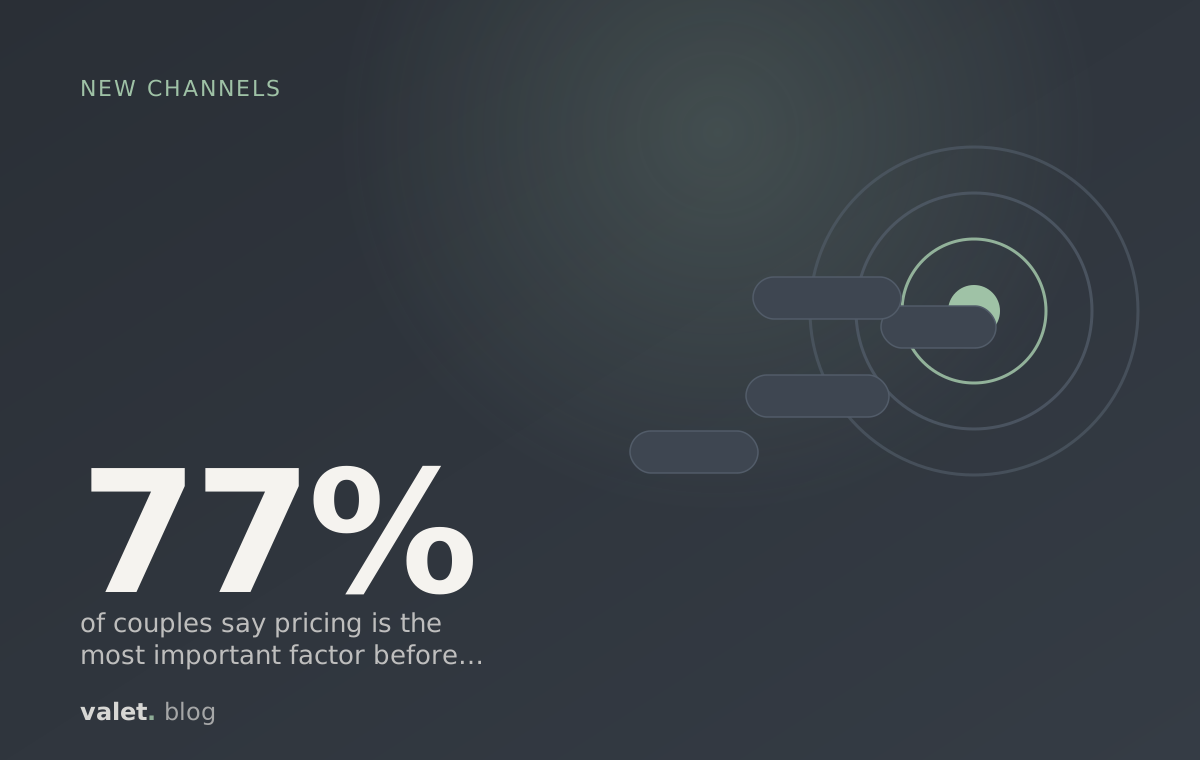
77%
of couples say pricing is the most important factor before contacting a vendor
WeddingPro, From Hello to Hired
48%
of answered Google-AI pricing calls did not get pricing information
Invoca, Jul–Nov 2025 (published 10 Dec 2025)
$12,900
average reception venue spend among couples married in 2025 (n=10,474)
The Knot Real Weddings Study 2026
Publish a starting price or a range, and your minimums, even if every job you do is custom. Keep the exact quote for the reply. Buyers decide whom to contact on price: 77% of couples say pricing is the most important factor before they contact a wedding vendor1. AI assistants now ask on the buyer's behalf, and many businesses have nothing to say. In Invoca's July to November 2025 data, 48% of answered Google-AI pricing calls got no price2. A written range fixes both without a public price list.
A Sunday night, a laptop, one word: "pricing?"#
Illustration For example, a wedding photographer sits at a kitchen table at 23:10 on a Sunday. The laptop fan is loud. Two memory cards from Saturday's wedding sit in a card reader, and the import bar has 2,400 files to go. A coffee from the afternoon has gone cold beside the trackpad.
An email arrives from a directory. It is three lines long. A date in June, a venue name, and one word with a question mark: "pricing?"
She has answered this email hundreds of times. She knows the honest answer is "it depends," because it does: hours of coverage, a second shooter, travel, an album. She also knows that if she writes "it depends," the couple will read it as "expensive" and move on. So she does what many custom-work owners do. She types "Would love to hop on a quick call to talk through your day," and goes back to the import bar.
The couple does not reply. She never finds out why.
Why do so many businesses hide their prices?#
Businesses hide prices for reasons that make sense from the inside. Custom work has no single price, and a published number can feel like a promise the owner will be held to on a job that turns out twice the size.
The best-known sales voice in the wedding trade makes a careful version of this case. Alan Berg, in a 2023 WeddingPro Q&A, advised that when couples ask for pricing, vendors should "provide a price range and ask for more details." He warned against a single figure, because "that number can stick in people's minds"3. That is a craftsman's caution. One number, quoted before you know the job, becomes the number.
Venues have their own tradition: "price on application." A UK venue-owner community piece from January 2025 argued it backfires. "If a couple does enquire and then discovers the pricing is far above what they anticipated, they may feel embarrassed or disheartened and choose to avoid further communication."4 The piece has no statistics behind it. It reads like something its author has watched happen.
And under all of this sits a quieter fear: being shopped. A price on the page invites comparison. Many owners would rather win on the conversation than on the number.
What do buyers do when the price is missing?#
Buyers who cannot find a price often treat the gap as a reason to skip the business, or a reason not to take their own inquiry seriously. A thread in r/Weddingsunder10k titled "Does ghosting go both ways in wedding planning" (20+ comments, around September 2026) put it in a couple's words. The top answer began: "If I have to send a vendor an inquiry to know what their starting prices are, then me sending…" The snippet ends there, but the thread title makes the point: ghosting can go both ways.
That is the other side of the photographer's Sunday night. To the vendor, the inquiry is a lead. To the couple, it is a form they filled in to find out a number, one of five. WeddingPro reports couples contact five vendors per category on average1.
The service trades argue the same way. A thread in r/marketing, "How to deal with 'What's your rate?' as a service provider" (120+ comments, around 2024), drew a top answer of four words: "Tell them your rate?"
There is one survey number in circulation, and it is soft. Photographer and writer Erica Comitalo reported in 2021 that in an informal survey, 74% of the women who responded had passed over photographers with unlisted prices5. It was not a controlled study. It points the same way as WeddingPro's 77%, which is the number to lean on1.
The AI will ask anyway#
AI assistants now ask businesses for prices on a customer's behalf, so a business without a written price meets the question whether or not it publishes one. Google's Business Profile Help says its automated calls exist to "book appointments," "check restaurant wait times," and "confirm price and availability of services and products"6.
Invoca tracked those calls from July to November 2025. 26% went unanswered. Of the calls that were answered, 48% "did not provide pricing information"2. Somebody picked up the phone, heard the question, and had no number to give. That is the photographer's "quick call" reply, said out loud to a machine. The machine reports back to the customer with the businesses that did give a number.
The AI also reads what is already published. SOCi's 2026 index, reported by Near Media, found the sources AI leaned on for local answers were, in order, Google Maps, niche directories, brand websites, Yelp and Facebook7. If a range is on your website and your directory profiles, it is in the places these tools look. For how the call itself works, see what to do when Google's AI calls your business for prices.
Full price list, a range, or price on application?#
The choice is not between publishing everything and publishing nothing. There is a middle option, and for custom work it usually wins. The table compares the three.
| Full price list | Starting price, range and minimums | Price on application | |
|---|---|---|---|
| Buyer who filters on price | Can decide alone | Can rule in or out before writing | Must write, or skips you |
| AI assistant asking for a price | Gets a number | Gets a range to report | Gets nothing; reported as no price |
| Risk the number "sticks" | High on custom jobs | Lower: the range explains what moves it | None in public; moves to the first reply |
| Inquiries you receive | Fewer, closer to ready | Fewer mismatched ones | More, many mismatched |
| Best fit | Fixed packages, products | Venues, photographers, florists, consultants, custom makers | Rare: work you cannot price until you see it, and then publish the visit fee |
The middle column keeps Berg's caution and drops the silence. A range with its reasons attached is harder to mistake for a promise than a single figure.
The price-range sheet and the never-invent rule#
A price-range sheet is a short, owner-signed page that states what a job usually costs, what moves the price and what is never offered without the owner. Fill it in once. Put the public lines on your website and directory profiles. Use the whole sheet for every reply, whoever or whatever sends it.
PRICE-RANGE SHEET  (owner: __________  last checked: ____)

PUBLIC LINES (website, directories, every reply)
Venue:         Weekend minimum spend from $____ (__ guests).
               Weekday/off-season from $____. Includes: ______.
Photographer:  Coverage from $____ for __ hours.
               Most couples spend $____ to $____. Album from $____.
Florist:       Weddings from $____. Typical full wedding
               $____ to $____. Delivery/setup: ______.
DJ / band:     From $____ for __ hours. Extra hour $____.
Consultant:    Projects from $____. Typical engagement
               $____ to $____ over __ weeks.
Custom maker:  Pieces from $____. Lead time __ weeks.
               Deposit __% to start.

WHAT MOVES THE PRICE (say these out loud)
Guest count / hours / season / travel / materials / rush.

ONE QUESTION TO NARROW IT
"What date and roughly how many guests / hours / pieces?"

NEVER-INVENT RULE
- Quote only numbers on this sheet.
- No discounts, deals or "I can probably do it for less"
  unless written here. Anything else: "I'll check with
  [owner] and reply by [day/time]."
- No promises about availability without checking the
  calendar.
- Deposits, refunds, contracts and complaints go to the
  owner.
The rule at the bottom matters as much as the numbers. A range that anyone can stretch into a discount is worse than no range. For the full sheet behind these lines, see the facts sheet, and for the ten questions couples ask besides price, the wedding vendor version.
What a missing price is worth#
A missing price is worth roughly what one qualified inquiry is worth, each time it costs you one. The Knot's 2026 Real Weddings Study of 10,474 couples put the average reception venue at $12,900 and the average photographer at $3,0008, with photographer spending quartiles of $1,500, $2,800 and $4,7009. Indigo Digital, a venue marketing firm, estimates about one in five qualified venue enquiries books10.
Illustration One inquiry, in expected value. At one in five, a qualified venue inquiry is worth about $2,580 ($12,900 × 20%). A photographer inquiry at the same rate is worth about $600 at The Knot's average. These are rough planning numbers from averages, not a forecast for any one business.
Whether publishing a range lifts the reply rate is a question nobody has measured well in public. Valet could run a mystery shop to test it: ask 100 venues and vendors for a price, once by email and once through an AI assistant, and count who answered with a number. Until someone runs that, the evidence is what buyers say (77%) and what businesses do (48% with no price).
What changes at the kitchen table, and what does not#
The change is small and practical. On the next Sunday night, the photographer's "pricing?" email gets a reply with a range, what moves it, one question, and two times to talk. The website already says "most couples spend $____ to $____," so fewer of the emails are from couples who were never going to book. When an AI calls the studio line on a Tuesday, whoever answers reads the same line off the same sheet.
What does not change: the import bar still has 2,400 files to go. Some couples still go quiet after seeing the range, and some of them would have gone quiet after a call too. A published number still gets compared. And a range does nothing for a reply that is never sent. That part of the work is still somebody's job, at 23:10, with the coffee gone cold.
Where Valet fits#
Valet answers pricing questions by email, website form, marketplace lead email and on your free Valet page, including those sent by AI assistants for a customer. It answers only from your own price list, packages, calendar and policies. It never invents a price or a discount; anything not on your sheet waits for you, and the customer is told when you will reply. Haggling, deposits and contracts come to you with one-tap replies. It offers real times, holds them, and follows up twice at most. To see how many "pricing?" emails went unanswered last season, start with the free lead check.
Questions people ask
Should I put prices on my website?
Publish a starting price or a range and your minimums, not necessarily a full price list. Buyers use price to decide whom to contact, and AI assistants ask for it on their behalf. Keep the exact quote for the reply, where you can ask about the details that change it.
Should wedding photographers list prices?
Most should show at least a starting price or a range. WeddingPro reports 77% of couples rank pricing as the most important factor before contacting a vendor. Industry sales speaker Alan Berg advises answering price questions with a range and a question back, rather than a single number.
Does 'price on application' hurt wedding venues?
It can. A UK venue-owner community piece from January 2025 argued that couples who enquire and then find pricing far above what they expected may feel embarrassed and stop replying. Publishing a minimum spend or a typical range lets couples rule themselves in or out before they write.
How do I give a price range without scaring customers off?
Give a range tied to what changes it: guest count, hours, season, materials. Say what is included at the low end. Add one question that would let you narrow it, and offer a real time to talk.
Will AI assistants ask my business for prices?
Yes. Google's Business Profile Help says its automated calls are used to confirm price and availability of services and products for customers. Gemini's Call for Me can also ask for quotes. A written range lets whoever answers give a number.
Sources
Confidence: H primary source checked · M credible secondary or reported · L vendor claim or single report. Reddit and forum items are quoted from public threads and summarised, not endorsed.
- From Hello to Hired: your guide to lead replies · WeddingPro · undated (retrieved 2026-10) H
- New Invoca study finds pricing request phone calls from Google's AI surged over 300% in November · Invoca · 2025-12-10 H
- Lead reply questions answered by Alan Berg · WeddingPro · 2023-06-23 M
- The link between ghosting and price on application for wedding venues · Coco Wedding Venues · 2025-01-27 M
- Should wedding photographers list their prices? · The Write Lens (Erica Comitalo) · 2021-01-13 L
- Google Business Profile Help: automated calls from Google · Google · 2026 (retrieved 2026-10-01) H
- Local AI study: AI Mode on-ramp, Google queries down (SOCi Local Visibility Index 2026) · Near Media · 2026-01-29 M
- Average wedding vendor costs (Real Weddings Study 2026, n=10,474) · The Knot · 2026-09-29 H
- Average cost of a wedding photographer · The Knot · 2026 H
- Wedding venue lead benchmarks guide · Indigo Digital · 2026-08-03 M
How to cite this page
Cite this page
Valet, "Should I publish my prices? The AI will ask anyway, and 48% of businesses can't answer", valet.team, October 2026.
Keep reading
 New channelsGoogle's Business Profile AI agent: what "Handled by your AI agent" and "Needs your attention" meanMessaging came back to some Google Business Profiles in June 2026, with an AI agent answering first. Here is what the two message tabs mean, what the agent reads, and what is still left for you.Explainers · 10 min · 1 October 2026
 New channelsWhat happens when a customer asks ChatGPT or Yelp Assistant to contact my business?AI assistants now ask businesses for quotes on a customer's behalf. The request does not arrive labelled as AI. Here is where each one lands, what to check first, and a three-message reply sequence.Playbooks · 9 min · 1 October 2026
 New channelsWhy marketplace leads die in your inbox (Thumbtack, Bark, Angi, The Knot, Yelp): the lead-email problem, and what you can actually controlA paid lead arrives as a notification email, shared with other pros, and the clock starts before you open it. You cannot fix lead quality from your side. You can fix what happens in the first hour and the next five days.From the Valet team · 10 min · 1 October 2026