
New channels
Google's AI called my business asking for prices: what it is, why it matters, and what to have ready
The automated call is not a scam, and opting out is not free. It is a price comparison run on the customer's behalf, and you win or lose it on whether your price was written down before the phone rang.
Short answer
It is most likely Google's automated calling feature (launched as Ask for Me in January 2025), which phones local businesses on a customer's behalf to confirm prices and availability, then reports back to the customer. It is free and runs in most US states. Invoca found 26% of these calls went unanswered and 48% of answered calls gave no price (Jul–Nov 2025). You can opt out in Business Profile settings, but the better fix is a written price range ready before the next call.
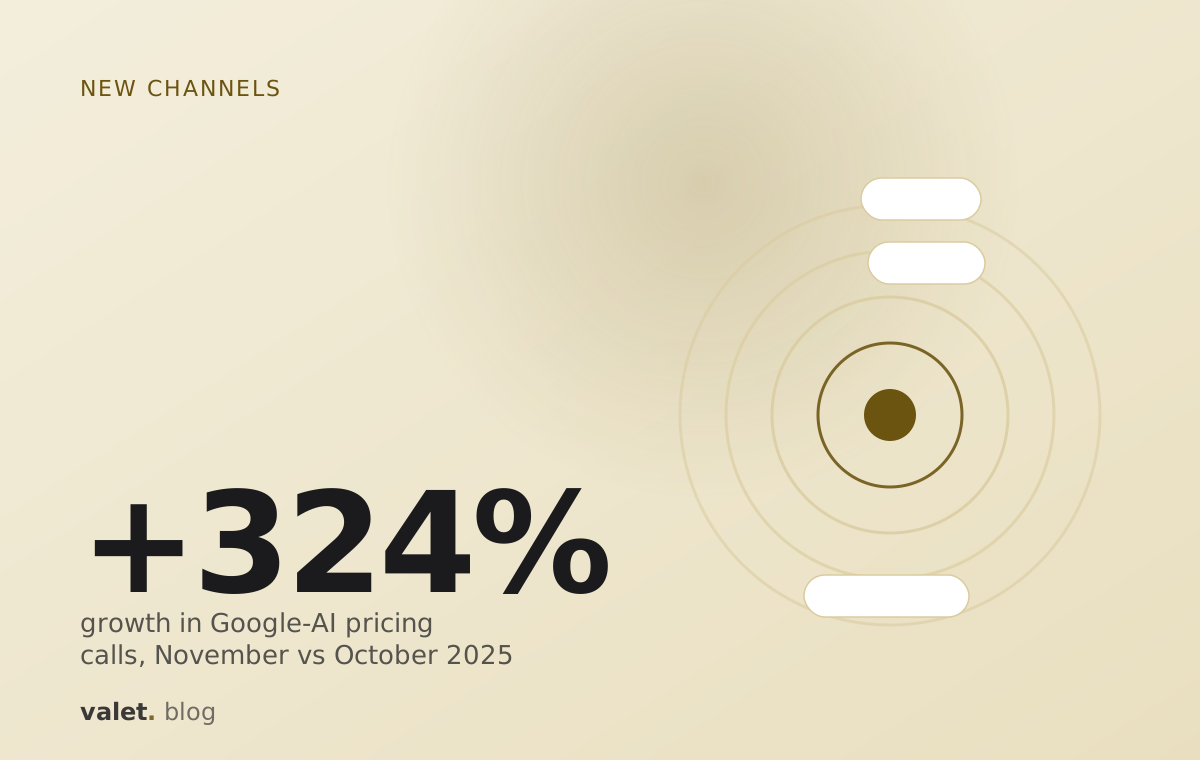
+324%
growth in Google-AI pricing calls, November vs October 2025
Invoca, 10 Dec 2025
26%
of Google-AI pricing calls went unanswered
Invoca, Jul–Nov 2025
48%
of answered Google-AI pricing calls did not get pricing information
Invoca, Jul–Nov 2025
If a call opened with "This is an automated service from Google," it was almost certainly Google's automated calling feature, first launched as Ask for Me, asking your price and availability for a real customer. Google says the calls are free and run across the US except five states1. Invoca tracked them from July to November 2025: 26% went unanswered, and 48% of the answered calls got no price2. You can opt out. The better move is to have a written price range ready, because the same question will reach you in writing too.
What is this call, and is it a scam?#
Google's automated call is a price-and-availability check placed by Google's AI for a customer who asked it to shop around. Google's Business Profile Help page says the calls are used to "book appointments," "check restaurant wait times," and "confirm price and availability of services and products"1. Google describes the feature as free for businesses and customers, and available in the United States except Indiana, Louisiana, Minnesota, Montana and Nebraska1.
The feature started small. It launched in Search Labs on 30 January 2025 for auto repair shops and nail salons5. JobNimbus reported in May 2026 that Google announced at I/O an expansion to home repair nationwide for summer 2026, with results returned to the customer "typically within 30 minutes" by text or email6. That is a vendor blog relaying an announcement, so treat the timing as reported.
A marketing blog for auto shops printed what the call sounds like in September 2025: "Hi, I'm calling on behalf of a customer who had some questions. This is an automated service from Google, and the call is monitored and recorded to improve Google services." The same post noted that "some shop owners have wondered if these calls are scams"3. The suspicion is reasonable. The caller is a machine, it wants a number, and it hangs up once it has one.
The consensus: answer it, or switch it off#
The mainstream advice to owners splits into two camps, and both are sensible on their own terms. The first camp treats the call as a phone-handling problem. Invoca's own recommendations after its study were to track how locations handle Google AI calls, train staff "with best-practice responses," and exclude these calls from retargeting2. In that view, the fix is a better-trained person at the front desk.
The second camp treats the call as a nuisance. Near Media, testing the tool in 2025, reported that "Many Local SEOs have expressed concern about spam/abuse potential and the tool wasting the business owners' time"4. Google itself offers an opt-out. An owner who is under a car or on a roof when the phone rings has a fair case for switching it off.
Why smart owners believe it#
Owners believe the call is a phone problem because, under the old cost structure, it was one. A price shopper who rang five shops used to be a low-value call. Most owners learned, correctly, that a caller who only wants a number is less likely to book than one who describes a job. Giving a price on the phone also invites a race to the bottom, and many trades price only after seeing the work.
Opting out looks like a cheap way to protect working hours. Every interrupted job has a coordination cost, and a machine asking for a number is the easiest interruption to cut. For a two-person business, that local optimum is rational: protect the hours, lose a few shoppers.
The cracked assumption: the call is not the channel#
The cracked assumption is that the call is the transaction. It is not. The call is a data-collection step in a comparison that the customer reads later, in writing. Near Media's testers saw how the results arrive: Google sends "two emails: an acknowledgment of the inquiry and another with the business responses," within an hour or less4. The tool contacted 7 to 8 businesses per request in their tests, and 3 of 8 responded in one case, 2 of 7 in the other4.
Read that as the customer does. They open an email with two or three businesses that gave a price, and silence from the rest. "No answer" and "call us for a quote" sit in the same column. The customer cannot ask a follow-up question of a business that gave nothing.
Here is the principal-agent problem in plain terms. The AI is the customer's agent. Its job is to bring back comparable answers. A business that withholds a price is not negotiating with the customer; it is failing the agent's task, and the agent simply reports the businesses that did not fail it.
The alternative mechanism in one sentence#
The automated call is a written price comparison carried out by phone, and a business wins or loses it on whether its price range was written down before the phone rang.
That sentence moves the fix away from the phone. Training staff helps only if staff have a number to give. Invoca's 48% figure is about calls that were answered2. Someone picked up and still had nothing to say.
Three lines of evidence, strongest last#
First, the volume is real and climbing. Invoca measured Google-AI pricing calls rising 162% in October versus September 2025, then 324% in November versus October2. Plumbing averaged a monthly increase above 650%, and veterinary services above 1,700%2. These are growth rates from a small base in a vendor's call data, so they say the channel is growing fast, not that it is large.
Second, the AI has more than one way in. Gemini's Call for Me began rolling out on 24 September 2026. It can call businesses to check hours and availability, get quotes and book appointments, and it will "identify itself as an AI assistant calling on the user's behalf, state the user's name and disclose that the call is being recorded"7. Coverage said nothing about whether the Business Profile opt-out applies to it7. Opting out of one caller may not opt you out of the question.
Third, and strongest: answering is not the bottleneck; the price is. Invoca found 26% of the calls unanswered, and 48% of the answered ones without pricing2. Put together, roughly 38% of these price requests ended with a price (0.74 × 0.52), so about 62% failed at the business. Answer rates varied by trade: 79% for auto repair and tires, 75% for pest control, 66% for plumbing and 65% for veterinary services2. Even the best-answering trade left roughly one in five unanswered, and the no-price failure sits on top of that.
Illustration What 62% means for one shop. For example, a plumbing business that receives 10 of these requests a month, for jobs averaging $500, is asked about $5,000 of work. If it fails 62% of them, about $3,100 a month of requested work is reported back to customers as "no answer" or "no price." That is demand, not lost revenue: some of those customers would never have booked.
Opt out, answer, or prepare? A decision inversion table#
The opt-out decision inverts once the call is seen as a written comparison. The table sets the first-order reading against the second-order effect.
| Choice | First-order effect | Second-order effect |
|---|---|---|
| Opt out in Business Profile | Fewer interruptions | Absent from the customer's comparison email; may not cover Gemini's Call for Me |
| Answer, but say "call us for a quote" | Call handled | Reported as no price; counted in Invoca's 48% |
| Let it ring | No time spent | Counted in Invoca's 26%; nothing reaches the customer |
| Answer from a written range | One minute per call | You appear with a number; the customer's next message comes in writing, and you need to answer that too |
What to have ready: the seven facts#
The seven facts below map Google's stated purposes for the call (price, availability, appointments, hours and products)1 to things a business can write down once. Keep the card by the phone and on the website, so the person who answers, and anyone who writes in later, gets the same answer.
WHAT THE CALL SOUNDS LIKE (reported, Sep 2025)
"Hi, I'm calling on behalf of a customer who had some questions.
This is an automated service from Google, and the call is
monitored and recorded to improve Google services."

THE SEVEN FACTS (one line each)
1. Starting price or range for our three most-asked services:
   ______________________________________________
2. What the price includes, and what changes it
   (size, distance, materials, urgency): ________________
3. Next available date or lead time: __________________
4. Opening hours and emergency / after-hours terms: _______
5. Services or products we do NOT offer: _______________
6. How to book (link, email, or phone + hours): _________
7. Where a written follow-up should go (email address):
   ______________________________________________

RULE: give the range, never a discount we have not written down.
If the job cannot be priced without a visit, say so and give
the visit fee or the typical range.

OPT-OUT (Google Business Profile Help, checked 1 Oct 2026)
- On the call: "Please remove my business from your list"
  or "Please stop calling my business."
- Business Profile > More > Business Profile settings >
  Advanced settings > "Google automated calls and text
  messages": turn off the features you do not want.
- Phone tree mapping opt-out: call +1-650-206-5555 and leave
  a voicemail with your business name and phone number.
Fact 7 matters more than it looks. The customer reads the comparison in an email or a text46, and if they pick you, the next message often arrives in writing: a website form, an email, a marketplace request. Leadferno's 2024 test of 225 small-business contact forms found 42.6% of inquiries got no reply at all8. A business that gave a good price on the call and then missed the email lost the same customer twice.
For the full sheet behind these seven lines, see the facts sheet to write before any AI answers customers. For the written reply itself, see how to answer "what are your rates?" by email.
Where the consensus still wins#
The opt-out camp is right in three cases. If every job needs a site visit before any number, the call has nothing to collect, and protecting working hours is the better trade. If your category is mostly price shoppers and your margin cannot survive a comparison, staying out of the comparison may be a deliberate position. And if your phone is a single mobile you answer from a ladder, the safety cost of interruptions is real.
Even then, write the seven facts. The question does not go away when the call does. It comes back by email.
Where I'd be wrong, and the Monday-morning decision#
This argument fails if customers who use these tools book businesses that gave no price as often as businesses that did. No public study has measured that. It also weakens if Google scales the feature back, or if Gemini's Call for Me turns out to respect the Business Profile opt-out, which coverage did not address7.
The Monday-morning decision is small. Fill in the seven facts, put them by the phone and on the website, and decide on the opt-out after that, with the price card in hand rather than instead of it.
Where Valet fits#
Valet does not answer the phone. It works on the written side of this: email, website forms, marketplace lead emails and requests on your free Valet page, including messages from AI assistants writing for a customer. It answers only from your own price list, packages, calendar and policies, and never invents a price or a discount; anything not on your list waits for you, and the customer is told when you will reply. It offers real times, holds them, and follows up twice at most. To see how many written price questions went unanswered last quarter, start with the free lead check.
Questions people ask
Is the automated call from Google a scam?
Usually not. Google's Business Profile Help describes automated calls it places for customers to book appointments, check wait times and confirm prices and availability. A marketing blog for auto shops reported in September 2025 that some owners wondered if the calls were scams; the call identifies itself as an automated service from Google.
What is Google Ask for Me?
Ask for Me is a Google feature that launched in Search Labs on 30 January 2025 for auto repair and nail salons. The customer answers a few questions, and Google's AI calls several local businesses to ask about price and availability, then sends the customer the results.
How do I stop Google's automated calls to my business?
Google's help page lists three ways: say 'Please remove my business from your list' or 'Please stop calling my business' on the call; turn off the options under 'Google automated calls and text messages' in Business Profile settings > Advanced settings; or leave a voicemail at +1-650-206-5555 with your business name and number for the phone tree mapping opt-out.
Should I answer Google's AI calls?
If you want the customer's business, yes, and with a price or range. Invoca found 48% of answered calls gave no pricing, which leaves the customer with nothing to compare. If you cannot quote any price without a site visit, opting out may cost you little.
Does opting out stop Gemini's Call for Me?
That is not documented in the sources we found. Gemini's Call for Me, rolling out from 24 September 2026, identifies itself as an AI assistant calling for a named user. Coverage did not mention a business opt-out.
Sources
Confidence: H primary source checked · M credible secondary or reported · L vendor claim or single report. Reddit and forum items are quoted from public threads and summarised, not endorsed.
- Google Business Profile Help: automated calls from Google · Google · 2026 (retrieved 2026-10-01) H
- New Invoca study finds pricing request phone calls from Google's AI surged over 300% in November · Invoca · 2025-12-10 H
- Google's Ask for Me experimental feature to call businesses to ask questions on behalf of consumers · Business Actualization · 2025-09-11 M
- Google Ask for Me, agentic shopping, Ask Maps moves · Near Media · 2025-07-18 H
- Google's Ask for Me feature calls businesses on your behalf to inquire about services, pricing · TechCrunch · 2025-01-30 H
- Google AI calling for home services · JobNimbus · 2026-05-27 M
- Gemini can now make phone calls for you; Canada has to wait · iPhone in Canada · 2026-09-24 M
- Research: website contact forms and lead management, uncovering costly mistakes · Leadferno · 2024-06-28 H
How to cite this page
Cite this page
Valet, "Google's AI called my business asking for prices: what it is, why it matters, and what to have ready", valet.team, October 2026.
Keep reading
 New channelsGoogle's Business Profile AI agent: what "Handled by your AI agent" and "Needs your attention" meanMessaging came back to some Google Business Profiles in June 2026, with an AI agent answering first. Here is what the two message tabs mean, what the agent reads, and what is still left for you.Explainers · 10 min · 1 October 2026
 New channelsWhat happens when a customer asks ChatGPT or Yelp Assistant to contact my business?AI assistants now ask businesses for quotes on a customer's behalf. The request does not arrive labelled as AI. Here is where each one lands, what to check first, and a three-message reply sequence.Playbooks · 9 min · 1 October 2026
 New channelsWhy marketplace leads die in your inbox (Thumbtack, Bark, Angi, The Knot, Yelp): the lead-email problem, and what you can actually controlA paid lead arrives as a notification email, shared with other pros, and the clock starts before you open it. You cannot fix lead quality from your side. You can fix what happens in the first hour and the next five days.From the Valet team · 10 min · 1 October 2026