
After the first reply
How to write a quote email that gets a reply: ask for the booking, offer real times
Most quote emails end the conversation instead of continuing it. The evidence on what is missing, an annotated template you can copy, and where quoting is heading as AI assistants start reading quotes for customers.
Short answer
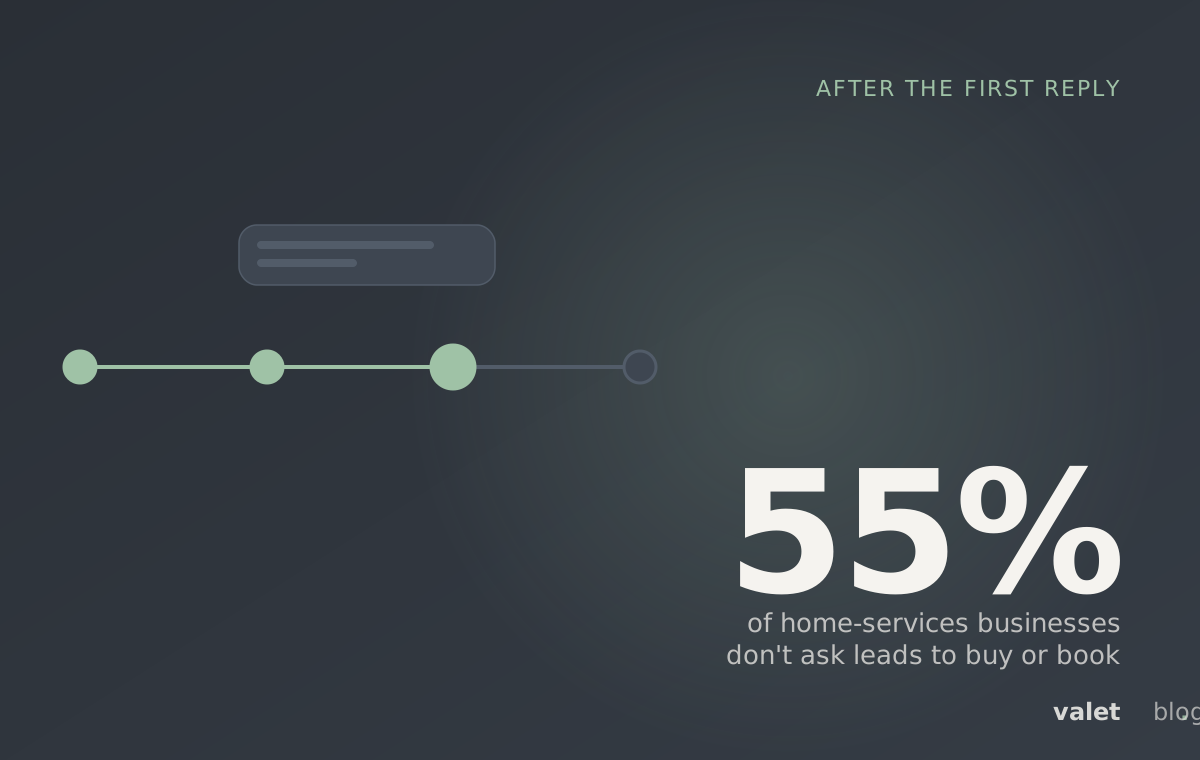
A quote email that gets a reply states the price plainly, says what it includes and when it expires, asks for the booking, and offers two or three real times the customer can accept in one word. Most quotes skip the ask: Invoca's 2026 benchmarks found 55% of home-services businesses don't ask leads to buy or book, and Pied Piper's 2026 mystery shop found an appointment offered in only 28% of interactions.
55%
of home-services businesses don't ask leads to buy or book
Invoca benchmarks, Jul 2026
28%
of interactions included an offer of an appointment; one top brand did it over 70% of the time
Pied Piper PSI, 3,211 locations, Apr 2026
5
vendors per category that couples contact on average
WeddingPro, From Hello to Hired
A quote email that gets a reply does four things: it states the price plainly, says what the price covers and when it expires, asks for the booking, and offers two or three real times the customer can accept with a one-word answer. Most quotes stop after the first two. Invoca's July 2026 benchmarks found that 55% of home-services businesses "don't ask leads to buy or book the job"1. Pied Piper's 2026 mystery shop of 3,211 home-services locations found an appointment was offered in only 28% of interactions2.
The usual reading of a silent quote is that the price was wrong. The data supports a different reading: the quote gave the customer nothing to say yes to. This piece sets out the evidence, an annotated template, and how quoting is likely to change as AI assistants start reading quotes on customers' behalf.
Why do quote emails go unanswered?#
Quote emails go unanswered mainly because they end with information rather than a decision. A customer who receives a price and a PDF has to do three things before replying: decide, find a time, and write a message. If any step stalls, silence is the cheapest response.
Competition makes the stall worse. WeddingPro reports that couples contact five vendors per category on average, and that 77% say pricing is the most important factor they consider before contacting a vendor4. A customer comparing five quotes will not write five considered replies. Owners see the result without the mechanism. In a Jobber Community thread from about August 2026 titled "Why do clients disappear after asking for a quote?", one answer offers "people get busy, they lose track of their messages, or they get overwhelmed and put off making a decision", and another "usually it is because they have a better quote"5.
Both explanations can be true at once. The first is the one a quote email can change. A customer who is busy or overwhelmed will answer "B" to a question with two options far more readily than "let me know what you think" with none.
What the 2026 data says about asking for the booking#
Asking for the booking is a behaviour, and the 2026 data shows it varies enormously between businesses doing the same work. That variance is the strongest signal in this topic, because it means the gap is learnable rather than structural.
| Finding | Source, sample, date | Reading |
|---|---|---|
| 55% of home-services businesses don't ask leads to buy or book | Invoca, home-services slice of a 70M+ call dataset, Jul 20261 | Phone, but the same omission appears in written quotes |
| An appointment was offered in 28% of interactions overall | Pied Piper PSI, 3,211 locations, 31 brands, Oct 2025–Jan 20262 | The baseline for "offered a time" |
| Customers calling the top-ranked brand were offered an appointment over 70% of the time | Same study2 | The same industry can do it more than twice as often |
| 72% of leads got no follow-up at all | Same study2 | A quote without an ask is usually also the last message |
Wedding-trade advice reached the same conclusion from practice. Aisle Planner tells planners to "schedule a short follow-up phone call before you send the proposal", because "scheduling the phone call before you send the proposal can help ensure they give you a yes or no and not just disappear"3. The principle generalises: the next step should exist before the customer finishes reading the price.
The anatomy of a quote email that gets a reply#
A quote email that gets a reply has six parts, each doing one job. The template below shows them in order; the table after it explains each part. Fill the brackets from your own price list and calendar, never from memory.
Subject: Your quote for [job, date or event]: $[total], and two times to confirm

Hi [first name],

Thanks for asking about [their request, in their words:
e.g. "a four-hour shoot on Saturday 14 June"].           [1]

The price is $[total]. That covers [main inclusions,
from your price list]. [Extras, if any: "Travel beyond
30 miles is $[x]."]                                     [2]

This quote holds until [date]. After that I can't
promise [the date / the price / the crew].              [3]

Would you like to book it?                              [4]

I've held two times for a short call to confirm details:
  A) [Tue 3 June, 10:00]
  B) [Wed 4 June, 16:00]
Reply A or B and it's yours. Both are held until
[Thu 18:00].                                            [5]

If something doesn't fit (budget, date, scope), tell me
which one and I'll say what I can change. And if you've
gone another way, just say so and I'll close this out.  [6]

[Your name]
[Business name] · [phone]
| Part | Job | Why it matters |
|---|---|---|
| [1] Their words | Shows you read the request | A customer comparing five vendors needs to see this quote is for their job |
| [2] Price in the body | Answers the question they asked | 77% of couples rank pricing first4; a price hidden in an attachment is a price unread on a phone |
| [3] Expiry | Makes the quote honest about time | Gives your second follow-up a real reason to exist |
| [4] The ask | Requests a decision | The step 55% of businesses skip1 |
| [5] Held times | Turns a decision into a one-letter reply | Offered in only 28% of interactions2 |
| [6] Easy no | Gives silence an alternative | A customer who can decline in one line is less likely to vanish |
Part 5 is the hardest to do by hand. A held time means the slot is blocked in your calendar until the hold expires, so it cannot be offered to anyone else. Without that, "A or B" becomes a promise you may not keep. With it, the customer's one-letter reply is a booking.
Should you offer real times or a booking link?#
Real, held times outperform a booking link on effort, though no public study has measured the difference for quotes. The argument is mechanical. A link asks the customer to open a page, read a calendar and choose; named times ask them to type one letter. A link also shows every open slot, which tells a high-value customer how empty your diary is.
The trade-off is calendar discipline. Two or three held times per open quote, each with an expiry, must be released automatically or your calendar fills with ghosts. A sensible default is to hold for 48 hours, say so in the email, and release the slot without asking. Keep a booking link as the fallback line for a customer who wants a different time.
Where quoting is heading: three scenarios to late 2027#
Quote emails are about to gain a second reader. AI assistants already ask businesses for prices on customers' behalf: Invoca reported in December 2025 that pricing-request calls from Google's AI rose 324% from October to November, that 26% of them went unanswered, and that 48% of the answered calls gave no price6. BrightLocal's 2026 survey found the share of consumers who used AI for local recommendations rose from 6% to 45% in a year7. The question is how fast that behaviour reaches the quote itself.
At the same time, the first reply is being commoditised. Thumbtack's Front Desk replies to messages within an average of two minutes8. Perfect Venue's First Reply answers contact-form inquiries automatically, and its help centre states that "everything after that is you"9. When the complement to a product becomes free, value moves to what remains scarce. Here, what remains scarce is the quote that closes: a price from real facts, an ask, and a held time.
Base case: the human-read quote with held times wins#
If AI assistants keep acting mainly as researchers, gathering prices and shortlisting, then customers still read and decide on quotes themselves. The businesses that win are the ones whose quote asks and offers times. The template above is the whole strategy. The diffusion curve here is slow: it moves at the speed of owners changing habits.
Acceleration: assistants accept quotes for customers#
If assistants start replying to quotes for their users, structure matters more than tone. An assistant can act on "$2,400, holds until 12 June, reply A or B" and cannot act on "let me know your thoughts". Quotes with the price in the body, a dated expiry and named times become the ones an assistant can complete. The leading indicator is inquiries arriving from assistants rather than people; Invoca's figures above are the first trace of that in phone data.
Structural stall: holds stay manual#
If owners do not connect quoting to their calendars, held times remain rare and the 28% baseline barely moves. Trust is the bottleneck in this scenario, not technology. Bluehost's 2026 survey of 350 small businesses found 16% had deployed AI and only 6% highly trusted it with their brand voice10. In that world, the advantage goes to the minority who hold times by hand.
| Indicator | Points toward | Where to watch |
|---|---|---|
| Share of your inquiries written by an AI assistant for a customer | Acceleration | Your own inbox; phone-call studies such as Invoca's |
| Share of your quotes that include an ask and held times | Base case (your position within it) | Last 20 quotes sent |
| Reply rate on quotes with held times vs without | Whether part 5 earns its effort | Your own sent folder, tagged by type |
| Owner trust and adoption of AI for customer replies | Stall if flat | Annual small-business surveys |
| Next Pied Piper "offered an appointment" baseline | Industry-wide movement | Their 2027 home-services study |
This forecast expires on 1 April 2027. Revisit it sooner if a major assistant starts booking services by email, or if a new mystery-shop study moves the 28% baseline.
How to tell whether your quote emails are working#
Your quote emails are working when the reply rate on quotes rises and the share closed with a reason replaces the share that simply went quiet. Reply rate is a leading indicator; bookings are the lagging one. Track both.
- Tag the last 20 quotes. For each, note whether it contained an ask (part 4) and held times (part 5).
- Record the outcome. Replied, booked, declined with a reason, or silent after your follow-ups.
- Compare the two groups. Twenty quotes is a small sample, so treat the result as direction, not proof.
- Change one thing at a time. Add the ask first, then held times, so you can see which one moved the number.
No public dataset yet compares reply rates for quotes with and without a held time. Valet has not published this figure; it is something Valet could measure from free lead checks, with owners' consent. When a quote does go quiet, the next message matters; see how many times to follow up before you stop and why couples ghost after pricing.
Where Valet fits#
Valet is a small business's own AI assistant for written inquiries. When a customer asks for a price, it answers only from your own price list, packages and policies, offers real times from your calendar, holds them and sends invites when one is accepted. It touches only the calendar events it created. If a customer goes quiet, it follows up at most twice, using the hold or the quote expiry as the reason, and then stops and tells you why. Discounts and haggling always come to you.
If you want to see how your recent quotes performed, the free lead check takes 10–20 recent inquiries and shows what went unanswered, what stopped after one reply, and what it was worth.
Questions people ask
What should a quote email include?
The total price, what it covers and what costs extra, the date the quote expires, a direct ask to book, and two or three real times the customer can accept with a one-word reply. Add one line inviting them to say what does not fit, so silence is not their only way to decline.
Should I put the price in the email or attach a PDF?
Put the total and the main inclusions in the body of the email and attach the full document if you have one. A customer reading on a phone, or an AI assistant summarising for them, should see the price without opening anything.
Is it pushy to ask for the booking in a quote?
No. Asking is the missing step in most quotes: Invoca found 55% of home-services businesses never ask leads to buy or book (2026). A plain ask with real options reads as service; pressure comes from repeated, empty follow-ups.
Should I send a booking link or offer specific times?
Offer two or three specific times and hold them for a stated period. A link moves the work back to the customer; named times let them reply with one letter. Keep the link as a fallback for customers who want a different slot.
How long should a quote be valid?
Long enough for the customer to decide and short enough to be honest about your availability, for example one or two weeks. State the expiry date in the email, and use it as the reason for your second follow-up.
Sources
Confidence: H primary source checked · M credible secondary or reported · L vendor claim or single report. Reddit and forum items are quoted from public threads and summarised, not endorsed.
- The Invoca Home Services Lead Conversion Benchmarks Report 2026 · Invoca · 2026-07 H
- Precision Garage Door Ranked #1 in Customer Lead Handling Effectiveness Home Services Study (Pied Piper PSI 2026) · Pied Piper Management Company via BusinessWire · 2026-04-12 H
- Beating the ghosting game: how to handle and minimize getting ghosted · Aisle Planner · undated L
- From Hello to Hired: your guide to lead replies · WeddingPro · undated H
- Why do clients disappear after asking for a quote? · Jobber Community · c. 2026-08 M
- New Invoca study finds pricing request phone calls from Google's AI surged over 300% in November · Invoca · 2025-12-10 H
- Local Consumer Review Survey 2026 · BrightLocal · 2026 H
- 3 takeaways from the 2025 Pro Summit · Thumbtack · 2025-11-06 H
- First Reply: automated responses to new inquiries · Perfect Venue Help Center · 2026-10 H
- State of Small Business AI Confidence 2026 (n=350) · Bluehost · 2026 H
How to cite this page
Cite this page
Valet, "How to write a quote email that gets a reply: ask for the booking, offer real times", valet.team, October 2026.
Keep reading
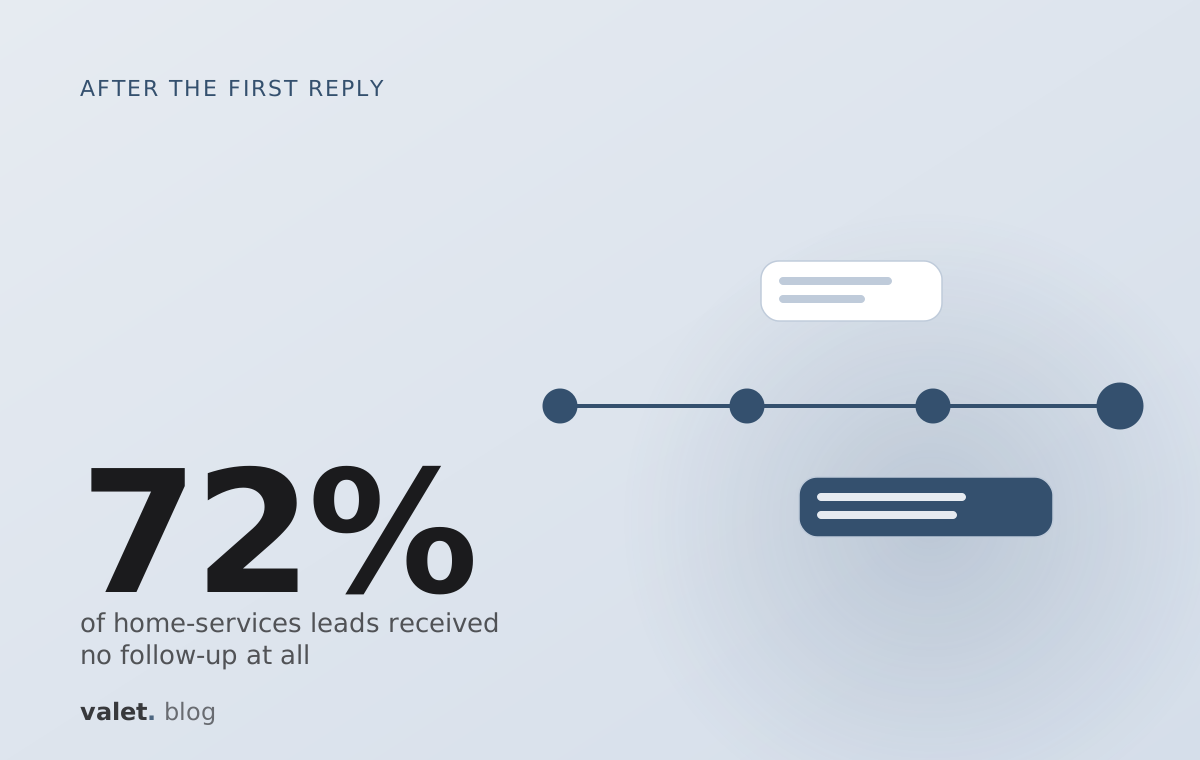
 After the first replyThe first reply is now free. The follow-up is where 72% of leads die.Meta, Google and the inquiry tools now answer the first message for you. The money is lost in the days after it, and almost nobody sells that part.From the Valet team · 11 min · 1 October 2026
 After the first replyHow many times should you follow up with a lead before you stop?A written standard for following up on inbound inquiries: what counts as a follow-up, what each nudge must contain, when the sequence must stop, and how to close a lead with a reason instead of letting it fade.Policy desk · 11 min · 1 October 2026
 After the first replyWhy leads go silent after you send a quote (and what it actually means)Silence after a quote is usually read as a verdict on price. The base rates say it is more often an unfinished conversation, and the thread itself carries signals that tell you which kind you have.Trends desk · 9 min · 1 October 2026