
After the first reply
How to follow up without being pushy (what customers say they tolerate)
Owners worry about sounding desperate; customers complain about vendors who won't stop. Read side by side, the two complaints point at the same defect, and it is not the number of messages.
Short answer
A follow-up reads as pushy when it carries no new information and gives the customer no easy way to say no. Fix both: make every nudge add one useful thing (a held time, an answer, a missing detail, an expiry), send it in the channel the customer used, stop after two or three, and end with a close-out that makes declining cost one word. Gmail asks senders to keep reported spam below 0.10% and never reach 0.30%.
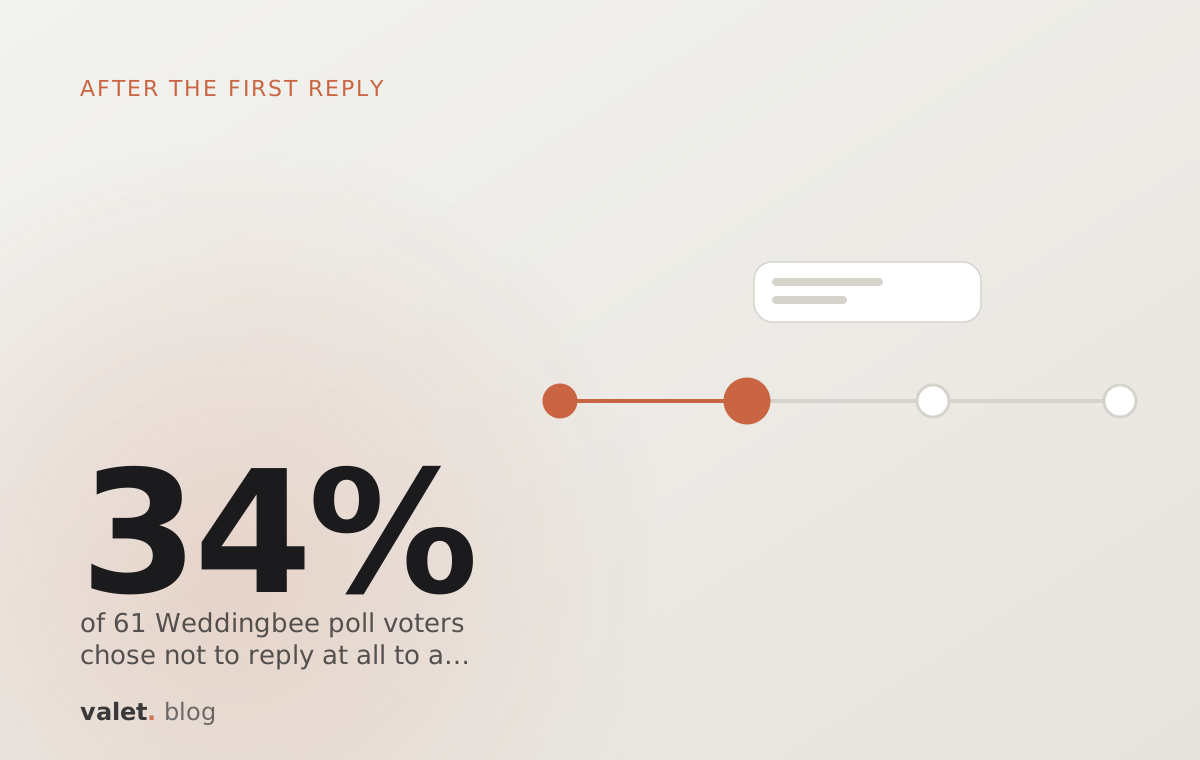
34%
of 61 Weddingbee poll voters chose not to reply at all to a vendor they were not hiring
Weddingbee boards poll, c. 2023
0.30%
spam-report rate Gmail tells all senders never to reach (target below 0.10%)
Gmail Email sender guidelines, in force since 1 Feb 2024
72%
of home-services leads got no follow-up at all
Pied Piper PSI, 3,211 inquiries, Apr 2026
A follow-up reads as pushy when it carries no new information and leaves the customer no cheap way to say no. The count matters less than owners fear. The fix has four parts: every nudge adds one useful thing, it arrives in the channel the customer chose, the sequence stops after two or three, and the last message makes declining cost one word. This article traces the complaint from both ends, owners and customers, and ends with a nudge spec and a close-out message you can copy.
The symptom: owners fear it, customers report it#
The "pushy" problem shows up as two complaints that never meet. Owners describe the fear before sending. A thread in r/sales titled "What's the best way to follow up without sound desperate" (50+ comments, about a year old) opens with: "I know I sound super desperate when I send a quick email a few days later after hearing nothing from a lead." Customers describe the result after receiving. An r/weddingplanning thread titled "Videographer won't leave me alone." (30+ comments, about a year old) is that complaint in five words.
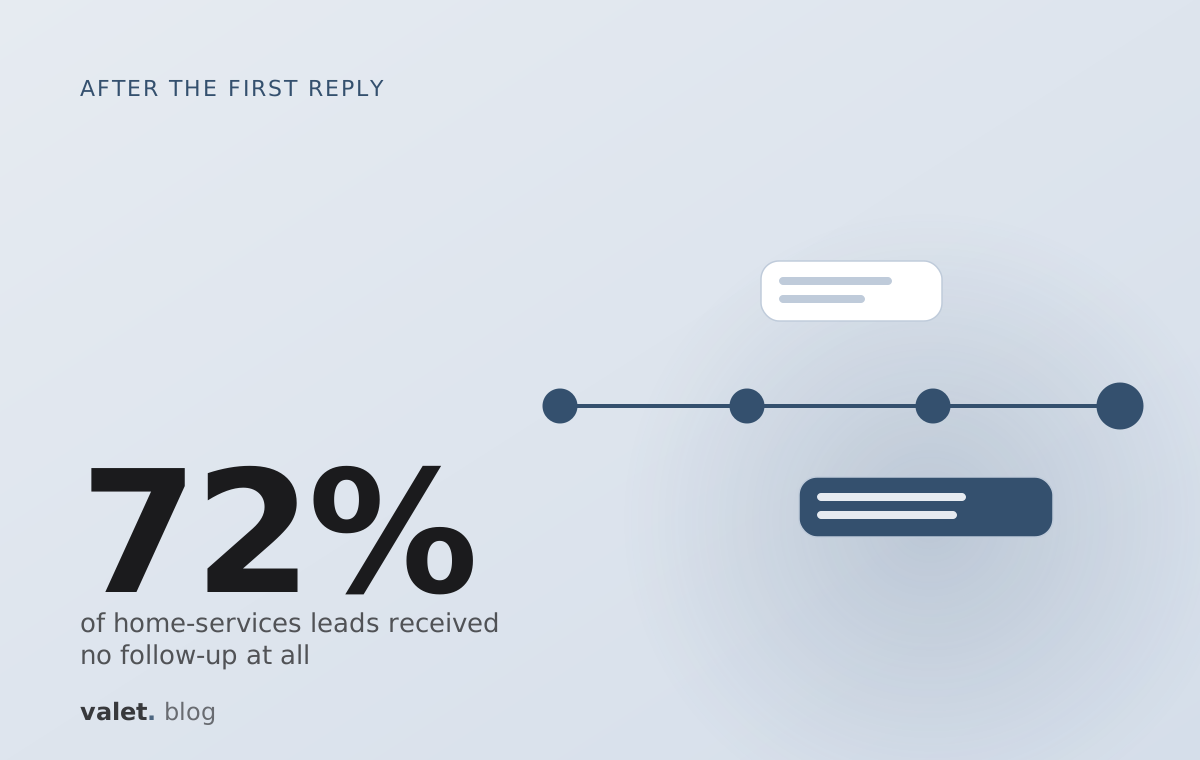
The cost of the fear is measurable; the cost of the complaint mostly is not. In Pied Piper's 2026 mystery shop of 3,211 home-services inquiries, 72% received no follow-up at all6. For most small businesses, under-following-up is the larger and more common failure. The aim here is not to send fewer messages. It is to send ones that do not trip the customer's pressure detector.
A follow-up is a small system with five parts#
A follow-up message is easier to debug when it is described as a system rather than a tone. It has a trigger, a payload, a channel, a cadence and an exit condition. "Pushy" is the customer's report that one of those parts misfired.
| Part | Correct state | Failure the customer reads as "pushy" |
|---|---|---|
| Trigger | The customer went quiet mid-conversation (asked, got an answer, stopped) | Sending after the customer already said no, or chose someone else |
| Payload | One new, useful item: a held time, an answer, a missing detail, an expiry | "Just checking in" with nothing they did not already have |
| Channel | The channel the customer used to reach you | A phone call to someone who emailed, days after the fact |
| Cadence | Two or three nudges, spaced days apart | No upper bound; "until they say no" |
| Exit | A close-out message, then stop and record a reason | Silence that never resolves, or a guilt-trip "last chance" email |
The count question (how many is too many) belongs to the cadence row and is covered in how many times to follow up with a lead. This article is about the other four rows, where most of the pressure comes from.
What do customers say they tolerate?#
Customer-side statements about follow-up are scattered and mostly old, but they agree on more than the owner-side advice does. The compiled set below is everything we could verify verbatim; forum posts are self-reported and unrepresentative, so read them as failure reports, not as a survey.
| What was said | Where, when | Which part it points at |
|---|---|---|
| A call "within a couple of days" was acceptable, but "if I received a phone call more than 3 or 4 days after, chasing me up as a potential customer, I'd probably feel pressured"; advised to "chase up with email or letter, not phone" | Customer replying in a PavingExpert contractors' thread, Feb 20131 | Channel and timing |
| "I don't really want any pestering or further contact unless I ask for it" | UK Business Forums, Oct 20062 | Payload (contact without a reason) |
| "If you don't respond, he may keep sending you follow-up emails." | Weddingbee boards, couples' thread, c. 20233 | Exit (no end in sight) |
| "I would understand the follow ups if we ghosted him after our initial call" | r/weddingplanning, "Videographer won't leave me alone." (30+ comments, about a year old) | Trigger (writing without a conversation to continue) |
| "a 4th email starts feeling creepy" | A Reddit user quoted by Apollo, 20264 | Cadence |
The Weddingbee thread also carried a poll, and it is the only customer-side count we found. Of 61 votes on whether to answer a vendor they had decided against, 21 (34%) chose not to reply at all, 25 (41%) chose to reply "but lie about why you won't be using their services," and 15 (25%) chose to explain3. Sixty-one forum voters is a tiny, self-selected denominator. The direction is still useful: most of these customers found it easier to vanish or to make something up than to say the true reason.
The measurable signal: the spam button#
The one place "pushy" becomes a number is the recipient's spam button. Gmail's sender guidelines tell every sender to keep "spam rates reported in Postmaster Tools below 0.10%" and to "avoid ever reaching a spam rate of 0.30% or higher"5. The same page requires all senders to authenticate with SPF or DKIM, and requires high-volume senders (5,000+ messages a day) to add DMARC and one-click unsubscribe headers per RFC 80585.
A small business replying to its own inquiries is nowhere near the high-volume tier, so the one-click unsubscribe rule does not bind it. The spam signal still applies to every message from its domain, including quotes and invoices. Apollo reports that a fourth touch raises spam-complaint risk against Google's threshold4; that is a vendor's claim without a published sample, and outbound rather than inbound. The mechanism is plain enough without it: a customer who finds no easy way to decline has one button that always works.
Three hypotheses that don't explain "pushy"#
Three common explanations each describe part of the problem and fail as root causes. Each one predicts something the evidence above does not show.
- "It's the number of messages." If count were the cause, the second message would be the offensive one. The customer statements above do not complain about a second message; they complain about messages after a decision, with no end, or with no reason. The r/weddingplanning poster accepted follow-ups in principle and objected to their trigger.
- "It's the timing." Timing matters, but in the PavingExpert reply it matters jointly with channel: a call within two days was fine, a call after four days was pressure, and email was preferred throughout1. Change the channel and the same delay reads differently.
- "It's automation." WeddingPro warns against "generic, disingenuous automated messages"7, which locates the defect in "generic", not in "automated". A hand-typed "just checking in" fails the same way. A system-sent message that carries the customer's date, a held time and an expiry does not.
The root cause: a zero-information payload with no exit#
The common defect in every complaint is a follow-up whose payload the customer already has, sent into a sequence with no visible end. A message with new information reads as service: the customer learns something, such as that Saturday the 14th is held until Friday. A message without it reads as a reminder that the business wants money. Repeat the second kind with no stated end and the customer's options shrink to ignoring, lying, or reporting spam.
The owner-side fear has the same root. The r/sales poster felt desperate because the planned message said nothing new. Owner-side advice that works tends to add information or an exit. A Jobber Community answer from August 2026 recommends a short "Are you still looking to get your [service] done?" and reports it "gets a response nearly 80% of the time"8. That rate is one owner's report, not a measurement, but the line works for a structural reason: it asks a yes/no question that is cheap to answer.
The illustration's nudge adds a fact (the light at 16:00), restates the held time and its expiry, and makes "no" a two-word reply. The prices and times in it are invented for the example.
The fix: a nudge spec and a close-out message#
The fix is a short spec each follow-up must pass before it is sent, plus one close-out message that ends the sequence with a clear stop. Both fit on a card.
- Trigger check. The customer asked, got an answer, and went quiet. They have not declined, booked elsewhere, or asked you to stop.
- New-information check. The message contains one item they do not have yet: a held time, an answer to a question they asked, the one detail you need to quote, or the date something expires.
- Their-words check. It names their request as they put it: the date, the room, the job.
- Channel check. It goes out in the channel they used. No phone call to an email inquiry unless they asked for one.
- Exit check. It contains a line that makes declining take one word.
- Cap check. It is the first or second nudge, or a third with something that changed. After that, send the close-out and stop.
Subject: Re: [their original subject]

Hi [name],

I'll stop writing after this one, so here's where things stand on [their date / job]:
- [the held time or quote] is held until [day, time]
- after that I'll release it to the next inquiry

If you'd still like it, reply "yes" and I'll confirm. If you've gone another way, a one-word "no" is completely fine, and it helps me plan.

Thanks for thinking of us,
[name], [business]
The close-out works on the Weddingbee poll's finding: customers who decided against a vendor mostly vanished or made up a reason3. A message that announces its own end, and treats "no" as useful, lowers the cost of the honest answer. It also gives you a reason to record when the inquiry closes.
Trade-offs and residual risk#
Capping and closing loses some replies, and that cost should be stated. In Belkins' 2026 analysis of 7.53 million B2B outbound emails, 58.6% of replies came from steps two to six, and its "sweet spot" runs to three to five steps including the first9. Outbound cold email is a different population from inbound inquiries, but the direction is clear: each step you remove forfeits some replies. The close-out also ends a few slow-burn inquiries that would have come back unprompted months later.
Two residual risks remain after the spec is in place. A message with new information can still land badly if the customer already decided and did not say so, which no sender can detect. And a domain with weak authentication can have legitimate follow-ups filtered regardless of content; Gmail's SPF-or-DKIM requirement applies to all senders5.
How to test your own follow-ups#
Testing a follow-up sequence takes about twenty minutes and needs only your sent folder and a phone. Run it on the last ten inquiries that went quiet.
- Diff each nudge against the previous message. List what is new. If the list is empty, the nudge fails the payload check.
- Check the trigger. Did any nudge go to someone who had already declined or booked elsewhere? That is the "won't leave me alone" case.
- Read it on a phone. Long nudges hide the one useful line; keep it near the top.
- Find the exit. Can the customer decline in one word? If the only way out is silence, expect silence.
- Count to the end. Did every quiet inquiry reach a close-out and a recorded reason? If not, some are still "open" in your head and nowhere else.
For what the second and third messages can say in specific situations, see what to say when a customer doesn't respond to a quote.
Where Valet fits#
Valet applies this spec by default. The Valet follow-up cap is two nudges per inquiry, and each must carry something useful: a held time, a missing detail, or a quote expiry. Valet answers only from the owner's own price list, calendar and policies, sends from the owner's own address, and signs every message as the business's AI assistant. When the cap is reached, Valet stops, tells the owner why, and the inquiry closes with a reason under the Valet Inquiry States. Each message has a Valet receipt showing what was asked, the rule used and the sources it drew on.
To see how your own follow-ups read, the free lead check takes 10–20 recent inquiries and shows what went unanswered, what stopped after one reply, and what it was worth.
Questions people ask
Is it rude to follow up twice?
No, if each message adds something the customer can use, such as a held time, an answer to their question or a quote expiry. Customers in public forums complain about vendors who keep writing after a decision or with nothing new, not about a second message as such.
How do you follow up without sounding desperate?
Reference what the customer asked in their own terms, add one new useful item, give one next step, and include a line that makes saying no easy. Desperation reads from empty check-ins and from follow-ups with no end in sight.
How do I politely end a follow-up sequence?
Send a short close-out that states you will stop writing, keeps the offer open on their terms, and lets them decline in a word. Then stop and record why the inquiry closed.
Should I follow up by phone or email?
Follow up in the channel the customer used unless they asked for a call. In a 2013 PavingExpert thread, a customer said a call within a couple of days was fine but a call more than three or four days later would make them feel pressured, and preferred email.
Sources
Confidence: H primary source checked · M credible secondary or reported · L vendor claim or single report. Reddit and forum items are quoted from public threads and summarised, not endorsed.
- How long do you leave it to follow-up a quote? (thread) · PavingExpert Brew Cabin forum · 2013-02-17 M
- Quote follow ups - how to? · UK Business Forums · 2006-10-16 M
- Choosing whether to respond or not to a vendor's email? · Weddingbee boards · c. 2023 M
- How to improve reply rates through strategic follow-up emails · Apollo · 2026 L
- Email sender guidelines · Gmail Help (Google) · retrieved 2026-10-01 H
- Precision Garage Door Ranked #1 in Customer Lead Handling Effectiveness Home Services Study (Pied Piper PSI 2026) · Pied Piper Management Company via BusinessWire · 2026-04-12 H
- Still waiting to hear from a lead? Here's why · WeddingPro · 2018 (modified 2026-09-02) M
- Why do clients disappear after asking for a quote? · Jobber Community · 2026-08 M
- Sales follow-up statistics · Belkins · 2026 M
How to cite this page
Cite this page
Valet, "How to follow up without being pushy (what customers say they tolerate)", valet.team, October 2026.
Keep reading
 After the first replyThe first reply is now free. The follow-up is where 72% of leads die.Meta, Google and the inquiry tools now answer the first message for you. The money is lost in the days after it, and almost nobody sells that part.From the Valet team · 11 min · 1 October 2026
 After the first replyHow many times should you follow up with a lead before you stop?A written standard for following up on inbound inquiries: what counts as a follow-up, what each nudge must contain, when the sequence must stop, and how to close a lead with a reason instead of letting it fade.Policy desk · 11 min · 1 October 2026
 After the first replyWhy leads go silent after you send a quote (and what it actually means)Silence after a quote is usually read as a verdict on price. The base rates say it is more often an unfinished conversation, and the thread itself carries signals that tell you which kind you have.Trends desk · 9 min · 1 October 2026