
Weddings & events
Engagement season for vendors: the January inquiry flood and the leads that die in it
January is when couples who got engaged over the holidays start writing to venues, photographers and planners. The first reply usually goes out. The second one is what the flood washes away.
Short answer
January is the busiest month for event leads: Tripleseat's 2026 report, built on 4.4 million events booked in 2025, names it the top month for event creation and reports leads up 9% year on year. Indigo Digital (2026) adds that the Christmas and New Year weeks drive a disproportionate share of a venue's yearly inquiries. Leads in that flood rarely die unanswered; they die after one reply, when nobody sends the second message. Prepare prices, dates and a hold policy before 26 December.
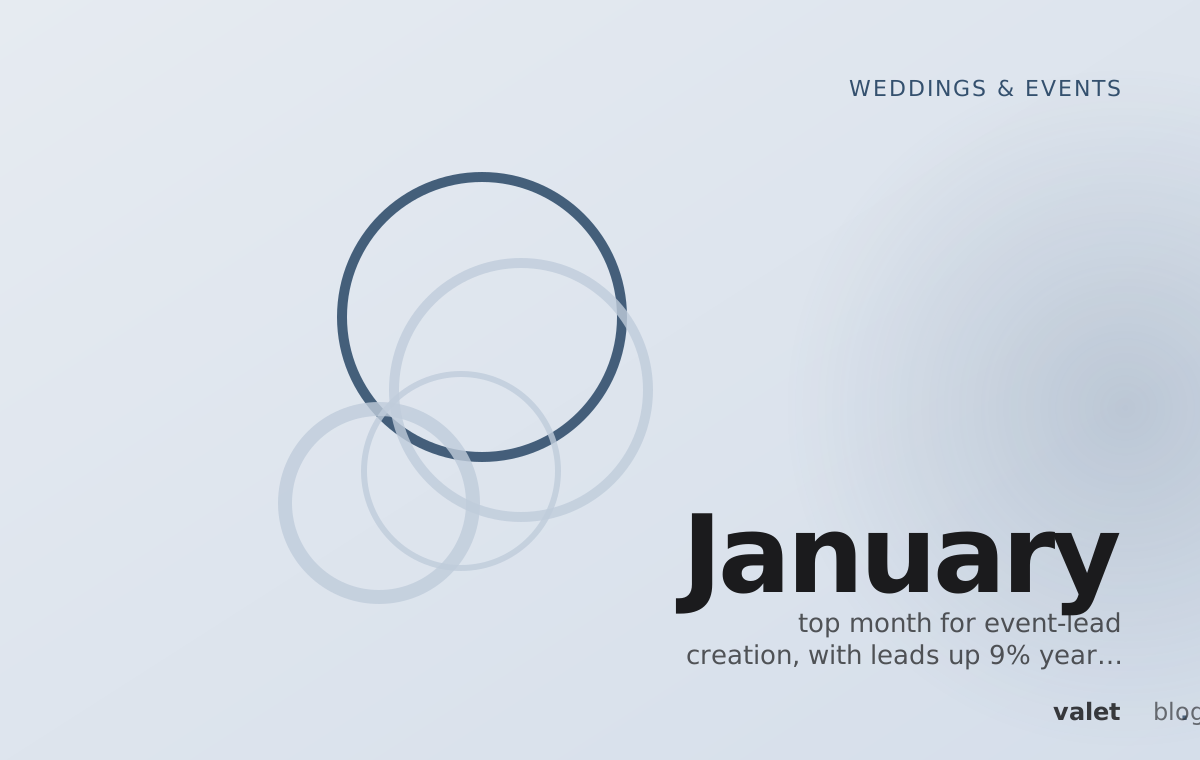
January
top month for event-lead creation, with leads up 9% year on year
Tripleseat Event Intelligence Report, 4.4M events, 2026
1 in 5
qualified venue inquiries that become a booking
Indigo Digital, August 2026
$12,900
average couple spend on a reception venue
The Knot Real Weddings Study, n=10,474, 2026
January is the busiest month of the year for event leads. Tripleseat's 2026 Event Intelligence Report, built on 4.4 million events booked through its platform in 2025, names January as the top month for event creation and reports leads up 9% year on year.1 Indigo Digital, a venue marketing agency, says the Christmas and New Year weeks drive a disproportionate share of a venue's annual inquiry volume.2 The leads in that flood rarely die unanswered. They die after the first reply, when the second message never goes out.
This post separates what the evidence establishes about engagement season from what merely circulates, identifies which vendors absorb the flood first, and closes with a must/should/may readiness matrix that a venue, photographer or planner can complete before 26 December.
When is engagement season, and what does the evidence establish?#
Engagement season is the trade name for the holiday weeks when many couples get engaged, and for the January inquiry surge that follows them. The concept is well established in trade education; the numbers attached to it are of uneven quality, and a vendor planning staff time around them should know which is which.
The status table below classifies each claim the way a regulator classifies a rule: in force (supported by a dated primary source), reported (secondary or single-vendor), or untraced (no primary source found). The distinction matters because the most-repeated statistic about engagement season sits in the third column.
| Claim | Source and date | Status |
|---|---|---|
| January is the top month for event-lead creation; leads up 9% year on year | Tripleseat 2026 report, 4.4M events in 2025, all event types | Reported (platform data, not wedding-only) |
| Christmas and New Year weeks drive disproportionate annual inquiry volume; compare year on year, not month on month | Indigo Digital, 3 Aug 2026 | Reported (agency guidance, no figure given) |
| A large share of inquiries arrive evenings, weekends and public holidays | Indigo Digital, 14 Jul 2026 | Reported (no figure given) |
| 69% of US weddings fall in May to November; October alone is 17%; average engagement is 15 months | MMCG, updated 14 Aug 2026 | Reported (market study) |
| "47% of proposals take place in engagement season" | Jeweler blogs, Dec 2025 | Untraced: no primary source found |
Sources: Tripleseat1; Indigo Digital23; MMCG4; jeweler blog10.
The 47% figure appears on jeweler marketing blogs each December.10 Our research could not trace it to a survey, a sample size or a year of collection, so it should not appear in a staffing plan or a pitch deck. The January lead peak needs no such support; it rests on booking-platform data.
Which wedding vendors does the January flood reach first?#
The January flood reaches venues first, because couples choose the venue before nearly everything else. WeddingPro's 2026 vendor report found that 82% of couples hired their venue first, and that couples spend about six hours a week researching vendors.6 A photographer, planner or florist feels the same wave a few weeks later, once a date and a place exist.
The applicability funnel for engagement season has three gates. A vendor is fully exposed when all three apply:
- Lead time. MMCG puts venue lead time at 12 to 18 months, and 18 to 24 months for peak Saturdays.4 A couple engaged at Christmas 2026 is shopping for summer and autumn 2027 and 2028 dates in January.
- Ownership. MMCG counts 35,829 US venues, of which 71.8% (25,726) are single-owner businesses.4 In a single-owner business the owner is the inbox, the tour guide and the person who signs the contract.
- Channel. Inquiries arrive through the venue's own address, its website form and listing sites at once, and Indigo reports that a large share arrive in the evening, on weekends and during public holidays.3 The busiest inquiry weeks are the weeks most owners are least at a desk.
Vendors outside these gates are not exempt, only less exposed. A photographer booked 12 months out passes the lead-time gate a little later; a planner with a coordinator passes the ownership gate partially.
Why January leads die after the first reply#
January leads die after the first reply because volume consumes the second message before it consumes the first. Answering a new inquiry is visible and feels urgent. Following up with a couple who went quiet four days ago is invisible, and in a flood week it is the first task to slip.
Three published facts frame the mechanism. Couples contact about five vendors per category, and 77% rank pricing as the most important factor in choosing one (WeddingPro, "From Hello to Hired").7 Outside weddings, Leadferno's 2024 test of 225 small-business contact forms found that 42.6% got no reply at all, and reported that about two-thirds of businesses made a single attempt.8 A wedding CRM vendor, ShootQ, wrote in January 2026 that "most photographers start feeling the strain somewhere between eight and fifteen active clients at once," naming "missed replies" first among the symptoms.9 ShootQ sells software for this problem, so treat that line as a practitioner observation, not a measurement.
Put together, a couple in January is comparing five of you on price, and the vendor who stops after one reply has left the comparison without being told no. For the cadence after the first reply, see how many times to follow up with a lead and why couples ghost after pricing.
What a dropped January inquiry costs a venue#
A dropped January inquiry costs a venue about one fifth of an average booking, which at current spend levels is roughly $2,580. Indigo Digital puts the qualified inquiry-to-booking rate at about 1 in 5,2 and The Knot's 2026 Real Weddings Study, drawn from 10,474 couples, puts average reception venue spend at $12,900.5 Five dropped qualified inquiries therefore equal about one lost booking.
Illustration. Suppose a venue receives 300 qualified inquiries a year, Indigo's figure for a venue booking 60 weddings, and that 100 of them arrive in the 12 weeks after Christmas. That one-third share is an assumption for this example; neither Indigo nor Tripleseat publishes a share. If 20 of those 100 receive one reply and nothing after it, and they would have booked at the average 1-in-5 rate, the season leaves 4 bookings, about $51,600, on the table.
The calculation is deliberately conservative in one respect and generous in another. It ignores the couples who never got a first reply at all, and it assumes a followed-up lead converts at the average rate, which no published study has tested for weddings. The method for replacing the assumptions with your own counts is the Lost Lead Audit.
The engagement-season readiness checklist: must, should, may#
The engagement-season readiness checklist sorts preparation into three tiers, borrowed from regulatory drafting. No statute requires any of it. Here "must" means the January process fails without the item, "should" means the evidence points to it, and "may" means it is a discretionary choice that depends on volume and budget.
| Tier | Item | Done when |
|---|---|---|
| Must | Facts sheet for next year's dates | Prices or starting prices, packages, minimums, guest limits and what is included are written down for 2027 and 2028 dates |
| Must | Open dates and tour slots | The calendar shows which Saturdays are open and at least two tour slots per week through February |
| Must | Date-hold policy | You can state in one sentence how long a date is held, what releases it and whether a deposit is needed |
| Must | Money owner | One named person answers discounts, payment plans and contract changes, with a reply-by time customers are told |
| Must | Follow-up rule | Every inquiry gets up to two follow-ups, each carrying something new (a held tour time, a missing detail, a hold expiry), then a close with a logged reason |
| Should | Tour offered in the first reply | The first reply names two real tour times rather than asking the couple to suggest some (Indigo recommends offering the site visit in the first response) |
| Should | Response-time target | A target is set and measured; Tripleseat's stated goal is every lead within 30 minutes |
| Should | Year-on-year baseline | Last January's inquiry count is on file so this January is compared year on year, not month on month |
| May | Evening and holiday coverage | A person or an assistant answers from the facts sheet outside office hours |
| May | Listing-site budget change | Any increase is decided after the March audit, not before the season |
The two "should" items rest on agency and platform guidance: Indigo recommends offering the site visit in the first response,3 and Tripleseat sets 30 minutes as its response goal.1 Neither publishes a controlled comparison, so they are expectations, not proven thresholds.
If you add an AI assistant before January 2027#
An AI assistant added before January 2027 will answer inquiries in the same month that several US state disclosure laws are reported to take effect. According to a secondary state guide published 19 July 2026, Colorado HB 26-1263, Oregon SB 1546 and Washington's Chatbot Disclosure Act take effect on 1 January 2027, with Colorado and Oregon penalties reported at $1,000 per violation and a private right of action reported in Oregon.11 We have not verified the statute text; confirm scope and thresholds before relying on that summary.
Two obligations follow regardless of the statutes. First, the assistant should say it is AI, in every reply. Second, the business is answerable for what the assistant tells customers: in Moffatt v. Air Canada (2024 BCCRT 149), the tribunal rejected the argument that a chatbot was "a separate legal entity" and ordered the airline to pay CAD $812.02.12 An assistant that invents a hold policy or a discount in January creates a commitment the owner may have to honour in March. This section is not legal advice; check with counsel for your state.
How to find the January leads you already lost#
The January leads you already lost can be found with a two-hour audit in March. Pull every inquiry received between 26 December and 31 March from your own address, website form and listing-site notifications, and sort each into one outcome: never answered, answered once and dropped, time offered, toured, booked, or lost with a reason.
- Collect. Search the inbox for form notifications and listing-site lead emails in the window, and export them to one sheet with date, channel and couple name.
- Classify. Assign each inquiry one outcome from the list above. An automatic confirmation does not count as an answer.
- Compare. Set the counts beside last year's same window, as Indigo advises, rather than beside December.2
- Value. Multiply the "answered once and dropped" count by your booking rate and average booking value.
The "answered once and dropped" row is the one engagement season inflates. If it is larger than the "never answered" row, the fix for next year is the follow-up rule in the matrix, not a faster first reply.
How we got this: the seasonal claims come from the Tripleseat, Indigo and MMCG sources cited above. Valet has not published this figure; it is something Valet could measure from free lead checks, with owners' consent.
Where Valet fits#
Valet is an AI assistant for a small business's written inquiries: email to your own address, website forms, listing-site lead emails and requests on your free Valet page. It answers from your facts sheet, offers and holds real tour times from your calendar, and follows up at most twice by default, each time with something useful. Every inquiry carries one of the Valet Inquiry States (New, Answered, Time held, Followed up, Booked, or closed with a reason), so the March audit is already done. Discounts, deposits and contracts wait for you, and every reply says it is AI.
To see last season's numbers first, use the free lead check: forward 10 to 20 recent inquiries and see what went unanswered, what stopped after one reply, and what it was worth.
Questions people ask
When is engagement season for wedding vendors?
Engagement season usually means the weeks around Christmas and New Year, when many couples get engaged, followed by a surge of vendor inquiries in January. Tripleseat's 2026 report names January as the top month for event-lead creation, and Indigo Digital (2026) says those holiday weeks drive a disproportionate share of a venue's yearly inquiries.
What is the busiest month for wedding inquiries?
January, according to Tripleseat's 2026 Event Intelligence Report, which covers 4.4 million events booked in 2025 and reports leads up 9% year on year. The report covers all event types, not only weddings, so treat it as the best available signal rather than a wedding-only count.
Is it true that 47% of proposals happen in engagement season?
That figure circulates on jeweler blogs, but our research could not trace it to a primary source. Do not plan around it. The January lead peak is better supported by booking-platform data such as Tripleseat's.
How should a venue prepare for engagement season?
Before 26 December, write down your 2027 and 2028 prices and minimums, open tour slots for January and February, set a date-hold policy, decide who answers money questions, and commit to two useful follow-ups per inquiry. Then audit the season in March to see which leads stopped after one reply.
Sources
Confidence: H primary source checked · M credible secondary or reported · L vendor claim or single report. Reddit and forum items are quoted from public threads and summarised, not endorsed.
- The 2026 Event Intelligence Report: Data, Benchmarks, and Blueprints for High Growth Venues · Tripleseat · 2026 M
- Wedding venue lead benchmarks guide · Indigo Digital · 2026-08-03 M
- Response time benchmark for venue enquiries · Indigo Digital · 2026-07-14 M
- The U.S. wedding venue market: an investment thesis for 2026-2030 · MMCG Invest · 2026-08-14 M
- Average wedding vendor costs (Real Weddings Study 2026, n=10,474) · The Knot · 2026-09-29 H
- The Knot vendor report (couples' vendor hiring) · WeddingPro · 2026-08-28 H
- From Hello to Hired: your guide to lead replies · WeddingPro · undated H
- Research: Website Contact Forms and Lead Management, Uncovering Costly Mistakes · Leadferno · 2024-06-28 H
- When your wedding business lives in your inbox, everything slows down · ShootQ · 2026-01-07 L
- Welcome to engagement season, when 47% of marriage proposals take place · The Jeweler Blog (Laura Diamonds) · 2025-12-18 L
- AI chatbot human disclosure laws: a state guide · beancount.io · 2026-07-19 M
- A word of caution: company liable for misrepresentations made by chatbot (Moffatt v. Air Canada, 2024 BCCRT 149) · McMillan LLP · 2024-02 H
How to cite this page
Cite this page
Valet, "Engagement season for vendors: the January inquiry flood and the leads that die in it", valet.team, October 2026.
Keep reading
 Weddings & eventsWhy couples ghost after you send pricing, and what the second message should sayThe usual answers are price, a hidden price list, or a slow reply. The bigger leak is that most vendors send one reply and stop, while the couple is still choosing between five of you.Strategy desk · 12 min · 1 October 2026
 Weddings & events"Our leads from The Knot / WeddingWire never respond": ghost leads, fake leads, or leads nobody followed up?Vendors say the leads are fake. The Knot says they are templated and ghosted. A U.S. senator has asked the FTC to look. None of them has published what happened to each inquiry, and that is the only record that settles it for your listing.Policy desk · 10 min · 1 October 2026
 Weddings & eventsHow many times should you follow up with a couple who hasn't replied? (And when the lead is dead)Wedding advice runs from "one more time than you are now" to "as many times as it takes". Nobody says when to stop. Here is a stop rule, a list of lost reasons, and the three messages that sit between the first reply and the end.People at work · 11 min · 1 October 2026