
Trust & AI handoff
Does telling customers it's AI hurt bookings? What the 2025–26 evidence says
The most-cited number says disclosure cuts purchases by four-fifths. It comes from one 2019 experiment on outbound sales calls. Here is what that study measured, what the 2025–26 evidence adds, and what it costs when customers find out late.
Short answer
The evidence does not show that disclosure hurts bookings from inbound inquiries. The study usually cited (Luo et al., Marketing Science, 2019, 6,200+ customers) found disclosure before an outbound sales call cut purchases by more than 79.7%. Customers there had not asked to talk. Five9's 2025 survey (n=1,006) found 72% open to AI if they can reach a human. And undisclosed bots found out later cost BMW Toronto about CAD $7,163 in 2026.
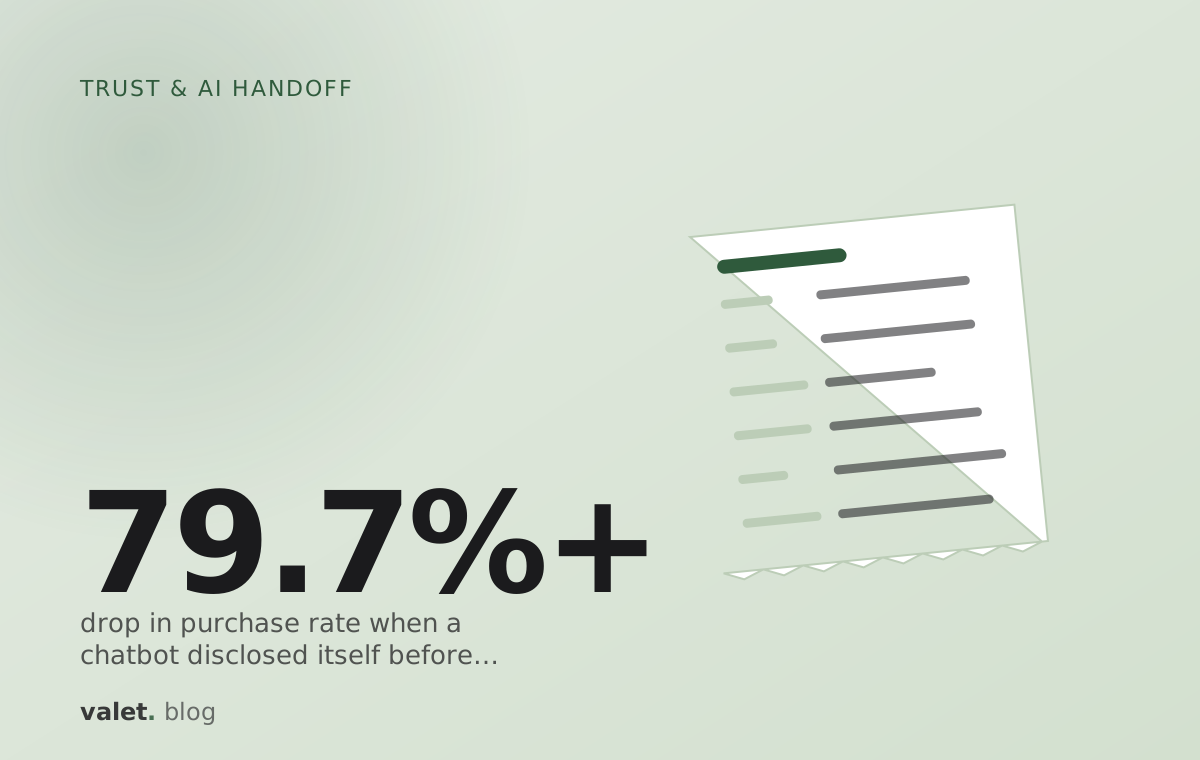
79.7%+
drop in purchase rate when a chatbot disclosed itself before an outbound sales call
Luo, Tong, Fang & Qu, Marketing Science, 2019, 6,200+ customers
72%
of consumers open to AI service if they can escalate to a human
Five9, n=1,006 US/UK/CA, March 2025
59%
of consumers prefer instant AI chat to waiting for an agent
Five9, n=1,006, March 2025
The evidence does not show that telling customers "this is AI" hurts bookings from inbound inquiries. The number usually quoted, a drop in purchases of more than 79.7%, comes from one 2019 field experiment on outbound sales calls, where customers had not asked to talk.1 The 2025–26 evidence points the other way for inquiries a customer starts: 72% of 1,006 consumers were open to AI if they could reach a human.2 And the measurable costs in recent cases came from bots that were not disclosed.
The headline number: 79.7%#
The headline figure is 79.7%. It comes from Luo, Tong, Fang and Qu, published in Marketing Science in September 2019. The design was a field experiment. More than 6,200 customers were randomly assigned to receive "highly structured outbound sales calls" from either chatbots or human workers.1
Three findings matter. Undisclosed chatbots were "as effective as proficient workers and four times more effective than inexperienced workers" at producing purchases. Disclosing the chatbot's identity before the conversation "reduces purchase rates by more than 79.7%." And customers who knew they were talking to a machine were "curt and purchase less because they perceive the disclosed bot as less knowledgeable and less empathetic."1
It is a real experiment with a real denominator. Randomisation makes it stronger than any survey in this piece. It is also the only causal estimate we could find. Everything below either narrows what it applies to or measures something else.
Why that study does not settle the question for inbound inquiries#
The 2019 result measured a different situation from the one most small businesses face. Four differences stand out.
- Direction. The calls were outbound. The business rang the customer to sell. An inquiry to a venue, a photographer or a store runs the other way: the customer wrote first and wants an answer.
- Channel. The study used voice calls. Written replies give the customer time to read a price, a held date and a policy, and to judge the answer on its content.
- Timing. The same abstract says the negative effect "can be mitigated by a late disclosure timing strategy and customer prior AI experience."1 Prior AI experience has changed since 2019. In 2019, few customers had typed a question into a chatbot.
- Scope. The abstract does not name the industry or product. One company's sales script is a narrow base for a rule about every inbox.
None of this says the 2019 effect is zero today. It says the population and the task differ. Applying an outbound-voice estimate to inbound written inquiries is an extrapolation, and the size of the gap is unknown.
What the 2025–26 evidence adds#
The recent evidence is mostly surveys and public cases. Surveys measure stated preference, not behaviour. Read every row below with that limit in mind.
| Finding | Population and denominator | Type | Points toward | Main limit |
|---|---|---|---|---|
| Disclosure before the call cut purchases by more than 79.7% | 6,200+ customers, randomised; 20191 | Field experiment | Disclosure costs sales | Outbound voice sales; pre-2020 AI exposure; one firm |
| Late disclosure and prior AI experience reduce the effect | Same study1 | Field experiment | The effect shrinks with familiarity | Magnitude not given in the abstract |
| 72% open to AI if they can escalate to a human | 1,006 consumers, US/UK/Canada; March 20252 | Survey | Disclosed AI is acceptable with a human path | Stated preference; vendor-run survey |
| 59% prefer instant AI chat to waiting for an agent | Same survey2 | Survey | Speed outweighs the label for many | Same |
| 86% say human connection matters more than speed | Same survey2 | Survey | People still want a person available | Same; sits beside the 59% |
| 64% would prefer companies not use AI for service; 53% would switch | Gartner, as cited by California Management Review; 20263 | Survey (secondary) | AI use itself carries a cost | Gartner primary not read; measures AI use, not disclosure |
| Undisclosed bot found out mid-negotiation: "I feel embarrassed, and I feel angry" | One BMW Toronto customer; June 20264 | Case | Late discovery costs trust and money | n=1 |
| Named bot "Sam" invented a policy; Cursor now labels AI email replies | One company; April 2025; HN thread 1,511 points, 606 comments56 | Case | Undisclosed AI multiplies the damage of an error | n=1; error and non-disclosure are confounded |
Compiled by Valet from the sources cited, October 2026. "Points toward" is our reading of each finding, not the authors' claim.
The Five9 rows deserve a second look. 59% prefer instant AI, and 86% say human connection matters more than speed. Both can be true for the same respondent. The 72% figure resolves the tension: AI is acceptable when a person is reachable.2 That is a condition about the human path, not about hiding the AI.
The Gartner figure is the strongest number against AI service. It measures attitudes toward AI use, not toward disclosure. A business that hides its AI does not escape that 64%. It postpones the moment the customer finds out.3
What it costs when customers find out late#
The cases with a known cost involve bots that were not disclosed. They point to a cost the 2019 experiment could not measure: discovery.
BMW Toronto's bot, Quinn, offered CAD $27,162.79 for a trade-in. The dealer's real best offer was CAD $20,000. The customer found out he had been dealing with a bot only when a salesperson called. The dealer revoked the offer, then reinstated it after media contact.4 The gap was about CAD $7,163, plus a news story.
Cursor's support bot signed its emails "Sam" and told a user about a one-device policy that did not exist. Cursor called it "an incorrect response from a front-line AI support bot," refunded the user, and said AI responses for email support are now "clearly labeled as such."5 One commenter in the 606-comment Hacker News thread pointed at the human name and wrote that "LLMs pretending to be people" and "not labeled as such" is "clearly intended to be deceptive."6
The complaint recurs in public forums. A thread in r/ask on a disclosure law (120+ comments) mentions "emails from bots with names like 'Louis T'."8 A thread in r/artificial titled "Companies should be required to disclose they are using an AI chatbot" drew more than 40.9 On Hacker News in March 2026, the user netsharc wrote: "I would rather just be sent to a regular old answering machine. Dealing with an AI is dehumanizing."7
Confounding is the honest caveat. In both cases the bot also got something wrong. We cannot separate the cost of the error from the cost of the concealment. What we can say is that concealment removed the customer's chance to discount the answer, and made the story worse when it broke.
Competing explanations: is it the label, or the answer?#
Three explanations fit the 2019 drop, and they predict different things for a small business today.
- Bias against machines. Customers discount anything labelled AI. If this dominates, the effect should persist regardless of answer quality. The 2019 authors' own finding that prior AI experience reduces it argues against a fixed bias.1
- Expected competence. Customers assume a disclosed bot knows less, so they ask less and buy less. The study's "less knowledgeable" finding fits here.1 If this dominates, a reply that shows its competence (a real price, a held date, a cited policy) should close most of the gap.
- Fear of being trapped. Customers expect no way out. Five9's 72%-with-escalation figure fits here.2 If this dominates, a disclosure that names the human path ("the owner replies on anything about money") should reduce the penalty.
Only the first explanation implies hiding the AI helps. The second and third imply the content of the disclosure matters more than its existence.
The rules have moved the baseline#
For many businesses, non-disclosure is no longer the comparison that matters. Article 50(1) of the EU AI Act, applicable from 2 August 2026, requires that people be informed they are interacting with an AI system unless that is "already obvious to a reasonably well-informed person."10 Several US states have disclosure laws taking effect from 1 January 2027; the details vary, and our plain-English map of the disclosure rules covers them.
Large platforms disclose by design. Google says its Gemini calling feature, rolling out from September 2026, "will identify itself as an AI assistant calling on the user's behalf" at the start of each call.11 Owners already feel the tension: Bluehost's 2026 survey of 350 US small businesses found 29% named losing the human touch as a top fear about AI, and only 6% highly trust AI with their brand voice.12
How to test disclosure wording on your own inbox#
The useful test for a small business is not disclosure against none. It is one honest wording against another. Both arms disclose in the first message.
- Write two disclosed versions. A: a plain signature line, "Sent by [Business]'s AI assistant." B: the same, plus the human path, "I'm [Business]'s AI assistant. [Owner] replies personally on anything about price changes or special requests."
- Alternate by week, not by customer. Week 1 uses A, week 2 uses B, and so on. This keeps the test simple and stops one customer seeing both versions in the same thread.
- Log three numbers per inquiry. Did the customer reply? Did they ask for a person? Did they book within 30 days?
- Check your denominator before you read the result. To detect a 10-point difference in reply rate around 50%, you need roughly 400 inquiries in each arm (a standard rule of thumb for 80% power). A business with 300 inquiries a year cannot reach that in one season.
- If your volume is small, read direction, not significance. Look at the "asked for a person" rate and at what customers write back. Those tell you which explanation above fits your customers.
What would change our reading: a randomised test on inbound written inquiries showing a large, lasting drop in bookings from disclosure, with a working human path in both arms. Nobody has published one. Valet could run that comparison across many inboxes using its receipts, between disclosed wordings only; it has not done so, and we will not guess at the result.
Where Valet fits#
Every Valet reply is signed as the business's assistant and says it is AI. Valet answers email, website forms and listing leads from the owner's own facts, offers real times from the calendar, and sends money questions, complaints and anything not on the list to the owner, telling the customer when the owner will reply. Each reply has a Valet receipt showing what was asked, the rule used and the sources. If you want to see how fast and how far your current replies go before you change any wording, the free lead check reviews 10 to 20 recent inquiries and shows what went unanswered, what stopped after one reply, and what it was worth. For what happens when a customer asks for a person, see what "never stuck with a bot" has to mean.
Questions people ask
Does telling customers they are talking to AI reduce sales?
In one 2019 field experiment on outbound sales calls (6,200+ customers), disclosure before the call reduced purchase rates by more than 79.7%. No published experiment has measured the same effect on inbound written inquiries, where the customer started the conversation.
Should my chatbot pretend to be human?
No. In the EU, AI systems must tell people they are interacting with AI from 2 August 2026 unless it is obvious, and several US state laws follow from 2027. Bots discovered later, such as BMW Toronto's in 2026 and Cursor's 'Sam' in 2025, produced public stories and costs.
Do customers prefer AI or humans for customer service?
It depends on the question asked. Five9 found 59% prefer instant AI chat to waiting and 72% are open to AI if they can escalate (2025). Gartner, as cited by California Management Review, found 64% would prefer companies not use AI for service (2026).
How can I test whether AI disclosure affects my bookings?
Compare two disclosed wordings, not disclosure against none. Alternate them by week, log reply and booking rates, and keep both arms honest. Most small inboxes need several hundred inquiries per arm to detect a 10-point difference.
Sources
Confidence: H primary source checked · M credible secondary or reported · L vendor claim or single report. Reddit and forum items are quoted from public threads and summarised, not endorsed.
- Frontiers: Machines vs. Humans: The Impact of Artificial Intelligence Chatbot Disclosure on Customer Purchases · Marketing Science 38(6), Luo, Tong, Fang & Qu · 2019-09-20 H
- New Five9 research reveals balancing AI and human connection is key to winning customers · Five9 · 2025-03-13 H
- Chatbot frustration is real: hidden costs and best practices · California Management Review Insights (Ren & Zhang) · 2026-04-28 M
- BMW dealer forced to pay $5,000 extra for used X3 over AI chatbot error · The Drive · 2026-06-20 H
- Cursor AI support bot invents fake policy and triggers user uproar · Ars Technica · 2025-04-17 H
- Cursor support bot discussion (item 43683012) · Hacker News · 2025-04 H
- "I built an AI receptionist for a mechanic shop" (story 47487536) · Hacker News · 2026-03-23 H
- "Would you support a law requiring AI to [disclose]" (120+ comments; Google snippet) · Reddit, r/ask · undated M
- "Companies should be required to disclose they are using an AI chatbot" (40+ comments; Google snippet) · Reddit, r/artificial · c. 2026-09 M
- Article 50, checked · Scrutineyes · 2026 H
- Gemini can now make phone calls for you; Canada has to wait · iPhone in Canada · 2026-09-24 M
- State of Small Business AI Confidence 2026 · Bluehost · 2026 H
How to cite this page
Cite this page
Valet, "Does telling customers it's AI hurt bookings? What the 2025–26 evidence says", valet.team, October 2026.
Keep reading
 Trust & AI handoffThe customer who fired a contractor over a bot: what "never stuck with a bot" has to meanA homeowner dropped a plumber because the AI receptionist could not pass him to a person. The public cases since then show where handoffs break, and what a working one has to promise.Field reports · 11 min · 1 October 2026
 Trust & AI handoffCan a quote from my AI be binding? What BMW Toronto taught every business that prices by emailA chatbot at a Toronto BMW dealer offered a customer about CAD $7,000 more than the dealer meant to pay. The number came from the dealer's own records, in the wrong place. Here is what that means for any business that quotes in writing, and a policy you can copy.From the Valet team · 9 min · 1 October 2026
 Trust & AI handoffWhat to ask an AI vendor before it talks to your customers: 12 questions (limits, handoff, receipts, disclosure, undo, insurance)The demo shows the AI writing a good reply. The questions that decide whether you keep your customers are about what happens when it should not reply at all.People at work · 10 min · 1 October 2026