
Trust & AI handoff
Do I have to tell customers they're talking to AI? The 2026–27 map in plain English, with copy-paste disclosure lines
In the EU, yes, since 2 August 2026, unless it is obvious. In the US it depends on the state, and the main laws start in 2027. One plain disclosure, made at the first message, covers nearly every version. Here is the map and the lines we would use.
Short answer
In the EU, yes: from 2 August 2026, Article 50(1) of the AI Act requires that people be told they are interacting with AI unless it is obvious, with fines up to €15M or 3% of turnover (lower caps for SMEs). In the US it depends on the state; Colorado's chatbot law takes effect 1 January 2027 with penalties reported at up to $1,000 per occurrence. One plain line at the first message covers nearly every rule. Not legal advice.
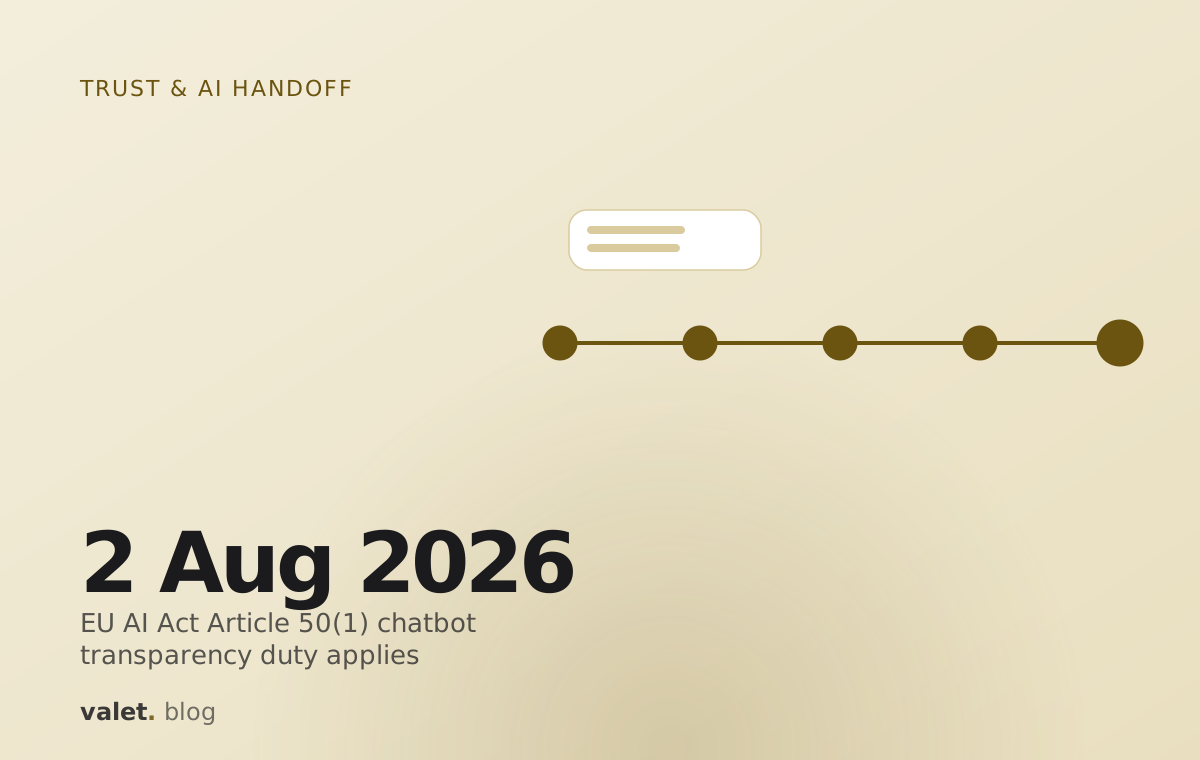
2 Aug 2026
EU AI Act Article 50(1) chatbot transparency duty applies
Scrutineyes, "Article 50, checked", 2026
€15M / 3%
maximum fine under Art. 99 for transparency breaches, with lower caps for SMEs
EU AI Act via Scrutineyes, 2026
$1,000
per occurrence under Colorado HB 26-1263, effective 1 Jan 2027 (as reported)
beancount.io state guide, 19 Jul 2026 (verify statute)
In the EU, yes. From 2 August 2026, Article 50(1) of the AI Act requires that people be told they are interacting with an AI system, unless that is obvious.1 In the US, it depends on the state, and the broad laws start on 1 January 2027.2 The practical answer is the same everywhere: one plain line in the first message, saying it is AI and how to reach a person, covers nearly every version of these rules.
This piece sets out the map as of October 2026, the decision we made at Valet, and five disclosure lines you can paste today. It is not legal advice. Laws in this area change quickly, and several statutes below are summarised from a secondary source. Check your own situation with counsel.
Why we decided every reply says it is AI#
Every Valet reply is signed as the business's assistant and says it is AI. That was a product decision, and it was not free. There is a respectable argument for the other way.
The strongest number against disclosure comes from a 2019 field experiment in Marketing Science. More than 6,200 customers received outbound sales calls from chatbots or people. When the chatbot disclosed itself before the call, purchase rates fell by "more than 79.7%."5 On a spreadsheet, that looks like a reason to stay quiet.
We read it differently, for three reasons. Those were outbound sales calls; an inquiry is a customer asking you something. The same study found the effect shrinks with later disclosure and with customers' prior AI experience.5 And the costs we can actually measure in recent years come from bots that were found out. We weigh that evidence in more detail in does telling customers it's AI hurt bookings.
BMW Toronto's customer learned he had been negotiating with a bot only when a salesperson called. The dealer ended up honouring an offer about CAD $7,163 above its real one.8 Cursor's support bot signed itself "Sam" and invented a policy; afterwards the company said AI email replies are now "clearly labeled as such."7 Neither cost was caused by disclosure. Both were made worse by its absence.
What the EU AI Act requires from 2 August 2026#
Article 50(1) of the EU AI Act is the one general chatbot disclosure duty in force today. In plain English, it says four things.1
- The duty. People interacting with an AI system must be informed that they are, "unless that is already obvious to a reasonably well-informed person."
- The timing. The information must be given "at the latest at the time of the first interaction or exposure."
- Who it falls on. Article 50(1) is written as a duty of the provider of the AI system. Whether a small business using a vendor's tool counts as a provider, a deployer, or neither, is a question for counsel.
- The reach. It applies to systems offered in the EU market, including by businesses based outside the EU.
Fines for breaching the transparency rules can reach €15 million or 3% of worldwide turnover, with lower thresholds for SMEs under Article 99. The European Commission published guidelines on 20 July 2026 and a voluntary Code of Practice on 10 June 2026.1
The US state map for 2026–27#
The US has no single federal chatbot disclosure law. The state laws below are summarised from one secondary guide, beancount.io, dated 19 July 2026 and updated 10 August 2026.2 We did not read the statute text. Treat every row as a lead to check, not a finding.
| State and law | Effective | Who it covers, as reported | Penalty, as reported |
|---|---|---|---|
| Colorado HB 26-1263 (Chatbot Safety Act) | 1 Jan 2027 | "Any public-facing conversational AI"; must disclose it is AI | "Up to $1,000 per occurrence" under the Consumer Protection Act |
| Oregon SB 1546 | 1 Jan 2027 | Described as companion-focused; check whether a customer-service assistant is in scope | "$1,000 in statutory damages per violation"; private right of action |
| Washington Chatbot Disclosure Act | 1 Jan 2027 | Described as following the companion-focused pattern; details not given | Not stated |
| Utah AI Policy Act (SB 149, amended by SB 226) | Not stated in the guide | Disclosure when the user asks directly, or in high-risk interactions involving health, financial or biometric information | Not stated |
| California SB 243 | 1 Jan 2026 | Companion chatbots; "ordinary customer service chatbots are expressly excluded" | Not stated |
| California AB 1609 | Pending | "Large private businesses"; may not represent a chatbot as human | "Up to $5,000 first violation and $10,000 each subsequent," if passed |
| Idaho, Iowa, Nebraska | Not stated | Described as the "widest approach", similar to Colorado | Not stated |
| New York; Tennessee SB 1580 | Nov 2025; 1 Jul 2026 | Companion models; AI presenting as a licensed mental-health professional | Not stated |
Source: beancount.io, "AI chatbot human disclosure laws: a state guide", 19 July 2026, updated 10 August 2026.2 The guide states it "is for general information only and is not legal, tax, or accounting advice." Confidence: M. Verify each statute before relying on it.
Two things stand out. Colorado is the broad one for a business answering customers in writing: any public-facing conversational AI, from 2027. And the penalties are sized per occurrence. For a business sending hundreds of AI replies a month, a per-message penalty is the number that matters, not the cap.
Valet works with businesses in the US and Canada. The research behind this page did not cover Canadian disclosure law, so check that with Canadian counsel. Canada did produce the clearest ruling on who owns a bot's words, which we cover below.
Disclosure is not a liability shield. In Moffatt v. Air Canada (2024 BCCRT 149), the tribunal rejected the argument that the chatbot was "a separate legal entity that is responsible for its own actions," and awarded CAD $812.02.4 Saying "this is AI" tells the customer who wrote the reply. It does not move responsibility for what the reply says.
The principle: one disclosure setup that satisfies every rule#
The rules differ on scope, timing and penalties, but they converge on one behaviour. A founder in r/SaaS, writing about the EU rule, put it this way: "one disclosure setup basically covers all of them."3 The beancount guide reaches the same view: a one-line "You're chatting with an AI assistant" notice at the start, or a persistent label, "satisfies the disclosure requirement in essentially every version of these laws."2
We would go one step further than a label. A disclosure that also names the human path answers the customer's real worry. Five9's 2025 survey of 1,006 consumers found 72% open to AI "provided they can escalate to a human when needed."6 So the operating rule we use has three parts.
- Say it first. The first message names the business and says the reply comes from its AI assistant. This meets the EU "first interaction" timing.
- Say it every time. Every AI-written email carries the line in its signature. Emails get forwarded; the next reader did not see the first message.
- Answer the question truthfully. If a customer asks "am I talking to a bot?", the answer is yes, in the next line. Utah's law, as reported, turns on exactly that question.
Five disclosure lines you can copy today#
The lines below are written for email, forms and chat. Replace the brackets. Keep the words "AI assistant"; avoid giving the assistant a human first name, which is the pattern behind the Cursor complaint.7
1. FIRST REPLY TO AN EMAIL OR FORM INQUIRY (opening line)
"Hi [Name], I'm [Business]'s AI assistant. I can answer from our prices,
availability and policies, and [Owner] reads every conversation."

2. EMAIL SIGNATURE (every AI-written reply)
"[Business]'s AI assistant, on behalf of [Owner].
Written by AI. Reply 'person' at any time and [Owner] will answer."

3. CHAT OR BOOKING-PAGE OPENER
"You're chatting with [Business]'s AI assistant. Ask me about dates,
prices or what's included. For anything else, I'll pass you to [Owner]."

4. WHEN A CUSTOMER ASKS "ARE YOU A BOT?"
"Yes, I'm an AI assistant for [Business]. If you'd rather talk to
[Owner], say so and I'll pass this conversation on now. [Owner]
will reply by [time, day]."

5. WHEN THE AI HANDS OFF
"This one needs [Owner], so I've passed our whole conversation on.
[Owner] will reply by [time, day]. I'm an AI assistant, and I won't
guess on this in the meantime."
Line 5 is not a disclosure requirement in any law above. We include it because a disclosure without a working human path is the setup customers complain about most. Our handoff contract covers what has to happen after that line is sent.
The trade-off, and what is still unsettled#
The trade-off is the 79.7% risk. If customers in your market discount anything labelled AI, disclosure will cost you some replies. We accepted that risk, because the alternative costs are larger and harder to undo: a customer who finds out late, a story in the press, and, from 2027 in some states, a per-occurrence penalty.
Three questions remain open. Which of the 2027 state laws cover an ordinary customer-service assistant once their final text is read. Whether California's AB 1609 passes, and at what business size. And, in the EU, where the line between provider and deployer falls for a small business using a vendor's assistant. We will update this page as each is settled.
Where Valet fits#
Valet answers a small business's written inquiries (email, website forms, listing leads and requests on its free Valet page) from the owner's own facts. Every reply is signed as the business's assistant and says it is AI. Money questions, complaints, contracts and anything not on the owner's list go to the owner with one-tap replies, and the customer is told when the owner will reply. Each reply carries a Valet receipt recording what was asked, the rule used, the sources and where it was sent from. If you want to see how your current inquiries are handled before you add any AI, the free lead check reviews 10 to 20 recent inquiries and shows what went unanswered and what stopped after one reply.
Questions people ask
Do I have to tell customers they are talking to an AI chatbot?
In the EU, yes, from 2 August 2026, unless it is obvious to a reasonably well-informed person. In the US, it depends on the state: Colorado's broad chatbot law takes effect on 1 January 2027, Utah requires disclosure when a user asks directly or in high-risk interactions, and California's customer-service bill is still pending. Check with counsel for your situation.
Does the EU AI Act apply to a US or Canadian small business?
Article 50 reaches AI systems offered in the EU market regardless of where the business is based. Whether your setup puts you in scope, and whether you or your vendor is the 'provider', is a question for counsel.
What should an AI disclosure say?
Name the business, say the reply comes from its AI assistant, and say how to reach a person. For example: 'I'm [Business]'s AI assistant. [Owner] reads every conversation and replies personally on anything about price changes or special requests.'
Where does the AI disclosure have to appear?
The EU rule requires the information at the latest at the first interaction. A line in the first message, repeated in the signature of every AI-written reply, meets that and is the simplest habit to keep.
Does a disclaimer protect me if the AI gets something wrong?
No. Disclosure and liability are separate. In Moffatt v. Air Canada (2024), the tribunal rejected the argument that the chatbot was a separate legal entity responsible for its own actions.
Sources
Confidence: H primary source checked · M credible secondary or reported · L vendor claim or single report. Reddit and forum items are quoted from public threads and summarised, not endorsed.
- Article 50, checked · Scrutineyes · 2026 H
- AI chatbot human disclosure laws: a state guide · beancount.io · 2026-07-19 (updated 2026-08-10) M
- "Anyone else dealing with the EU AI Act chatbot rule…" (Google snippet) · Reddit, r/SaaS · c. 2026-08 M
- Coverage of Moffatt v. Air Canada (2024 BCCRT 149) and chatbot liability · PYMNTS · 2026-07-01 H
- Frontiers: Machines vs. Humans: The Impact of Artificial Intelligence Chatbot Disclosure on Customer Purchases · Marketing Science 38(6), Luo, Tong, Fang & Qu · 2019-09-20 H
- New Five9 research reveals balancing AI and human connection is key to winning customers · Five9 · 2025-03-13 H
- Cursor AI support bot invents fake policy and triggers user uproar · Ars Technica · 2025-04-17 H
- BMW dealer forced to pay $5,000 extra for used X3 over AI chatbot error · The Drive · 2026-06-20 H
How to cite this page
Cite this page
Valet, "Do I have to tell customers they're talking to AI? The 2026–27 map in plain English, with copy-paste disclosure lines", valet.team, October 2026.
Keep reading
 Trust & AI handoffThe customer who fired a contractor over a bot: what "never stuck with a bot" has to meanA homeowner dropped a plumber because the AI receptionist could not pass him to a person. The public cases since then show where handoffs break, and what a working one has to promise.Field reports · 11 min · 1 October 2026
 Trust & AI handoffCan a quote from my AI be binding? What BMW Toronto taught every business that prices by emailA chatbot at a Toronto BMW dealer offered a customer about CAD $7,000 more than the dealer meant to pay. The number came from the dealer's own records, in the wrong place. Here is what that means for any business that quotes in writing, and a policy you can copy.From the Valet team · 9 min · 1 October 2026
 Trust & AI handoffWhat to ask an AI vendor before it talks to your customers: 12 questions (limits, handoff, receipts, disclosure, undo, insurance)The demo shows the AI writing a good reply. The questions that decide whether you keep your customers are about what happens when it should not reply at all.People at work · 10 min · 1 October 2026