
Weddings & events
Couples contact five vendors per category: a venue's reply-time math, and how to book without being the cheapest
A five-way comparison gives every venue a fair share of one booking in five. Price is how most venues try to beat that share. The cheaper lever is being the easiest conversation in the comparison.
Short answer
Couples reach out to about 5 vendors per category, and 77% say pricing is the most important factor before they make contact (WeddingPro). Five-way odds give each venue a fair share of one booking in five, close to the rate Indigo Digital cites for qualified venue enquiries. You beat that share without cutting price by being the easiest conversation: a reply from your real prices within three hours (2.2x more replies), a real tour time, and two useful follow-ups.
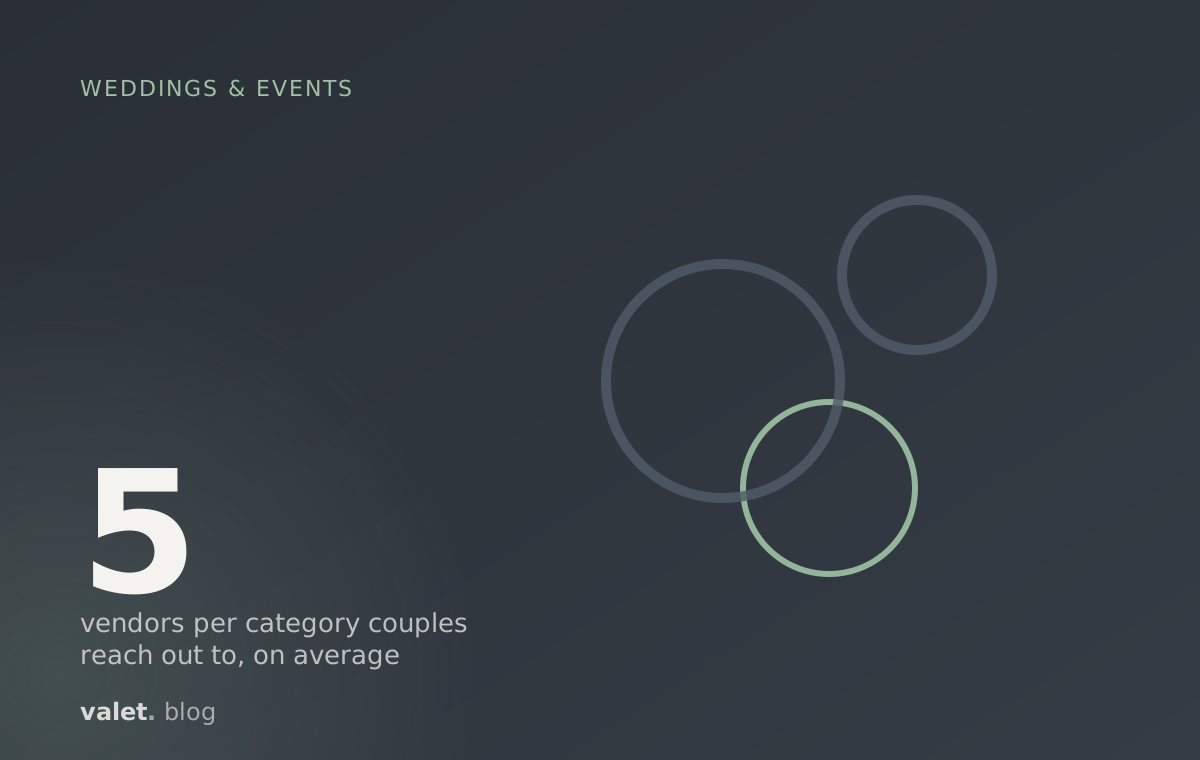
5
vendors per category couples reach out to, on average
WeddingPro, From Hello to Hired (updated Aug 2026)
77%
of couples say pricing is the top factor before contacting a vendor
WeddingPro, From Hello to Hired
$2,580
expected value of one qualified venue inquiry ($12,900 x 1 in 5)
Inference from The Knot 2026 and Indigo Digital 2026
Couples reach out to about 5 vendors per category, and 77% say pricing is the most important factor before they make contact1. Five-way odds give each venue a fair share of one booking in five. That is close to the rate a venue-marketing agency cites for qualified venue enquiries3. Most venues try to beat that share on price. The cheaper lever is being the easiest conversation in the comparison: an answer from your real prices within three hours, a real tour time, and two follow-ups that each carry something new.
How many vendors do couples contact before booking?#
Couples contact about five vendors in each category before booking, according to WeddingPro's lead-reply report, updated in August 2026: "couples reach out to 5 vendors per category, on average"1. The Knot's 2025 vendor report adds that "Almost 50% of couples considered multiple vendors before booking", that couples worked with an average of 14 vendors, and that 82% hired their venue first2.
Older and smaller estimates bracket that figure. Easy Weddings, an Australian directory, put it at "between 3 and 10 suppliers" in 20186. Slamdot, a US web agency, said in 2025 that couples "contact 2-5 of their top places" when venue shopping7. Dual Spark, a venue-marketing agency, says couples tour "three to five venues"8. None of these three shows its method, so treat them as practitioner estimates.
Photographers describe the same pattern from the inbox. A thread in r/WeddingPhotography titled "Why do people inquire and then ghost you?" (70+ comments, 2025) put it in one line: "Couples are reaching out to more vendors than ever. This leads to information overload."
A venue's reply-time math, in one table#
A venue's reply-time math starts with the expected value of one inquiry, not the value of one booking. The Knot's 2026 Real Weddings Study puts average reception venue spend at $12,9005. Indigo Digital estimates that about one in five qualified venue enquiries books3. Multiply the two and each qualified inquiry is worth about $2,580 before anyone has replied.
That number changes how a slow reply looks on the books. Indigo poses the question without doing the arithmetic: what does it add up to "if even one in twenty qualified enquiries is lost purely because of a slow or absent response"4? The calculator below does the arithmetic. The worked figures are illustrations; replace them with your own.
| Line | Input or formula | Worked example A (illustration) | Worked example B (illustration) | Yours |
|---|---|---|---|---|
| A. Qualified inquiries per year | Count from your inbox | 300 (Indigo's 60-wedding example) | 150 | |
| B. Vendors the couple contacts | WeddingPro average | 5 | 5 | 5 |
| C. Fair share | 1 / B | 20% | 20% | 20% |
| D. Your booking rate | Bookings / A | 20% (Indigo, ~1 in 5) | 8% (assumed) | |
| E. Average booking value | Your figure; The Knot avg is $12,900 | $12,900 | $8,000 (assumed) | |
| F. Value per inquiry | D x E | $2,580 | $640 | |
| G. Bookings per year | A x D | 60 | 12 | |
| H. Inquiries lost to no reply or one reply | From your audit; Indigo's framing is 1 in 20 | 15 (5%) | n/a | |
| I. Value lost per year | H x F | $38,700 | n/a | |
| J. Value of two extra bookings | 2 x E | $25,800 | $16,000 | |
| K. Above or below fair share? | D compared with C | At fair share | Below fair share |
Sources: B from WeddingPro1; D (example A) from Indigo Digital3; E from The Knot 20265; H framing from Indigo Digital4. Example B uses assumed inputs for a smaller venue.
Line K is the one to look at first. A venue at or below one booking in five is doing no better than chance in a five-way comparison. A venue above it is winning something other than the draw.
Why being the cheapest is the expensive answer#
Being the cheapest is the expensive answer because a price cut dilutes margin on every booking, including the ones you would have won at full price. In example A, a 10% discount across 60 bookings gives up $77,400 a year. It would take six to seven extra weddings just to earn that back. Two extra bookings from better follow-through cost nothing in margin.
The 77% figure tempts venues toward price1. Read it carefully: couples rank pricing as the top factor before contacting a vendor. A couple who inquired has already seen your price, or a range, and wrote anyway. Price got you onto the shortlist. It is a weaker reason for losing once you are on it.
We at Valet made a product decision on this point that has a cost. Valet never offers a discount, never haggles and never invents a price that is not on the owner's list. Money questions go to the owner with one-tap replies, and the couple is told when the owner will answer. Some couples would have accepted an instant discount and booked that night. We accept losing them, because an assistant that discounts to close is spending the owner's margin without the owner's approval.
Why a faster first reply alone does not win the shortlist#
A faster first reply gets a venue onto the shortlist, and the evidence for that is solid. WeddingPro reports couples are 2.2x more likely to reply when a vendor answers in under three hours1. Thumbtack reported in November 2025 that pros replying within 30 minutes were 25% more likely to be hired than those replying within three hours10. Tripleseat's 2026 report goes further, asserting that "When a guest reaches out to three venues, the one that responds first almost always wins the date"9. It gives no figure for that claim.
Speed is also becoming free. Perfect Venue sends an automatic first email to contact-form inquiries and says so directly: "First Reply handles the first touchpoint; everything after that is you."13 The Knot Worldwide announced "AI-powered automation tools for faster vendor responses" in April 202514. When every venue in a five-way comparison can answer in minutes, the first reply stops separating anyone.
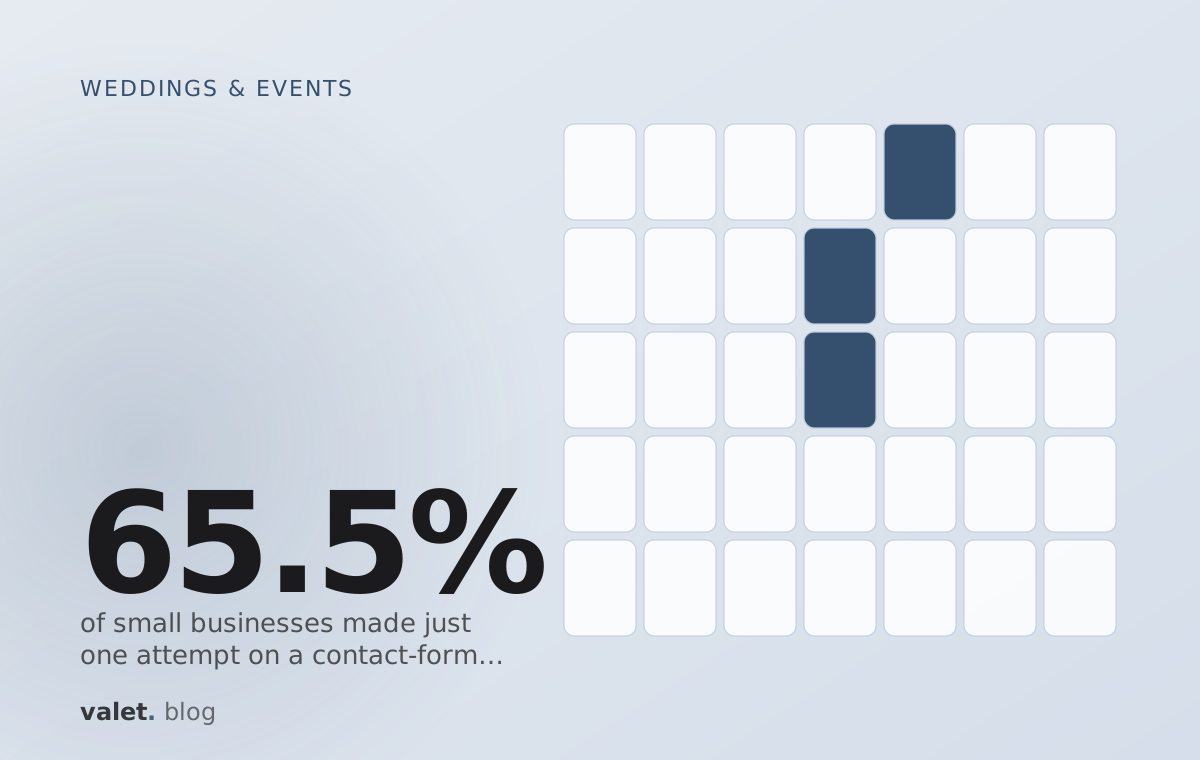
What still separates venues is what happens after it. In Pied Piper's 2026 mystery shop of 3,211 home-services inquiries, 72% got no follow-up at all and only 28% were offered an appointment11. Leadferno reported in 2024 that 65.5% of small businesses made one attempt on a contact-form lead and stopped12. Neither is a wedding study. Both describe the inbox habits of small teams, which is what most venues are.
Couples apply their own cut-off. On WeddingWire's forums in January 2018, one wrote: "I automatically ruled out any vendors that don't respond." Another: "The three that didn't respond I took my business elsewhere."16
The operating principle: be the easiest conversation#
The easiest conversation is the one that asks the couple to do the least work to reach a decision. Studio Ninja, a photographer CRM, describes couples who "communicate with multiple suppliers simultaneously, naturally shifting attention to easier conversations"15. That matches what the numbers above suggest: when price and speed are similar, effort decides.
In practice, the easiest conversation in a five-way venue comparison has four properties:
- It answers the question asked. Date availability from the calendar, the price or range from your list, and the one policy the couple will need next, in the first reply.
- It offers a real tour time. Two specific slots, not "let me know when suits". Indigo's response-time benchmark puts the site visit "in the first response"17.
- It holds what it offers. A held tour slot or a held date has an expiry and a reminder, so the couple has a reason to answer.
- It follows up with something new, then stops. Two follow-ups, each with a held time, a missing detail or an expiry, and a clear close.
None of the four requires a lower price. Each one removes a step the couple would otherwise have to take.
How we apply it at Valet#
We built Valet around those four properties, and each one is a product decision with a reason. Valet answers only from the owner's facts: price list, packages, calendar and policies. It offers real times from the owner's calendar, holds them and sends invites, and it only touches calendar events it created.
The Valet follow-up cap is two follow-ups by default. WeddingPro's own guidance is to reach out three to five times in the first 30 days1, so our default is deliberately lower. The reason is the rule attached to it: each follow-up must carry something useful, and after the second one Valet stops and tells the owner why. Owners can change the cap per topic. We chose a low default because a follow-up with nothing in it costs goodwill, and the third empty nudge costs more than it recovers.
Every inquiry carries a state in the Valet Inquiry States: New, Answered, Time held, Followed up, Booked, or closed with a reason logged. That makes line H in the calculator something you can count, not guess.
The trade-off, and the question nobody has answered yet#
The trade-off in this approach is real. A capped, factual assistant will lose some couples a persistent salesperson or an on-the-spot discount would have won. The opportunity cost is easier to see than the margin saved, and owners should weigh both.
The open question is time to offered slot. Venues measure time to first reply when they measure anything. Nobody has published how the time from inquiry to a concrete tour offer relates to booking for wedding venues. Valet has not published this figure; it is something Valet could measure from free lead checks, with owners' consent. Until then, the honest benchmark is your own, from the 90-day Lost Lead Audit. For what the second message should say, see why couples ghost after pricing, and for the weekend version of this problem, when couples send inquiries.
Where Valet fits#
Valet is an AI assistant for a venue's or vendor's written inquiries: email to your own address, website forms, and directory or marketplace lead emails. It answers in minutes from your own prices, packages, calendar and policies; offers real tour times and holds them; and follows up twice by default, each time with something useful, then stops and tells you why. Discounts, deposits and contracts wait for you. Every reply is signed as your assistant and says it is AI. During early access, pricing is a small monthly base plus a fee only for bookings Valet wins, capped monthly.
To fill in line H with real numbers, start with the free lead check: forward 10 to 20 recent inquiries and see what went unanswered, what stopped after one reply, and what it was worth.
Questions people ask
How many vendors do couples contact before booking?
WeddingPro reports that couples reach out to 5 vendors per category on average, and The Knot's 2025 vendor report says almost 50% of couples considered multiple vendors before booking. Older industry estimates range from 3 to 10 suppliers.
How many venues do couples tour?
No neutral study measures it. A venue-marketing agency, Dual Spark, says couples tour three to five venues, and another agency, Slamdot, says couples contact two to five of their top places. Treat both as practitioner estimates.
How much is a slow reply costing my venue?
Multiply your qualified inquiries by the share lost to no reply or a single reply, then by your booking rate and average booking value. At 300 inquiries, 5% lost, one booking in five and $12,900, that is about $38,700 a year, as an illustrative calculation.
Should I lower my price to win more couples who are comparing venues?
Not as a first move. A discount cuts margin on every booking, including the ones you would have won anyway. Answering faster from your real prices, offering a tour time and following up twice changes your odds without changing your price.
Sources
Confidence: H primary source checked · M credible secondary or reported · L vendor claim or single report. Reddit and forum items are quoted from public threads and summarised, not endorsed.
- From Hello to Hired: your guide to lead replies · WeddingPro · 2026-08-28 H
- The Knot Real Weddings 2025 Vendor Report · WeddingPro · 2026-08-28 H
- Wedding venue lead benchmarks guide · Indigo Digital · 2026-08-03 M
- The real cost of a missed enquiry · Indigo Digital · 2026-08-03 L
- Average wedding vendor costs (Real Weddings Study, n=10,474) · The Knot · 2026-09-29 H
- Responding to enquiries · Easy Weddings Pro · 2018-05-23 L
- Why wedding venues are losing bookings online and how to fix it · Slamdot · 2025-03-20 L
- Why couples aren't booking after the tour and what to do about it · Dual Spark Marketing · 2026-01-12 L
- The 2026 Event Intelligence Report · Tripleseat · 2026 M
- 3 takeaways from the 2025 Pro Summit · Thumbtack · 2025-11-06 H
- Precision Garage Door Ranked #1 in Customer Lead Handling Effectiveness Home Services Study · Pied Piper Management Company via BusinessWire · 2026-04-12 H
- Research: website contact forms and lead management, uncovering costly mistakes · Leadferno · 2024-06-28 H
- First Reply: automated responses to new inquiries · Perfect Venue Help Center · 2026 H
- Taking action on feedback · WeddingPro (The Knot Worldwide) · 2025-04-02 H
- Why couples ghost wedding vendors · Studio Ninja · undated L
- Unresponsive vendors · WeddingWire forums · 2018-01 H
- The venue enquiry response time benchmark · Indigo Digital · 2026-07-14 M
How to cite this page
Cite this page
Valet, "Couples contact five vendors per category: a venue's reply-time math, and how to book without being the cheapest", valet.team, October 2026.
Keep reading
 Weddings & eventsWhy couples ghost after you send pricing, and what the second message should sayThe usual answers are price, a hidden price list, or a slow reply. The bigger leak is that most vendors send one reply and stop, while the couple is still choosing between five of you.Strategy desk · 12 min · 1 October 2026
 Weddings & events"Our leads from The Knot / WeddingWire never respond": ghost leads, fake leads, or leads nobody followed up?Vendors say the leads are fake. The Knot says they are templated and ghosted. A U.S. senator has asked the FTC to look. None of them has published what happened to each inquiry, and that is the only record that settles it for your listing.Policy desk · 10 min · 1 October 2026
 Weddings & eventsHow many times should you follow up with a couple who hasn't replied? (And when the lead is dead)Wedding advice runs from "one more time than you are now" to "as many times as it takes". Nobody says when to stop. Here is a stop rule, a list of lost reasons, and the three messages that sit between the first reply and the end.People at work · 11 min · 1 October 2026