
Trust & AI handoff
Should AI reply to customers automatically or draft for approval? The approval matrix by action type
Approving every draft is slow, and full autopilot will one day promise something you never offered. The answer is a rule per action, written down before the first customer writes in.
Short answer
Decide by action, not by tool. Let AI send replies that come straight from your written facts: answers, listed prices, available times and holds. Have it ask you first before anything that moves money within a set cap. Hand off discounts, complaints, contracts, deposits and requests for a person, with a reply-by time. Approving everything is slow: Leadferno found the first human reply to a web form averaged 17 h 49 m (2024). Full autopilot risks promises you must honour.
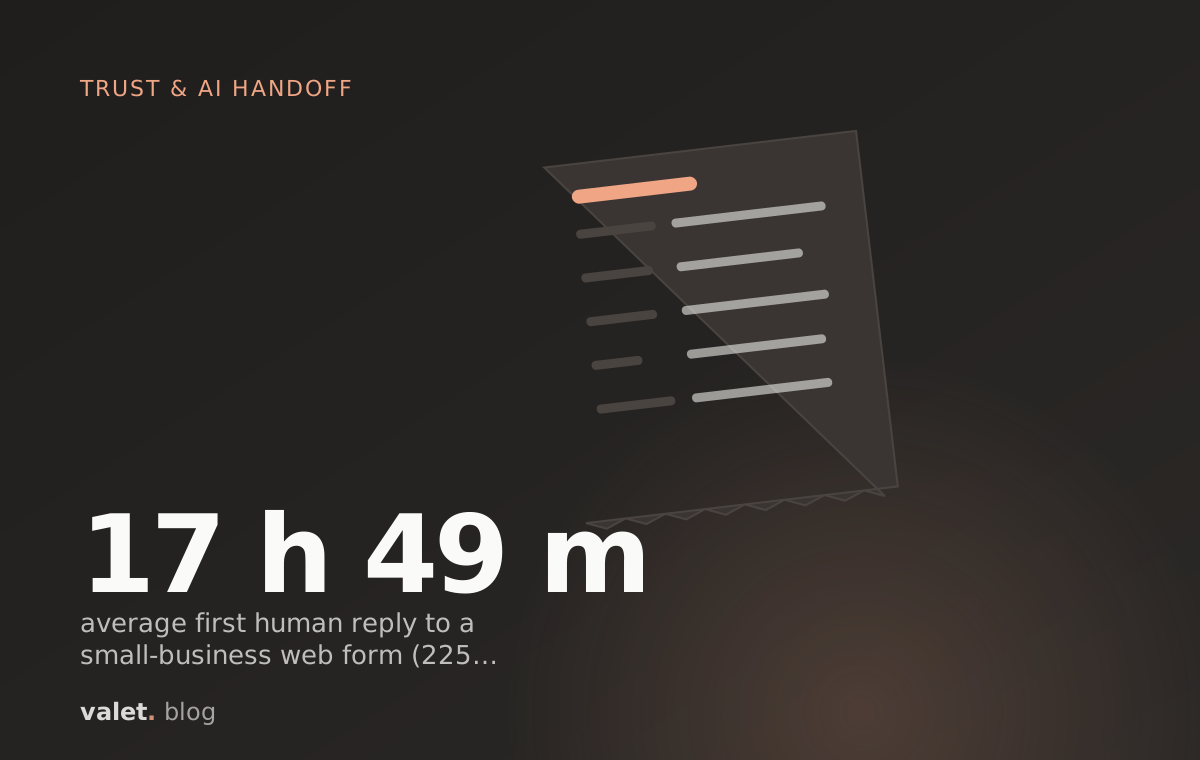
17 h 49 m
average first human reply to a small-business web form (225 forms)
Leadferno, June 2024
6%
of small businesses highly trust AI with their brand voice (n=350)
Bluehost State of Small Business AI Confidence, 2026
40%
of consumers will stop doing business with a company after one bad experience (n=1,006)
Five9, March 2025
A thread in r/AI_Agents titled "Stop building autonomous email agents" (40+ comments, mid-2026) made its case in one line: "one hallucinated refund or commitment at 2am costs you the customer."1 The opposite risk gets less attention. An assistant that drafts everything and waits for the owner is only as fast as the owner's free time.
The answer sits between the two, and it depends on what the AI is about to do. Let it send replies that come straight from your written facts. Have it ask you first when money moves within a limit you set. Hand off discounts, complaints, contracts, deposits and requests for a person, with a reply-by time. The matrix below sorts sixteen common actions.
Should AI reply automatically or draft for approval?#
Whether an AI should send on its own depends on the action, not on the tool. An answer copied from your price list carries little risk. A refund carries a lot. Treating them the same, in either direction, is where the cost comes from.
Owners already think this way. Bluehost surveyed 350 US small businesses in 2026. Only 6% highly trusted AI with their brand voice, and the top fears were accuracy (32%) and losing the human touch (29%). Bluehost's conclusion was that owners "prioritize approval mechanisms before AI directly engages customers."2
Developers call this "human in the loop." For a small business it means something plainer: a rule for each action that says send, ask me, or give it to me. There are three settings, and every action gets one.
| Setting | What the AI does | What the customer sees |
|---|---|---|
| Send on its own | Replies from your written facts and logs what it used | A reply within minutes, signed as your AI assistant |
| Ask me first | Drafts the reply; you approve, edit or reject with one tap | A reply once you approve; if it waits long, a note saying when |
| Hand off | Stops on that topic and sends you the conversation | Who will reply and the time they will reply by |
What does approving every reply cost?#
Approving every AI draft costs speed, because the draft waits for you. That is the same wait the customer had before you bought the tool. A draft in a queue is an unanswered inquiry with better grammar.
The baseline wait is already long. Leadferno tested 225 small-business website contact forms in 2024. 42.6% never got a response, and the first human reply averaged 17 hours 49 minutes.3 Jobber's 2026 survey of 1,050 home-service owners found over 70% of customers expect a same-day response, but only 20% of pros respond within the hour. 40% of owners named communicating with customers as one of their most time-consuming daily tasks.4
Picture where the approvals actually happen.
Nothing in that draft needed the owner. The date was on the calendar and the package was on the price list. For more on what a slow first reply costs, see how fast a small business should reply.
What does full autopilot cost?#
Full autopilot costs you the moment the AI answers something it should have passed on. The public cases are all about money or policy. Air Canada's chatbot described a bereavement refund the airline did not offer, and a tribunal ordered CAD $812.02.5 BMW Toronto's chatbot offered CAD $27,162.79 for a trade-in the dealer valued at CAD $20,000, and the dealer honoured it.6 Cursor's support bot invented a one-device policy, and users posted that they were cancelling.11
The opposite failure is quieter and costs as much. In Lilach Bullock's test of an AI receptionist, a caller asked the AI to match a £3,900 competitor quote. Instead of flagging it, the AI offered a callback "within 2 business days." Bullock estimated the lost booking at about £4,200.7 That was not a reply sent too freely. It was a high-value action with no rule at all.
Customers do not give many second chances. Five9 found 40% of consumers will stop doing business with a company after one bad experience.8 A thread in r/PickAorB (1.3K+ comments, September 2026) asked whether an HVAC company that "lost a big job" after switching to an AI receptionist should bring back a human. One reply: "I would literally be happier to reach the contractor's voicemail than to reach an AI receptionist."9
The approval matrix by action type#
The approval matrix gives each common action one setting and one line the customer hears. Copy it, change the cap and the times to fit your business, and keep it next to whatever tool you use.
| Action | Setting | Condition | Customer is told |
|---|---|---|---|
| Answer a question from your written facts | Send on its own | Exact match in your facts; otherwise hand off | The answer, signed as your AI assistant |
| Quote a listed price or package | Send on its own | Only figures on the price list; no "from about" | The listed price and what it includes |
| Offer available times | Send on its own | Real calendar times only | Two or three times to choose from |
| Hold a time | Send on its own | Hold expires at a stated time | "Held for you until [time]" |
| Book a confirmed slot | Send on its own | Customer chose the time; no deposit rule involved | Confirmation and invite |
| Reschedule | Send on its own | Within your written notice period; otherwise ask me | New time and invite |
| Cancel a booking | Ask me first | You check fees and deposit terms | "Received; [Name] will confirm by [time]" |
| Send an invoice or payment link | Ask me first | You check the amount | The link once approved |
| Credit or refund inside written policy, under [cap] | Ask me first | Amount shown on the draft | "[Name] is confirming this by [time]" |
| Refund outside policy, or over [cap] | Hand off | Never promised by the AI | Who will reply and by when |
| Discount or price match | Hand off | The AI never names a number | Who will reply and by when |
| Complaint or angry message | Hand off | Short reply-by (hours, not days) | An acknowledgement and a reply-by time |
| Contract change | Hand off | Only you change terms | Who will reply and by when |
| Deposit terms or a payment problem | Hand off | Money is moving | Who will reply and by when |
| Health, legal or safety question | Hand off | No AI answer at all | Who will reply and by when |
| Customer asks for a person | Hand off | At any point, in any words | Who will reply and by when |
Three things in the matrix are easy to miss. "Send on its own" still means only from your written facts; it does not mean the AI may improvise. "Ask me first" needs a cap you write down, or it drifts into "Hand off" for everything. And every handed-off row gives the customer a clock time. Our AI handoff policy template sets those times by trigger. Founders running software support can compare a ticket-type version in should a startup use AI for customer support.
How to write the rules in plain English#
An approval rule works best as one sentence a new employee would understand. If you cannot say it in one sentence, the AI should not be acting on it alone. Here are sample rules for a small service business:
- "Answer questions about packages, hours and parking from the facts sheet. If it isn't there, send it to me."
- "Offer times from my calendar and hold one for 48 hours."
- "Never agree a discount, a match or a 'best price'. Tell them I'll reply by end of day."
- "Refunds under $50 inside the written policy: draft it and ask me. Anything else: hand it to me."
- "Anyone upset, anyone mentioning a review, anyone asking for a person: hand it to me and tell them I'll reply within two hours."
- "Every reply says it's from my AI assistant."
The last rule matters more than it looks. When Cursor's bot invented its policy, it was signing as "Sam" with no AI label. Afterwards the company said AI responses "are now clearly labeled as such."11
How to move a topic from "ask me first" to "send on its own"#
Moving a topic to automatic is a decision you make with evidence, not a setting you flip on day one. Start where the stakes are lowest. In a February 2026 thread in r/AiForSmallBusiness, one owner's advice was to "test it on overflow or after-hours first and keep humans for complex calls." Another said AI was valuable if it "can handle 80% of routine calls and escalate the rest cleanly."10
- Start every new topic on "ask me first." Read each draft before it goes.
- Count edits. Note when you approve a draft unchanged and when you rewrite it.
- Promote on a run, not a feeling. A rule of thumb: move a topic to "send on its own" after a few weeks of drafts approved without edits.
- Demote fast. One reply that states something not in your facts sends the topic back to "ask me first" until the facts are fixed.
The other habit is a short review when you come back from a job, an event or a day off. It takes ten minutes:
- Holds the AI placed, and when each expires
- Drafts waiting for you, oldest first
- Handoffs, and whether each reply-by time is still ahead of you
- Every reply that mentioned money, read in full
- Any question the AI could not answer, added to your facts sheet
None of this makes the decision permanent. A topic you trusted in March may need your eyes again in June, when prices change or a new package launches. The matrix is a list you keep editing, the way you would correct a new employee in their first season.
Where Valet fits#
Valet's rules use the same three settings. Each topic is set to Autopilot, Ask me first or Always you, and the owner can change any of them. Valet answers only from the owner's own facts and calendar, offers real times, holds them and books. Money questions such as discounts, refunds and haggling, plus complaints, contracts, deposits and health, legal or safety questions, go to the owner with one-tap replies, and the customer is told when the owner will reply. Every reply is signed as the business's AI assistant, and the Valet receipt shows what was asked, the rule used and the sources. The free lead check looks at 10 to 20 recent inquiries and shows what went unanswered.
Questions people ask
Should I let AI reply to customers automatically?
For some actions, yes: answers that come straight from your written facts, listed prices, available times and holds. Money within a set cap should wait for your approval, and discounts, complaints, contracts, deposits and requests for a person should go to you with a reply-by time.
What is human in the loop AI for a small business?
It means a person approves or takes over certain actions before the AI completes them. For a small business it is best set per action: the AI sends some replies on its own, drafts others for one-tap approval, and hands the rest to the owner.
Is it safer to have AI draft every email for approval?
Safer for accuracy, but slow. If drafts sit until you are free, the customer waits as long as they would without AI. Leadferno found the average first human reply to a small-business web form was 17 hours 49 minutes in 2024.
How do I start trusting AI to send replies on its own?
Start with low-stakes topics and with overflow or after-hours inquiries, approve drafts for a few weeks, and move a topic to automatic only when you have approved its drafts without edits for a sustained run.
Sources
Confidence: H primary source checked · M credible secondary or reported · L vendor claim or single report. Reddit and forum items are quoted from public threads and summarised, not endorsed.
- "Stop building autonomous email agents" (40+ comments; Google snippet) · Reddit, r/AI_Agents · c. 2026-06 M
- State of Small Business AI Confidence 2026 · Bluehost · 2026 H
- Research: website contact forms and lead management, uncovering costly mistakes · Leadferno · 2024-06-28 H
- 2026 Home Service Trends Report · Jobber · 2026 H
- A word of caution: company liable for misrepresentations made by chatbot · McMillan LLP · 2024-02 H
- BMW dealer forced to pay $5,000 extra for used X3 over AI chatbot error · The Drive · 2026-06-20 H
- AI receptionist small business test · Lilach Bullock (practitioner blog) · 2026 M
- New Five9 research reveals balancing AI and human connection is key to winning customers · Five9 · 2025-03-13 H
- "A or B: Our HVAC company lost a big job after we switched to an AI receptionist" (1.3K+ comments; Google snippet) · Reddit, r/PickAorB · c. 2026-09 M
- "Serious question for small business owners" (snapshot) · Reddit, r/AiForSmallBusiness · 2026-02-27 H
- Cursor AI support bot invents fake policy and triggers user uproar · Ars Technica · 2025-04-17 H
How to cite this page
Cite this page
Valet, "Should AI reply to customers automatically or draft for approval? The approval matrix by action type", valet.team, October 2026.
Keep reading
 Trust & AI handoffThe customer who fired a contractor over a bot: what "never stuck with a bot" has to meanA homeowner dropped a plumber because the AI receptionist could not pass him to a person. The public cases since then show where handoffs break, and what a working one has to promise.Field reports · 11 min · 1 October 2026
 Trust & AI handoffCan a quote from my AI be binding? What BMW Toronto taught every business that prices by emailA chatbot at a Toronto BMW dealer offered a customer about CAD $7,000 more than the dealer meant to pay. The number came from the dealer's own records, in the wrong place. Here is what that means for any business that quotes in writing, and a policy you can copy.From the Valet team · 9 min · 1 October 2026
 Trust & AI handoffWhat to ask an AI vendor before it talks to your customers: 12 questions (limits, handoff, receipts, disclosure, undo, insurance)The demo shows the AI writing a good reply. The questions that decide whether you keep your customers are about what happens when it should not reply at all.People at work · 10 min · 1 October 2026