
After the first reply
"We lost the deal because we replied on Monday": after-hours and weekend inquiries, and who answers while you're doing the work
A Friday-afternoon inquiry in a business closed at weekends waits about 66 hours for Monday. The numbers on what that wait costs, the principle we built Valet around, and a response-time policy you can copy.
Short answer
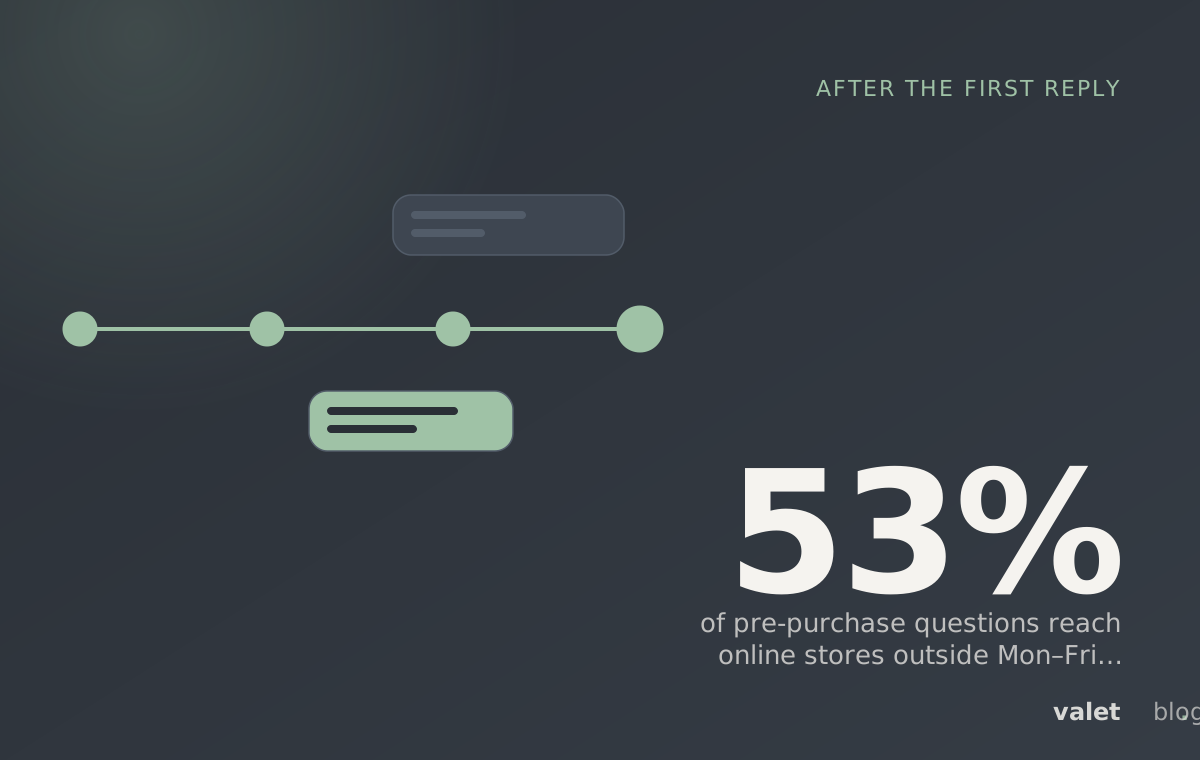
An inquiry that arrives after hours usually waits until the next working morning, and one sent on Friday afternoon often waits until Monday. That wait is common: Gorgias (July 2026) found 53% of online stores' pre-purchase questions arrive outside weekday business hours, with a median human reply of about 15 hours versus 2.2 in hours. Answer factual questions at any hour, hold a real time, and tell the customer when you will personally reply.
53%
of pre-purchase questions reach online stores outside Mon–Fri 9am–6pm
Gorgias Ecom Lab, July 2026
17 h 49 m
average first human reply to a small-business contact form
Leadferno, 225 forms, June 2024
>70%
of home-service customers expect a same-day response
Jobber 2026 Home Service Trends, n=1,050
An inquiry that arrives after hours usually waits until the next working morning. One that arrives on Friday afternoon often waits until Monday. From 3pm Friday to 9am Monday is 66 hours, which is 39% of the week. For a business that answers email only during the working day, that is the Monday window, and it is where a good share of inquiries sit unanswered.
The fix is not to work weekends. It is to separate the answer from the owner. Factual questions (price, availability, what is included) can be answered at any hour from your own facts. A real time can be held. Everything that needs your judgement waits for you, and the customer is told exactly when you will reply. This piece sets out the numbers, the principle we built Valet on, and a response-time policy you can copy.
What happens to an inquiry that arrives on Friday evening?#
An inquiry sent on Friday evening to a five-day business is usually read on Monday morning, answered some time on Monday, and followed up later in the week if at all. The customer, meanwhile, has had a full weekend to ask someone else.
The share of inquiries that land outside working hours is large. Gorgias's Ecom Lab defined business hours as Monday to Friday, 9am to 6pm local, and counted everything else as after hours, weekends included. On that definition, 53% of pre-purchase questions reached online stores after hours, and the median human first reply stretched to about 15 hours, against 2.2 hours during the day1. That is ecommerce data, but the clock arithmetic is the same for any small business: Mon–Fri 9–6 covers 45 of the week's 168 hours. The other 123 hours belong to the customer.
Service businesses report the same pattern without the measurement. Indigo Digital, which works with wedding venues, wrote in July 2026 that "a large share of wedding and event enquiries arrive in the evening, on weekends, and during public holidays"9. Nobody has yet published that split for small service firms by hour and day. We say more on that below.
Why "I'll answer it on Monday" looks like the right call#
"I'll answer it on Monday" is a reasonable decision on paper. The owner is the business's only salesperson, estimator and, often, its only pair of hands. Time spent on email at 9pm comes out of sleep, family or the job itself. The opportunity cost is real.
Owners say so in public. A thread in r/smallbusiness titled "I have a hard stop rule. Does anybody else do this?" drew more than 130 comments (2022). In r/msp, a thread titled "Complete overload - one man MSP" (150+ comments, 2023) includes the line "can't take a day off properly." Jobber's survey of 1,050 home-service owners, run in December 2025, found that customer communication was the second-largest drain on their time, named by 40%, behind jobsite management at 48%4.
So the spreadsheet logic runs like this. Headcount is one. Weekends are the owner's only recovery time. A reply on Monday is still a reply. On those inputs, a hard stop looks like discipline rather than a leak.
The flaw is in the last input. A reply on Monday is a reply to a customer who may no longer be waiting.
What the 2024–2026 data says about the wait#
The wait costs more than owners assume, and the evidence comes from several directions at once. None of it isolates weekends cleanly, so each figure below is stated with its limits.
| Finding | Source, sample, date | What it means for the Monday window |
|---|---|---|
| 53% of pre-purchase questions arrive outside Mon–Fri 9–6; median human reply about 15 h after hours vs 2.2 h in hours | Gorgias Ecom Lab, July 20261 | The only recent dataset that splits replies by business hours. Online stores, not services. |
| 42.6% of contact-form inquiries got no reply at all; first human reply averaged 17 h 49 m | Leadferno, 225 small-business forms, June 20242 | A 17 h 49 m reply to a 4pm Friday form lands at 9:49am Saturday. A business closed at weekends replies on Monday. |
| 47% of online property inquiries ignored; average reply 8 h 17 m, median 39 min | Mike DelPrete, 100+ secret shops, 25+ brokerages, August 20243 | These inquiries were sent during weekday business hours. Nearly half went unanswered in the easy case. |
| Over 70% of customers expect a same-day response; 20% of pros reply within the hour | Jobber, 1,050 home-service owners, December 20254 | "Same day" on a Friday evening means Friday evening. |
| A one-hour delay cut hiring odds by 46%; 24 hours or more made a freelancer 90% less likely to win | Management Science study of 11M+ Fiverr transactions, reported by Entrepreneur, July 20265 | A marketplace, where rivals are one click away. The Monday window is longer than 24 hours. |
| Up to 85% of callers whose calls go unanswered will not call back | CallRail, 1.1M conversations, January 20256 | Phone, not email. Shows how rarely a lost first contact returns. |
Read together, these numbers set a floor. Customers expect a same-day answer. Many businesses miss it even during the week. A reply delayed by a day or more is, in the one large controlled dataset we have, close to a lost job. The Monday window is longer than all of those thresholds.
A thread in r/CRMSoftware titled "How are you handling leads that come in after business hours" (20+ comments, late September 2026) opens with a lead who asks a question at night, while "the first useful reply comes the next morning. By then…". In r/Entrepreneur (80+ comments, about April 2026), a founder described a demo form: "Someone would fill it out at 6pm and we'd email them the next morning with calendar links."
Google has drawn the same line. From 1 October 2026, Google Local Services Ads bills business-hours missed calls as valid leads when the caller stays on the line for more than 20 seconds; after-hours calls are exempt8. Google's billing treats the working day as the period you are expected to answer. Your customers do not make that exemption.
The operating principle: separate the answer from the owner#
The Monday window closes when the parts of a reply that need the owner are separated from the parts that do not. Most first questions are factual. What does it cost? Are you free on the 14th? Do you cover my area? Is parking included? Those answers already exist in the owner's price list, calendar and policies. They do not change at night.
The parts that need the owner are fewer and easier to name: a discount, a refund, a complaint, a contract term, a deposit exception, anything about health, safety or the law, and anything not written down. Those should wait for the owner, every time, at every hour.
That gives three rules for out-of-hours inquiries:
- Answer the factual part at any hour, from your own facts only. If a price or policy is not written down, the answer waits. An invented answer at 11pm costs more than a late one.
- Hold a real time instead of asking "when suits you?" Pied Piper's 2026 mystery shop of 3,211 home-services locations found an appointment was offered in only 28% of interactions7. A held time gives the customer something to accept before Monday.
- Tell the customer when you will reply to the rest. "The owner will answer the deposit question on Monday by 11am" is a promise a customer can plan around. "We'll be in touch" is not.
A response-time policy you can publish#
A response-time policy is a short written promise that says, for each kind of inquiry, how fast the first reply comes, who or what sends it, and what the customer is told. Writing it down forces the split between factual answers and owner decisions. The template below is the version we would start from for a one- to five-person business.
RESPONSE-TIME POLICY: [Business name]
Working hours: [Mon–Fri 9:00–17:00, time zone]
Inboxes covered: [info@, bookings@, contact form, listing leads]

1. FACTUAL QUESTIONS (any hour, including weekends)
   Covers: prices from the price list, packages, availability,
   service area, what is included, opening hours, directions.
   First reply: within [15 minutes], answered only from the
   written facts sheet. If the answer is not written down,
   treat it as an owner decision (section 3).

2. BOOKING REQUESTS (any hour)
   First reply offers [2–3] real times from the live calendar.
   A chosen time is held for [48 hours].
   Holds expire automatically; the customer is told when.

3. OWNER DECISIONS (working hours only)
   Covers: discounts, refunds, complaints, contract changes,
   deposits, health, legal or safety questions, anything
   not on the facts sheet.
   Out of hours, the customer is told:
   "[Owner name] will reply to this personally by
   [next working day, 11:00]."
   Owner reply: by that time, without exception.

4. FOLLOW-UP
   If the customer goes quiet: at most [2] follow-ups,
   each with something new (a held time, a missing detail,
   an expiry date). Then stop and record why.

5. MONDAY CHECK (every Monday by [10:00])
   For each inquiry received Fri [15:00] to Mon [09:00]:
   [ ] answered or given a held time
   [ ] owner-decision promises kept on time
   [ ] nothing left with only an auto-acknowledgement
Two parts of the template carry most of the weight. Section 3 keeps money and judgement with the owner, so the policy never commits you to something you did not decide. Section 5 is the audit: it takes ten minutes, and it tells you each week whether the Monday window is closed or merely hidden.
What does the Monday window cost a small business?#
The cost of the Monday window depends on four of your own numbers, and none of them should be borrowed from a vendor. The worksheet below shows the arithmetic with example inputs. Replace each one.
| Line | Example value | Where your number comes from |
|---|---|---|
| A. Inquiries per month | 30 | Count the last 90 days and divide by three |
| B. Share arriving Fri 3pm–Mon 9am | One-third (assumption) | Sort the same 90 days by arrival time |
| C. Share of those never answered or answered too late to matter | 42.6% (Leadferno's no-reply rate, used as a stand-in)2 | Mark each weekend inquiry: answered by Saturday noon, Monday, or never |
| D. Close rate on inquiries that get a timely answer | 25% (assumption) | Your bookings ÷ answered inquiries over the same period |
| E. Average booking value | $3,000 (assumption) | Your own invoices |
| Monthly exposure = A × B × C × D × E | 30 × ⅓ × 0.426 × 0.25 × $3,000 ≈ $3,200 | About $38,000 a year on these inputs |
The result is exposure, not proven loss. Some of those customers would have booked elsewhere anyway. Some would have waited for you. But the line that matters is C, and most owners have never measured it. The Lost Lead Audit gives a method for finding it in an afternoon.
Compare that exposure with the price of cover. A part-time assistant does not work Saturday nights. A receptionist at the BLS median of $18.27 an hour10 answers phones during the day. The unit economics of the Monday window are poor for any option that needs a person to be awake.
The trade-off we made, and the question we have not answered#
One product choice we at Valet made early has a cost. Valet answers whoever writes, at any hour, but only from the owner's own price list, calendar and policies. Money (discounts, refunds, haggling), complaints, contracts and deposits always go to the owner, with one-tap replies, and the customer is told when the owner will reply.
That means some weekend customers wait. A customer who writes on Saturday night asking for 10% off will get a held time and a clear promise, not a discount. We could let the assistant negotiate. We decided that an assistant which invents a price at midnight is an unforced error waiting to happen, and that a stated wait is better than a wrong answer. The owner can change the rule for any topic; the default stays with the owner.
The question we cannot answer yet is the shape of the Monday cliff itself: how inquiry arrivals and reply times line up by hour and day across small service businesses. Valet has not published this figure; it is something Valet could measure from free lead checks, with owners' consent. Until then, the figures above are the best public evidence, and your own 90 days of email are better than any of them.
Where Valet fits#
Valet is a small business's own AI assistant for written inquiries. You forward info@ or bookings@ to it; it answers email, contact forms and listing leads at any hour, from your own facts only, and replies go out from your own address. It offers real times from your calendar and holds them. Money, complaints and contracts wait for you, and the customer is told when you will reply. Every inquiry has a state under the Valet Inquiry States, and every reply comes with a Valet receipt.
If you want to see what your own Monday window looks like, the free lead check takes 10–20 recent inquiries and shows what went unanswered, what stopped after one reply, and what it was worth. For what happens after the first reply, see the first reply is now free; the follow-up is where leads die.
Questions people ask
What happens to leads that come in over the weekend?
In most small businesses they wait for Monday. Leadferno's 2024 test of 225 small-business contact forms found an average first human reply of 17 hours 49 minutes and no reply at all for 42.6%, so a Friday-afternoon form often gets its first answer on Monday or never.
Should a small business respond to leads after hours?
Respond to the factual part at any hour if you can do it accurately: price ranges, availability, what is included, a time you can hold. Leave money decisions, complaints and anything off your price list for working hours, and tell the customer when you will reply to those.
Do customers buy from whoever responds first?
Speed matters, but the popular '78% buy from the first responder' figure has no traceable primary source. The strongest recent evidence is a Management Science study of Fiverr reported in July 2026: a one-hour delay cut hiring odds by 46% on average, and 24 hours or more made a freelancer 90% less likely to win.
Is an auto-reply enough for after-hours inquiries?
No. An auto-reply that says 'we will be in touch' tells the customer nothing they can act on. A useful after-hours reply answers the question from your own facts, offers or holds a real time, and states when a person will follow up.
How do I take weekends off without losing leads?
Write down which questions can be answered without you, give those a fast reply rule, and give everything else a stated reply-by time. Then check one thing each Monday: did every weekend inquiry get an answer, a held time or a promise that you kept.
Sources
Confidence: H primary source checked · M credible secondary or reported · L vendor claim or single report. Reddit and forum items are quoted from public threads and summarised, not endorsed.
- Your team is sleeping on 53% of shopper questions · Gorgias Ecom Lab · 2026-07-30 H
- Research: Website contact forms and lead management, uncovering costly mistakes · Leadferno · 2024-06-28 H
- Secret shopping: 47% of online property inquiries are ignored · Mike DelPrete · 2024-08-13 H
- Blue Collar Strong: The 2026 Home Service Trends Report (1,050 owners, surveyed December 2025) · Jobber · 2026 H
- Companies are tracking response time delays for freelance jobs (Management Science study of Fiverr) · Entrepreneur · 2026-07-16 M
- CallRail releases report benchmarking marketing efforts for small businesses · CallRail via BusinessWire · 2025-01-14 H
- Precision Garage Door Ranked #1 in Customer Lead Handling Effectiveness Home Services Study (Pied Piper PSI 2026) · Pied Piper Management Company via BusinessWire · 2026-04-12 H
- Google LSA advertisers face missed-call charges from October 1 · ppc.land · 2026-09-25 H
- Response-time benchmark for venue enquiries · Indigo Digital · 2026-07-14 M
- Occupational Outlook Handbook: Receptionists · U.S. Bureau of Labor Statistics · 2026 H
How to cite this page
Cite this page
Valet, "We lost the deal because we replied on Monday: after-hours and weekend inquiries", valet.team, October 2026.
Keep reading
 After the first replyThe first reply is now free. The follow-up is where 72% of leads die.Meta, Google and the inquiry tools now answer the first message for you. The money is lost in the days after it, and almost nobody sells that part.From the Valet team · 11 min · 1 October 2026
 After the first replyHow many times should you follow up with a lead before you stop?A written standard for following up on inbound inquiries: what counts as a follow-up, what each nudge must contain, when the sequence must stop, and how to close a lead with a reason instead of letting it fade.Policy desk · 11 min · 1 October 2026
 After the first replyWhy leads go silent after you send a quote (and what it actually means)Silence after a quote is usually read as a verdict on price. The base rates say it is more often an unfinished conversation, and the thread itself carries signals that tell you which kind you have.Trends desk · 9 min · 1 October 2026