
Weddings & events
Why couples don't book after the venue tour (the dead end after "we'll think about it")
The tour is the most expensive hour in a venue's sales process, and the step after it is the least managed. Here is what the evidence says, what it does not, and a hold-expiry workflow that turns "we'll think about it" into a date.
Short answer
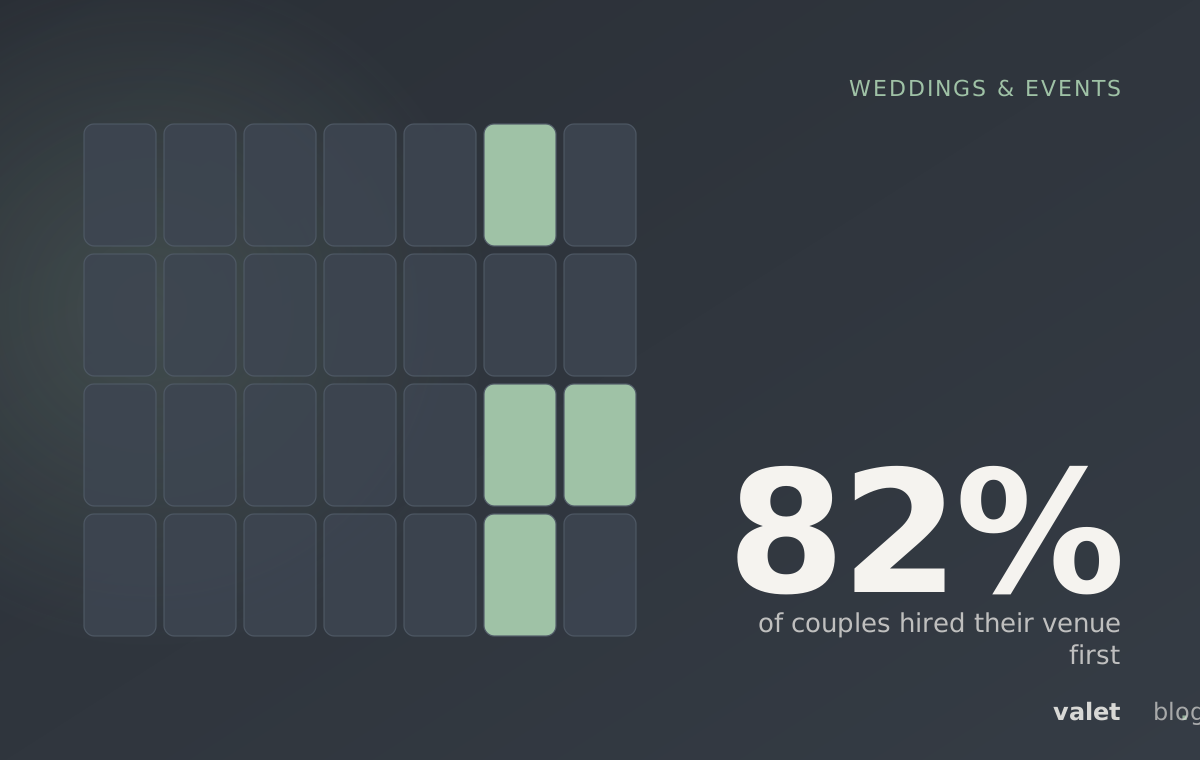
Couples usually leave a venue tour without booking because nothing is set to happen next: no date held with an expiry, no proposal that day, no second message. They tour several venues, and the excitement of the visit fades within days. The Knot's 2025 vendor report says 82% of couples hire their venue first, so a stalled decision holds up the whole wedding. Send a same-day thank-you with the proposal and a hold expiry, follow up within 48 hours, remind before the hold lapses, and release the date in writing.
82%
of couples hired their venue first
The Knot Real Weddings 2025 Vendor Report
~1 in 5
qualified venue enquiries book
Indigo Digital, August 2026
<30%
enquiry-to-site-visit rate that signals a reply problem
Indigo Digital, May 2026
Couples usually leave a venue tour without booking because nothing is set to happen next: no date held with an expiry, no proposal that day, no second message. They tour several venues, and the pull of the visit fades within days. The Knot's 2025 vendor report says 82% of couples hired their venue first2, so a stalled venue decision holds up the rest of the wedding. The fix is stateful: a same-day thank-you with the proposal and a hold expiry, a follow-up within 48 hours, a reminder before the hold lapses, and a written release.
The signal venue owners misread: "we'll think about it"#
Venue owners tend to read "we'll think about it" as a verdict on the venue: the price, the room, the date, a rival with a better view. Some of the time it is. More often, if the vendor-side commentary is right, it is a description of what happens next, which is nothing. Dual Spark, a marketing firm that writes for venues, put it in one line in January 2026: "The tour should be the finish line, but for many venues, it becomes the dead end"1.
The same piece lists why: "Once they leave, real life kicks back in. Work emails. Family opinions. Budget stress." And: "If there is no reason to act now, booking gets pushed to 'later,' and later turns into never"1. Dual Spark publishes no data behind these lines. Neither does anyone else, and that absence is the first finding of this piece.
Evidence note. Public evidence on what happens after a venue tour is thin and mostly comes from firms that sell venue marketing or software. Couple-side forum discussion of post-tour silence is scarce. Read the mechanisms below as well-argued hypotheses, and the funnel numbers as benchmarks with stated sources, not as measured tour-to-booking rates.
Base rates: what a venue funnel looks like in 2026#
The venue funnel has two published benchmarks with stated sources and one widely repeated figure that is only a worked example. Indigo Digital estimates about 1 in 5 qualified enquiries books, so a venue booking 60 weddings a year needs about 300 qualified enquiries3. Indigo also sets a warning line at the top of the funnel: if enquiry-to-site-visit "sits below 30% for wedding enquiries, the problem is nearly always response speed or the quality of the first reply"4.
The step after the visit has no neutral benchmark. A "40% tour-to-booking" figure circulates from a 2022 Everbridal blog post, but it appears inside an illustrative calculation ("If your tour-to-booking conversion is 40%…"), not as a measured rate5. Treat it as an example, not a norm. Indigo's advice is to track site-visit-to-booking separately, because "This one belongs to the sales team, not marketing"4.
Two structural facts raise the stakes on that one step. The Knot's 2025 vendor report says 82% of couples hired their venue first and that almost 50% considered multiple vendors before booking2. MMCG puts typical venue lead times at 12 to 18 months, and 18 to 24 months for peak Saturdays6. A couple who leaves a tour undecided is holding up the photographer, the florist and the caterer, and the most-wanted dates are being booked by someone else while they wait.
Why the tour becomes a dead end#
The tour becomes a dead end because it is the most expensive step in the venue's process and the least systematised one after it. The owner or coordinator gives an hour or more, in person, often on a weekend. Inquiry tools have automated the cheap step before it. Perfect Venue's help centre describes its automated reply plainly: "First Reply handles the first touchpoint; everything after that is you"8.
The commoditization of the first reply pushes value to the steps after it, and the post-tour step is the clearest case. Four mechanisms show up repeatedly in vendor commentary:
- No clear next step. "You are leaving the decision entirely in the couple's hands with no urgency"1.
- The feeling fades. Releventful wrote in July 2026 that a couple "can fall in love with your venue from the photos. They book it because of the tour"9. The tour's effect has a half-life measured in days.
- Price arrives late. "Many couples fall in love during the tour and then get sticker shock when pricing is reviewed later"1.
- Silence reads as indifference. "Couples do not interpret silence as patience. They interpret it as lack of interest"1.
Photographers report a version of the same stall. A thread in r/WeddingPhotography titled "Clients ghosting AFTER saying they are ready to book" drew 60+ comments (around March 2026). The pattern is a couple who reached the edge of a decision and then had no structure to cross it.
How long should a venue hold a date after a tour?#
No published industry standard sets how long a venue should hold a date after a tour. Dual Spark recommends "a soft hold on the date for a set number of days" and gives no number1. Venue policy pages vary, and the choice belongs to the owner.
What matters more than the length is that the hold has a stated end. A hold with no expiry is not a hold; it is an open question both sides avoid. Pick a length you can keep, such as five or seven days, write the exact day and time in the message, and remind the couple before it lapses. If another couple asks about the same date during the hold, say so only if it is true.
The hold-expiry workflow#
The hold-expiry workflow turns the tour into a short sequence of states, each with a next step and a time: toured, held with an expiry, booked with a deposit, or released with a reason. Deposits, contracts and any change to price stay with the owner.
STATE: TOURED -> HELD (expires [day, time])
When: the same day as the tour
Subject: Your date at [venue], held until [day]

Hi [names],

Thank you for coming out today. Your proposal for [date] and
[guest count] guests is attached: [package, price, what is included].

I've placed a hold on [date] until [day, time]. To confirm it, the
next step is [contract + deposit of the amount on our policy]. If it
helps to talk it through with family, I have [day, time] or
[day, time] for a short call.

[Your name]


FOLLOW-UP: about 48 hours after the tour, if no reply
Subject: One thing couples ask after the tour

Hi [names],

After a tour, most couples want to know [payment schedule / what
happens if guest count changes / what is included for the
ceremony]. The short answer: [one or two lines from your own policy].

Your hold on [date] runs until [day, time].

[Your name]


REMINDER: the day before the hold expires
Subject: Your hold on [date] ends tomorrow

Hi [names],

A quick note that the hold on [date] ends tomorrow at [time]. If you'd
like to keep it, reply here and I'll send the contract. If you need a
few more days, ask, and I'll tell you whether I can extend it.

[Your name]


RELEASE: on the expiry day, then stop
Subject: [Date] released

Hi [names],

I've released the hold on [date] as planned. No need to reply. If you
decide [venue] is the one, write back and I'll check whether the date
is still open.

Thank you again for visiting, and good luck with the planning.

[Your name]

LOG: booked (deposit date) / released: no reply / chose another venue /
budget / date changed / other. One reason per couple.
The release message is the step most venues skip, and it is the one that ends the thread on clear terms. It also frees the date for the next couple without guilt. For the general stop rule behind this sequence, see how many times to follow up with a couple. For the case where couples went quiet before the tour, after pricing, see why couples ghost after pricing.
Three ways the post-tour gap plays out at a venue#
The post-tour gap behaves differently depending on season and volume, and three scenarios cover most venues. Each has a condition that triggers it and a signal you can see in your own records.
Base case: steady volume, inconsistent follow-up. If tours run at a pace the owner can handle, most couples get a thank-you, and some get a second message. Holds are verbal. The signal is a calendar with pencilled dates that nobody released and nobody confirmed.
Engagement-season squeeze. Tripleseat's 2026 Event Intelligence Report names January as the top month for event creation and reports leads up 9% year on year10. If tour volume spikes in the first quarter while the team also runs events, post-tour messages are the first thing dropped, because they have no deadline attached. The signal is a rise in "toured, never followed up" threads from January to March.
Upstream speed, downstream stall. If a venue adopts an instant first reply but changes nothing after the tour, enquiry-to-visit improves and the tour becomes the new choke point. Indigo recommends offering a site visit "in the first response, with live availability where possible"11. In this scenario, more couples tour and the same share go quiet afterwards. The signal is a higher visit rate with a flat booking count.
Leading indicators to track in your own venue#
Four numbers tell a venue owner whether the post-tour step is the leak. All can be counted by hand from the last 90 days.
| Indicator | Type | What it tells you |
|---|---|---|
| Enquiry-to-visit rate | Leading | Below 30%, the leak is before the tour (Indigo)4 |
| Tours with a written hold and expiry sent the same day | Leading | Whether every tour ends with a next step |
| Holds that expired with no message sent | Leading | Dates you are holding for couples who have already moved on |
| Toured, never followed up | Lagging | The direct count of tours that ended in silence |
How we will measure it: the Lost Lead Audit sorts each inquiry from the last 90 days into never answered, answered once and dropped, time offered, booked, or lost with a reason. Tagging which inquiries reached a tour gives a "toured, never followed up" count across wedding venues. Valet has not published that data; no Valet figure is used here.
The money is easy to estimate once you have the count. For example, a venue running 100 tours a year that lifts its tour-to-booking rate by 5 points books 5 more weddings; at The Knot's 2026 average venue spend of $12,9007, that is about $64,500. The 5 points is an assumption; use your own before-and-after.
Where this analysis would be wrong, and when to revisit it#
This analysis would be wrong for a venue whose post-tour couples already receive a same-day proposal, a written hold with an expiry and a follow-up, and still go quiet. For that venue the binding constraint is price, the room or the date, and the honest fix is a different offer, not a different message. It would also be wrong where couples tour only one venue; then the comparison mechanism does not apply.
Revisit it in October 2027, or sooner if a neutral source publishes measured tour-to-booking rates. Pied Piper's 2026 home-services study found only 28% of businesses offered an appointment when scheduling was the natural next step12; a wedding-venue equivalent for the post-tour step does not yet exist. To count your own, use the Lost Lead Audit.
Where Valet fits#
Valet is an AI assistant for a venue's written inquiries: email to the venue's own address, website forms, and directory or marketplace lead emails. It answers from the venue's own packages, policies and calendar, offers real tour times and holds them, sends invites, and follows up at most twice by default with something useful each time, such as a held date before it expires. Then it stops and tells the owner why. Contracts, deposits and any discount go to the owner with one-tap replies, and the couple is told when the owner will reply. Every reply says it is AI.
To see how many of your own tours ended in silence, start with the free lead check: forward 10 to 20 recent inquiries and see what went unanswered, what stopped after one reply, and what it was worth.
Questions people ask
Why do couples go quiet after a venue tour?
Usually because the tour ended without a next step. Couples tour several venues, then go back to work, family opinions and budgets. Without a held date, a proposal and a deadline, the decision drifts, and silence is easier than a no.
How long should a venue hold a date after a tour?
There is no published industry standard. Pick a length you can keep, such as five or seven days, write the exact expiry day in your message, remind the couple before it lapses, and tell them in writing when you release it.
What should a venue tour follow-up email say?
Send it the same day: thank them, attach the proposal for their date and guest count, state the hold and its expiry, and offer the next step, such as a contract and deposit or a call with whoever helps them decide. Follow up again within 48 hours if they don't reply.
What is a good tour-to-booking rate for a wedding venue?
No neutral published benchmark exists. A 40% figure circulates from a 2022 blog post's worked example, not a measured study. Indigo Digital suggests tracking site-visit-to-booking separately from enquiry-to-visit so you can see where couples drop out.
Sources
Confidence: H primary source checked · M credible secondary or reported · L vendor claim or single report. Reddit and forum items are quoted from public threads and summarised, not endorsed.
- Why couples aren't booking after the tour (and what to do about it) · Dual Spark Marketing · 2026-01-12 L
- The Knot Real Weddings 2025 Vendor Report · WeddingPro (The Knot Worldwide) · 2026-08-28 H
- Wedding venue lead benchmarks guide · Indigo Digital · 2026-08-03 M
- Five venue funnel metrics worth reporting on · Indigo Digital · 2026-05-12 M
- Wedding venue show rate improvement · Everbridal · 2022-01-11 L
- The U.S. wedding venue market: an investment thesis for 2026–2030 · MMCG · 2026-03-21 M
- Average wedding vendor costs (Real Weddings Study, n=10,474) · The Knot · 2026-09-29 H
- First Reply: automated responses to new inquiries · Perfect Venue help center · 2026 H
- Wedding venue tour booking · Releventful · 2026-07-08 L
- The 2026 Event Intelligence Report: data, benchmarks and blueprints for high-growth venues · Tripleseat · 2026 M
- The response time benchmark every venue is failing · Indigo Digital · 2026-07-14 M
- Precision Garage Door Ranked #1 in Customer Lead Handling Effectiveness Home Services Study · Pied Piper Management Company via BusinessWire · 2026-04-12 H
How to cite this page
Cite this page
Valet, "Why couples don't book after the venue tour (the dead end after 'we'll think about it')", valet.team, October 2026.
Keep reading
 Weddings & eventsWhy couples ghost after you send pricing, and what the second message should sayThe usual answers are price, a hidden price list, or a slow reply. The bigger leak is that most vendors send one reply and stop, while the couple is still choosing between five of you.Strategy desk · 12 min · 1 October 2026
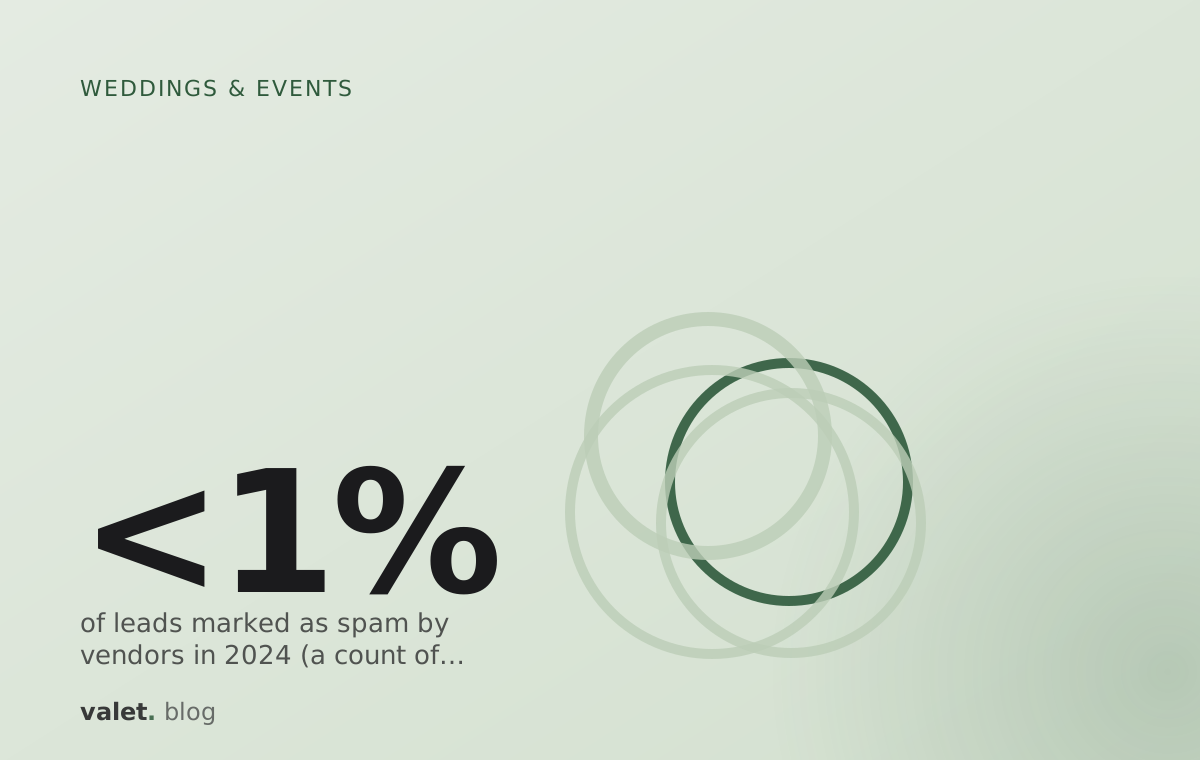 Weddings & events"Our leads from The Knot / WeddingWire never respond": ghost leads, fake leads, or leads nobody followed up?Vendors say the leads are fake. The Knot says they are templated and ghosted. A U.S. senator has asked the FTC to look. None of them has published what happened to each inquiry, and that is the only record that settles it for your listing.Policy desk · 10 min · 1 October 2026
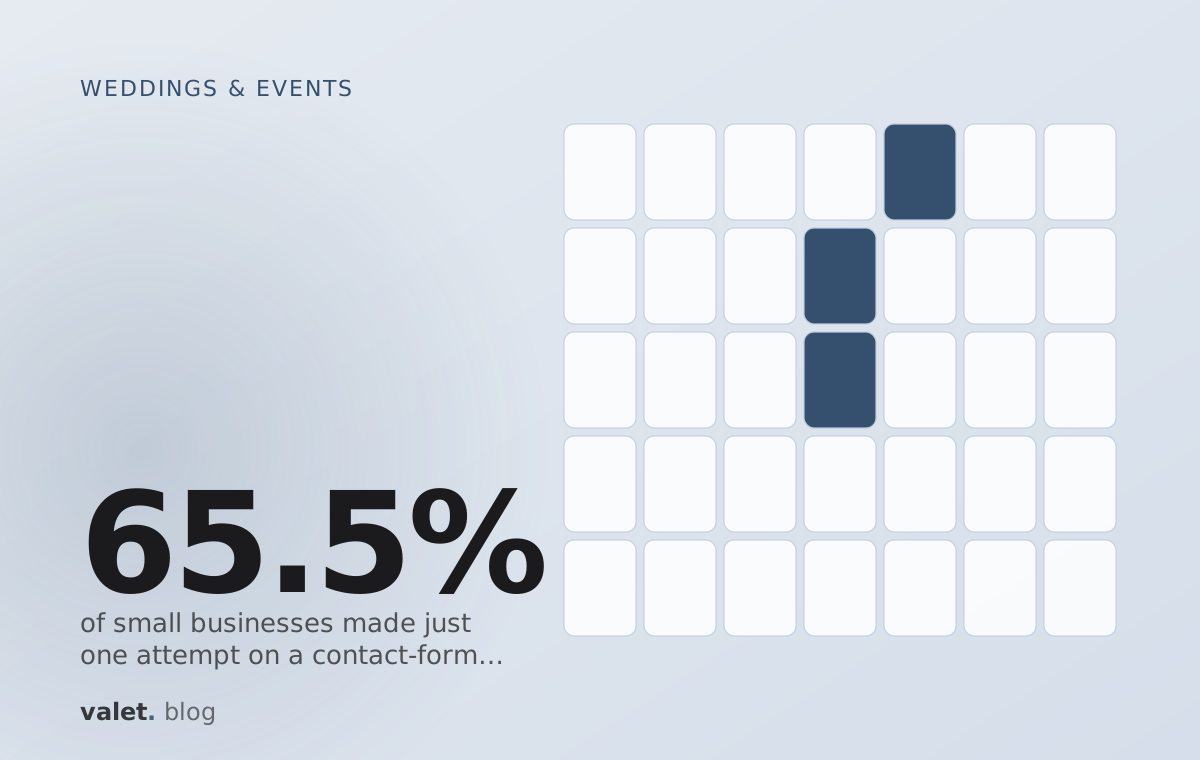 Weddings & eventsHow many times should you follow up with a couple who hasn't replied? (And when the lead is dead)Wedding advice runs from "one more time than you are now" to "as many times as it takes". Nobody says when to stop. Here is a stop rule, a list of lost reasons, and the three messages that sit between the first reply and the end.People at work · 11 min · 1 October 2026